Thousands of men stood shoulder to shoulder in broad daylight, facing enemy soldiers barely a hundred yards away, calmly reloading smoothbore muskets while bullets tore through their ranks. To modern eyes, it looks like a suicidal relic of a bygone age, especially in a war defined by railroads, telegraphs, and devastating new weaponry. Yet those orderly lines were not a death wish born of blind tradition. They were a brutal, calculated system of survival and domination, a deadly equation where standing firm could mean victory and breaking could mean massacre.
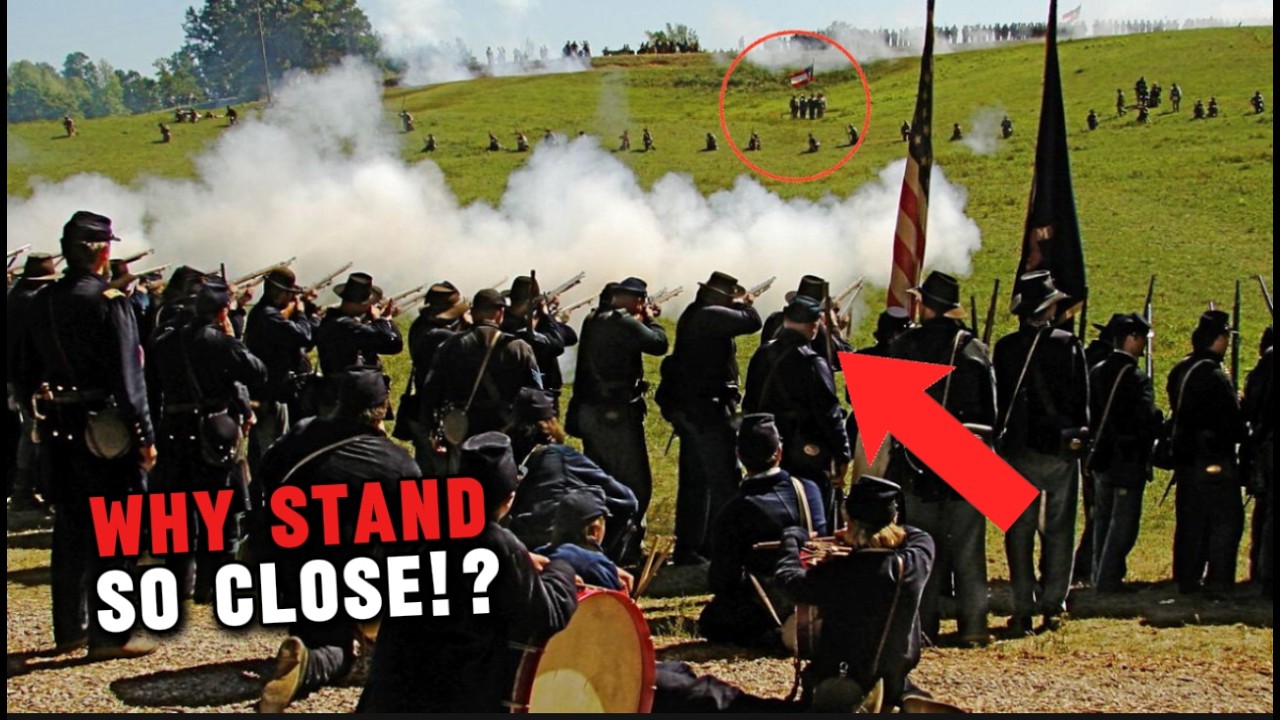
Civil War soldiers fought in rigid lines because close-order linear tactics were the most effective method of combat available to them. That doctrine had dominated European military thinking since antiquity. From Macedonian phalanxes to Roman legions and medieval infantry with interlocked shields, armies meeting in set-piece battles arranged themselves in structured formations. The arrival of gunpowder weapons initially produced deep square columns that combined pikemen and musketeers, a configuration that allowed a unit to move as a single body and offered protection on all sides.
The widespread adoption of the bayonet eventually eliminated the pike, and ranged infantry became the standard of war. Yet even into the late 1700s, firearms remained shockingly limited. The smoothbore musket was barely more accurate or longer-ranged than the slings and bows it replaced. The iconic British Brown Bess, for example, was only reliably effective to about a hundred yards.
Soldiers still relied on swords, bayonets, and lances for close combat. Innovations did occur, however. Experience revealed that thin, extended lines were superior to deep, dense columns because they maximized the number of men who could see and engage a target. Formations shrank from eight ranks deep to just two or three, since any greater depth made it dangerous and impractical for rear-rank soldiers to fire without hitting their own men.
The inherent inaccuracy of muskets drove the adoption of volley fire. Rather than aiming individually, an entire line discharged its muskets simultaneously at a single objective, creating a saturation effect that ensured at least some enemy casualties. Military training relentlessly drilled soldiers to reload and fire as quickly as possible, and the sheer volume of projectiles often decided engagements. A regiment able to deliver four volleys per minute held a decisive edge over one managing only two or three.
The physical process of reloading required soldiers to remain upright, using gravity to pour powder down the barrel, and they packed tightly together to concentrate the greatest number of muskets toward the enemy at any moment. Combat in this era centered on psychologically overwhelming the adversary and forcing a retreat. Volley fire could destroy large portions of an enemy force, shatter morale, and trigger a disorderly flight. These engagements often resembled a high-stakes contest of nerve, each side waiting for the other to break and run first.
Volleys were commonly followed by bayonet assaults meant to exploit gaps in the opposing line and drive the enemy into rout. The psychological ordeal of standing in such close order was undeniable, so why did soldiers comply? Within the most rigorously disciplined European forces, infantry endured constant drilling and faced severe punishment for disobedience. Prussian armies were especially feared for their harsh discipline, employing punishments like making an offender run a gauntlet between two lines of soldiers who struck him as he passed.
George Washington understood the critical importance of professional officers and exhaustive drill, and he held militia forces in very low regard, famously comparing reliance on them to leaning on a broken staff. He also recognized the contagious nature of panic, writing of his deep concern that the behavior and lack of discipline among militia significantly demoralized regular troops, whose officers, with few exceptions, were scarcely competent. Perhaps the paramount reason infantry held their place was the ever-present danger of cavalry. When infantry lacked the mutual protection of a square or an attack column, individual flanks lay exposed, and excessive spacing between soldiers allowed horsemen to charge through gaps, inflict heavy losses, regroup, and strike again.
A solid, unbroken line presented a unified front of bayonets that deterred horses from impaling themselves. Although formations remained vulnerable to flank or rear attacks, they could be trained to shift rapidly into squares, a far more resilient defense against horsemen, as the British demonstrated against Marshal Ney’s charges at Waterloo. This defensive strength carried a trade-off: dense formations were easier targets for artillery. But given the centuries-old inaccuracy of cannons, most generals accepted the risk.
Linear fighting also vastly simplified the task of maneuvering large bodies of troops cohesively across a battlefield. Without structure, soldiers risked becoming scattered and disoriented. Musket fire produced immense volumes of smoke, and after just a few volleys visibility dropped dramatically. Staying in formation allowed men to identify the comrades beside them and preserved unit integrity.
When battlefield communication depended entirely on shouted orders, musical signals, and flags, maintaining formation was essential to prevent disorganization and the collapse of a line. If an army became divided during an attack, effective command and control could vanish altogether, making coordinated defense or assault impossible. Line infantry was the era’s primary battle force, but not all combat followed that pattern. Guerrilla tactics were used historically, especially in conflicts like the French and Indian War, where the dense forests and rugged terrain of North America, so unlike Europe’s open fields, greatly enhanced their effectiveness.
European armies also deployed light infantry trained to use cover, disperse, and skirmish, harassing the enemy and screening the main battle lines. Yet if threatened by cavalry, light infantry would immediately try to form tight defensive ranks or take refuge with line infantry or within broken ground. The advent of more accurate firearms, most notably the Minié ball, dramatically amplified the lethality inherent to line tactics. This became starkly evident during the American Civil War, which also saw armies resort increasingly to trench warfare in sieges like those at Atlanta, Vicksburg, and Petersburg.
The new weapons could disrupt cavalry charges at extended ranges, diminishing the battlefield dominance of both massed infantry formations and mounted units. Even so, linear tactics persisted in some form into the early stages of World War I, contributing to the catastrophic casualties of that conflict’s opening months. Only the full integration of breech-loading rifles, mass-produced machine guns, and breech-loaded artillery rendered close-order combat completely obsolete. The image of opposing lines of men standing exposed, seemingly taking turns to fire, appears absurd to contemporary observers.
Yet it was the optimal method of fighting under the technological constraints of the era. Had superior tactics existed, commanders would not have persisted with lines at the expense of battlefield success. The obsolescence of formation warfare stemmed directly from the industrial revolution and the revolutionary technological advancements it delivered. After the First World War, warfare evolved into a style far more recognizable to the modern eye.
The soldiers who held those lines were not foolish. They fought in formation because it was the only shield they had against cavalry, the fog of war, and the sheer terror of the battlefield. Their courage was measured in holding the line, sometimes for hours, and in refusing to abandon the men beside them. The industrial revolution did not just change how armies fought.
It changed what courage looked like, and the Civil War soldier locked in his line stood at the precipice of that change, a stark monument to the terrifying cost of progress and the brutal reality that warfare always reflects the limits of its time.