She washed the dishes. She set them on the rack to dry. Then she put on the clothes she had worn a hundred times before—her brother’s borrowed suit, the coarse wool coat, and the flat cap she pulled low against the May night air—and left the little adobe house on North San Pedro Street for the last time. She did not look back.
It was May 30, 1907, in San Jose, Santa Clara County, California. The big orchards ringing the town were in early-summer fullness, and the downtown streets carried the familiar smells of horse droppings, coal smoke, and warm dust rising from unpaved tracks whenever a wagon passed. Gas lamps on San Pedro Street had long since been lit. The firehouse next door to number 28 kept its lights burning through the night, as it always did.
Inside that small adobe dwelling, a woman lay quietly in the dark beside her sleeping husband. Captain Mario Narciso Barr—known to everyone as Frank—was forty-three, a California cattle-ranching man who had risen to command Chemical Engine No. 1 of the San Jose Fire Department. Six years earlier he had married Bertha Zittel as his second wife.
By the spring of 1907, their marriage had become a mixture of silence, suspicion, and letters never answered. Before one o’clock struck, that stretch of North San Pedro Street would be shattered, and a woman who had spent years looking away would look away no longer. To understand what happened in that little adobe house, one must understand the two lives that chance or fate had put together. Bertha Zittel was born on March 14, 1877, in Morton, Renville County, Minnesota.
Her parents, Xavier Zittel and Mary Rey, were German immigrants who had made their way to the American Midwest the way so many of their countrymen did—through hard work, careful saving, and patient farming. Little is recorded about her early years. What is known is that she arrived in California around the turn of the century, made her way to San Jose, and was by all accounts a capable, determined young woman. Frank Barr, born Mario Narciso Barr on October 29, 1863, came from very different roots.
He descended from one of California’s founding families, with lines reaching back to the early missions and the great ranches of the Salinas Valley. By the time Bertha knew him, he was a short, dark, mustached man of considerable self-regard, holding the rank of captain for Chemical Engine No. 1. His first marriage had not ended well.
In September 1893, his first wife, known in the papers as Bell, tried to end her life by drinking chloroform from a bottle obtained from Fisher’s pharmacy. Her twelve-year-old daughter Lilly ran into the street screaming for help, and a neighbor named Michael Haggerty managed to wrest most of the chloroform away. Bell survived. In her later account to the San Jose Daily Mercury, she said Frank had abused her physically and left her in extreme poverty.
Frank filed for divorce two years later, in November 1895. Frank and Bertha married on Christmas Day 1901. She was twenty-four; he was thirty-eight. The marriage began with some warmth.
The warmth did not last. Within about eighteen months of the wedding, Bertha noticed that her husband’s affections had cooled noticeably. She began to suspect other women. Quarrels followed.
The little adobe house on North San Pedro Street, located right beside Frank’s firehouse, became the stage for those fights and for the long, exhausting silences between them. Eventually Bertha left San Jose altogether. She rented a room in San Francisco and found work as a saleswoman at The Emporium, a respectable department store at 835 Market Street, where a woman of her character could find steady employment and a degree of independence. Frank did not visit.
But he wrote—letters urging her to come back to San Jose, urging her to come home. After six months, Bertha relented and returned. The relationship did not improve. The pattern held: Frank would disappear for days at a time, miss meals, and Bertha would wait.
In February 1907, matters took another turn. On February 10, Frank and a fellow fireman named De Amador were arrested and taken to the county jail on suspicion of election fraud and vote buying. According to rumor, the men were questioned and released, though the investigation was still under way at the time of later events. The uncertainty around Frank deepened—his movements, his actions, the accusations that might reach him.
During a two-week stretch in the middle of that year, Frank stopped coming home for meals entirely. He was required to spend his working nights at the fire station, so his nighttime absences were not suspicious in themselves. But Bertha could not determine how or where he was eating. She became sleepless.
According to her later testimony, she got only an hour or two of rest each night. She began borrowing her brother’s clothes—the flat cap, the plain wool suit—to follow her husband through the streets of San Jose after his shifts ended. She wanted to know where he went. The pattern was steady.
At the end of his shift, Frank would leave through the front entrance of the station, walk a short distance south to El Dorado Street, and spend his time there. By 1907, El Dorado Street had earned a considerable reputation. Its establishments were of a particular kind. On May 26, Frank suddenly left San Jose without explanation.
He returned the next day, though not to Bertha. He said he had gone to Oakland to collect a fireman’s hat and spent the night at his sister’s house. Bertha did not believe him. She thought he was preparing to flee to Mexico with another woman in case he was arrested again.
She concluded that the pattern had run its course. On May 29, Frank returned to the adobe house at 28 North San Pedro Street and invited Bertha to accompany him to the theater. They attended the Jose Theatre that evening, on South Second Street. It had opened only three years before, in 1904, and was one of the newest and most pleasant entertainment venues available to the citizens of San Jose.
They took their seats, watched the show, and to any observer looked like an ordinary couple spending an ordinary evening. They returned to their adobe home on North San Pedro Street. There was some conversation. Frank, according to his later testimony, recalled no quarrel of any importance—only a brief exchange of words when Bertha asked about his recent trip to Oakland.
He insisted the evening had been pleasant and that nothing hinted at what would follow. Bertha’s account differed. She testified that they talked at length, that Frank warned her he expected to be re-arrested for election fraud, and that his words opened in her a wide and draining despair. She said she suspected other women.
She said she had found letters. Just after midnight, in the early morning of Friday, May 30, 1907, Bertha took Frank’s straight razor from its place and used it on him while he slept. What followed was witnessed by the men of the adjoining firehouse. Fireman Diamonte was the first to see Frank Barr staggering through the back entrance of the Chemical Engine No.
1 station. The captain was covered in blood, screaming in pain, barely able to stand. Diamonte acted quickly, binding the wound to stop further bleeding. His colleagues arranged transport, and Frank was rushed to the Red Cross Hospital that night.
His doctors later stated that although the wound was serious and the risk of blood poisoning real, he would unquestionably survive. Bertha was already gone, moving through the night streets of San Jose to the north end of the city, where she obtained and put on a man’s suit. Police searched the city for hours. They did not find her that night.
Within twenty-four hours she was found near the Brodge warehouse, on a bicycle, wearing the borrowed suit, preparing to leave. She was taken to the San Jose city jail. Upon arrest, Bertha Barr confessed to what she had done. She showed no remorse.
Her statement to police, as reported in the Santa Cruz Sentinel on June 2, 1907, was direct. She had wanted revenge on a husband she believed intended to abandon her and flee to Mexico. She said she had lost her mind for a time and had committed the act. Frank Barr lay in his bed at the Red Cross Hospital under the care of physicians who spent the following days treating the wound and preventing infection.
The nature of the injury was such that attending doctors had great difficulty describing it in clinical terms adequate for court records. Dr. J. C.
Spencer, who examined Frank Barr, testified to the seriousness of the wound and its deliberate nature, assuring the court that the injury required deliberate force and was inflicted with precision. The instrument was a straight razor, Frank’s own. On June 1, propped in his bed, Frank swore a complaint before Judge Brown, formally charging his wife, Bertha Barr, with mayhem. The charge was drawn from Section 204 of the California Penal Code, as reprinted by the San Jose Daily Mercury: whoever unlawfully and maliciously deprives a human being of a member of his body, or renders it useless, or cuts or disables the tongue, or puts out an eye, or slits the tongue, nose, ear, or lip, is guilty of mayhem.
The penalty for the felony was up to fourteen years in prison. Bertha was held in the San Jose city jail in lieu of a $10,000 bond, an amount far beyond the reach of any ordinary working woman of that era. She would remain in custody until her trial. The case of People of the State of California v.
Bertha Barr was prepared over the following months. The press noted that considerable public sympathy had formed for the accused woman, and that selecting twelve impartial men for the jury proved a lengthy task. Attorney P. A.
Harrington agreed to represent Bertha in her defense. The prosecution was handled by deputy district attorneys H. A. Bridges and C.
C. Collidge. The trial was set to begin in January 1908 before Judge James R. Welch in San Jose.
Proceedings opened on Monday, January 13, 1908, at the Superior Court of San Jose. The courtroom was reported to be packed. Frank Barr was called as the prosecution’s first witness. Deputy District Attorney Collidge asked him to proceed with what the attorney described in the record as the revolting but necessary details of this terrible case.
Frank testified that the evening of May 29 had been ordinary—a visit to the theater, a return home, no quarrel worth mentioning except Bertha’s inquiry about his Oakland trip. He insisted the attack was entirely unprovoked. He claimed Bertha had invited him to bed before the attack. Harrington conducted a cross-examination.
More witnesses followed: the firemen who first aided Frank, the police officers who conducted the search, medical witnesses including Dr. Spencer, a switchman named Elma Mitchell who had been near the station at the time of Bertha’s arrest, and a neighbor named Mrs. M. McClellan, who testified about the strained relations between the couple and Bertha’s earlier expressions of suspicion.
Several witnesses testified to statements Bertha had made in the period before the incident. She was said to have threatened violence against her husband if she caught him betraying her again. Then Bertha herself took the stand. She presented a defense that the San Francisco Call described as emotional insanity produced by intense jealousy.
She described years of suspicion of infidelity, letters she had found, months of separation, and weeks of sleepless surveillance. She described wearing her brother’s clothes to follow Frank through the streets. She said that on that night she could not remember what had happened, that she lost consciousness in a fit of rage and only regained it afterward. The judge gave his instructions to the jury.
His words were preserved: a wife’s jealousy is not an excuse for committing the crime of mayhem. The law does not distinguish between the sexes in crime. A woman is as subject to the law as a man. The jury withdrew.
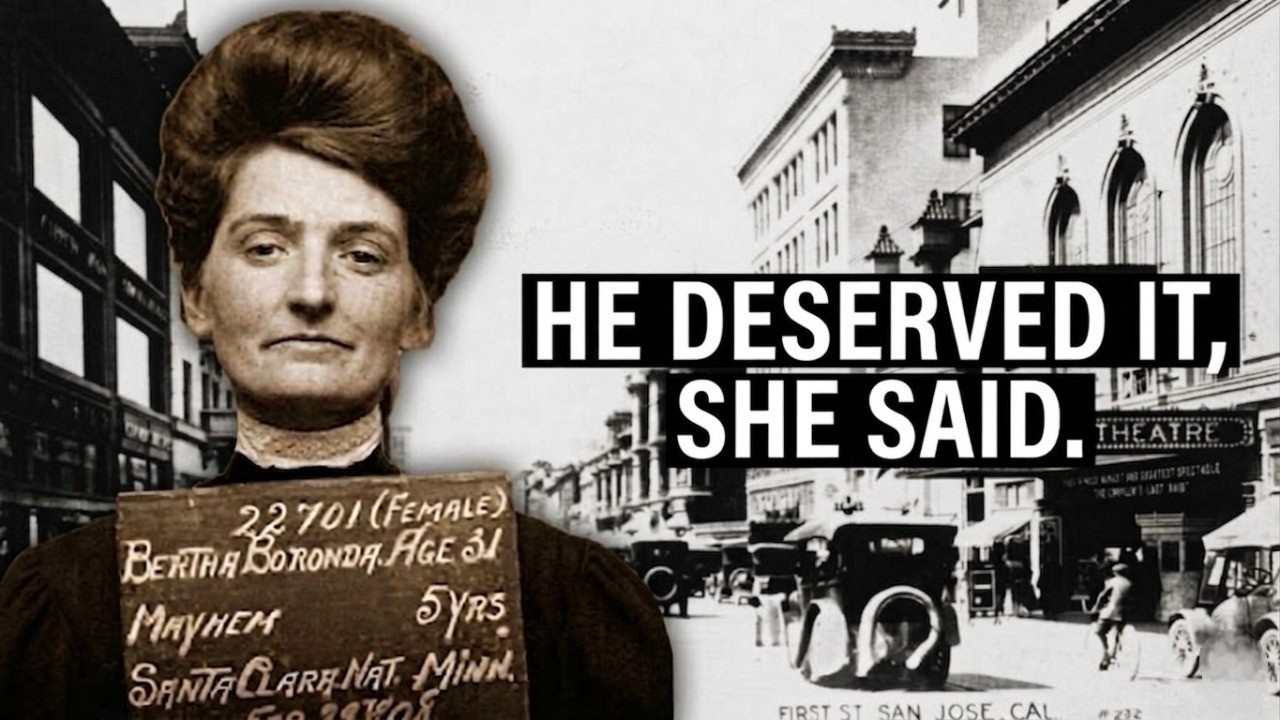
After two hours of deliberation, they returned. Bertha Barr was convicted of mayhem. She was sentenced to five years in San Quentin. On February 29, 1908, a leap day, Bertha Barr was photographed at San Quentin as part of the prisoner intake procedure.
The photograph’s subject shows a woman in a dark dress holding a steady gaze, her expression, in the view of many who have studied it in later years, approaching something like satisfaction. By any measure, it is not the face of remorse. Bertha served two years of her five-year sentence and was released from San Quentin on December 20, 1909, granted early release for good conduct. After his recovery, Frank Barr found his position in the San Jose Fire Department untenable.
He resigned. According to the account preserved by local historian Leonard McKay, he left the city and returned to the family ranch near Salinas. During his hospital stay he had fallen in love with one of his nurses, according to McKay. He married her and had a child.
He later married a third time, to a woman named Josie Warberton, thirty-three years his junior. Frank Barr died in 1940 at the age of seventy-seven. After her release, Bertha found work as a hotel maid in San Francisco. She later worked as a waitress at Camp Micah, a rural resort in the redwood country of northern California.
In 1921 she married an elderly widower named Alexander Patterson in Los Angeles. That marriage also ended in divorce. The records say little about her final decades. She died on January 18, 1950, at the age of seventy-two, and was buried in Calvary Catholic Cemetery on the east side of San Jose, the same city through whose streets she had once fled in darkness in borrowed clothes.
One footnote to the case was recorded by Clyde Arbuckle, who was called to inspect the basement of the San Jose courthouse during renovations in the 1940s. In a cabinet containing physical exhibits from earlier trials, he found a glass jar listed as Exhibit A in the case of People v. Bertha Barr. The jar contained a shriveled organ preserved in formaldehyde, about the size of a dried plum—all that remained of the most famous case in the history of the Santa Clara County courts.
The papers of the time were remarkably restrained in their language. The Santa Cruz Sentinel, in its June 1907 report, wrote only that she took a razor and wounded her husband. Then Bertha went to her nephew’s room and said quietly, the way a woman who had finished her task speaks: “Frank cut himself. ” She never said anything else.
She never expressed regret for what she had done. The criminal photograph of Bertha Barr has become one of the most widely circulated images in the early history of San Quentin. The woman in the photograph looks out steadily across more than a century. There are no tears on her face.
No pleading. Only that calm, unreadable gaze, and the weight of a woman who had decided long before the picture was taken that she was done apologizing. The gravestone in Calvary Cemetery says none of this.
Stone and silence, with thick California grass growing slowly over it.