In January 1862, scarlet fever swept through the Longstreet household in Richmond with a cruelty no battlefield could match. James Longstreet buried three of his children in a single week, then walked out of that house and back into the war with something permanently rearranged inside him. Those who knew him before said he was sociable, warm, quick to laugh. Those who knew him after said he had gone quiet in a way that never fully lifted.
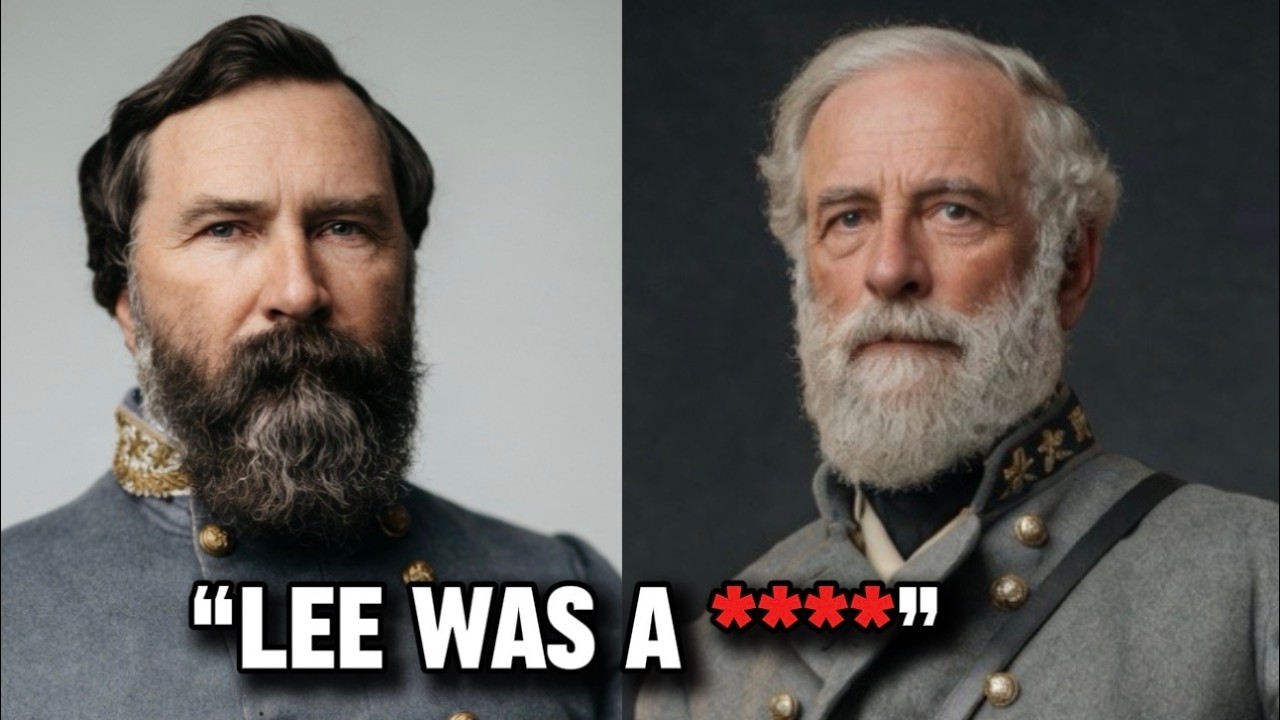
That detail matters, not because grief explains everything about a man, but because it helps explain why Longstreet became the kind of soldier he became: methodical, protective of his men’s lives, deeply skeptical of attacks that cost blood without guaranteeing anything in return. He had already paid a price no military objective could balance. What followed was one of the most complicated relationships in American military history. Longstreet genuinely admired Robert E.
Lee and also believed Lee was repeatedly wrong in ways that mattered enormously. He said so while Lee was alive. He said so after Lee was dead. And when the men who built the Lost Cause mythology came for him because of it, he said so again.
When Longstreet joined the Confederate Army in 1861, he was thirty-nine years old. He had served in the Mexican War, been wounded at Chapultepec, and watched men like Ulysses S. Grant and George McClellan operate under fire. He was not a young officer looking for a father figure.
His military mind operated on a specific conviction: the Confederacy could not win a war of attrition. The numbers were against it. The industrial capacity was against it. The only viable strategy, as Longstreet saw it, was a defensive-offensive posture—make the Union come to you, bleed them on ground of your choosing, and force the northern public to tire of the cost.
Lee thought differently. His instinct was aggressive, almost aesthetic in its aggression. He wanted to impose his will on the enemy, keep the initiative, attack. In the first year of the war, that instinct produced something close to miracles: the Seven Days, Second Bull Run, Fredericksburg, Chancellorsville.
Lee looked to nearly everyone like the greatest battlefield commander on the continent. Longstreet admired this. In his memoirs, he described Lee as possessing a moral courage he had never encountered in another man, a complete absence of fear—not just of death, but of judgment, of criticism, of being wrong in front of others. He called it audacity and meant it as high praise.
But admiration and agreement are different things. From at least the spring of 1863 onward, Longstreet was no longer in full agreement with where that audacity was leading them. The argument that would follow him to his grave began at Chambersburg, Pennsylvania, in late June 1863. The Army of Northern Virginia was moving north.
Lee had decided to invade Pennsylvania to relieve pressure on Virginia, gather supplies from northern soil, and because he believed a decisive victory on Union territory might break the northern will to fight. Longstreet wanted to maneuver into a strong defensive position between the Union Army and Washington, force Meade to attack, and destroy the Army of the Potomac on Confederate terms. He brought this plan to Lee directly. Lee listened.
Lee nodded. Lee did not agree. What happened next at Gettysburg is one of the most analyzed three days in the history of warfare. The standard telling often frames Longstreet’s conduct during those days as obstruction, the work of a sulking, reluctant general who dragged his feet because he couldn’t get his own way.
That framing came from a very specific group of people with a very specific interest in making it stick. Longstreet himself believed he was right. He had watched the Confederate Army assault entrenched Union positions at Malvern Hill in 1862, when D. H.
Hill later said it was not war but murder. He believed, with the conviction of a man who had studied the Mexican War and the early battles of this conflict carefully, that the tactical offensive against defended positions had become a killing machine. The problem was that in 1863, in the Confederate Army, being right was not enough. You also had to carry out the orders of your commanding general, and Longstreet did.
He attacked at Gettysburg when ordered. The attack was late, and he admitted this, but it was not sabotaged. His corps came closer to breaking the Union line on July 2 than most people realize; the assault on the Wheatfield, Devil’s Den, and Little Round Top came within a single brigade of possibly changing everything. It wasn’t enough.
After Gettysburg, something in the relationship between Longstreet and Lee shifted into a new register. One of Longstreet’s deepest convictions was that Lee’s conception of the war was, at root, a Virginia conception. Lee thought in terms of the Army of Northern Virginia and its theater, reluctant to strip troops from his own command to reinforce other fronts even when strategy demanded it. After Chickamauga in September 1863, Longstreet was sent west with two divisions to reinforce Bragg.
The campaign was a disaster, not because of his corps, which performed well, but because of command dysfunction at every level. He came back east with a deep-seated conviction that the Confederate war effort was being managed badly at the top. He never said any of this publicly while the war was ongoing. He argued his position to Lee’s face when he believed the situation required it, and he wrote letters to secretaries of war suggesting strategic alternatives, but he fought.
He bled at the Wilderness in May 1864, shot by his own men in a collision eerily similar to the way Stonewall Jackson had been wounded exactly a year before. He spent months recovering and returned to command in the final months of the war. He was with Lee at Appomattox. In the last hour before the surrender, Lee raised the possibility of dispersing the army, letting the men scatter into the countryside and continue the fight as guerrilla war.
Longstreet told him no, not hesitantly, not diplomatically. If Lee led his men into guerrilla warfare, they would become outlaws. Their farms would be burned, their communities punished. The men would become hunted fugitives rather than paroled soldiers.
The cause had already been decided by the military verdict. The only honorable course was to accept that verdict and let the men go home. Lee agreed. At the most critical moral moment of the war’s end, it was Longstreet who spoke plainly to Lee about what his duty required—and Lee, who had spent four years not always taking Longstreet’s counsel, heard him.
Robert E. Lee died in October 1870, having spent his last five years as president of Washington College, largely silent about the war. He gave almost no interviews and wrote very little for public consumption. This silence created an opportunity.
The men who built the Lost Cause needed Lee as their centerpiece—perfect, undefeated in their telling, a commander overwhelmed only by Union numbers and northern industry. Under this mythology, any Confederate loss had to be explained by betrayal or incompetence from within. Gettysburg needed a villain. They chose Longstreet.
Jubal Early was the most aggressive architect of this campaign. William Nelson Pendleton, Lee’s former artillery chief, gave a speech in 1872 directly accusing Longstreet of losing Gettysburg by disobeying orders and attacking too late. Other former Confederate officers wrote articles, gave speeches, and coordinated. They controlled the Southern Historical Society and used it to build the case systematically.
The charge was this: Lee had ordered Longstreet to attack at sunrise on July 2, Longstreet had disobeyed out of personal disagreement, and this delay had cost the Confederates the battle and the war. There was no sunrise attack order. There is no contemporary documentation of one. Lee’s own report of the battle, written months later, does not mention it.
The officers physically present at the relevant meetings did not describe one. The sunrise order, as a historical claim, was a fabrication—a story invented after the fact to serve a narrative purpose. Longstreet knew this. He also knew that pointing it out made him sound defensive, which is exactly how his accusers wanted him to sound.
He fought back anyway. In 1867, he published a letter in the New Orleans Times advising Southern men to accept the results of the war, cooperate with Reconstruction, and recognize the federal settlement as legitimate. In the immediate post-war South, this was considered close to treasonous. Then he became a Republican.
Then he accepted a federal appointment in New Orleans. Then he commanded black militia troops against a white supremacist paramilitary organization at the Battle of Liberty Place in 1874. He was physically assaulted, briefly captured, and his command overwhelmed—but a former Confederate general standing at the head of troops defending a Reconstruction government against former Confederates was, in its time, an almost incomprehensible act. His enemies used all of it to paint him not just as a bad general but as a traitor.
The military criticism and the political attacks became inseparable. Jubal Early had his own serious failures, but he had maintained his Confederate credentials and refused to cooperate with Reconstruction, which made him a hero to the very people who needed Longstreet to be a villain. Longstreet understood exactly what was happening. He wrote that his accusers had decided the only way to preserve Lee’s reputation was to destroy his, and that they chose him specifically because he had made himself politically vulnerable.
For most of the next hundred years, the popular image of Longstreet was the one his enemies constructed. His memoirs, published in 1896 as From Manassas to Appomattox, became one of the most underread documents in Civil War literature. They are defensive and self-justifying in places, but also strikingly honest. He wrote that Lee could inspire confidence in soldiers in a way he never saw duplicated.
He wrote that Lee’s physical presence on a battlefield had an almost electrical effect, that his calm functioned as a structural element in the army’s ability to hold together. But he also wrote that Lee was inclined by nature toward solutions that required élan over calculation, and that this inclination—magnificent when conditions favored it—became dangerous when they did not. Lee’s greatest victories were won when boldness disrupted Union command psychology before the tactical math could catch up; by 1863, Meade and Grant were not men whose nerve could be broken by audacity alone. Longstreet describes his last conversation with Lee before Gettysburg, laying out his defensive plan one final time, and Lee rejecting it.
He left the meeting with the belief that they were about to fight a battle that could not be won on the terms Lee was proposing. And then he went ahead anyway, prepared the attack as ordered, and led his corps into ground he believed was wrong. When it failed, he felt not vindicated but hollow. This is not the writing of a man who hoped Lee would fail.
This is a man who respected his commanding general enough to fight like hell for a plan he disagreed with. Historians who have examined the Gettysburg controversy most carefully—Gary Gallagher and Jeffrey Wert among them—have largely concluded that the sunrise attack story was a post-war fabrication and that Longstreet’s performance on July 2, while not flawless, was not the catastrophic disobedience his accusers claimed. What that reckoning restores is the status of Longstreet’s criticism of Lee as the informed professional judgment of an experienced officer, not the bitter complaint of a failed subordinate covering his tracks. Longstreet outlived Lee by thirty-four years, dying in Gainesville, Georgia, in January 1904.
He lived long enough to see the mythology fully constructed and calcified, the statues going up, the textbooks rewritten, the Lost Cause becoming something close to official history in the white South. The veterans’ organizations that honored a man like Early had no place for him, and the newspapers treated him as a footnote at best. Yet he kept writing, kept corresponding with Northern veterans and historians trying to reconstruct an accurate account, and cooperated with researchers in ways most former Confederate officers would not. He understood that what was being written about the war in the 1880s and 1890s was not history but a political document dressed in the language of memory.
He was not willing to watch the public record become unrecognizable and stay quiet because staying quiet was easier. In 1902, two years before he died, Longstreet gave an interview to a journalist. He was eighty-one, in declining health, his hearing going. Asked whether he blamed Lee for Gettysburg, he said Lee was the finest soldier he had ever served under, and that Lee at Gettysburg had insisted on a battle that should not have been fought on the terms it was fought.
Any account of Robert E. Lee that required choosing between those two statements, he said, was not an honest account. The reason this position caused fierce reaction is not because it is wrong but because it requires treating Lee as a human being subject to human limitations. For the people who built their post-war identity around the Lost Cause, that was intolerable.
The rehabilitation of Longstreet began with military historians who took his operational criticism of Lee seriously on its merits. It reached the popular imagination through Michael Shaara’s novel The Killer Angels, published in 1974, which portrayed Longstreet as the war’s most prescient military mind, and the Ken Burns documentary extended this to a mass audience. By the end of the twentieth century, Longstreet had gone from villain to something close to a tragic hero. This, too, is a simplification.
The real Longstreet was neither Early’s villain nor quite Shaara’s hero. He was a very good general who disagreed with his commanding general on important strategic questions, made political choices after the war that expressed genuine convictions and cost him enormously, and spent three decades insisting that the public record include the honest version of events. In 1998, a statue of Longstreet was unveiled at Gettysburg. There had been opposition even at that late date.
The statue shows Longstreet on horseback looking out over the same ground he had surveyed on July 2, 1863. He is not looking triumphant. He is not looking defeated. He is looking like a man still working through a problem that has no clean solution.
He spent his entire post-war life doing exactly that—holding an honest balance between the admiration he felt for Lee and the criticism he believed was warranted, refusing to let either cancel out the other. He never found a formulation that satisfied the people who wanted him silent, but he found one he could stand behind. Lee was great. Lee was wrong.
Both of those things lived inside the same record, and that record deserved to exist whole.