Every other Confederate general who reached the top did it the same way: old money, a famous last name, a father or grandfather who already wore stars on his collar. Thomas Jonathan Jackson had none of that. He was an orphan by age seven, a failure by every measure West Point could apply to him, and a man so strange in his private habits that his own students at the Virginia Military Institute mocked him behind his back and called him crazy to his face. Yet this same awkward, friendless, nearly impossible-to-like man became the most feared general the Confederacy produced.
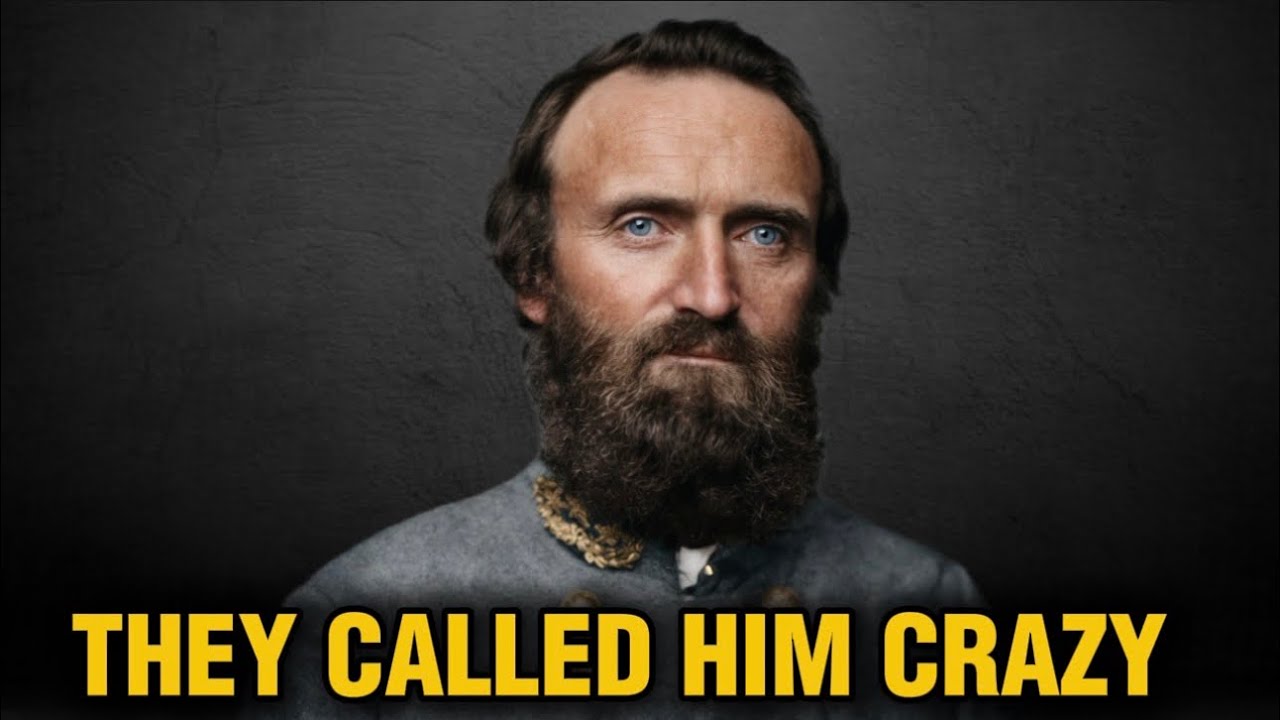
Robert E. Lee had breeding. James Longstreet had polish. Jeb Stuart had charm.
Jackson had none of it. And that absence was exactly what made him unstoppable. Jackson’s childhood reads less like the beginning of a military legend and more like a list of things a person is supposed to survive rather than build a life from. His father died when he was two, leaving debt so deep the family sold off their furniture to cover it.
His mother remarried, and the new husband did not want another man’s children in the house, so Jackson and his sister were sent away to relatives. By the time he was seven, his mother was dead too. The boy who would one day terrify Union generals was left with nothing but an uncle’s farm and no reputation anyone was building for him. He grew up poor, even by frontier Virginia standards, working odd jobs and teaching himself what he could.
He applied to West Point almost as an act of desperation rather than ambition, and got in mostly because the other candidate from his district backed out. He arrived with almost no formal education, so far behind his classmates that he was placed near the bottom of his class in nearly every subject. Most cadets in that position quietly transferred out or failed their way home. Jackson did something almost nobody in that academy’s history had done before him: he simply refused to stay behind.
He studied by firelight after lights out, memorized textbooks word for word because he could not yet reason through the material the way his wealthier, better-schooled classmates could, and clawed his way up the rankings one grade at a time. By graduation he had climbed from the bottom of his class to seventeenth out of fifty-nine. The joke among his fellow cadets was that if the course had lasted one more year, Jackson would have graduated first. He was not gifted; he was relentless.
And relentless turned out to be a far more dangerous quality on a battlefield than natural talent ever was. Classmates remembered him sitting bolt upright at his desk late into the night, one eye covered with his hand, forcing himself to keep reading even when his vision blurred from exhaustion. He suffered from poor eyesight and a string of minor health complaints his whole life: dyspepsia, cold hands, a lopsided sense of balance he tried to correct by holding one arm raised above his head for minutes at a time, convinced it helped the blood flow evenly through his body. Other cadets found it comical.
Nobody thought it was the discipline of a future legend, because at the time it was not attached to anything legendary at all. It was just a strange, friendless young man trying to outwork a disadvantage nobody else at that school had to think about. The Mexican-American War gave Jackson his first taste of combat and revealed something in him that unsettled even the officers who outranked him. While most young lieutenants sought safety in the chaos of artillery exchanges, Jackson kept moving his guns forward, closer to the enemy line, arguing that the danger of exposure was worth the accuracy it bought him.
At Chapultepec he pushed his battery so far ahead of the supporting infantry that his own superiors questioned whether he had lost his mind. He had not. He had simply calculated correctly that boldness carried a smaller cost than hesitation, a philosophy that would define every major decision of his Civil War career a decade later. When the Civil War began, Jackson was teaching at the Virginia Military Institute, and by every account available he was a terrible teacher.
His students mocked his rigid posture, his strange dietary habits, the way he sucked on lemons to settle a stomach that never seemed to cooperate with him, and his refusal to explain a concept a second way if a cadet did not understand it the first time. They nicknamed him Tom Fool behind his back. Nobody at that institute in 1860 would have guessed that this same man would within two years be feared by name across the entire Union high command. The nickname history remembers him by was born at First Manassas, and the story behind it is stranger than the legend usually allows.
As Confederate lines buckled and panicked soldiers streamed past him in retreat, another general, Barnard Bee, looked over and saw Jackson’s brigade holding its ground like it was rooted into the hillside itself. Bee shouted to his own retreating men that Jackson stood like a stone wall. Whether he meant it as praise or as criticism of a man standing still while everyone else was dying has been argued by historians for over a century. Bee was killed minutes later and never lived to clarify.
The nickname stuck regardless, and it stuck to a man who, by every account of his own soldiers, embodied exactly what it implied: immovable, unshakeable, and more than a little strange in how calmly he seemed to accept the idea of his own death. What separated Jackson from every other Confederate commander was not bravery alone. The Confederacy had no shortage of brave men willing to die in a field for a cause. What Jackson had was a willingness to do the thing that looked insane on paper and turned out to be correct on the ground.
His Valley Campaign in the spring of 1862 is still taught in military academies today, not simply as a Confederate triumph, but as a masterclass in deception and speed. Facing a force a fraction of the size of the armies arrayed against him, Jackson marched his men so fast and so unpredictably across the Shenandoah Valley that three separate Union armies, each larger than his own, became convinced they were facing a force many times its actual size. He struck at Kernstown, then vanished into the mountains before anyone could organize a response. He reappeared days later at McDowell, hit hard, and vanished again.
By the time he was finished, he had defeated four different Union commanders in the span of a few weeks, tied up nearly sixty thousand federal troops who were desperately needed elsewhere, and done it all while marching his infantry so hard and so often that they earned the nickname Jackson’s foot cavalry from their own exhausted ranks. Jackson did not fight the way other Confederate generals did. Lee planned with the patience of an aristocrat playing chess. Longstreet argued for caution and defense, a general who wanted to win the war by not losing it.
Jackson wanted the opposite of caution entirely. He believed, almost to a religious degree, that a war should be fought with total and relentless aggression, that half measures cost more lives in the long run than total commitment ever could. He once told a fellow officer that once war had begun, the goal should be to make it so terrible that the enemy would sue for peace out of pure exhaustion, a philosophy that horrified even some of his fellow Confederates. His own men learned quickly that his aggression was not reserved for the enemy alone.
He court-martialed officers for what other commanders would have dismissed as minor lapses, once arresting a general under his command for arriving late to a march despite an otherwise spotless record. And he expected the same punishing pace from a private in the ranks that he demanded from himself as a cadet. Soldiers who served under him did not always love him the way they loved Lee. What they felt was closer to respect mixed with a genuine fear of disappointing him.
That turned out to be exactly the ingredient that made his troops perform like no other unit in either army. And the thinking came from somewhere personal. Jackson was a devout Presbyterian who believed his own life and death were already decided by God long before any battle began. Soldiers described an officer who prayed constantly, who refused to fight or even discuss military strategy on Sundays whenever it could be avoided, and who genuinely believed that a bullet could not touch him unless it had been ordained to.
That belief is the missing piece that explains everything else about him. It explains why he could push his artillery further forward than anyone thought safe, why he could march his men to the point of collapse and then order them into battle anyway, and why he seemed almost disappointed rather than afraid when danger arrived. He had already made peace with the idea that his death, whenever it came, was not his decision to make. That same certainty followed him to Chancellorsville in May of 1863, where Jackson executed the single most audacious flanking maneuver of the entire war.
He marched twelve thousand men across the front of the Union Army in broad daylight, a move so exposed that any competent Union commander should have crushed him before he ever completed it. Joseph Hooker, commanding a Union force nearly twice the size of Lee’s entire army, watched Jackson’s column moving and convinced himself it was a retreat. It was not a retreat. It was Jackson circling behind the entire Union right flank.
When he struck at dusk, he shattered it so completely that Union soldiers were eating dinner around campfires one moment and running for their lives through the woods the next. Those who survived described Confederate men screaming out of the tree line as the single most terrifying moment of the entire war, worse than any artillery barrage they had lived through. It was, without argument, the greatest tactical victory of Jackson’s career. It was also the night that ended his life.
Riding ahead of his own lines in the darkness to scout the chaos he had just created, Jackson was mistaken for Union cavalry by his own men and shot three times by Confederate rifles in the confusion. The general who believed no bullet could touch him without divine permission was cut down not by the enemy he had spent two years outmaneuvering, but by the soldiers under his own command, in the dark, on the night of his single greatest victory. He lingered for eight days before pneumonia finished what his own army’s confusion had started. Lee, upon hearing the news, reportedly said that Jackson had lost his left arm, but that he himself had lost his right.
News of his death spread through the Confederate ranks in a way no other single casualty of the war ever quite matched. Soldiers who had marched forty miles in a day under his orders, men who had cursed his name in the exhaustion of the Valley Campaign, wept openly at word that he was gone. In the South, church bells were rung in mourning, and newspapers that had spent two years questioning his strange habits now printed his portrait beside headlines calling him the finest soldier the Confederacy had produced. None of that grief changed the outcome waiting two months down the road at a small Pennsylvania town called Gettysburg, where Lee gave orders to subordinates who lacked the one quality Jackson had never once lacked in two years of war: the willingness to finish an attack exactly as aggressively as it had been ordered.
The Confederacy never recovered a general who could replace what Jackson provided, and historians have spent over a century and a half arguing what might have happened at Gettysburg had Jackson still been alive to execute Lee’s orders the way only he seemed capable of doing. That question will never have an answer. But the reason his name still carries weight in military academies on both sides of a war that ended over 160 years ago comes down to the same fact with which this story opened. Every other Confederate general climbed to power on a ladder his birth had already built for him.
Jackson built his own ladder, one exhausting, obsessive, faith-driven rung at a time. And when the war finally came, that difference was exactly what made him the most dangerous man on the field.