Otto Carius was born on May 27, 1922, in Zweibrücken, in the Palatinate region of southwestern Germany. His father, a schoolteacher, would later serve as a reserve major in the German army and reportedly dismissed tanks as metal death traps. Young Otto was drawn to music, an accomplished cellist and pianist, and seemed headed for a life in the arts or mechanical engineering. Then the war came, and the unassuming teenager tried to enlist in the German army, twice.
Both times he was rejected. The reason given was blunt: not fit for service, underweight. He kept trying, and in May 1940, just as German forces were smashing into France, he was finally accepted into the 104th Infantry Replacement Battalion. Restless with infantry life, he volunteered for the Panzer branch in the autumn of 1940, and by June 1941 his regiment was moved east to East Prussia as part of the massive build-up along the Soviet frontier.
On June 22, 1941, Operation Barbarossa began, the largest land invasion in human history. Carius went into Russia as a loader on a Panzer 38t, a light Czech-designed tank serving with Panzer Regiment 21 of the 20th Panzer Division. Early German success was stunning. His division pushed toward Vitebsk and then toward the Smolensk–Moscow highway.
In mid-July, his unit reached Yartsevo and ran headlong into determined Soviet resistance. On July 8, 1941, near Vitebsk, Carius was wounded, one of the first of what would become an extraordinary list of injuries. It earned him the Wound Badge in Black. The fighting dragged on through the summer, and on August 1, 1941, he was promoted to junior non-commissioned officer and selected as an officer candidate.
Sent back to Germany to attend officer training, on February 2, 1942, he failed the course entirely. He returned to a division that had been nearly decimated by the failed advance on Moscow. The euphoria of Barbarossa was gone. For a time he served in unglamorous roles, including managing an officers’ club in Paderborn.
It was there that fortune intervened. He struck up a friendship with an officer who would command the second company of the 502nd Heavy Tank Battalion, a unit being equipped with a revolutionary new weapon: the Tiger. Armed with a devastating 88-mm gun and protected by frontal armor that could shrug off hits from most Soviet tank guns, the Tiger was slow and mechanically finicky, but on the battlefield it was nearly unstoppable. For Carius, whose career seemed stalled, the chance to join a Tiger battalion was, in his own recollection, a gift from heaven.
The 502nd Heavy Tank Battalion fought almost continuously in the marshy, forested terrain around Leningrad, a city under German and Finnish siege since September 1941. By June 1943, Carius, now a lieutenant, commanded the second company. He was not the battalion’s only rising star. Johannes Bölter and Albert Kerscher, both eventually credited with over 100 tank kills, served in the same close-knit company.
The 502nd claimed an aggregate total approaching 1,400 enemy tanks destroyed by war’s end. In January 1944, Soviet forces launched the offensive that finally broke the siege of Leningrad. The 502nd was rushed south to Gatchina. In the chaotic fighting around the village of Syaskelevo, 11 Tigers were completely destroyed in a matter of days, and the commander of the third company, finding his position surrounded and hopeless, chose suicide rather than surrender.
The entire German Army Group North began a general withdrawal toward the port of Narva. Carius arrived at Narva by train in early January 1944. The Narva bridgehead was one of the most heavily contested pieces of ground on the entire Eastern Front. Hitler had declared the line must be held at all costs.
Field Marshal Walter Model, Hitler’s favorite troubleshooter, personally gave Carius a blunt and almost impossible order: stop the Russian tanks without losing a single Tiger. Carius set about the task with a combination of caution, aggression, and a deep understanding of how to use his heavy tanks defensively. On February 12, 1944, east of Narva, Carius destroyed four Soviet tanks. Four days later, a massive Soviet assault struck the lines, and Carius, commanding just two Tigers, moved to support a hard-pressed infantry commander whose positions were being overrun.
The German defenders settled along the river by late February, and even received a few days’ rest at a sauna near the coastal town of Sillamäe. It did not last. On March 17, a massive Soviet bombardment signaled a new offensive. Within two days, the headquarters area where Carius was stationed came under direct attack from six T-34s.
Carius and his crews fought them off. Two days later, near a position called Lembitu, his Tigers knocked out several more T-34s. On March 22, Soviet forces attempted an amphibious landing at Meriküla, but the landing force had already been destroyed by other German units. His performance had not gone unnoticed.
On May 4, 1944, at Pskov, Carius was awarded the Knight’s Cross of the Iron Cross, one of Nazi Germany’s highest military decorations, in recognition of his actions between March 17 and March 22. A little over a month later, he received a personal letter of congratulation from General Heinz Guderian, the father of German armored warfare doctrine. For a lieutenant who had been rejected for being underweight and had failed his officer course, it was validation at the highest level. By late June 1944, Carius was back with his unit.
On July 2, the battalion moved by rail to Daugavpils, a critical rail and road junction in eastern Latvia, bracing for the Soviet summer offensive, Operation Bagration, which was shattering German Army Group Center. On July 22, 1944, Carius encountered a mob of panicked German troops fleeing before the Soviet onslaught. A terrified corporal told him Russian tanks were already in the next village. From a ridge overlooking the village of Malinava, Carius saw two T-34s at the near entrance and more armor entering from the north.
Malinava was held by the advance guard of what was likely a full Soviet tank brigade, possibly close to 20 armored vehicles, including some of the new and formidably armored IS-2 heavy tanks. Carius returned to his company. He had eight Tigers under his command, but the terrain offered only a single narrow road into the village. Sending his entire company down that bottleneck would expose his tanks to concentrated fire.
He decided to attack with just two Tigers, his own and that of his close friend Albert Kerscher, keeping the remaining six in reserve. Speed, surprise, and the accuracy of the 88-mm gun at close range would have to substitute for numbers. What happened next unfolded, according to Carius’s memoir Tigers in the Mud, in less than 20 minutes. The two Tigers drove directly into the village, catching the Soviet crews completely by surprise.
The narrow streets became a killing ground, engagements taking place at ranges sometimes as short as a few dozen yards. Carius radioed that he had personally destroyed 17 Stalins and five T-34s. The after-action report filed by battalion commander Major Heinrich Schwanner credits the Second Company with destroying 17 tanks in total, of which 10 were attributed to Carius’s own Tiger and four to Kerscher’s, and describes the majority as T-34s, not the IS-2s Carius’s later account emphasized. Soviet archival records for the 5th Tank Corps suggest a similar overall figure, somewhere in the range of 15 tanks lost near Malinava that day.
The essential core of the story appears corroborated by evidence from both sides. Carius’s later claim of a second, follow-on ambush that same afternoon, in which his Tigers allegedly destroyed 28 tanks of the Soviet 1st Tank Brigade near the village of Basuki, has been treated with far greater skepticism. No German unit records beyond Carius’s own recollection appear to corroborate an ambush of that scale, and no Soviet unit seems to have recorded losing a formation of that size in a single engagement on that date. Whatever the exact final tally, by clearing the village and blunting the advance of the Soviet 5th Tank Corps, Carius’s company had prevented, at least temporarily, a Soviet breakthrough toward Daugavpils.
For this action, he would be awarded the Oak Leaves to his Knight’s Cross. On July 24, 1944, two days after Malinava, Carius set out ahead of his company on a motorcycle with sidecar to scout the road toward Daugavpils. He was ambushed by Soviet troops. He was shot through the thigh, struck again in the arm, and then four more times in the back as he lay exposed on the open ground.
Three Soviet soldiers reached the wounded Carius, and one of them, an officer, drew his pistol and aimed directly at his head. As the trigger was pulled, Carius managed to turn his head, and the bullet meant to kill him struck him through the neck, missing anything immediately fatal by the narrowest possible margin. The Tigers of his own company, alerted to the ambush, thundered onto the scene, scattering the Soviet troops and saving his life with seconds to spare. His crew bandaged his wounds in the field, using his own elastic suspenders to help stop the bleeding from his leg.
He was lifted onto the back of one of the surviving Tigers and clung to the turret as it rumbled back toward friendly lines. Against considerable odds, he made what doctors would describe as a full recovery. He was loaded onto a ship at Tallinn on July 25, and it was aboard that ship, in the middle of the Baltic Sea, that he received word of his Oak Leaves, awarded on July 27, 1944. While Carius convalesced through the late summer and autumn of 1944, the war collapsed.
The Eastern Front had become a landscape of continuous retreat. Early in 1945, following his recovery, Carius was assigned as commander of a company within the newly formed 512th Heavy Anti-Tank Battalion, equipped with the Jagdtiger, a 72-ton tank destroyer armed with a 128-mm gun. He was distinctly unimpressed. It was extremely slow, mechanically unreliable, and lacked a rotating turret.
His company was called into action in March 1945 without having completed its training. On March 8, his second company was directed to the front lines near Siegburg on the Rhine. By early April, his unit had become trapped within the Ruhr Pocket, where some 300,000 German troops were surrounded by advancing American forces. On April 15, 1945, the order came to cease all combat operations.
The following day, in the district of Iserlohn, Otto Carius was taken prisoner by the United States Army, three weeks before the war in Europe formally ended. He was released from captivity on May 21, 1945. He was 23 years old, trained for nothing but war, in a country utterly devastated. He chose pharmacy.
He completed a preliminary internship and enrolled to study pharmacy at the University of Freiburg in 1948. Then, in 1956, he took over an existing pharmacy in the small village of Hirschweiler-Pettersheim and renamed it the Tiger-Apotheke, the Tiger Pharmacy, a direct tribute to the tank that had defined the most consequential years of his life. He ran it for the next 55 years, finally retiring in 2011 at the remarkable age of 89. In 1960, Carius published Tigers in the Mud, a vivid, detailed memoir of his wartime service.
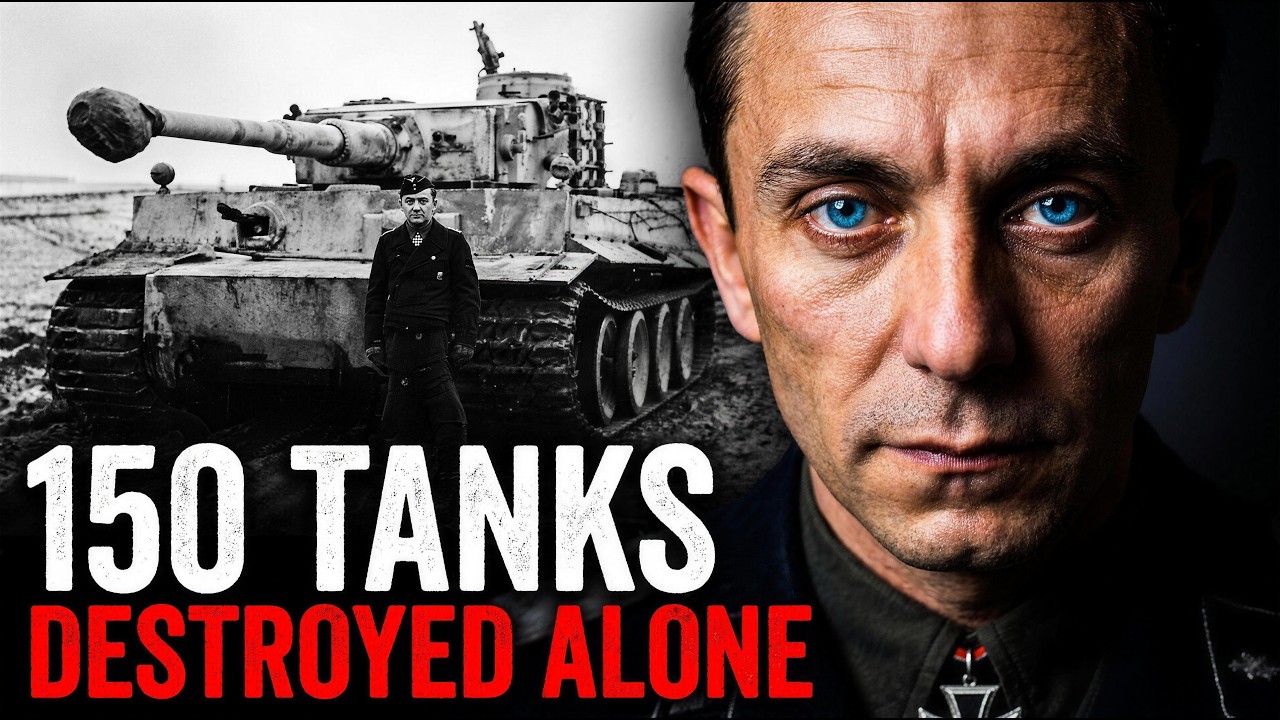
It proved successful enough to go through four subsequent editions, was eventually self-published and distributed directly by Carius through his own pharmacy, and was translated into 17 languages, making it one of the most widely read individual memoirs to emerge from the German side of the war. In one of its more unexpected adaptations, Hayao Miyazaki, the legendary animator later celebrated for Studio Ghibli films, created a watercolor manga adaptation titled Tigers Covered with Mud, serialized in the Japanese magazine Model Graphics between 1998 and May 1999. In later interviews, Carius came across as a sharp, articulate, and modest man, and he offered his own deflationary reassessment of his tank kill count, revising the commonly cited figure of over 150 downward to something closer to 100 or fewer, explaining that he had never personally kept a precise count. Otto Carius died on January 24, 2015, in the same village where he had spent nearly 60 years of his civilian life.
He was 92 years old. He was buried in the local cemetery, surrounded, according to accounts of his funeral, by his family and by those closest to him from both his wartime and civilian lives. He was neither a monster nor an uncomplicated hero, but something far more human and far more difficult to categorize.
A supremely skilled young soldier who fought a series of desperate battles for a criminal regime, who survived against odds that should by any reasonable calculation have killed him, and who then spent the far longer remainder of his life quietly serving the ordinary medical needs of his small community.