The most powerful woman in England could not undress herself. She could not verify that her wine had not been poisoned. She could not send a letter to her own godson without at least one other set of eyes knowing it existed.
Elizabeth I held more raw power than nearly any woman in English history up to that point. She could end a nobleman’s career with a sentence. She could keep an entire kingdom guessing about her marriage for four decades. And yet, at midnight in her own bed chamber, she was never alone. Not once, not for the length of an entire reign.
Power at that scale did not buy privacy. It cost her every scrap of it.
The throne room was a performance built for ambassadors and foreign eyes. The real Elizabeth lived somewhere smaller. In a privy chamber at Whitehall past midnight, lit by two candles instead of the 50 that burned when the court was watching, there was only a woman in a linen shift and a wool wrap, seated near the last of the heat.
Close enough to hear her breathe was one other person. Maybe a woman in her 30s who had served in that bed chamber for 11 years and had never once spoken about what she had seen there to anyone outside those walls.
The aging came first, slowly enough that most of England never noticed. From a distance, she was still the pale red-haired queen from the coins and the portraits. But the women who dressed her every morning were an arm’s length away in daylight. They saw the change years before it reached the public.
One of the first things they noticed was her hands. A queen’s hands are watched constantly, held out for rings, extended for kisses. The women who cared for those hands noticed the skin thinning at the knuckle, noticed a stiffness in the mornings that had not been there five years earlier.
Her eyesight changed too. Her ladies learned to angle documents at particular distances without being asked. They learned which candles to place where, not for warmth, but because certain positions of light let her read without holding a paper close enough to give the game away.
Hair thins with age. Hers did too. The solution was practical, the kind of everyday problem solving that happens in every household where someone is getting older, just conducted with silk and gold thread instead of anything ordinary.
The kitchens knew a different Elizabeth entirely. For all the ceremony around royal dining, her own private appetite ran surprisingly plain. She favored certain dishes prepared exactly one way, and the kitchen staff who had served her longest could produce them with their eyes closed.
They also knew what her appetite told you about her state of mind. A queen eating heartily after a difficult council meeting was a queen who had won the argument. A queen picking at her food and sending most of it back untouched was carrying something she had not spoken aloud to anyone yet.
Reading her moods was practically a second occupation for anyone who worked in close proximity to her. The tilt of her chin when she entered a room told you something. The speed of her footsteps down a gallery told you something else entirely.
Her secretaries became students of her handwriting. The size of her letters on the page, the pressure of the pen, whether her signature ran level or dipped slightly toward the end of a document, all of it shifted with her state of mind.
Several of her closest attendants developed a private system for managing the flow of difficult news. A letter carrying bad tidings from Ireland, arriving on a morning when she was already short-tempered, might sit in a drawer for an extra hour, or even an extra day, waiting for a moment when she seemed more able to absorb it.
This was not disobedience. It was an act of devotion so complete that it edged into a kind of risk these attendants accepted willingly. They were gambling with their own positions on the belief that serving her well sometimes meant not telling her everything the instant it arrived.
Consider the ones who burned letters they were never ordered to burn. Not state secrets, but personal correspondence, love letters from decades earlier, unguarded complaints about counselors she later relied on. A handful of attendants took it upon themselves to quietly destroy documents like these whenever they crossed paths with them.
Nobody ordered them to. Nobody ever thanked them for it either. As far as the official record goes, it never happened at all.
By the later years of her reign, the queen owned a wardrobe so vast that keeping track of it had become an entire small department of its own. Somewhere near 3,000 gowns by some counts. Cloth itself was extraordinarily valuable in this period, and a gown that no longer suited the queen’s current taste was never simply thrown away.
It was unpicked thread by thread by women whose entire job was this kind of careful, patient unmaking, and its fabric returned to storage to become something else entirely a year or two later.
As she aged, certain gowns required quiet structural adjustments that no ambassador’s report ever mentioned. The women who did this work developed an intimate, almost architectural knowledge of the queen’s body over decades, and they carried it the way a good tailor carries a client’s exact measurements, quietly, professionally, and without ever remarking on it.
There was an enormous amount of recycling happening beneath the surface of what looked like limitless royal excess. Sleeves from one gown reappeared on another the following season. Embroidered panels were carefully removed and rewn onto a fresh base fabric when the original had worn thin.
Repairs happened constantly, because a queen could not be seen in public wearing a torn hem or a loosened seam. A small team of needle women effectively lived on call, sometimes working through what remained of a night so that a dress damaged during an evening’s dancing could be entirely restored by the following morning.
The jewels lived a similarly hidden life. Every piece was cataloged, weighed, and recorded with obsessive precision. Ledgers listed not just what a jewel was, but where it had come from, who had given it, and what particular occasion it had last been worn for.
A pendant given as a gift from one prince might be broken down within a year, its stones removed and reset into an entirely different piece. The jeweler responsible held a position of remarkable quiet trust, sitting alone at a workbench with rubies scattered in front of him like ordinary pebbles.
Certain pieces were never stored in the same location two nights running, moved instead between several secured chambers on a rotation known to perhaps four or five people in the entire palace.
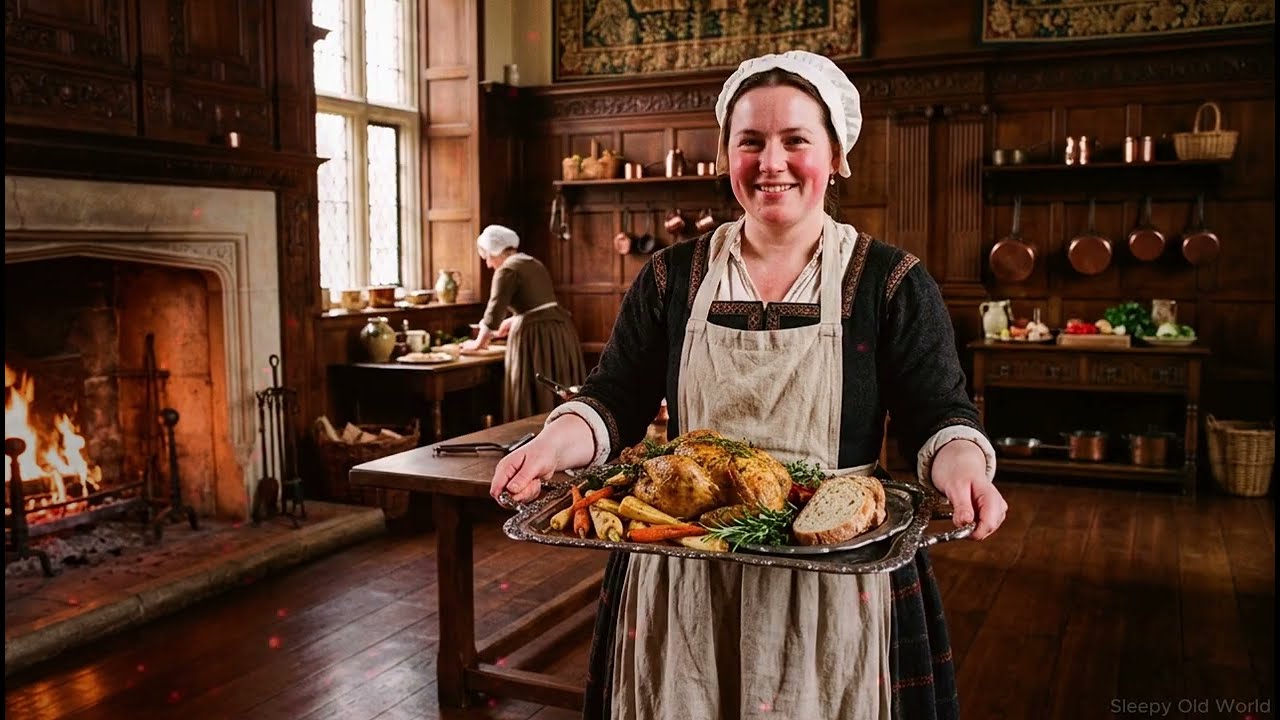
The kitchens themselves ran on a scale closer to a small factory than anything we would recognize as cooking today. Dozens of people worked across departments so specialized that a person who worked the roasting fires might spend an entire career there without ever setting foot in the room where sauces were prepared.
Food tasting was not the dramatic singular ritual people sometimes imagine. It was quieter, a series of small checks at multiple stages rather than one theatrical moment. Ingredients were inspected on arrival. Dishes were tasted during preparation. A final taste happened again close to the point of service.
The grand banquets staged for foreign dignitaries were an entirely different beast. Dozens of dishes might be carried out in elaborate procession. Most of this food was never meant to be eaten by the queen at all. It was theater calculated to demonstrate wealth and power.
Leftover food from royal tables did not simply vanish. A significant portion was distributed afterward to household staff, and further portions sometimes made their way through channels nobody advertised openly to the poor waiting at palace gates on the days following a major feast.
There is a whole invisible department that almost never comes up when people imagine Tudor court life, and that is the laundry. An operation that ran on a scale genuinely difficult to overstate, staffed by women whose entire working lives revolved around cloth, water, and heat.
Starching alone deserves its own quiet mention. The great ruffs of the period required a genuinely difficult technical skill to produce and maintain. A skilled starcher who could produce a ruff sitting perfectly, evenly, brilliantly white was valued highly enough to be almost impossible to replace.
Laundry reveals things that polite conversation never would. A launderess handling the queen’s linens over years came to understand her body in ways almost nobody else did. This kind of knowledge was treated with an almost sacred discretion.
Every palace Elizabeth lived in contained a second architecture layered invisibly over the one visitors saw. A network of narrow passages, back staircases, and unmarked doors that let servants move between rooms without ever crossing paths with the court above.
This was not an accident of construction. It was deliberate, built into these palaces from the ground up because a household this large simply could not function if every servant carrying firewood or removing dishes had to walk through rooms full of courtiers.
These passages carried more than just people and dishes. They carried information moving through the household at a speed that rivaled anything the official channels of court gossip could manage. A piece of news picked up in the kitchens could reach a lady’s maid in the privy chamber within the hour.
Security within this hidden network mattered enormously. Certain doors connecting the passages to the royal apartments were kept locked except at specific hours, and the keys themselves were held by a very small number of trusted senior staff.
Nowhere in the household did trust matter more than among the small circle who handled the queen’s correspondence. A single misplaced letter could unravel years of careful diplomacy.
Her principal secretaries oversaw a genuinely enormous flow of paper. Dispatches from ambassadors scattered across half of Europe. Reports from agents whose names appeared nowhere on any official document. Petitions from her own subjects.
A clerk deciding which letters were urgent enough for immediate attention, and which could wait, effectively controlled in some small daily way the queen’s own priorities.
Ciphers and codes were an entirely ordinary part of this world. Sensitive correspondence was frequently written in cipher, and a handful of trusted clerks developed genuine skill at both creating new codes and breaking ones intercepted from enemies.
The network of informants feeding information back to court reached further than most people at the time ever suspected. Managing this network fell to a small number of people operating with an almost complete absence of official acknowledgement.
Summer meant movement. When Elizabeth set out on one of her famous progresses through the countryside, she traveled with something closer to a small army of household staff. Hundreds of carts loaded with furniture, tapestries, cooking equipment, official documents, and enough clothing to outfit a small city.
Organizing this fell to officials whose job existed almost entirely outside public recognition. Advanced parties were sent days ahead to inspect roads, arrange accommodation, and negotiate with local suppliers for provisions on a scale that could genuinely strain a smaller town’s entire market.
A host family selected for one of these visits often understood it as an honor and a genuine financial disaster in almost equal measure. Hosting the queen and her enormous retinue for even a handful of days could cost more than that family’s entire annual income.
The logistics of moving that much material safely across English roads required constant problem solving. Carts broke wheels. Rivers flooded unexpectedly. Rain turned roads to mud thick enough to trap a loaded wagon for the better part of a day.
Behind every gracious royal arrival at some noble house sat weeks of largely invisible preparation on both ends. The seamlessness of the queen’s transition from one grand house to the next was manufactured through exhausting labor performed entirely out of sight, often through the previous night.

Grand ceremonies looked from the audience’s position like something that unfolded almost by magic. What that audience never saw was the sheer volume of rehearsal and correction that made this apparent effortlessness possible.
Precedence, the exact order in which people of different rank walked, stood, and were addressed, mattered with an intensity that seems almost absurd from a modern vantage point. A single mistake could genuinely wound someone’s pride badly enough to create lasting political consequences.
The queen’s own appearance during these ceremonies required its own separate mountain of preparation. A single miscalculated timing, torches burning down too early, could leave her walking into half darkness at a moment meant to be her most magnificent.
What happened after these grand occasions ended tells you almost as much as the ceremony itself. The moment the queen withdrew from public view, an entire small army of people descended immediately on the space she had just left, extinguishing candles, gathering discarded decorations, and beginning the exhausting work of restoring order.
The queen herself, once she had withdrawn to her private chambers, underwent a transformation almost nobody outside her closest attendance ever witnessed. The elaborate public figure was carefully, methodically dismantled piece by piece.
A particular kind of quiet settles over a palace in the minutes right after an ambassador’s formal audience ends. The formal mask the queen wore for these encounters did not simply dissolve the moment the doors closed. It came off in stages.
Sometimes what followed was simple, exhausted quiet. Other times, particularly after a difficult negotiation, the departure of the formal mask revealed something closer to genuine anger, sharp and immediate, directed at nobody in particular, but felt by everyone standing nearby.
What ambassadors themselves never saw was the debriefing that sometimes happened immediately after they left. A handful of trusted advisers and secretaries gathering quickly to pick apart everything that had just been said, searching for meaning in word choices and pauses.
There was also on calmer days something almost tender in these immediate aftermaths. A joke might surface here that would never have been spoken in the ambassador’s presence. A complaint about some minor detail of court etiquette might finally find its way into words.
The gifts that arrived with foreign visitors created their own small aftermath ritual, unwrapped and assessed once the giver had departed. The people responsible for this quiet assessment effectively functioned as an informal intelligence check.
Maintaining the image of an untouched, almost timeless queen required a kind of continuous, quiet stagecraft that her closest attendants understood as simply part of the job.
Positioning mattered enormously. A woman standing near a window on an overcast afternoon reads very differently to the eye than the same woman standing directly beneath strong midday sun. The attendants who managed her public appearances learned exactly which locations within each palace flattered her at any given hour.
Distance mattered just as much as light. Formal audiences were structured to keep foreign visitors a respectful fixed distance from the throne. The same convention also happened to keep observers far enough away that the finer details a closer inspection might reveal simply were not visible.
Portraits themselves became an active site of this same careful management. Certain approved likenesses were circulated and recopied for years after they were originally painted, long outliving their accuracy, because a familiar, reassuring image of eternal youth served the crown’s interests better than an honest, updated one ever could.
Illness presented the single greatest challenge to this entire careful performance. A serious illness affecting the queen was a genuine matter of state security capable of destabilizing alliances and emboldening enemies the moment word of it spread.
Her physicians learned early that treating the queen meant also simultaneously managing information about her condition with a care that bordered on the diplomatic.
There were periods across her long reign when her health genuinely frightened the small circle of people close enough to see it clearly. Illnesses serious enough that questions of succession briefly became urgent rather than theoretical.
This meant a peculiar kind of choreography around illness. Visitors to the palace during these periods were sometimes told the queen was simply resting or occupied with private business. Careful phrases designed to explain her absence from public duties without ever confirming the truth.
Toward the very end of her reign, as her health declined in ways that became increasingly difficult to fully conceal, the small circle managing this information faced perhaps their most difficult sustained challenge.
What survives from this period comes mostly through fragments. Brief mentions in letters written by people adjacent to the household rather than direct testimony from the attendants themselves, who mostly kept the specifics of those final months exactly as private in death as they had kept them in life.
Music filled far more of the queen’s private hours than most accounts of her reign ever bother to mention. She played the virginals herself reasonably well by most surviving accounts, and she practiced in private in rooms where only a handful of trusted attendants were ever present.
Her court musicians learned her taste with the same precision the kitchen staff learned her appetite, understanding which composers she favored, which particular pieces she requested again and again over the years.
Private evenings sometimes included music that had nothing to do with performance for an audience at all. Simply the queen and a small handful of trusted companions, singing or listening or dancing informally in a room lit by nothing more than firelight.
Religious observance occupied its own significant portion of her private schedule. Private prayer conducted with a regularity and evident sincerity that some of her closest attendants noted with genuine respect.
Some names did survive against the odds. Katherine Ashley, known to nearly everyone as Cat, entered Elizabeth’s life when the future queen was still a small child and remained close to her for decades afterward. By any reasonable reading of the surviving letters, it was something closer to the closest thing to a mother Elizabeth had left after her own mother’s execution when she was not yet three years old.
Blanch Perry offers an even more staggering example of sheer duration, serving Elizabeth for well over 50 years by the time of her own death. Two women, both aging together across an entire adult lifetime, one of them the most powerful figure in England, and the other one of the very few people permitted to see her without any performance at all.
These long-serving women occupied a genuinely unusual social position. They were not nobility in the grandest sense. And yet their proximity to the queen, sustained across decades, granted them an influence that some far grander figures never achieved in their entire careers.
When these women died, and inevitably across a reign this long, several of them did die before the queen herself, the loss registered in ways that went well beyond the simple practical inconvenience of needing to train someone new.
Her temper was, by every surviving account from people close enough to witness it directly, genuinely formidable. The servants who worked nearest to her learned to work around it, with a weariness that never entirely faded.
One particular account passed down through household memory describes an incident where a lady in waiting, having made some small mistake in handling a piece of the queen’s jewelry, found herself on the receiving end of a reaction that went well beyond simple verbal correction.
What is genuinely remarkable is how quickly these same servants learned to absorb this kind of moment and simply continue their work afterward without any lasting rupture in their loyalty.
There were also moments that ran in the entirely opposite direction. Sudden warmth and genuine tenderness that could arrive just as unpredictably as the anger did. A servant who had been quietly dreading a difficult morning might instead find the queen unexpectedly gentle, asking after their own family.
The actual economics of this kind of service were considerably more precarious than the popular image suggests. Wages for most household staff were modest, often paid irregularly, sometimes falling significantly behind schedule during periods when royal finances were strained.
The gentlewomen serving in the privy chamber and the bed chamber occupied a somewhat different economic position. For these women, the real currency of the position was not the modest formal salary attached to it, but the access and influence that came with genuine royal proximity.
Retirement, in any sense a modern person would recognize the term, essentially did not exist for most household staff. Service typically continued until illness, old age, or death made it genuinely impossible to continue.
Among the queen’s attendants sat a particular group worth its own separate attention. The young unmarried gentlewomen known as her maids of honor, typically the daughters of noble or gentry families sent to court in their teenage years.
The queen took an active, sometimes surprisingly strict interest in the personal conduct of these young women. Several accounts describe her genuine, sometimes explosive displeasure upon discovering that one of her maids of honor had secretly married or become romantically involved without first seeking royal permission.
Discovery of a secret marriage or a secret pregnancy among her attendants could trigger consequences that seem genuinely harsh by modern standards. Periods of confinement, banishment from court.
Security around the queen’s person, particularly at night, involved a level of careful arrangement that most visitors to the palace never had reason to think about. Genuine plots against her life surfaced periodically throughout her reign.
Guards were posted at multiple points throughout the routes leading toward her private apartments. The women who slept nearest to the queen’s own chamber, often taking turns through the night, carried a particular kind of responsibility that went well beyond ordinary household duty.
Locks and keys formed their own careful, deliberate system. Losing track of a single key, even briefly, could trigger a genuinely serious response from the officials responsible for the queen’s safety.
Food security extended into the nighttime hours too, with particular attention paid to anything left within the queen’s private chambers that she might reach for during the night.
The turning of the year brought its own distinct rhythm to the household. The New Year’s gift exchange generated an enormous amount of quiet, careful labor behind the scenes.
Nobles and courtiers were effectively expected to present the queen with gifts at the start of each year. In return, the queen distributed gifts of her own, typically pieces of gilt plate calibrated with a careful precision to the recipient’s actual rank.
Christmas itself brought weeks of preparation that stretched the household’s resources considerably. For the household staff actually performing all this labor, the holiday season paradoxically meant some of the hardest, most exhausting working weeks of the entire year.
Animals moved quietly through this world too. The queen’s evident fondness for her dogs gave the household staff one more small, ordinary window into a side of her that rarely made it into any formal account of the reign.

Horses mattered enormously, both for the practical necessity of travel and for the queen’s own genuine skill and evident enjoyment of riding. The grooms and stable staff responsible for her horses developed their own specialized, largely invisible expertise.
Falconry involved its own small, dedicated staff maintaining the birds used for the sport. The falconers who served the royal household understood their birds with an intimacy that rivaled anything the wardrobe women understood about gowns.
No relationship in her private life received closer, more careful observation from the household than her long connection to Robert Dudley, later the Earl of Leicester. A man she had known since childhood, and whose presence in her life generated more court gossip than perhaps any other single subject.
Servants who worked in the privy chamber during the years when Dudley’s influence ran at its peak understood better than almost anyone at court exactly how genuine and how complicated that particular bond actually was.
Several of her closest women very likely knew things about this relationship that never made it into any surviving letter or account. Details of private conversations overheard while attending to ordinary duties in the same room.
When Dudley eventually married another woman, a development that reportedly caused the queen genuine visible distress when she learned of it, the attendants who witnessed her reaction saw a side of her that the wider political world never fully glimpsed. Something closer to ordinary heartbreak than to calculated political disappointment.
The fullest, most accurate version of this particular story likely died along with the small handful of women who actually watched it unfold across all those years.
There was one crisis early in her reign that tested the household’s discretion more severely than almost anything else. In the autumn of her fourth year on the throne, Elizabeth contracted smallpox.
For several days, her closest attendants genuinely believed she might die at a moment when no clear agreed succession existed to take her place.
The women who nursed her through this illness worked through days and nights of genuine sustained fear, both for the queen’s life and for their own understanding of what her death would mean for the kingdom.
She survived, recovering gradually over the following weeks, though the illness reportedly left some lasting marks on her skin that her attendants would have been intimately aware of for the rest of her life.
No single episode across the entire reign tested the discretion and emotional endurance of her closest attendants quite like the long, agonizing decision surrounding Mary, Queen of Scots, and the eventual signing of the warrant that sent her cousin to execution.
The people closest to Elizabeth during the weeks and months leading up to that decision witnessed a depth of visible anguish and indecision that rarely surfaced so openly during any other episode of her reign.
Her secretary, William Davidson, the man who eventually carried the signed warrant forward, found himself at the center of a genuinely fraught sequence of events. He bore severe consequences afterward, imprisoned and effectively made to answer for a decision that likely involved considerably more complicated royal intention than the simple, clean narrative of an unambiguous royal order.
The attendants present in the queen’s private chambers during the days immediately following news of the execution reaching her witnessed a response that several accounts describe as genuine overwhelming distress.
A search for someone to blame followed in the immediate aftermath, creating a genuinely dangerous atmosphere within the household.
Language itself formed one more quiet, specialized layer of hidden household labor. Elizabeth’s own genuinely impressive command of multiple languages coexisted with a diplomatic world where correspondence with foreign courts still required careful, skilled translation.
Ambassadors visiting the English court sometimes underestimated how much the queen herself understood of their own language. Several accounts describe moments when Elizabeth apparently allowed a foreign visitor to continue believing translation was strictly necessary, gathering through this quiet deception small, useful pieces of information.
There is a particular piece of jewelry worth returning to. A ring given to her at her coronation, said to symbolize her marriage to the kingdom itself, and by most surviving accounts worn continuously for the rest of her life.
Growing so deeply embedded into the flesh of her finger across the decades that eventually near the very end of her reign, it apparently had to be cut away rather than simply slipped off.
A single piece of metal worn without interruption for the better part of 45 years. Present through every crisis and celebration. An unbroken physical thread connecting the frightened young woman who first took the throne to the elderly, increasingly frail woman who eventually wore it into her final days.
By the final months, the small circle who remained closest to her watched a decline that moved slowly enough to deny for a long while, and then quite suddenly seemed to accelerate.
She reportedly grew increasingly withdrawn during these last months, spending long stretches in silence that her attendants learned not to interrupt.
One detail survives, repeated across several later accounts with enough consistency to suggest genuine truth. During her final illness, she refused for a considerable stretch of time to go to bed at all, insisting instead on remaining upright, sometimes sitting on cushions on the floor of her chamber.
Eventually, in the final day or two, she reportedly stopped speaking almost entirely, though several accounts suggest she remained conscious and aware for longer than her silence alone might suggest.
She died in the very early hours of a March morning. The small group of attendants present in the room at the actual moment of her death would carry that specific memory for the rest of their own lives.
One woman present in the room, Lady Scrope, apparently held some private signal already arranged with her brother waiting outside the palace. A plan to convey the moment of the queen’s death quickly toward those who needed to move fast to secure a smooth transition of power.
The transition itself, when it came, proceeded with remarkable speed and remarkable order. King James was proclaimed in London within hours of her death.
In the hours and days immediately following her death, the palace underwent its own quiet ceremonial unmaking. Older household traditions required certain officers to symbolically break their staffs of office over her body or her grave.
The household that had operated with such careful sustained precision for so many decades began within days the process of dissolving and reforming under new authority.
For the attendants who had known her longest, the women who had served for 20, 30, in Blanch Perry’s remarkable case well over 50 years, this ending must have carried a particular singular kind of grief.
What actually survives from all of this amounts to remarkably little given how much these people must have genuinely known. A handful of wills mentioning small bequests to particular servants. Scattered household account books listing wages and purchases. Fragments of letters written by people adjacent to the household.
Somewhere in England across the early 1600s, elderly former attendants of the queen were dying one by one, ordinary deaths mostly unremarked beyond their immediate families. And with each one of those deaths, a small, unique, irreplaceable body of knowledge about one of history’s most consequential women simply vanished from the world entirely.
We are left now, four centuries later, with only the faintest outline of what these people actually knew.
And yet something does survive. Something less concrete than a specific fact, but genuinely real all the same. A kind of accumulated impression passed down through the pattern of how this household operated across four and a half decades.
The sheer consistency of loyalty and discretion sustained by dozens, ultimately hundreds of different individuals across an entire reign.
There were small rituals threaded through her days that meant almost nothing on their own, and yet taken together formed the actual texture of what serving her closely felt like hour to hour.
She reportedly kept a particular fondness for sweetmeats, small sugared treats that her attendants learned to keep quietly available during long council sessions.
Her prayer book carried in the margins of several surviving copies small handwritten notes and markings that suggest a woman engaging quite personally and specifically with particular passages.
Godchildren appear scattered throughout her correspondence. A role she apparently took with genuine seriousness, sending gifts, and in at least a few well-documented cases, taking real personal interest in a child’s upbringing.
The physical ritual of hands being kissed carried its own small hidden dimension. Her attendants would have noticed subtle variations in how she offered her hand to different individuals. Tiny physical signals that an experienced observer could learn to read as indicators of genuine warmth versus mere obligatory courtesy.
There is something worth genuinely sitting with in the psychological weight all of this must have placed on the people carrying it. Imagine holding for decades knowledge that could genuinely damage or embarrass someone you had also grown to care about personally. Knowledge that powerful, dangerous people at court would have paid enormous sums to extract from you.
Real loneliness must also have been woven through it. A woman returning home to visit family after months at court, greeted with eager questions about what the queen was really like, would have needed to maintain the same careful discretion even there among people who posed no genuine security risk at all.
Picture a palace corridor well past midnight. Most of the household long since asleep, except for the small rotation of attendants whose duty it is to remain quietly, carefully awake.
The stone underfoot holds a particular cold that never fully leaves it, even in high summer. Somewhere further down that same corridor, a single torch burns low in its bracket, throwing long, uneven shadows.
The sound in a space like this is its own particular quality. Not silence exactly, because a building this large, holding this many people, even in sleep, is never truly silent. There is the low creak of settling timber. There is, somewhere distant, the faint sound of a dog shifting in its sleep near some banked fire.
The women taking their turn in this nighttime rotation developed a genuinely intimate familiarity with exactly how this particular building sounded and felt at this particular hour.
It would be unfair to tell this whole story as though the warmth only ever flowed in one direction. The surviving fragments suggest something more genuinely reciprocal than that.
A servant recovering from illness, receiving unexpected personal attention or practical assistance directly from the queen herself, was the kind of gesture people apparently remembered and spoke of for years afterward.
There are scattered references to the queen personally inquiring after a servant’s sick family member, or quietly arranging some small practical assistance for an attendant facing financial difficulty.
The women and men who served Elizabeth this closely for years were not simply performing loyalty out of fear or calculated self-interest. Though both of those motivations genuinely existed too. Many of them appear based on everything that does survive to have genuinely liked her.
There is a wider pattern worth naming before we let this particular story rest. Every grand public figure in every era has depended on exactly this kind of invisible supporting labor. People whose skill and attention and discretion made possible whatever polished, confident public performance history eventually remembers and celebrates.
Think of the people whose careful, unglamorous work makes your own days function smoothly enough that you rarely stop to notice it at all. The maintenance worker who fixed something in your home before you ever knew it was broken. The person who prepared food you ate without ever meeting them.
Long before any of tonight’s stories about queenly authority and careful household management, there was a considerably more dangerous chapter in her life. During her sister Mary’s rule, Elizabeth spent a genuinely frightening stretch of time imprisoned in the Tower of London.
Cat Ashley endured her own period of imprisonment and interrogation during this same dangerous stretch. Questioned harshly about her young charge’s activities and loyalties in a process that must have been genuinely terrifying.
This was survival-level secrecy maintained under genuine threat of torture and execution by a woman whose loyalty to her young charge apparently held firm through an ordeal that would break many people considerably tougher.
The attendants who survived this dangerous period alongside the young Elizabeth carried for the rest of their lives a particular hard-won understanding of exactly how fragile her position had once been.
This shared history between the queen and her longest serving attendants, forged during genuine shared danger rather than simply through the more comfortable proximity of established royal service, likely explains a great deal about why these particular relationships lasted as long and as deeply as they clearly did.
The question of marriage hung over her entire reign. Marriage negotiations with various foreign princes stretched on for years at different points throughout her reign.
Some candidates she reportedly found genuinely appealing on a personal level, based on fragments of household memories suggesting real warmth in her private reactions to particular ambassadors.
Political calculation clearly played the dominant role in why she ultimately never married. But the attendants who witnessed her private reactions across these various courtships suggest something more personally complicated sat alongside the political calculation too.
There is a particular medical dimension to these marriage negotiations worth mentioning carefully and factually. Foreign courts negotiating a potential royal marriage sometimes required assurance of the queen’s health and fitness for the arrangement being discussed.
The summer the Spanish Armada approached English shores brought a different kind of pressure into the household entirely. Weeks of genuine sustained uncertainty about whether invasion was imminent.
Her famous speech at Tilbury required careful preparation behind the scenes. Choosing exactly what she would wear for the occasion carried genuine symbolic weight.
Behind that famous, carefully composed public moment sat private hours of a different character entirely. Her closest attendance would have seen a more uncertain, more genuinely frightened version of the queen than the confident figure who addressed the troops at Tilbury ever revealed publicly.
The kitchens and wardrobe departments found themselves drawn into contingency planning too during these anxious weeks. Quiet preparations for the possibility that the court might need to relocate quickly.
When news of the English fleet’s success against the Armada finally reached the palace, the relief that swept through the household must have been genuinely overwhelming.
There is one more household role worth understanding before we let this story rest. The office of the groom of the stool, a title that sounds almost comically undignified to modern ears, and yet represented in practice one of the most intimately trusted positions available to any man in royal service.
Physical intimacy, the accumulated closeness of dressing someone, tending their private space, managing their most personal daily needs, builds a specific kind of trust that formal political relationships simply cannot replicate.
Royal households across this entire period developed two separate overlapping structures of genuine influence. The visible official one built on titles and council seats, and a quieter less visible one built on physical proximity and accumulated personal trust.
Courtiers who understood this dynamic sometimes went to elaborate lengths to cultivate goodwill among these physically proximate attendants. Small gifts, careful courtesy, attentive kindness extended toward people whose formal social rank sat well beneath their own.
The gardens surrounding her various palaces offered one more overlooked stage where this hidden household world quietly operated. Elizabeth reportedly enjoyed walking in these gardens regularly.
The gardeners responsible for maintaining these spaces developed their own quiet expertise in understanding exactly what the queen valued. Which particular walks she favored. Which specific plantings she had expressed appreciation for.
These garden walks occasionally became the setting for genuinely important private conversations away from the more formal watched atmosphere of indoor council chambers.
Beyond the grander world of court physicians sat a quieter, more domestic tradition of household medicine, centered on what was typically called the still room. A dedicated space where herbal remedies, preserves, and medicinal preparations were made by hand.
The woman who managed Elizabeth’s own still room would have held a particular kind of quiet, practical authority within the household, trusted to prepare remedies that the queen herself might actually consume.
Warming pans and simple physical comforts rounded out this same tradition of quiet practical care. Brass pans filled with hot coals and run carefully between bed linens before the queen retired for the night.
Consider, finally, just how many individual hands this evening’s story has actually passed through without ever naming most of them. The women who dressed her. The men who guarded her doors through cold, uneventful nights. The cooks and tasters who kept her fed and safe in equal measure. The secretaries who managed her letters. The gardeners who read the sky correctly before a walk.
Every single one of these people carried a version of Elizabeth that the history books simply do not and mostly cannot contain.
What we are left with instead, four centuries later, is something closer to a silhouette than a photograph. An outline traced by absence, by the sheer volume of care that clearly must have existed to keep one woman safe, fed, dressed, informed, and reasonably sane across 45 demanding years.
Somewhere in a small unmarked grave in an English churchyard lies a woman who once knew exactly how Elizabeth Tudor liked her hair arranged on a difficult morning. Exactly which words could ease a foul temper, and which would make it worse.
All of that knowledge once so precisely carefully held is simply gone now. And has been gone for a very long time.
Reading filled more of her private hours than most people would guess. She reportedly translated classical texts herself for her own private satisfaction rather than for any public display, working through difficult passages of Latin and Greek late into the evening.
Evening reading became for her one more small pocket of genuine private time carved carefully out of an otherwise relentlessly public existence.
Reports from distant voyages brought back by men like Francis Drake and Walter Raleigh reached her first in private careful briefings long before any wider court celebration. She had genuine evident fascination with these distant places and distant peoples.
The gifts that occasionally arrived alongside these reports, unusual specimens and objects gathered from distant shores, required their own careful handling by household staff unfamiliar with anything quite like them.
Let’s come back one final time to that quiet privy chamber where we began. The fire down to embers. Two candles instead of 50. A woman in a linen shift seated near what remains of the heat, and one other person close enough to hear her breathe.
So much has happened between that first image and this one. Decades compressed into a single evening’s listening. Crises and quiet ordinary nights. Grand ceremonies and the small unglamorous labor that made those ceremonies possible.
What remains now is mostly just this. A pattern. A shape traced through absence as much as through evidence. The outline of hundreds of individual lives spent in careful patient service to one particular woman.
We do not know most of their names. We will never know most of what they actually witnessed.
And yet these people chose across decades, again and again, small daily choices repeated so many times they stopped feeling like choices at all. To be trustworthy. To carry difficult knowledge carefully. To protect someone else’s dignity and safety, even when doing so cost them something real.
That choice, repeated by hundreds of different people across 45 years, built something that mattered enormously at the time, and that still, in its own quiet way, matters now.
The fire in that room we imagine together tonight has long since gone fully cold. The actual physical embers scattered to dust centuries ago along with everyone who ever stood near them.
But something of what happened in rooms like that one persists anyway. Not as fact exactly. Not as anything a historian could footnote with real confidence. But as a quiet lasting sign of how much ordinary human care and loyalty a life can actually hold.