Anthony Armstrong-Jones, the man who would one day marry into the British royal family, was not born into nobility, but his upbringing placed him firmly within the upper classes. His father was a barrister, and his mother’s second marriage to Lawrence Parsons, the Earl of Rosse, brought him into a noble household. That standing meant a great deal in 1930s England. He attended a series of boarding schools, including Eton, where he took up photography, boxing, and rowing, all while contending with a limp left over from a childhood battle with polio.
He went on to Cambridge University to study architecture, and for a time it seemed he had found his path, until he failed his second-year exams. That setback seemed minor at the time, but it redirected the entire course of his life. When he proposed becoming a professional photographer, his normally cold parents grew even more disapproving. However, his upbringing, his noble stepfamily, and his years at England’s most prestigious schools had given him friends in high places.
Throughout the 1950s, Anthony made a name for himself taking fashion photographs and portraits of stage stars. He also developed a reputation for living extravagantly. It was no secret that after photographing attractive young women in his studio on Pimlico Road, he invited them to stay for the raucous parties he hosted there. Scandalous rumors also circulated about his relationships with men, and stories about his male affairs followed him for years.
Having conquered the worlds of fashion, theater, and studio photography, he set his sights on royal portraits. He was in the right place at the right time. Queen Elizabeth II asked him to photograph her family, and although his relaxed style was controversial, the Queen was delighted with the results. At that moment, the rakish, handsome young photographer seemed like a welcome addition to the royal circle.
As his success and proximity to the royal family grew, Anthony learned to keep his private life private. He was polite and charming but tight-lipped about his romantic interests. The only relationship he allowed the gossip columns to speculate about was his long, on-and-off situation with showgirl Jacqueline Chan. By the late 1950s, however, he was using her to cover up a far more scandalous romance.
What had begun as a friendship with Princess Margaret, the Queen’s sister, had blossomed into something deeper. They appeared together in groups in public, but Margaret took great delight in disguising herself and sneaking away to see Anthony, who asked her opinions on his ongoing work. The royal family was determined to handle this relationship better than Margaret’s previous romance with Peter Townsend, which had ended under intense media scrutiny. Still, they required a major sacrifice from Anthony.
He would have to give up his career if he wanted to marry Margaret. He agreed, and long before the press even suspected a romance, he quietly began withdrawing from his professional commitments. In 1960, a press release announced the engagement of Princess Margaret and Anthony Armstrong-Jones. Everyone involved seemed delighted, with one glaring exception.
Anthony’s father reacted in a typically cold fashion, expressing doubts that his son was suited for the role and comparing his temporary accommodation at Buckingham Palace to being confined to barracks. The couple married on May 6, 1960, in a lavish ceremony. It was a historic first, as no royal wedding had ever been broadcast on television before, and twenty million people tuned in. For their honeymoon, Anthony and Margaret set off on a six-week trip to the Caribbean.
They missed several events, including the birth of Anthony’s friend Jeremy Fry’s child, an event that would later return to haunt him. At the time, however, it looked as though they had finally found their happy ending. More traditional segments of the British press did not approve of a union between a princess and a commoner. Anthony faced snobbery from all directions, even at home, where some servants treated him rudely because he was not equal to the other royals.
He also clashed with members of the royal family. Prince Philip had always been cold toward him, but after the marriage this turned into pronounced distaste. Anthony was artistic and sensitive, while Philip was a rugged outdoorsman. With press scrutiny and the loss of his career, the pressure on Anthony was immense.
It would only be a matter of time before the cracks began to show. Princess Margaret gave birth to a son in November 1961, and Anthony accepted the royal title of Earl of Snowdon. Margaret may not have shared many of Anthony’s interests, but they had one thing in common. Both were caught up in the energy of swinging London in the early 1960s, and both took advantage of it.
Anthony found his way into a circle that included senior figures at Vogue, while Margaret made friends with celebrities like the Beatles and Peter Sellers. In 1964, Margaret gave birth to their second child, a daughter named Sarah. Just four years into their marriage, they looked like the perfect family on the surface. But by 1965, the distance and the pressure of royal life had gotten to Anthony.
He planned a trip with a friend from the publishing world, yet something was off. The palace claimed Margaret could not accompany him because she needed to remain at home during the Queen’s absence. In reality, Anthony had begun spending a significant amount of time with married Vogue editor Pamela Colin. Instead of sinking into depression, Princess Margaret decided to play her husband’s game.
She had a fling with her daughter’s godfather, a man named Anthony Barton, and began spending more time with actor Peter Sellers. Rumors circulated about dalliances with famous figures like Mick Jagger, Warren Beatty, and Leslie Hutchinson. Then came her affair with Robin Douglas-Home, nephew of the former prime minister. The affair was brief but had disturbing repercussions.
Eighteen months after it ended, Douglas-Home took his own life at just thirty-six years old. This was only the beginning of years of back-and-forth infidelity between the royal couple. Margaret was miserable, and the rest of the royal family was acutely aware of the problems between them, hoping the two could quietly lead separate lives and spare everyone the embarrassment of a divorce. The couple went along with it, but the arrangement weighed far more heavily on Margaret.
She acted out by drinking and behaving rudely in public, and anti-monarchists began criticizing her and the cost of her upkeep. As the swinging sixties came to a close, the constant cheating lost its excitement and became just another burden in the lives of Anthony Armstrong-Jones and Princess Margaret. On their honeymoon, a friend had given them a six-acre plot of land on the small Caribbean island of Mustique. Anthony had never returned, but Margaret had used it as a refuge during the rockiest parts of her marriage.
It was there that she took up with Roddy Llewellyn, the vagabond son of a famous British equestrian. They had been friends for a couple of years and met when he was twenty-five and she was forty-three. It seemed like just another affair, but this one blew everything up. Rupert Murdoch had sent a New Zealand journalist to Mustique, who pretended to vacation there with his wife.
While on the island, the journalist captured a photograph of Margaret and Roddy together. The publication of those photographs was the final nail in the coffin, not only for Anthony and Margaret, but also for the royal family’s hope that the cold, distant marriage could continue. Everyone knew they finally had to admit that things were not right. Anthony was tired of waiting.
He was spending more and more time as a documentary filmmaker, working closely with a production assistant named Lucy Lindsay-Hogg. He had made progress toward a legal separation, only for the royal family to procrastinate. Anthony then made a decisive move. He announced the separation himself, without the consent or knowledge of Margaret or the royal family.
The couple divorced in 1978, and Anthony wasted no time moving on. His relationship with Lucy Lindsay-Hogg had become romantic long before that, but it still came as a surprise to Margaret when Anthony announced he would marry Lucy just five months after the divorce. They were married in December 1978. It was not exactly happily ever after.
Although Anthony had lost the bitterness that had marked the final years of his marriage, he had not abandoned all his old habits. Somewhere between his separation and divorce, he had begun an affair with married journalist Anne Hills. She was shocked to read that he had married Lucy but was not willing to give him up over it. Because his marriage seemed to be going well, he kept the affair with Anne Hills a secret.
The affair went on for twenty years. Anne Hills always wanted more from Anthony, but with each passing year it became clear she would never have it. She saw other people and even had live-in boyfriends, but she still longed for him. After writing a column for the Guardian for many years, she was let go in late 1996.
Another boyfriend had just left her, and she had spent another Christmas without Anthony. Deeply depressed, Anne Hills took her own life. She left a note telling Anthony she had always loved him and asking that a family heirloom he had given her be returned to him. During the investigation, authorities collected her diaries, which contained details of her two decades with Anthony.
Newspapers quickly printed the contents. That was how Anthony’s wife, Lucy, learned he had been cheating on her for the entire duration of their marriage. Two years after the press revealed his long-term affair with Anne Hills, Lucy uncovered another bombshell. Anthony had fathered a child with a magazine editor named Melanie Cable-Alexander, who was nearly thirty years younger than him.
He eventually parted ways with Melanie, and Lucy filed for divorce. Remarkably, Anthony and Lucy remained friends afterward, and she cared for him in his final years. It was in those final years that many of his most scandalous secrets came out. His indiscretions were not limited to women.
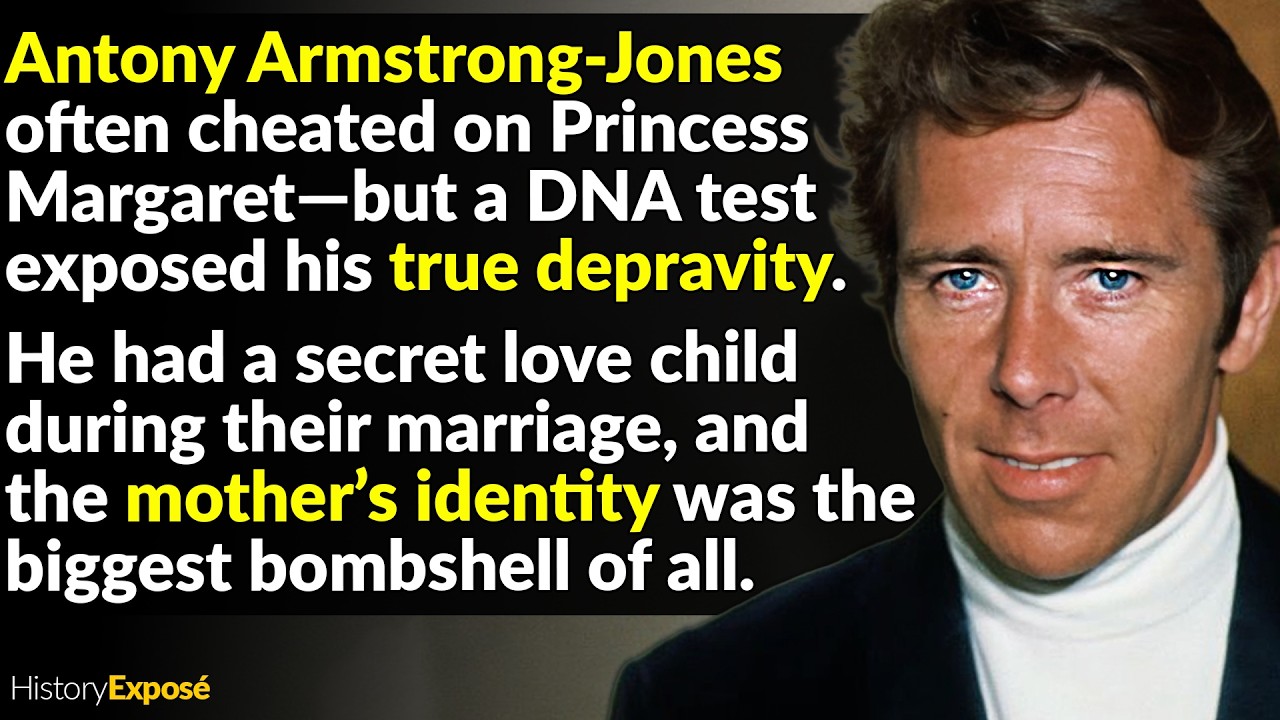
People speculated that he was gay, and according to one biographer, he later admitted to being bisexual. Some men claimed to have had romances with him, though this remains unproven. The public watched Anthony Armstrong-Jones’s marriage to Princess Margaret fall apart in front of them, but it had actually started much earlier than anyone realized. In 2004, DNA testing proved that he had an illegitimate daughter born just weeks into his marriage to Margaret.
A British woman named Polly Higgson was revealed to be Anthony’s daughter, born during his honeymoon with Margaret. Polly’s mother was Camilla Fry, and Polly had grown up believing her father was Jeremy Fry, a member of the family behind Fry’s Chocolate. Jeremy had been Anthony’s best friend and had nearly served as best man at his wedding to Princess Margaret. Anthony had not only cheated on his wife; he had done so with his best friend’s wife.
Though both Jeremy Fry and Anthony initially denied the story, Anthony later admitted it was true after Fry’s death.