By the spring of 1864, Robert E. Lee had spent three years learning to read the men who opposed him. Not maps, not terrain—men. Through a brutal, intimate education, he had concluded that the Army of the Potomac carried a fatal flaw that had nothing to do with its soldiers.
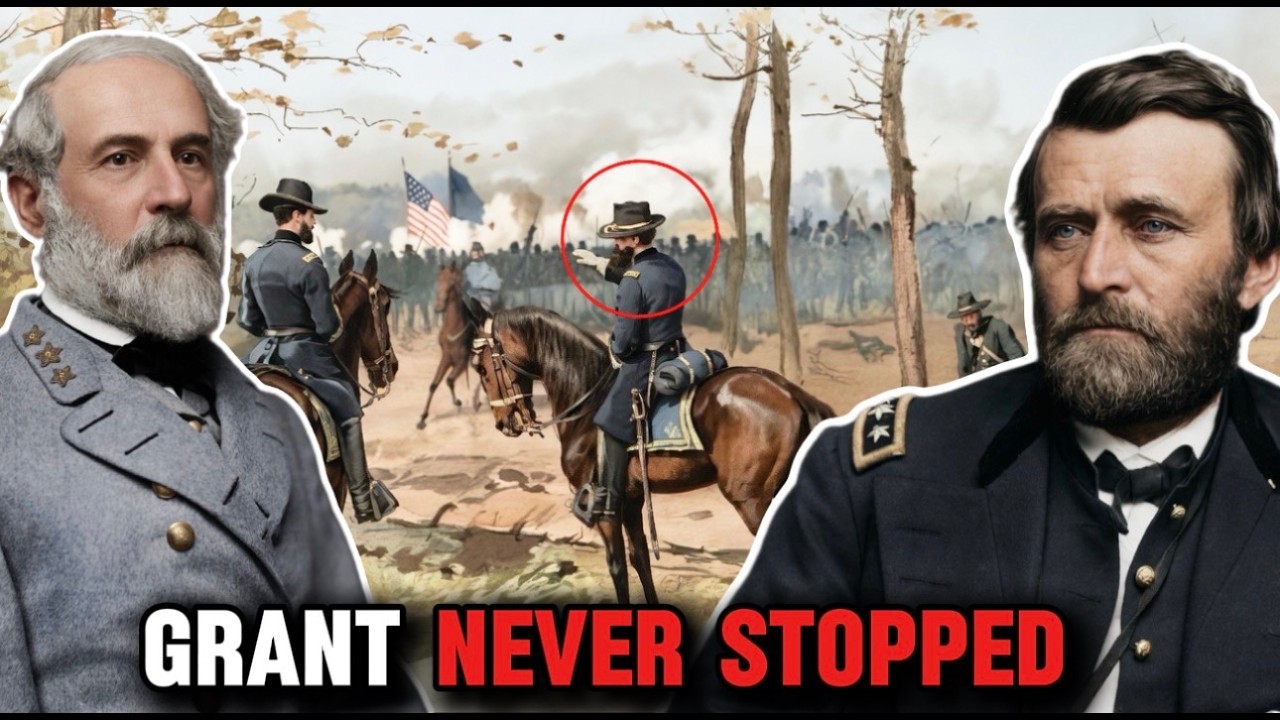
The soldiers were brave, determined, and willing to bleed on any field Lee chose. The flaw lived higher up, in the men who commanded them. And that flaw, more than any fortification or geographic advantage, had kept the Confederacy alive when, by every material measure, it should already have been finished. The pattern had become almost rhythmic.
Lee would absorb a Union punch, find the seam, and strike hard at something the enemy commander had left unprotected. Within days, sometimes hours, the man across from him would begin looking for a way to step back. Not always a full retreat—sometimes just a pause, a reevaluation. But that backward motion, however slight, was enough.
In a war of attrition, when one side is slowly hemorrhaging men and material it cannot replace, backward motion is a sentence. It just takes time to be carried out. McClellan had possessed an army that could have ended the war in 1862. He commanded it with the energy of a man protecting a museum collection, too precious to risk, too carefully assembled to use.
After Antietam, when Lee’s army was exhausted and exposed and in no condition to absorb a sustained blow, McClellan wrote to his wife that he had done enough for one day. Lee slipped back across the Potomac and began rebuilding. McClellan was eventually removed. The war continued.
Pope came west with a mouth full of confidence and a head empty of caution. Lee smashed him apart at Second Bull Run with a brilliance that bordered on contempt. Burnside sent wave after wave of men up Marye’s Heights at Fredericksburg, not because the assault had any real prospects of success, but because stopping felt like surrender. He lost nearly thirteen thousand men in an afternoon.
Hooker maneuvered beautifully at Chancellorsville, catching Lee in exactly the exposed position the textbook said you wanted your enemy in. At the moment the hammer needed to fall, he hesitated. Lee hit him back so hard that Hooker spent the rest of the battle in a daze, eventually pulling the army across the Rappahannock and calling it a campaign. Meade won at Gettysburg but did not chase, did not press, did not turn a Confederate defeat into a Confederate destruction.
Three years, seven commanders, the same result dressed in different clothing each time. What Lee understood in his bones by the time Ulysses Grant came east was that the Army of the Potomac had an institutional memory of retreat. Not cowardice—retreat. The two are different things.
The soldiers would charge any position they were ordered to charge, but the generals, after taking a mauling, would find reasons to step back. And stepping back gave Lee time. Time was the only currency the Confederacy had left in meaningful supply by 1864, and every Union commander had been depositing it into Lee’s account without realizing it. Grant understood this, not as an abstraction, but as the specific mechanical reason the war had not ended.
When Lincoln brought him east and gave him command of all Union armies, Grant sat down with the problem the way an engineer sits with a broken machine—not cursing it, not mystified by it, but looking for what part had failed and what replacing it would actually require. The answer was almost uncomfortably simple. The Army of the Potomac needed to stop retreating after being hit. It needed to take the blow, stay on the field, and hit back immediately, not after resupply and reorganization.
Every Confederate counterpunch had to be treated not as a signal to disengage, but as confirmation that the enemy was still in front of them, still reachable, still capable of being worn down. This was not how wars were generally managed in the mid-nineteenth century. Accepted doctrine held that an army that had absorbed serious punishment needed time to recover its cohesion, refit its supply lines, and prepare properly before re-engaging. There was nothing shameful about it.
It was considered sound. Every general Lee had faced believed in it at some level, which is precisely why Lee kept working. Grant discarded that thinking not out of recklessness, but out of calculation. He looked at the arithmetic of the two armies and concluded that temporary tactical retreat was not just unnecessary—it was actively dangerous to the Union cause.
The Confederacy could not replace its losses. The Union could. A war of mutual attrition, sustained long enough without pause, could only end one way—but only if the Union side refused to give Lee the pauses he needed to rebuild, rearm, and reset the psychological clock. When the Army of the Potomac crossed the Rapidan River in the first days of May 1864 and entered the dense Virginia wilderness south of the river, Lee attacked immediately.
He hit the Union columns before they could clear the woods, before the federal artillery could be brought to bear effectively, before Grant had finished organizing his march. The fighting in the Wilderness was among the most disorienting combat of the entire war. Men fired at muzzle flashes they could barely see. Units dissolved into the undergrowth.
The wounded burned to death when the dry leaves caught fire from the gun smoke. By the second day, Grant had taken roughly seventeen thousand casualties. The army was hurt, confused, and rattled. Behind them, the road led north, back across the Rapidan, back to the relative safety of the Union side of the river, back to the pattern that had governed the last three years.
Every instinct of every previous commander would have pointed north. Grant turned south. When word moved through the columns that they were not retreating, that the wagons were pointing toward Richmond rather than away from it, the soldiers cheered. They cheered in the middle of a forest where they had just been devastated, with their dead still on the ground behind them.
After three years, someone was refusing to leave. Lee received the news with his usual composure, but the implications were not lost on him. Grant had passed the first test. Every other commander had failed it, and failing it had given Lee the initiative back within days.
The kind of war Lee had been fighting—the war of strategic patience and psychological exploitation—was no longer available in the same form. Over the next six weeks, the Eastern Theater produced something it had never seen before. Grant moved southeast from the Wilderness toward Spotsylvania Courthouse, trying to slip past Lee’s right flank and force him to either fight on ground of Grant’s choosing or abandon Richmond. Lee moved faster, got there first, and dug in.
The fighting at Spotsylvania lasted nearly two weeks, including the savage struggle at the position known as the Bloody Angle, where Union and Confederate soldiers fought across a log barrier for nearly twenty hours, and men were killed so densely that bodies had to be moved so the living could stand and keep shooting. Grant attacked, pushed, probed, and when direct assault proved too costly, moved again. He moved to the North Anna River. He moved to Cold Harbor.
At Cold Harbor, he made the worst tactical decision of the campaign: a frontal assault on June 3rd against entrenched Confederate positions that produced seven thousand Union casualties in under an hour. Grant later called it the one order he most regretted giving in the entire war. But even at Cold Harbor, the army did not retreat. It dug in across from the Confederate line, held its position, and waited while Grant reconsidered.
That reconsideration produced one of the most remarkable logistical feats of the war. In the space of a few days, Grant secretly disengaged the army, moved over sixty thousand men across the Chickahominy River and then across the James River on a pontoon bridge stretching more than two thousand feet, all without Lee detecting the movement until Grant’s forces were already approaching Petersburg. For the first time in the war, the Army of Northern Virginia had genuinely lost track of its opponent. Lee wrote to Jefferson Davis during those days with a note of anxiety that had not been there before.
He called Grant’s movements difficult to interpret. The deeper revolution Grant brought was not simply that he refused to retreat. He combined that refusal with relentless mobility and an absolute clarity about what mattered. What mattered was not Richmond.
What mattered was Lee’s army. Cities could be evacuated and reoccupied. Symbolic victories could be discarded. But if Lee’s army was destroyed as a functioning military force, the Confederacy had nothing left to negotiate with.
McClellan had wanted Richmond because capturing capitals meant winning wars in the old model. Grant wanted to kill the Army of Northern Virginia. Everything else—the routes, the rivers, the turning movements—was mechanism. Lee understood objectives too.
By 1864, his objective was not to win the war in any traditional sense. The Confederacy had long passed the point where it could defeat the Union Army in the field and dictate terms. What it could do was make the cost of Union victory so grotesque that northern voters would refuse to pay it. The presidential election of 1864 was coming.
Lincoln was vulnerable. The Peace Democrats were gaining ground. If Grant’s army bled badly enough, loudly enough, for long enough, Lincoln would lose, and a new administration might negotiate. It was a strategy built on the willingness of Union generals to pause and regroup, because every pause gave the northern anti-war movement more time to make its argument.
Grant took that strategy apart not by winning every engagement, but by refusing to stop. He lost more men than Lee did in the Overland Campaign. The casualty figures were staggering enough that northern newspapers began calling him a butcher. But Lee’s strategy had depended on those losses breaking northern will before Confederate strength collapsed entirely.
Grant’s persistence denied him that race. The Army of the Potomac that arrived at Petersburg in June 1864 was battered, exhausted, and deeply shaken. It was also still there, still fighting, and holding Lee inside a siege line stretching for dozens of miles. Petersburg has often been framed as a stalemate, a place where the war bogged down into trench warfare.
But it was not a draw. It was a slow-motion execution. Every month the siege continued, Lee’s army shrank. Desertion accelerated as Confederate soldiers received letters from home describing starvation and collapse.
Supply routes were cut one by one. The army that had terrified Union commanders for three years was being drained into the Virginia dirt, not in one dramatic battle, but in the grinding daily arithmetic of a siege it could not break out of and could not survive indefinitely. Lee knew it. His letters from the siege lines carried a weight they had not carried before.
He wrote about his men surviving on almost nothing, horses too weak to pull artillery, reinforcements of boys and old men who had never fired a weapon in anger. He had always worked with limited resources, but there had always been the option of movement, of striking back, of choosing when and where to force a confrontation. The siege removed that option. Grant’s gift was not tactical brilliance.
It was the ability to hold his nerve after absorbing punishment, to look at a shattered morning and see not a reason to withdraw, but confirmation that the enemy was still within reach. Every previous commander had allowed setbacks to send them back to the drawing board, which meant physically moving the army back, which meant time for Lee to breathe, rebuild, and reset. Grant simply did not go back to the drawing board. He went sideways.
He went around. He kept moving, kept pressing, kept the Confederate army reacting to him instead of dictating to him. A general who keeps his opponent reacting controls the pace of the war, and controlling the pace, when one side has more men and more material than the other, is tantamount to controlling the outcome. Lee’s effectiveness had always depended partly on the gap between what he knew and what his opponent suspected.
He had exploited that gap masterfully, sending Jackson on flank marches that Union commanders could not quite believe until they were already happening, dividing his army in the face of superior numbers because he understood that the man across from him would not move fast enough to punish the division. That exploitation required an opponent who was fundamentally uncertain, fundamentally reactive, fundamentally willing to pause when things looked bad. Grant was none of those things. He did not pause when things looked bad.
He continued. When the siege of Petersburg finally broke in the spring of 1865, and Lee began his final retreat westward, the Army of Northern Virginia had been reduced to something barely recognizable as the force that had repelled seven Union commanders over three years. Its soldiers were hungry, sick, barefoot, and outnumbered at every point. Lee was trying to reach Danville to link up with Johnston’s army in North Carolina, to find some configuration that might allow the war to continue.
Grant would not let him reach it. He kept pushing, kept sending cavalry ahead to block the roads, kept driving his infantry in pursuit at a pace that denied the Confederate army any chance to rest and reconstitute. The last week of the Army of Northern Virginia’s existence was a running fight, not a final stand. At Appomattox Courthouse, Grant rode to meet Lee wearing a mud-spattered private’s coat with general’s stars sewn on the shoulders, carrying no sword.
Lee came in his finest uniform with a ceremonial blade at his side. The terms Grant offered were generous: officers kept their side arms, soldiers kept their horses if they owned them privately, and no one would be prosecuted for treason if they obeyed parole terms. Lee had expected harsher conditions, partly because of what he knew his army had cost Grant in blood, and partly because he had spent years learning to read the character of the men across from him. He had not been able to read Grant the way he had read the others.
There had been no vanity to exploit, no hesitation to exploit, no backward motion to exploit. When Lee rode away from the McLean house on April 9th, 1865, his soldiers crowded the road and wept. Lee told them to go home, to be good citizens, to build something worth building. He told them they had done their duty.
What no one needed to say was that the war had ended the way it ended because, for the first time in the Eastern Theater, the Army of the Potomac had been led by a man who simply would not stop. Not brilliant, not always right, not bloodless in his methods—but relentless in a way that Lee’s entire strategic structure had never been designed to withstand. The Confederacy had been built to outlast the Union’s willingness to absorb pain. Grant proved the willingness was there.
It had always been there in the soldiers. It had just needed, finally, to be there in the man at the top. Once it was, once Lee faced a commander who treated every setback as a reason to press harder rather than pull back, the outcome of the war was no longer a question of if. It was only a question of how long the arithmetic would take to finish its work.
The arithmetic finished its work at Appomattox.