In 2010, the yellow shopping bag was everywhere. Forever 21 occupied entire wings of American malls, offering 90,000 square feet of crop tops, bodycon dresses, and $5 jewelry across multiple floors. The fitting room lines wrapped around clothing racks, the music pounded, and a small Bible verse was printed on the bottom of every bag.
At its peak, Forever 21 operated 800 stores across 48 countries. The company employed 43,000 people and generated $4.4 billion in annual revenue. The family behind it, Korean immigrants who arrived in Los Angeles with $11,000 and no English, built a fortune worth $5.9 billion.
By 2025, every single US store had closed. The empire was liquidated in 106 days.
The story begins with Do Won Chang, born in South Korea in 1954. The Korean War had ended only months earlier. Chang grew up in poverty, running a coffee delivery business as a child in Seoul to help support his family. He never attended college.
His wife, Jin Sook Chang, worked as a hairdresser in South Korea, developing an eye for style that would later define the company’s merchandise strategy. The couple married young and watched their country transform from a war-ravaged nation into an industrial power.
In 1981, they landed at Los Angeles International Airport. Do Won was 27. Jin Sook was 25. They arrived with $11,000 in savings, limited English, and no college degrees.
The first years in America demanded superhuman effort. Do Won worked three jobs simultaneously, often laboring 19 hours per day at $3 per hour. He washed dishes before dawn, worked eight-hour shifts at a gas station, and cleaned offices late into the night. Jin Sook worked as a hairdresser.
The pivotal insight occurred at the gas pump. Do Won noticed that the people driving the nicest cars were all in the garment business. Korean immigrants in fashion were pulling up in Mercedes-Benzes and BMWs. He asked them what they did for a living.
This curiosity led him to a position at a clothing store, where his work ethic immediately distinguished him. Los Angeles in the early 1980s was the epicenter of American garment manufacturing. Chang immersed himself in the ecosystem, learning wholesale purchasing, trend identification, and retail margins.
After three years of brutal saving, the Changs had accumulated $11,000. On April 16th, 1984, they invested their entire nest egg to open Fashion 21 at a 900-square-foot storefront in Highland Park, Los Angeles. First-year revenue hit $700,000.
The 1987 rebranding from Fashion 21 to Forever 21 marked a crucial pivot. Do Won explained the philosophy: old people want to be 21 again, and young people want to be 21 forever. The first mall-based location opened in Panorama City, California in 1989.
Growth accelerated through the 1990s, with the Changs adding new stores every six months, fueled entirely by reinvested profits. This discipline allowed expansion without diluting family ownership. The 2005 acquisition of Gadzooks for $33 million instantly doubled the store count to 400.
Do Won developed a signature real estate strategy, acquiring anchor tenant spaces vacated by bankrupt department stores and transforming them into Forever 21 mega stores. The Times Square location spanned 90,000 square feet across four stories with 151 fitting rooms. Las Vegas reached 127,000 square feet.
By 2015, store count reached 794 across 48 countries. Employee headcount hit 43,000. Annual revenue peaked at $4.4 billion.
The Changs maintained absolute authority, rejecting numerous buyout offers and IPO opportunities. Do Won served as CEO and controlled all operational decisions. He personally approved every real estate lease, even after surpassing 500 stores. He scrutinized executive expense reports down to lunch receipts.
Jin Sook served as chief merchandising officer and creative force. Her domain was the lower floor of headquarters, where buyers showed bags to security upon exiting and windows were covered with blinds.
At their zenith in 2015, the Changs commanded a $5.9 billion fortune, ranking them number 119 on the Forbes 400. They were America’s wealthiest Korean immigrants. Their wealth derived from a single source: 99% equity ownership in Forever 21.
The family’s primary tangible asset was their Beverly Hills residence, a 6,597-square-foot home purchased in 2008 for $7.5 million. Current estimates place its value at $20 to $25 million. No evidence emerged of private jets, yachts, or additional real estate. Do Won famously reinvested profits into business expansion rather than personal consumption.
The brand’s cultural power extended far beyond financial metrics. During its peak from 2005 to 2015, Forever 21 commanded 9 to 10% of US teens’ favorite clothing brand preferences. The decision to print John 3:16 on every shopping bag created a unique brand identity that merged commerce with Christian evangelism.
The Changs attended early morning prayers at a local church nearly every day, a practice maintained even at the height of their success.
Trouble began to accumulate. Forever 21 faced over 50 copyright infringement lawsuits between 2007 and 2019, making it one of the most litigated fashion retailers in history. Diane von Furstenberg sued over copied wrap dress designs. Gwen Stefani’s L.A.M.B. brand sued over replicated patterns. Legal fees and settlement costs likely exceeded $50 to $100 million.
Labor controversies proved equally damaging. A three-year national boycott organized by garment workers began in October 2001. In 2017, the US Department of Labor investigated Los Angeles garment factories supplying Forever 21 and found violations at 85% of visited facilities.

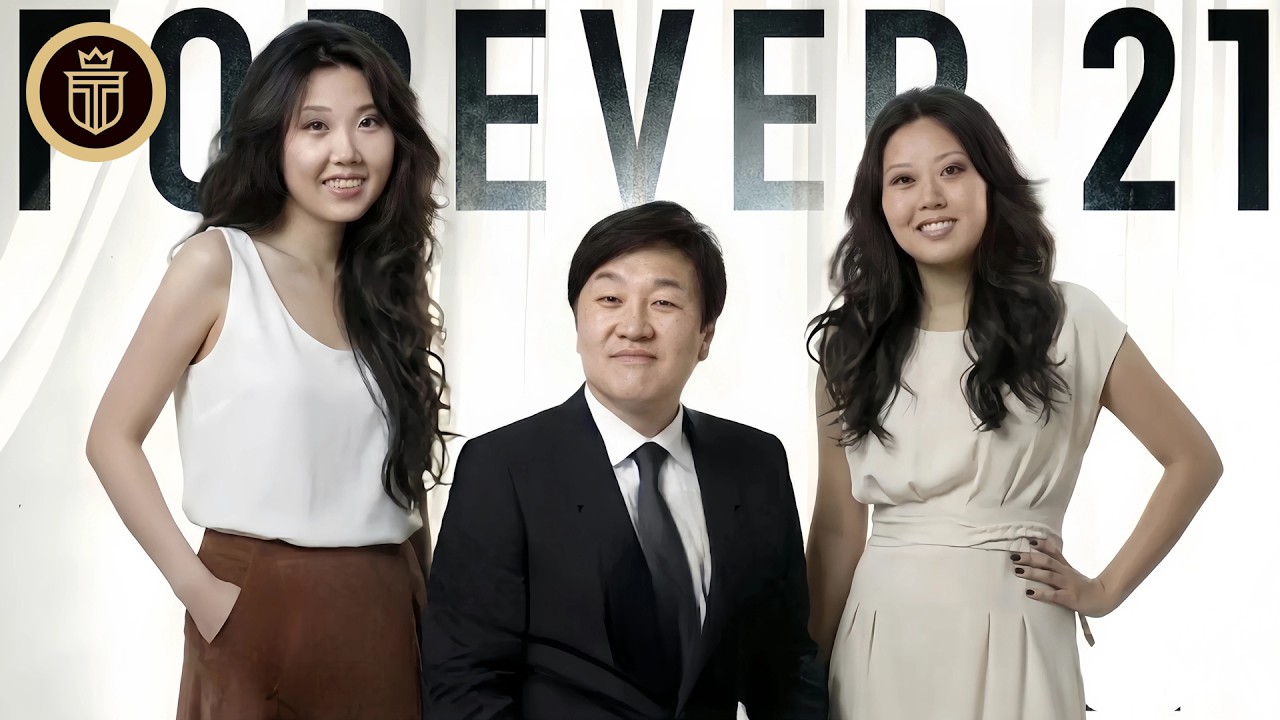
The Changs’ daughters, Linda and Esther, were positioned as the next generation of leadership. Linda earned an Ivy League undergraduate degree and assumed the role of executive vice president by age 32. Esther earned an Ivy League degree and became VP of merchandising by age 30.
On paper, the succession plan appeared robust. In practice, Do Won never relinquished decision-making authority. All strategic decisions still required his personal approval. The daughters were positioned as successors but operated as subordinates.
In 2015, as financial troubles mounted, Do Won and Jin Sook borrowed $5 million each from their daughters’ personal trusts at only 2% interest. The loan was unsecured, meaning creditors would take priority over Linda and Esther in any bankruptcy.
In 2019, Ariana Grande sued Forever 21 for $10 million after the company hired a lookalike model to mimic her aesthetic. Eric Gordon, a professor at the University of Michigan’s Ross School of Business, identified the core problem: hubris is common among founders, but it can be particularly detrimental if you’ve enjoyed prolonged success. They lacked a board of directors to provide reality checks.
The international expansion was accelerating the collapse. Forever 21’s international footprint exploded from seven stores in 2005 to 262 stores across 40 countries by 2015. International operations lost an average of $100 million annually between 2014 and 2018.
German stores opened without anyone realizing German retailers close on Sundays, eliminating one-seventh of potential revenue. European wage standards ran three to five times higher than US levels, making retail operations structurally unprofitable at Forever 21’s price points.
Digital strategy proved equally disastrous. E-commerce generated only 16% of Forever 21 sales in 2018 compared to industry leaders commanding 30 to 40%. Online inventory was invisible in physical stores.
H&M prided itself on bringing new designs to market in 7 weeks. Forever 21’s supply chain took 20 weeks from concept to store delivery. In fast fashion, a 13-week lag is fatal.
McKinsey was hired in 2015 and recommended complete overhaul of inventory systems and mobile investment. Forever 21 implemented 15% of the recommendations. Bain recommended halting European expansion in 2014. Forever 21 opened 23 new European stores over the following two years.
The Changs paid millions for expert advice they refused to follow.
Store formats had become crushing liabilities. Seventy locations exceeded 35,000 square feet, with combined annual occupancy costs approaching $450 million. Six leases signed for former Mervyn’s locations would not expire until 2027 and 2028, locking the company into oversized spaces as mall traffic collapsed.

Gen Z preferences were shifting fundamentally. The clean beauty movement made Forever 21’s formulations look toxic to younger buyers. Kylie Cosmetics and digitally native brands sold community and authenticity. Forever 21 sold $5 tops that fell apart after three washes.
On September 30th, 2019, the company filed for Chapter 11 bankruptcy, citing $1.58 billion in debt and announcing plans to close stores in 40 countries. The restructuring would only delay the final collapse by six years.
In February 2020, a consortium of Authentic Brands Group, Simon Property Group, and Brookfield Property Partners acquired Forever 21’s operating company for $81 million. The price represented a 98.2% discount from the $4.4 billion implied valuation at peak.
The Changs’ 99% stake had been worth approximately $5.8 billion in 2015. In 2020, that same stake was worth approximately $80 million. The restructuring marked the permanent end of family control. Do Won and Jin Sook were forced to cede operational authority, retaining no board seats, no operational roles, and no voting rights.
The daughters’ $10 million loan was classified as unsecured debt. They recovered approximately 18 cents per dollar, losing $8.2 million.
Despite five years of restructuring under new ownership, Forever 21 never recovered. In 2023, Shein acquired a one-third stake in the parent company. Pop-ups were installed in select Forever 21 stores. Forever 21 merchandise was listed on Shein’s marketplace. The partnership failed across every dimension.
More than 11% of invoices were over 91 days late by November 2024. Manufacturers in China, Vietnam, and South Korea received payment delays of 60 to 90 days, forcing some to halt shipments entirely.
Store closing sales commenced February 14th, 2025. The official bankruptcy filing came March 16th. All 354 US stores closed by April 30th. The Los Angeles corporate headquarters was permanently shuttered with 358 employees laid off.
The Chang family’s fortune had evaporated. $5.9 billion in 2015. $1.6 billion in 2019. Billionaire status lost entirely in 2020. $500 to $800 million by 2025, primarily the Beverly Hills mansion.
Do Won Chang noticed something at a gas station in 1981. He built an empire on that observation. He lost that empire because he stopped noticing anything that contradicted what he already believed.
The yellow shopping bags are gone now. The Bible verses printed on the bottom live only in memory. The stores that once occupied entire wings of American malls stand empty, waiting for the next tenant.