On the night of Christmas Eve in 1909, a seventy-four-year-old man with wild white hair stood in the doorway of a large, empty house in Connecticut. His youngest daughter lay in a coffin that servants had placed in the library near the piano. Snow fell outside the tall windows. Hours earlier she had been wrapping Christmas gifts, laughing, making plans for the holiday.
Now she was gone at twenty-nine, and she was the last of his children to go. He did not weep the way other men weep. He stood very still and said quietly that this was the bitterest of all his losses. Then he went upstairs and did the only thing he had ever known how to do with pain.
He wrote. This was the man the world knew as Mark Twain, the funniest man in America, creator of Tom Sawyer and Huckleberry Finn, the white-suited humorist who could make a hall of a thousand strangers weep with laughter. Behind those jokes, for forty years, he had been quietly becoming the most bereaved father in America. His name was Samuel Langhorne Clemens.
He was born in November 1835 in a small Missouri village, a sickly premature child no one expected to survive his first winter. Two weeks before his birth, Halley’s Comet had blazed across the sky, a fireball that returns only once in roughly seventy-five years. From the beginning, part of him believed he would leave the same way he arrived. Death had been his companion from the start.
He saw his father die when he was eleven. He lost siblings in childhood. His younger brother Henry was killed in a steamboat boiler explosion, a disaster Samuel had foreseen in a vivid dream days before it happened. He blamed himself for Henry’s death for the rest of his life, convinced that he could have prevented it.
This was the pattern of his entire existence. Again and again, he believed the deaths around him were somehow his fault. If only he had been wiser, more careful, more present, the people he loved would still be alive. By his thirties, the riverboat pilot and failed silver prospector had transformed himself into a literary phenomenon.
He took the pen name Mark Twain, the river call meaning the water is safe to cross. Under that name he became the most cheerful voice in America. Then he fell in love with Olivia Langdon, called Livy, a refined, frail, deeply religious woman from a wealthy New York family. They married in 1870.
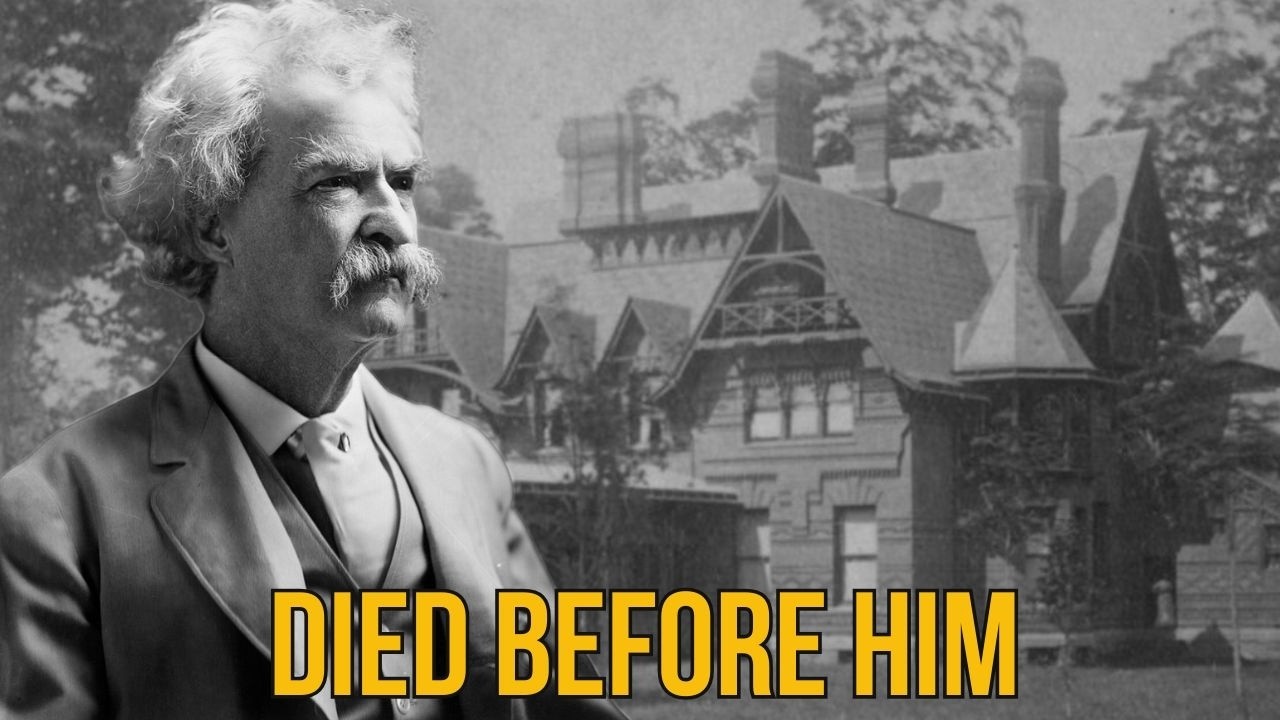
They built a remarkable home in Hartford, Connecticut, a vast red-brick mansion with nineteen rooms, a greenhouse, and a billiard room on the top floor where Twain wrote and smoked endless cigars. For a time, he had everything a man could want. He was wealthy, world-famous, married to the woman he adored, surrounded by daughters who found him the most enchanting creature on earth. Four children came.
A son, Langdon, born in 1870, weak and premature and fragile. Then three daughters: Susy in 1872, brilliant and sensitive, the one her father loved with fierce devotion; Clara in 1874, strong and determined; and little Jean in 1880. Twain was, by every account, a wonderful father in those golden years. He invented elaborate stories on demand.
He staged plays with the girls in the library. Susy, as a teenager, secretly began writing a biography of her father, a small book full of admiration and humor. When he discovered it, it became one of the treasures of his life. The first crack appeared in a horse-drawn carriage in cold weather.
In the spring of 1872, Twain took his infant son Langdon for a ride. The boy was about nineteen months old, still fragile, wrapped in furs and blankets against the cold. Twain, lost in thought, did not notice that the blanket had slipped, leaving the boy exposed to the freezing air. The infant caught a chill.
His health, never strong, deteriorated. He contracted diphtheria, the brutal child-killer of the nineteenth century. On June 2, 1872, the little boy died. Medically, the carriage ride almost certainly did not kill him.
Diphtheria is a bacterial disease, not caused by a chill, and the fragile child may well have died regardless. But medicine had nothing to do with what happened inside his father. Twain believed immediately and absolutely, for the rest of his life, that he had killed his son, that his inattention and distraction had allowed the cold in and ended the boy’s life. He would not be persuaded otherwise.
He added his child to the ledger of deaths he was certain he had caused. Life continued. There were three daughters to raise. For more than twenty years, the Clemens family climbed back into the sunlight.
But two slow catastrophes were forming. The first was money. Twain, despite his genius, was a disastrous businessman. He poured his fortune into a mechanical typesetting machine called the Paige Compositor, a marvel of engineering with thousands of moving parts that never worked reliably.
He invested tens of thousands of dollars, then more, feeding it like a furnace. By the mid-1890s, he was effectively bankrupt, drowning in debt, and the beloved Hartford house was beyond their means. The second catastrophe was quieter. Jean, the bright warm youngest child, began suffering strange seizures.
She was later diagnosed with epilepsy, a condition poorly understood in the nineteenth century, carrying a terrible social stigma and no real treatment. In 1895, at fifty-nine, Twain embarked on a grueling worldwide lecture tour to repay every creditor in full, dollar for dollar. He traveled across America, then to Australia, New Zealand, India, South Africa, and England, standing on stage night after night to be funny. Livy went with him.
Clara went too. But Susy, twenty-three and fragile, stayed behind in America with her aunt and with Jean. The family was scattered across the earth to pay for a machine that never worked. By the summer of 1896, the tour had nearly succeeded.
Plans were made for reunion. Susy and Jean were to sail to England to join their parents. Susy never boarded the ship. In late summer 1896, she fell suddenly and violently ill with spinal meningitis, a vicious infection of the brain and spine.
She was taken to the only place she still felt safe, the big empty Hartford house, now closed and unoccupied, the family’s belongings in storage, the silence echoing through its rooms. There she lay dying in fever and blindness while her parents were thousands of miles away across the ocean, unreachable. By the time urgent telegrams reached England, by the time Livy and Clara boarded a ship home, it was too late. Twain, unable to secure a berth, remained alone in England waiting for news.
The telegram arrived: Susy, the daughter he loved more than anyone in the world, was dead at twenty-four. She died alone in the empty Hartford house while her father was an ocean away, exactly as his infant son had died while he blamed himself. The pattern had closed its jaws again, and this time it had taken the person he loved most. The death of Susy did not break Mark Twain.
It did something worse. It hollowed him out from the inside. He still told jokes. He still wore the white suit.
But the man inside would never be the same. He could not come home for the funeral. He sat alone in that rented house in England and wrote: that one can lose the thing he loves most and keep living, and that this is the strange horror of it. The heart does not have the decency to stop.
Livy returned to an empty house and a dead daughter, and something in her began to crumble. The couple sold the beloved Hartford house. They could not bear to live where Susy died. They wandered through Europe, from rented home to rented home, carrying their grief across the continent.
Jean’s epilepsy was growing worse. The treatments of that era were useless and often cruel. She was sent repeatedly to sanatoriums, exiled from the family for long stretches in the name of a cure that did not exist. Clara, strong-willed, became by grim necessity the daughter who had to hold the ruins together.
In June 1903, the family made a final desperate move for Livy’s failing heart. Doctors recommended the mild air of Italy. They went to a villa outside Florence. Livy declined through the winter and into the spring.
She was so fragile that Twain, who had adored her for more than three decades, was often allowed to see her only a few minutes at a time, for fear that strong emotion would strain her heart. On June 5, 1904, Olivia Langdon Clemens died. The family was now a father and two daughters, one of them severely ill. They brought Livy home to be buried in Elmira, New York, in the family plot where Langdon already lay, and where Susy already lay.
Twain stood at that grave and buried his wife beside two of their children. He was sixty-eight years old. After Livy’s death, the remaining family tried to piece itself back together. Clara collapsed from years of managing everyone’s grief and illness.
Jean’s epilepsy continued unchecked, terrifying and uncontrollable. Twain settled finally in a new house he built in Redding, Connecticut, called Stormfield. For a time, Jean’s condition seemed stable enough for her to come home and live with her father. She managed the household, handled his correspondence, cared for the animals she loved.
For the first time in years, father and youngest daughter were together, building a quiet ordinary life. He allowed himself to hope. He allowed himself to believe that Jean, at least, would stay with him. That was December 1909.
Jean was twenty-nine, at home at Stormfield, happily preparing for Christmas. She bought gifts and wrapped them. The house was decorated. The Christmas tree was ready.
On the morning of December 24, Christmas Eve, Jean drew a bath. A seizure struck while she was alone in the water. She lost consciousness and sank beneath the surface. By the time she was found, she was dead.
The last of Mark Twain’s children had drowned in a few inches of bathwater on Christmas Eve in the house where she had just finished wrapping her father’s gifts. He was upstairs when they told him. He came down and stood at the doorway and looked at the body of his youngest, the last one he had allowed himself to believe he would keep. Langdon in the carriage, Susy in the empty house, Livy in Florence, and now Jean on the bathroom floor on Christmas Eve.
Three of his four children. He had outlived his wife, his brother, and nearly everyone he had ever loved. He could not even attend her funeral. His health was failing, his heart giving out, and the doctors would not allow the winter journey to the grave in Elmira.
He went upstairs in the empty, snow-silent house and wrote alone through Christmas, a piece about Jean’s death so honest and so moving it breaks the heart of anyone who reads it. He wrote that the cloud had lifted from his life and he was left in the dark. He wrote that he would never write anything after this, and he was almost exactly right. He was seventy-four.
He had angina, crushing chest pains. His only surviving daughter, Clara, had married a pianist named Ossip Gabrilowitsch weeks before Jean’s death and departed for Europe. The great house at Stormfield, built to be a refuge for his old age, had become the emptiest place on earth. In his final months, his mind turned more and more toward the comet.
He had been born in 1835, two weeks after Halley’s Comet appeared. He had known this all his life and made it a kind of personal prophecy. Halley’s Comet returns roughly every seventy-five years, and it was due again in 1910. He had said more than once that he came in with the comet and expected to go out with it.
He joked that the Creator had said, here are these two unaccountable freaks, they came together, they must go together. His greatest disappointment in life, he said, would be if he did not die with Halley’s Comet. By April 1910, he was too weak to survive. A friend brought him by ship to Stormfield to die in his own bed.
Clara hurried across the Atlantic to be at her father’s side. Mark Twain, who blamed himself for the lonely deaths of his son and his beloved daughter Susy, did not die alone. Clara was there. Halley’s Comet reached its peak brightness on April 20, 1910.
On April 21, 1910, Samuel Langhorne Clemens, known as Mark Twain, died of heart failure at Stormfield at the age of seventy-four. He had come in with the comet and gone out with it, just as he had promised. The nation mourned on a scale few private citizens had ever received. Thousands lined up to view his body in New York.
He was carried to Elmira and laid to rest in the family plot on the hill, beside Livy, beside Susy, beside Jean, beside little Langdon who had waited there since 1872. The family that had been scattered across oceans and decades and disasters was finally reunited in the only place left to them: the earth. He spent the last fourteen years of his life in almost unbroken mourning, burying those he loved one after another. Susy in 1896, Livy in 1904, Jean in 1909, himself in 1910.
Four coffins in fourteen years, added to the son he buried in 1872. The funniest man in America had also been one of the most grief-stricken fathers in American history. He made the jokes from the grief. Every laugh he gave the world was paid for with the currency of his dead.
The white suit was always hiding something. Clara, the strong one, the survivor, carried his legacy alone. She lived until 1962, fifty-two years after her father’s death. For decades she guarded his memory.
She suppressed some of his darkest writings, including Letters from the Earth, a bitter and furious attack on religion and on the cruelty of a universe that took his children one by one. She could not bear for the world to see her father as the angry, grieving, God-haunted man he had become. The book was not published until 1962, the same year Clara died. Only when the last guardian of the laughing legend was gone could the grieving Twain finally speak.
The manuscript came out, and readers met a Mark Twain they had never known: not the brilliant humorist, but a father screaming at the sky over the graves of his children. Clara’s only child, Nina, lived a troubled life and died in 1966 without children. The direct line of Mark Twain simply ended. The family that once filled the Hartford house with light had, over ninety years, shrunk to a row of graves on an Elmira hill, and then to nothing at all.
What remained was the work, and finally the full truth behind it. The laughter and the graves beneath the laughter, both together, exactly as he lived them.