On a hot summer day, the visitor crosses a pedestrian bridge over the James River and steps onto Belle Isle in Richmond, Virginia. It is difficult now to imagine the island as it was during the American Civil War, when it held thousands of Union prisoners in conditions nearly as brutal as those at the infamous Andersonville camp. Green grass, pathways, and a crumbling 1993 environmental education center cover much of the ground. Beneath the modern surface, however, lie the faint outlines of earthworks and the memory of a place where thousands of United States soldiers suffered and died.
Belle Isle was originally fortified to protect the river approaches to Richmond, with large guns placed on earthen mounds to guard the Confederate capital. As the war ground on, the island was converted into a prisoner-of-war camp, designed to hold around three thousand men. Yet at any given time, it was packed with many more, with estimates ranging from fifteen hundred to eight thousand prisoners on the island at once. Over the course of the war, the numbers fluctuated wildly depending on the source, but by the time of the Confederate surrender, approximately twenty thousand Union soldiers had passed through Belle Isle.
The death toll stood in the thousands. The prisoners were mostly enlisted men, not officers. They were housed in tents, exposed to the blistering heat of Virginia summers and the bitter cold of winters made worse by the wind cutting across the river. The trees on the island had been torn down, leaving the men no shelter from the elements.
They slept in mildew-molded tents, wore ragged wet clothes, and suffered from a lack of food. The Confederate army itself struggled to feed its own soldiers, and the prisoners bore the consequences of that shortage. Every day, they could look across the water and see the city of Richmond, including the government buildings where Confederate officials came and went. Some citizens, particularly southern women, crossed the river to bring care packages and attempt to help the suffering soldiers, though this part of the story is rarely told.
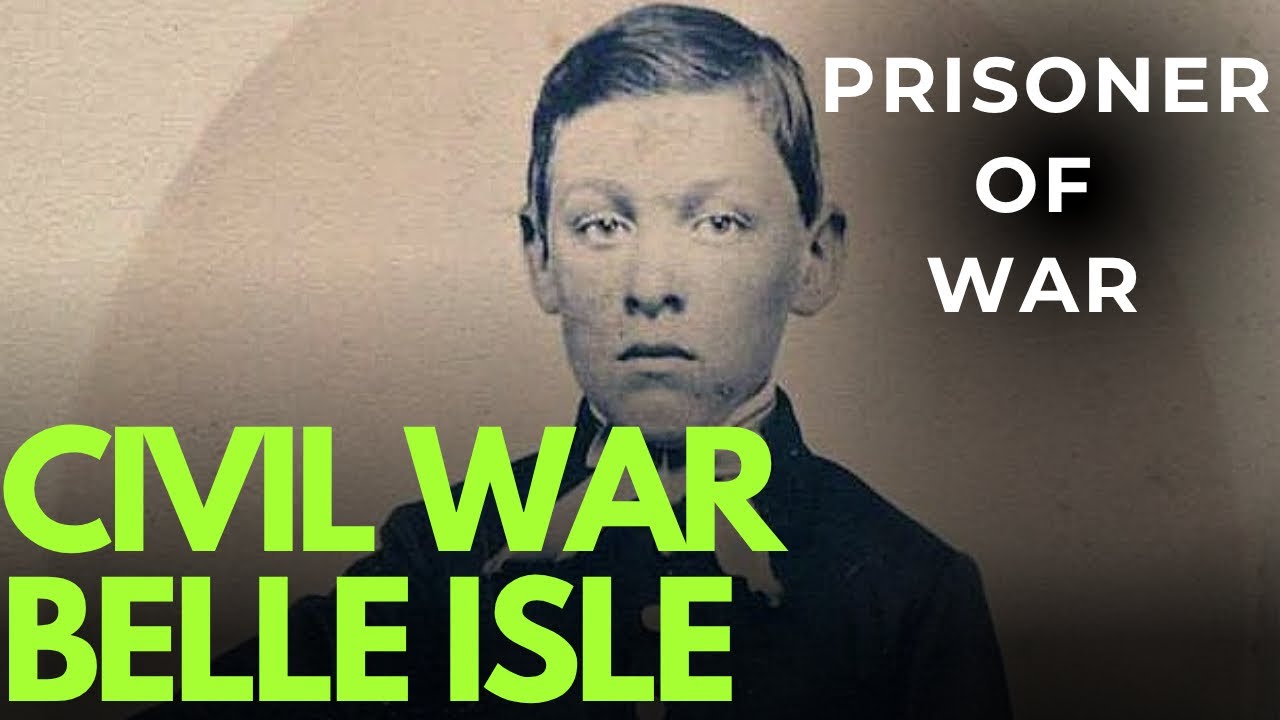
Among the thousands who found themselves trapped on Belle Isle was a young drummer boy from Connecticut named Lucian Wells. In July 1862, he enlisted in the Union Army. Soon after, he was present at the Battle of Antietam. His mother, deeply worried about her son, wrote to him around the time the battle commenced, assuring him that she had not forgotten him.
She thought of his long weary marches and his lodgings on the ground, and prayed that the dreadful war would soon end. After the battle, Lucian wrote back to her, describing his experience bringing off the wounded while balls flew thick and fast. One bullet had passed through his hat, the closest he came to being hit. His mother continued to write, constantly asking after his health and well-being.
In January 1863, she pleaded with him, if he loved her, not to expose his life unnecessarily. It remains unclear whether the young boy had proper consent from his parents to serve, but he remained with the 14th Connecticut and continued to see the war’s worst fighting. By July 1863, Lucian was at Gettysburg. He wrote home in graphic detail about the actions of the 14th Connecticut on the third of July.
The regiment was ordered to charge a barn occupied by Confederate sharpshooters. They succeeded in reaching the barn, but then a brigadier ordered the 14th to advance on a house held by enemy sharpshooters. It was there that the regiment was cut down. Lucian witnessed the destruction of his unit in those desperate final moments of the battle.
His luck ran out on October 13, 1863, at the Battle of Bristoe Station, where he was captured and sent to Belle Isle. In one of his final letters home, he wrote that he would like to be paroled so he could come home to see his mother once more. It was not to be. In the spring of 1864, Lucian came down with a severe case of diarrhea and died soon after.
His last words to his family expressed his fear that he would never see home again, a fear confirmed by a man named Patrick Carroll, who later wrote to Lucian’s grief-stricken mother in May 1865. Belle Isle’s history did not end with the war. After the conflict, the island became a manufacturing and industrial center, and brick ruins from that era still dot the landscape. Later, the island was transformed again, this time into a public park.
Today, visitors walk paths over the old earthworks, ride dirt bikes over mounds of dirt that were once fortifications, and skateboard in a park built on ground where prisoners starved and died. Much of the Civil War history on the island has been lost. There is very little signage explaining what happened there, and much of the original fortifications have been covered by grass or damaged by modern use. From the river, however, the remnants of the war era remain visible.
Beneath the Manchester Bridge, built in the 1970s, stand the pylons of an older bridge from 1865. That bridge was the same one that likely carried Jefferson Davis into Richmond when he arrived to become the only president of the Confederate States. It was also part of the evacuation route used when the Confederacy collapsed. Across the water, the Richmond Railway Bridge and the Richmond and Petersburg Railway Bridge can still be seen, the latter serving as a major Confederate supply route throughout the war.
Belle Isle raises a painful question about how history is remembered. The island is now a place of recreation, a habitat for deer, and a spot for sightseers, while the men who died there are largely unrepresented. The suffering of thousands of prisoners, including the young drummer boy who wrote home to his mother until his illness took him, is buried beneath grass, dirt bike paths, and a skate park. The landscape itself remains, transformed over the years from a bare, windswept island with earthen gun mounds into an industrial hub and then into a city park.
But the story of what happened at Belle Isle, and the soldiers who endured it, has all but slipped away with time.