She had been called the most beautiful woman alive, and she had spent her life trying to become unforgettable. By the time she was locked away, almost no one remembered her name. Gladys Deacon was born in Paris in 1881 to wealthy American parents, but her childhood ended when she was eleven at the Hotel Splendid on the French Riviera. There, her father, Edward Deacon, forced his way into his wife’s rooms and shot her lover, a Frenchman named Émile Abel, who died the next morning.
Edward was tried in Nice for a crime of passion, not murder, and served only a short sentence. The couple divorced, and the court gave custody of the three older children to the father who had done the shooting. Edward took Gladys to America, where his mind deteriorated. He was committed to an asylum in Massachusetts and died there in 1901.
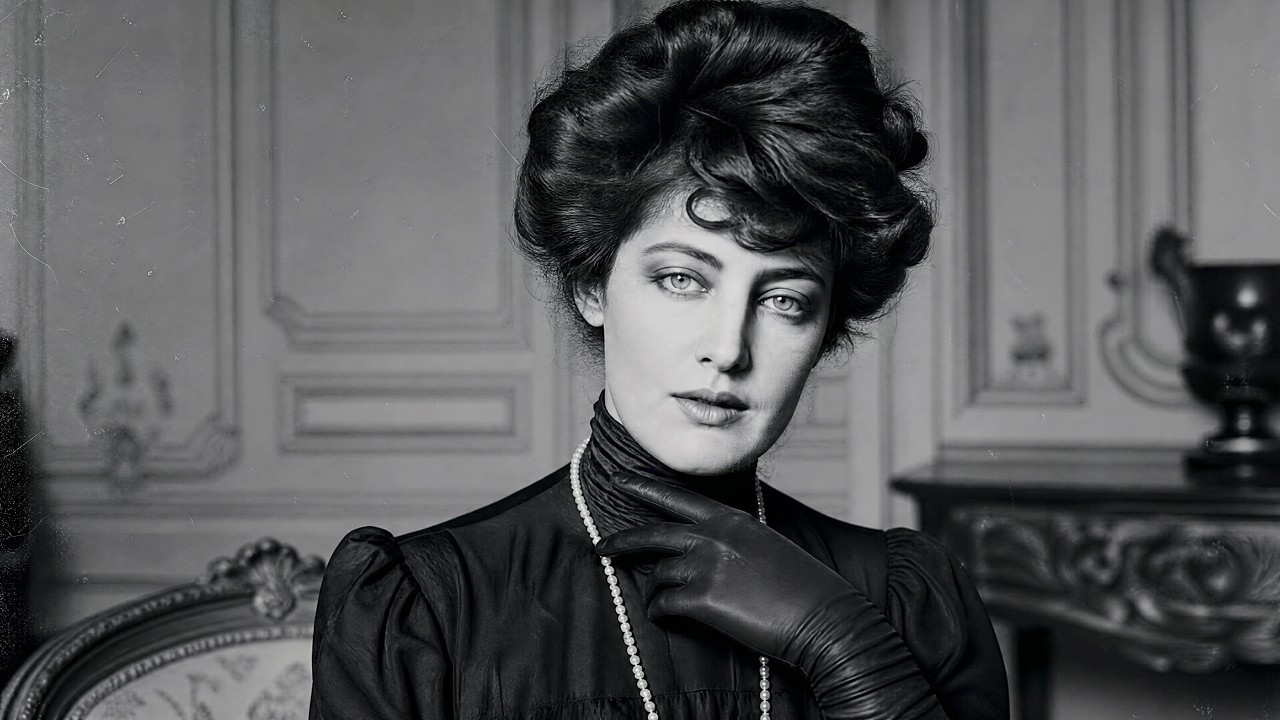
Before she was twenty, Gladys had learned two lessons that would rule her life: a woman’s beauty was a form of power men killed for and courts forgave, and madness ran in her own blood, patient and waiting. She returned to Europe and grew into one of the celebrated beauties of the Belle Époque. Her eyes were enormous, luminous blue shading toward turquoise, and contemporaries called her the Sphinx, the beautiful riddle no one could solve. She spoke several languages, moved easily among painters, writers, and philosophers, and commanded the salons of Paris as completely as any woman of her age.
Auguste Rodin befriended her and drew her. Claude Monet welcomed her. John Singer Sargent and Giovanni Boldini painted her. Marcel Proust wrote that he had never seen a girl with such beauty, such magnificent intelligence, such goodness and charm.
She was, by the testimony of dozens of witnesses, the most painted woman of her time. Her only capital was herself. At fourteen she had made a vow. She announced she would marry Charles Spencer-Churchill, the ninth Duke of Marlborough, known to his family as Sunny.
The Duke was master of Blenheim Palace and first cousin of Winston Churchill. When Gladys chose him, he was about to marry Consuelo Vanderbilt, an American railroad heiress whose fortune would rescue the crumbling palace. The teenage girl with a scandal for a surname and no great fortune looked at that immovable fact and decided to wait it out. She did not attack the marriage from outside.
She got inside it. In the late 1890s she was invited to Blenheim and made herself charming and beloved, becoming a genuine friend to Consuelo. She learned the house from within, its rhythms, its unhappiness, its cold and formal marriage that had been arranged for money and produced no love. She saw the crack in the wall early.
At about twenty-two, Gladys did something that would define the rest of her life. She had paraffin wax injected beneath the skin of her face to smooth a small dent above her nose that no one else could see. Paraffin injection was a fashionable early form of cosmetic surgery, offered by doctors and sought by women who wanted a flawless Grecian line without a scar. The problem was that wax is soft and the human body is warm.
Over months and years it migrated downward, hardening into lumps and ridges beneath the skin. What went in could not come out. The horror was slow. In the years just after the injection the damage was subtle, and she was still beautiful, still painted, still adored.
But she carried inside her own skin a slow-moving ruin creeping lower with every passing season. In the early years of the new century, the friendship with the household at Blenheim became something else. The Duke, cold and unhappy in his arranged match, fell under the spell of the brilliant young American his wife had welcomed as a friend. Gladys became his mistress, inside his own house, under the roof he shared with the woman she intended to replace.
In 1901 the Crown Prince of Prussia visited Blenheim and was so struck by her that he gave her a ring, and the Kaiser himself is said to have intervened and demanded it back. Bernard Berenson, the most powerful art authority in Europe, loved her and considered marriage. She refused him and refused every other safe offer. She had chosen the Duke at fourteen and would not settle for a lesser prize.
Consuelo Vanderbilt had not wanted the Duke. She had been forced into the marriage by her mother at seventeen and is said to have wept behind her veil. The settlement of about two and a half million dollars in railroad stock flowed into Blenheim and saved the palace. The marriage was doomed long before Gladys moved against it.
In 1906, after roughly eleven years and two sons, the Duke and Consuelo formally separated. But a separation was not a divorce, and they remained legally married for years while Gladys remained legally nothing. Then came the First World War, which swallowed Europe and froze every private life inside it. The world of salons and princes and golden afternoons was blown apart.
Gladys, no longer young, the wax settling ever lower in her face, waited through the catastrophe for a divorce the war pushed further out of reach. Between the separation of 1906 and the divorce that finally came in 1921, fifteen more years passed. Close to twenty-six years passed from the choosing to the winning. The divorce came in 1921.
She was forty years old. They married in Paris, the city where she was born. Gladys Deacon became the Duchess of Marlborough, mistress of Blenheim Palace, a member of the highest rank of the British aristocracy. The prize she had chased since girlhood was finally hers.
And almost at once it turned to ash. She had fallen in love not with the man but with what he represented, the coronet, the palace, the rank. The Duke himself was proud, conservative, cold, and dull, with none of the brilliance that had surrounded her whole life. She said it herself: she had married a house and not a man.
She called Blenheim an intellectual wilderness. She had spent twenty-six years to reach a place that bored her, married to a man who could not match her, in a country where she was a foreigner, with a face that was slowly coming apart. She marked the house with herself anyway. In 1928 she commissioned the painter Colin Gill to paint her own enormous blue-green eyes across the ceiling of the north portico of Blenheim, where they remain to this day.
In 1930 she had a pair of lead sphinxes installed on the water terraces with her own face. She could not make the marriage a home, so she filled the house with images of herself. The marriage curdled fast. The Duke converted to Roman Catholicism, and his religion and his coldness pulled him further from a wife who had lived among freethinkers and artists.
They had no children. She kept a loaded revolver by her bedside to keep her husband out. At a dinner around 1931 she is said to have sat with the gun beside her and told an alarmed guest she might just shoot Marlborough. She bred Blenheim spaniels by the dozen and penned them in the great hall, giving them their own parties and their own Christmas tree.
By then the paraffin wax had slid down her face and settled in hardened lumps along her jaw and chin. The disfigurement could not be hidden and could not be fixed. The woman who had built her power on being looked at ordered the mirrors removed from her rooms. She could no longer bear to see the ruin of the thing that had been her whole fortune.
The Churchill family began to call her mad. It was not an idle word, and Gladys knew it. She had grown up in the shadow of her father’s madness, watched him die confined in an asylum, and feared her whole life that the same fate lived in her blood. In 1933 the Duke fired her servants, packed his bags, and locked her out of Blenheim.
The house, the title, the money, the very right to be there all flowed from him, and when his will turned against her, the grandeur of her position offered no protection. Before any settlement could be reached, the Duke died in 1934. Gladys was not a divorced woman cast off with a settlement. She was a widow, a dowager duchess, holding a grand and empty title with no husband, no home, and no clear place in the world.
She had held the title in any real sense for about twelve years. She gathered her dogs and her paintings and her jewels and withdrew from the grand world that had first crowned and then discarded her. By the late 1930s she had settled at Grange Farm in the village of Stoke Bruerne. She called herself Mrs.
Spencer. She reversed the clock entirely, sleeping through daylight and moving about her house only at night. She surrounded herself with animals, and slowly the house filled and darkened and declined into squalor. She barricaded her doors.
The children of the village called her a witch. One loyal friend is said to have brought food in baskets that had to be hauled up on ropes to an upper window because Gladys would not open the door. She was never photographed again after about 1935. She simply removed herself from the visible world on her own terms.
On the fifteenth of March 1962, four men in white coats came to Grange Farm. Gladys was eighty-one. She resisted violently, but she was found in a state of severe neglect and removed to St. Andrew’s Hospital in Northampton, a private asylum where she would spend the last fifteen years of her life.
The daughter had followed the father into the locked ward at last. There the story might have ended in silence. That it did not is because of one improbable thing. In the last two years of her life, a young writer named Hugo Vickers, in his twenties and fascinated by the vanished glamour of the Edwardian age, learned she was still alive and went to see her.
Between 1975 and 1977 he visited her more than sixty times, and he drew out of her the memories of a world that had otherwise entirely died. She remembered Proust. She remembered Rodin. She remembered the salons, the princes, the painters.
She was very likely the last living link to that vanished court, and but for his persistence all of it would have died unrecorded. She still guarded fiercely the question that had haunted her life. She insisted there was a chasm between sanity and madness, and that madness was an inability to balance or impress. Vickers became a staunch defender of her lucidity.
Gladys Deacon died on the thirteenth of October 1977 at the age of ninety-six, in the asylum she had dreaded her whole life. Vickers published her biography in 1979 and issued an expanded version in 2020 under the title The Sphinx. She survives in the painted eyes on the portico and the lead sphinxes on the terraces, in the portraits by Boldini and Sargent and the bronze by Jacob Epstein. The face she could not bear to look at is one of the best-preserved faces of the Belle Époque.
She left behind a face on a ceiling, two sphinxes in a garden, portraits by the greatest artists of an age, one biography, one magazine article on the psychology of beauty, and a single deathless line from Proust. She won everything she aimed at and found it empty. The most brilliant woman of her generation left almost nothing that was truly her own, because her world offered her exactly one arena for her gifts: a marriage. She believed it, she spent twenty-six years proving it, and it destroyed her.
The wax was the shape of her existence written small in her own flesh. Everything she built on the surface eventually slid out of place and hardened into something she could not bear to look at. Then it slipped, and everything she built fell away, and only the eyes remained, still looking down from the ceiling of the palace that once locked her out.