In 1982, Paul Newman was arguing about a salad dressing label. The objection was not the recipe. It was the picture. For nearly three decades, studios, magazines, and strangers had treated his face as public property, especially the blue eyes he could neither take credit for nor escape.
Now a food company wanted to put that face on a bottle. Newman’s first response, later remembered by his foundation, was disbelief. Stick my face on the label. Yet the joke contained an old irritation.
He had spent years asking how much of his success belonged to his work, and how much to an appearance he had done nothing to earn. This time, the unwanted asset suggested a different use. If the face could sell dressing, he and his friend A. E.
Hotchner could give the profits away. Celebrity could sell the bottle. The money could move away from the celebrity. What began as a lark became one of the strangest and most practical answers Newman ever found to a lifelong question.
That question had followed him long before the supermarket shelf. What in a life crowded with luck, beauty, talent, mistakes, discipline, and accident could he honestly call his own? Newman was born in Ohio in January 1925 and grew up in Shaker Heights outside Cleveland. His father Arthur ran a successful sporting goods business.
Newman remembered him less for warmth than for standards, a merchant whose reputation for paying debts and keeping his word mattered even during the Depression. As a boy and teenager, he worked in the store, learning the ordinary mechanics of retail. Years later, when jars and bottles carried his face, he could joke that life had brought him back to merchandising. Home was more complicated than the later image of the all-American movie star suggested.
His father was Jewish. His mother, Teresa, had theatrical interests of her own. Paul grew up between practical expectations and performance, between the store and the stage. He possessed the looks strangers would discuss endlessly, but he did not experience them as stable confidence.
The memoir assembled from interviews he gave in the late 1980s and early 1990s is striking for how little triumph he attached to his appearance. He remembered insecurity far more readily than entitlement. That memoir matters because Newman had spent much of his public life resisting confession. Beginning in 1986, he sat for long interviews with his friend, screenwriter Stewart Stern, and asked family members, Navy friends, actors, directors, and others to speak as well.
The transcripts were thought lost before being recovered and published decades later. They do not overturn the public record so much as roughen it. Newman was harder on himself than the legend had been. He described drinking, emotional distance, failures as a husband and father, and the peculiar uncertainty of being praised for features he could not regard as achievements.
Before fame came war. Newman enlisted in the United States Navy during the Second World War and hoped to become a pilot. Color blindness ended that plan. He trained instead as an aviation radioman and gunner, work that placed him in the rear of aircraft rather than at the controls.
It was an early lesson in having one imagined path closed by something beyond argument. He served in the Pacific. In the spring of 1945, his torpedo squadron was connected to the aircraft carrier Bunker Hill. Newman and his pilot did not reach the ship for a reason almost absurdly small beside what followed.
The pilot developed an ear problem and the crew was held back. Then Japanese kamikaze aircraft struck Bunker Hill off Okinawa. The attack killed hundreds and devastated the carrier’s air groups. Naval records later noted that the young radioman-gunner had just missed the battle because his pilot was unable to fly.
Chance would repeatedly stand beside effort in his story. He left the Navy in 1946 and entered Kenyon College under the GI Bill. At Kenyon, football initially seemed to matter as much as theater. Then a barroom fight changed the balance.
Newman was removed from the football team. The college stage became more central. He later joked that he had not been driven toward acting by a sacred calling. He had been running away from the sporting goods business.
The joke understates the work. Newman performed in a long series of Kenyon productions, from The Front Page to The Taming of the Shrew and Antigone. The professor remembered having trouble not casting him prominently. Newman remembered himself less generously, slow to learn, not naturally gifted, but persistent.
That distinction, gift versus work, would preoccupy him for the rest of his life. He graduated from Kenyon in 1949. That same year, he married Jacqueline Witte, whom he had met in summer stock. Their marriage began before he had money or fame.
In the early years, the couple moved through the uncertain geography familiar to young actors. When Arthur Newman died in 1950, Paul returned to Ohio with Jackie and their infant son, Scott, and tried to take his place in the family business. He could not make a life there. He eventually turned the business over to his brother.
Newman took his family to New Haven and entered Yale’s drama program in the fall of 1951. He stayed for one academic year, appeared in student productions, and withdrew before completing the three-year course. The archive does not pretend to know why. Later biographies can make every early move look inevitable.
Yale’s own record is more modest. Newman arrived, worked, and left. New York gave him the next step. Television was expanding.
Theater remained a serious proving ground. The Actors Studio had become a place where performers studied behavior rather than mere presentation. Library of Congress attendance sheets still show his penciled signature among the names passing through the studio in the mid-1950s: Paul Newman, Marilyn Monroe, Eva Marie Saint, Rod Steiger, Geraldine Page. Not finished monuments, but working actors signing in.
In 1953, Newman joined the Broadway production of Picnic. Joanne Woodward was also associated with the production, and their meeting became one of the decisive events of both their lives. She was a serious young actress from Georgia, quick, intellectually alert. Newman, meanwhile, was married and had children.
The later fifty-year marriage is often told backward, as if its durability erased the pain of its beginning. It did not. Newman’s first opportunity in Hollywood did little to settle his doubts. Warner Brothers put him in The Silver Chalice, released in 1954, a biblical spectacle he came to despise.
He would later mock his own acting in it with a severity few publicists would recommend. Failure arrived at a useful moment. He could not claim he had conquered Hollywood by force of certainty. He had made a bad film and knew it.
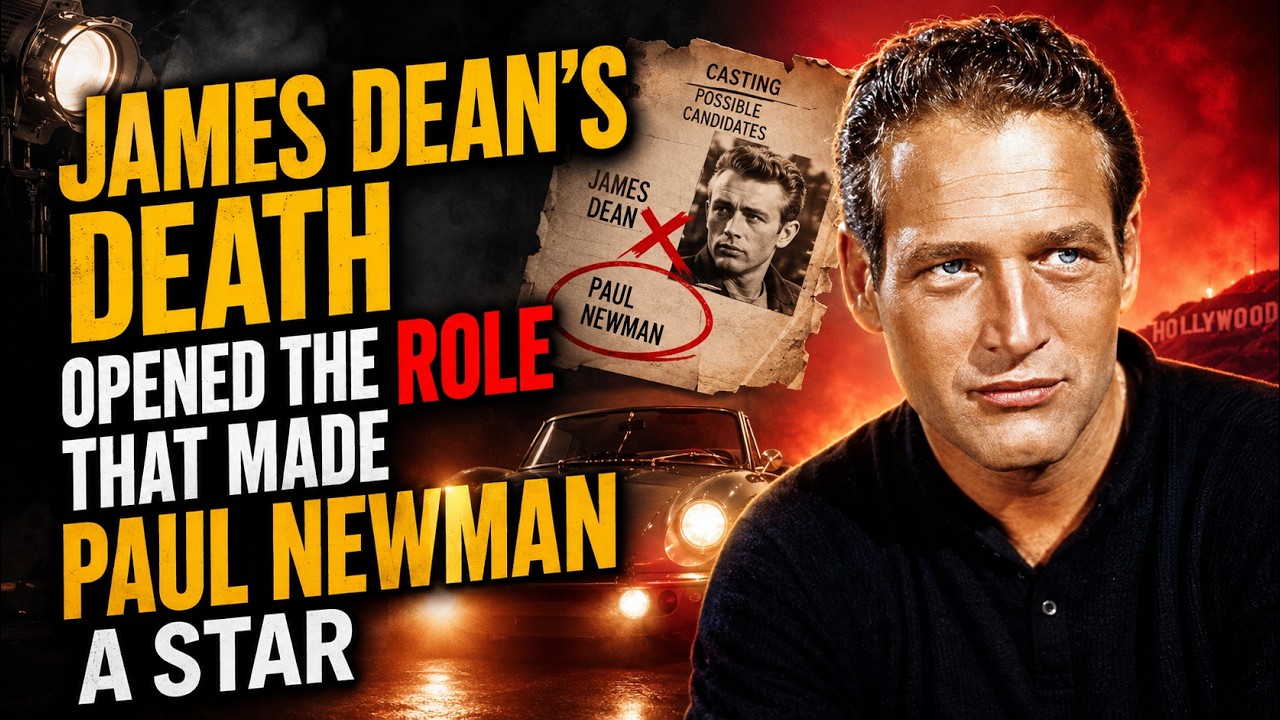
Then Chance intervened again. James Dean had been intended for the role of boxer Rocky Graziano in Somebody Up There Likes Me. Dean died in a car crash in 1955. MGM turned to Newman.
The film, released in 1956, was the success The Silver Chalice had not been. Suddenly the young actor who had embarrassed himself on screen had evidence that he could carry a picture. Yet even this breakthrough did not answer the question that would trouble him later. Was the opportunity earned or inherited through catastrophe?
By the middle of the 1950s, he had become a working film actor. The Rack gave him another demanding role. Television and stage experience had taught him how to build behavior in smaller increments, and the camera rewarded restraint. At the same time, his private life was becoming less defensible.
His relationship with Woodward deepened while Jackie remained his wife. By the time they divorced, they had three children: Scott, Susan, and Stephanie. In January 1958, Newman married Joanne Woodward. Less than two months later, she won the Academy Award for best actress for The Three Faces of Eve.
The woman beside the increasingly famous Paul Newman reached Hollywood’s highest acting honor before he did. That same year accelerated Newman’s own ascent. The Long, Hot Summer placed him opposite Woodward. Cat on a Hot Tin Roof with Elizabeth Taylor made his screen magnetism nearly impossible for the culture to ignore.
He received his first Academy Award nomination for best actor. The more successful he became, the harder it was to know whether people were responding to the actor, the star, or the face. Newman kept choosing roles in which charm was not enough, men whose attractiveness could not excuse their damage. The Hustler, released in 1961, made that strategy unmistakable.
Fast Eddie Felson was a gifted pool player whose talent is inseparable from arrogance and self-deception. Newman received another Academy Award nomination. Two years later, Hud pushed the contradiction further. Hud Bannon is handsome, amused, sexually confident, and morally corrosive.
Outside the movies, the culture was changing more quickly than any studio career. Newman supported civil rights and took part in the March on Washington in 1963. In archival footage, he dismissed the idea that professional status relieved anyone of citizenship. His phrasing was plain.
You can’t give up your citizenship because you’ve got a Screen Actor’s Guild card. During the 1960s, he campaigned, spoke, and involved himself in causes at a level unusual for a major star. The risk was not imaginary. Cool Hand Luke, released in 1967, gave him perhaps the purest version of the Newman rebel, a prisoner whose refusal to submit becomes both magnetic and destructive.
By then, his face had become one of the most recognizable in American movies. Recognition changed ordinary movement. Friends and biographers remembered the intrusion of admirers, the insistence that he remove dark glasses so strangers could inspect the famous blue eyes. One of the clearest examples of his taste began with a novel.
Margaret Laurence’s A Jest of God reached Woodward as a possible film project. She recognized the part of Rachel Cameron, a lonely, constrained school teacher, as something worth fighting for. Hollywood was not eager to finance it. Newman was one of the most bankable men in movies.
He could have attached himself in front of the camera and made the package easier to sell. He did the opposite. After initially doubting the material, he became increasingly involved and finally decided to direct it. He would produce Rachel, Rachel and remain off-screen.
The most marketable element in the household would not appear in the picture at all. Rachel, Rachel opened in 1968 and received four Academy Award nominations, including best picture and best actress for Woodward. Stewart Stern later remembered that Newman had been frightened by the possibility of failing, yet moved toward the challenge. Directing, Stern believed, gave him a rare chance not to have to be Paul Newman.
Then 1969 opened two very different doors at once. One led to the most famous screen friendship of Newman’s career. The other led away from the movie set and toward a stopwatch. Butch Cassidy and the Sundance Kid paired Newman with Robert Redford and turned male friendship, wit, danger, and charm into enormous popular success.
That same year, Newman starred in Winning, a racing drama. What began as professional training turned into a passion strong enough to create a second career. Racing offered a different measurement. A camera could adore a face.
A stopwatch could not. For a man who kept asking what success was truly attributable to him, the appeal was obvious. Newman did not approach racing as a celebrity hobby. He trained, competed, made mistakes, and kept returning.
Woodward had reason to dislike the danger, even when she respected the seriousness with which he pursued it. Careers built on travel and production schedules consumed time. Six children do not experience absence as an abstract consequence of professional obligation. Newman’s later reflections on fatherhood are among the least self-congratulatory parts of his recovered memoir.
He did not pretend that providing materially was the same as being emotionally available. Drinking complicated matters further. He acknowledged periods when it came dangerously close to damaging what he had. In November 1978, Scott died at the age of 28 from an accidental overdose involving drugs and alcohol.
The event exposed the limit of every resource Newman possessed. Money, access, discipline, charm, and public influence could not recover a son. The family later supported drug education in Scott’s name. Newman spoke about the death only with restraint, and the recovered memoir shows how deeply he carried questions of responsibility.
He could not make a clean, causal story out of Scott’s life. In racing, Newman reached a level that made the word hobby ridiculous. In 1979, he entered the 24 Hours of Le Mans with Dick Barbour and Ralph Sturmelen in a Porsche. Their car finished second overall and first in its class.
For a 54-year-old movie star, it was an extraordinary competitive result. Nobody could nominate him because he looked right for the car. The finish existed on a timing sheet. The verdict, released in 1982, gave him Frank Galvin, a lawyer damaged by alcohol and professional defeat who receives one last chance to act with integrity.
The performance brought Newman another Academy Award nomination. The role arrived in the same year as the salad dressing. On the surface, the two events could hardly be less alike. Yet both involved the same mature question.
What should a man do with the advantages he still possessed? Newman and Hotchner had been making dressing as gifts. Friends wanted more. A commercial possibility appeared.
The company’s founding principle was radical because it was simple. After expenses, profits would be donated to charitable causes. Newman’s Own could exploit celebrity as aggressively as any commercial brand and then refuse the ordinary destination of the money. The more the face sold, the less Newman personally needed to gain from it.
He accepted a commercial version of the very recognition he had spent years trying to escape because he could redirect what that recognition produced. The first year made clear that the idea was not going away. The company earned substantial profits, and Newman insisted on giving them away. More products followed.
So did more grants. In a 1995 interview, he laughed at the return. The boy who had worked Saturdays in the store was now selling salad dressing. By the middle of the 1980s, Newman had accumulated a remarkable series of Academy Award nominations without a competitive win.
In 1986, the Academy gave him an honorary award. Martin Scorsese cast him again as Fast Eddie Felson in The Color of Money, released that year. At the Academy Awards held in 1987, Newman finally won his first competitive Oscar for best actor. He did not attend the ceremony.
By the late 1980s, he was building something that would give his philanthropy a physical place. Newman had become interested in creating a camp for children with serious illnesses, a place designed not around treatment as identity, but around ordinary mischief, friendship, adventure, and fun. The Hole in the Wall Gang Camp opened in Ashford, Connecticut in 1988. Its name was borrowed from Butch Cassidy and the Sundance Kid, but its purpose had little to do with film nostalgia.
Newman’s language for the place was characteristically irreverent. Children should be able to raise a little hell. In its first summer, the camp served 288 children. The camp transformed the logic of Newman’s Own.
Food profits now had somewhere concrete to go. A bottle sold in a supermarket could become part of a chain leading to a week of freedom for a family. The accidental asset became part of an intentional system. The network of camps inspired by the Connecticut model expanded internationally.
In 1994, Nobody’s Fool gave him one of his finest late roles. Sullivan is a small town handyman, irresponsible in some ways, stubborn in many, and finally confronted by the family consequences of choices made long before. In early 1995, Newman sat with GQ correspondent Peter Richmond and returned to the question that had followed him since youth. What was attributable to me?
He wondered how much of his career belonged to accomplishment, and how much to an appearance he had never controlled. The uncertainty remained because there was no control group, only the life he had actually lived. In 2005, he created Newman’s Own Foundation to help preserve the philanthropic structure. In 2006, he played Doc Hudson in Cars, a retired racing champion carrying an old wound beneath a quiet exterior.
He died on September 26, 2008, at his home near Westport, Connecticut, after cancer. He was 83. Woodward, his wife of 50 years, survived him, as did his daughters and the institutions that had become part of his later identity. After his death, the company remained tied to the promise that profits would serve charitable purposes rather than enrich the founder’s heirs.
By the foundation’s current account, Paul Newman and the organization that carries his name have given more than $600 million to good causes. The mechanism had survived the man whose face launched it. That is why the salad dressing label belongs near the center of the life rather than in a charming epilogue. Newman never proved that fame was earned in exact proportion to its rewards.
He found a more practical answer. If recognition had economic value, he could stop arguing with the value and redirect the result. The solution was not withdrawal from celebrity. It was conversion, helped by comedy.
On the label, the face that once made Newman doubt what belonged to him still looks outward from the shelf. The face had not disappeared. It had simply learned at last to point somewhere else.