On June 25, 1876, George Armstrong Custer led five companies of the Seventh Cavalry Regiment—roughly 210 men—onto the hills east of the Little Bighorn River. Most of his soldiers carried the Springfield Model 1873, a powerful and accurate single-shot carbine the United States Army believed was ideally suited for warfare in the American West. In less than an hour, every man with Custer was dead. Not a single survivor remained to describe the final minutes or reveal which weapon Custer held when the circle closed around him.
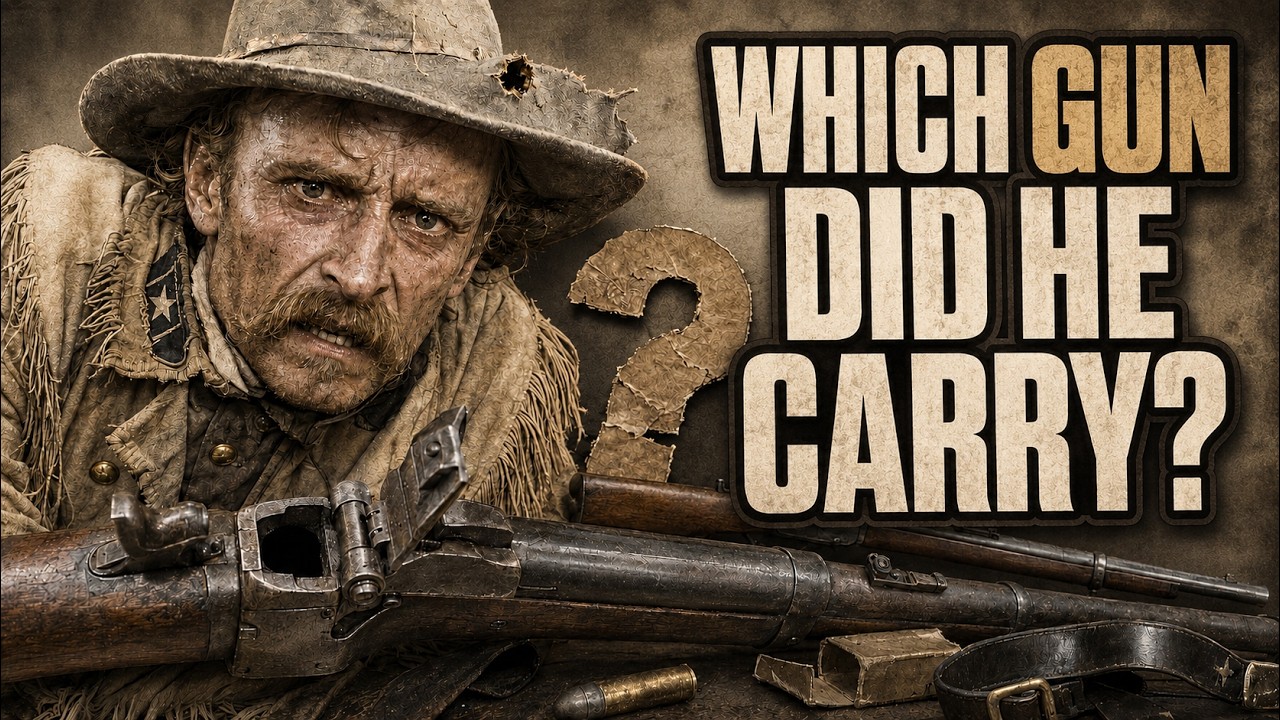
His famous Remington rolling block vanished. The two British revolvers believed to have belonged to him were never conclusively identified. The painting of Custer standing on a hilltop, firing a gun in each hand until his last bullet, was likely the creation of artists and the press rather than a record of what actually happened. The armed forces Custer led had not always been equipped the same way.
Thirteen years before Little Bighorn, at Gettysburg in 1863, Custer commanded men who carried weapons that were changing cavalry warfare. On July 3, Confederate cavalry under J. E. B.
Stuart advanced toward the Union rear, and the task of stopping them fell to a 23-year-old Custer, promoted to brigadier general only four days earlier. His Michigan Cavalry Brigade was not uniformly armed. The Spencer repeating carbines were concentrated mainly in the Fifth Michigan and part of the Sixth Michigan; the other regiments still carried a mixture of carbines, revolvers, and sabers. Even so, the Spencer was a remarkable weapon.
It held seven cartridges in a tube inside the stock, allowing a dismounted soldier to fire several shots before reloading. Against an enemy expecting the familiar pause after a volley, the quick succession of fire could break the momentum of a charge. But the Spencer also produced clouds of black powder smoke, and once its seven rounds were spent, reloading took time. Stuart’s cavalry continued to advance.
Custer chose to attack first. He appeared before the First Michigan, shouted “Come on, you Wolverines! ” and drove his horse into the charge. The two formations collided in a cloud of dust, and the fight devolved into close combat with revolvers and sabers.
Custer came through alive, and Gettysburg made him a hero. The victory reinforced a dangerous belief: that boldness and speed could compensate for any weakness. At Gettysburg, Custer had troops on both sides, a connected battle line, and friendly forces behind him. That belief traveled with him westward.
Five years later, on November 27, 1868, Custer attacked Black Kettle’s Cheyenne village on the Washita River before dawn. The Seventh Cavalry carried a layered system of weapons: Spencer carbines for distance, percussion revolvers for close quarters, and sabers for the final instant when there was no room left for a gun. The attack worked, and the village was destroyed. But the battle also revealed the limits of the method.
A detachment under Major Joel Elliot became separated and was surrounded, and its men were killed. Custer withdrew with the prisoners rather than turn back to search for them, a decision that saved the regiment but left a lasting fracture among his officers. It was a divided attack that succeeded only while every detachment remained under control. In 1874, the Seventh Cavalry began receiving the new Springfield Model 1873, the trapdoor carbine.
The replacement of the seven-shot Spencer with a single-shot weapon seems like a step backward, but the army had reasons rooted in logistics. After the Civil War, the arsenal contained a chaotic mixture of Spencer, Sharps, Burnside, Maynard, and Remington carbines, each using different ammunition. Supplying dozens of types of cartridges across hundreds of miles of open country invited disaster. The army wanted standardization: one ammunition type, one easy-to-teach action, one that could endure dust and hard riding.
The Springfield fired a heavier and more powerful 45-caliber cartridge that retained its energy at long range. Its weakness was the gap between shots. A soldier had to open the breech, remove the empty case, insert a new cartridge, and close the action. In close-range combat, that gap was long enough for a mounted warrior to cross dozens of yards.
The army also feared that soldiers with repeating firearms would exhaust their ammunition under stress, so the single-shot design forced careful fire. That assumption required a soldier who had time to aim and a formation that held together. Custer understood the trade-offs. During the 1873 Yellowstone campaign, he wrote to his wife about his personal sporting Springfield, describing shots at running antelope at roughly 200 and 280 yards.
He compared his rifle with the Winchesters carried by his brother Tom and other officers, rating the Winchester highly accurate at close range but preferring the Springfield at greater distances. Later that year, he praised a Remington rolling block sporting rifle in 50-70 caliber. Custer valued power, range, and accuracy, not merely speed. But his personal firearms did not always stay in his hands.
A soldier named Tuttle often carried Custer’s sporting Springfield. On August 11, 1873, during a clash along the Yellowstone River, Tuttle took up that same rifle on the riverbank and fired at Lakota warriors. Found in a protected position, he used the rifle’s long range until a bullet struck him in the head. The man who carried Custer’s gun died beside it.
The rifle was present in combat, but Custer never fired it. The archaeology of Little Bighorn tells its own story. In 1983, a major fire burned off the thick grass covering the battlefield. When the soil was exposed, thousands of cartridge cases, bullets, gun fragments, spurs, and unfired cartridges emerged.
Archaeologists marked the exact location of each artifact and mapped them. Under microscopes, they compared firing-pin impressions, breech-face marks, and extractor scratches, identifying cases consistent with having been fired from the same weapon. They identified roughly 47 different types of weapons used by Lakota and Cheyenne forces, from old muzzle-loaders to Civil War revolvers, Sharps rifles, Spencers, Henrys, and Winchesters. The battlefield had not been a neat, motionless circle.
The cartridge cases revealed that firearms moved across the landscape, that groups of soldiers were pushed back, that warriors advanced through ravines hidden from view, and that some positions collapsed before others. Unfired cartridges beside fallen soldiers showed that many men died before they could use the ammunition they still carried. The mismatch of speed was real, but it was not the whole cause. At close range, some of the native warriors carried Henrys and Winchesters that could fire several rounds in succession, and the Springfields’ rate of fire could not match them.
The fallback weapon was the Colt Single Action Army, which held six rounds in its cylinder. The cavalry sabers had been left behind during the 1876 campaign. The deeper problem was the way Custer’s command fractured before the battle began. Reno led three companies into the valley and was driven back.
Benteen was far south. The regiment was divided, and the detachments lost sight of one another. The pack train carrying most of the reserve ammunition stayed behind. Custer took five companies across the high ground east of the river, beyond sight of the other detachments.
The village below contained thousands of people and a far larger warrior force than he had expected. Kuster did not lose only because the Springfield fired slowly. He placed five companies on hills with dead zones in their fields of view, where warriors could approach through ravines. He depended on forces that could no longer see him.
The terrain, the numerical imbalance, and the collapse of coordination created the conditions no single firearm could save. Whether Custer had carried a Winchester or a repeating weapon of his own, the five companies still faced a massive encirclement. Repeating rifles consume ammunition faster, and the spare ammunition was left behind. They might have extended the fight and caused heavier casualties, but they could not have reconnected the separated companies or changed the size of the force ahead.
Near the end, Custer’s men were pushed toward the hill later called Last Stand Hill. Small groups and companies supporting the center had been broken earlier. Custer’s own body was found with a wound near the heart and a wound to the head, but no one knows which came first, or whether he was still alive or able to fight in the final minutes. His Remington rolling block disappeared.
The two British revolvers Godfrey described as “bulldogs” could not be identified as any specific model. The pearl-gripped Smith & Wessons he owned were not British, and there was no evidence they were on the battlefield. The Springfield was another possibility no one could prove. The final gun itself, the final caliber, and the final target all remain unknown.
What archaeology made clear was that the destruction was not one moment of glorious resistance. It was a sequence of collapses. Groups of soldiers became isolated, withdrew toward other positions, and were intercepted along the way. The evidence confirms that the troops fought hard and used the powerful Springfield effectively wherever a formation held, but the formation could not hold.
The bullet in each chamber was powerful; the problem was the time required between shots in a battle where warriors kept closing through ground the soldiers could not see. Even Custer’s own weapons, however well made, could not have corrected the distance between the companies, the ammunition train left behind, the misjudged size of the village, or the belief in speed that his previous victories had made him trust.