On October 15, 1948, in Grace Episcopal Church in Grand Rapids, Michigan, Elizabeth Ann Bloomer married Gerald Ford. She wore a sapphire blue dress. He arrived late, his shoes still caked with mud from a day spent working farmland in the district. The date of the wedding had been set not for sentimental reasons but for political ones, and Ford had refused to explain why before she agreed.
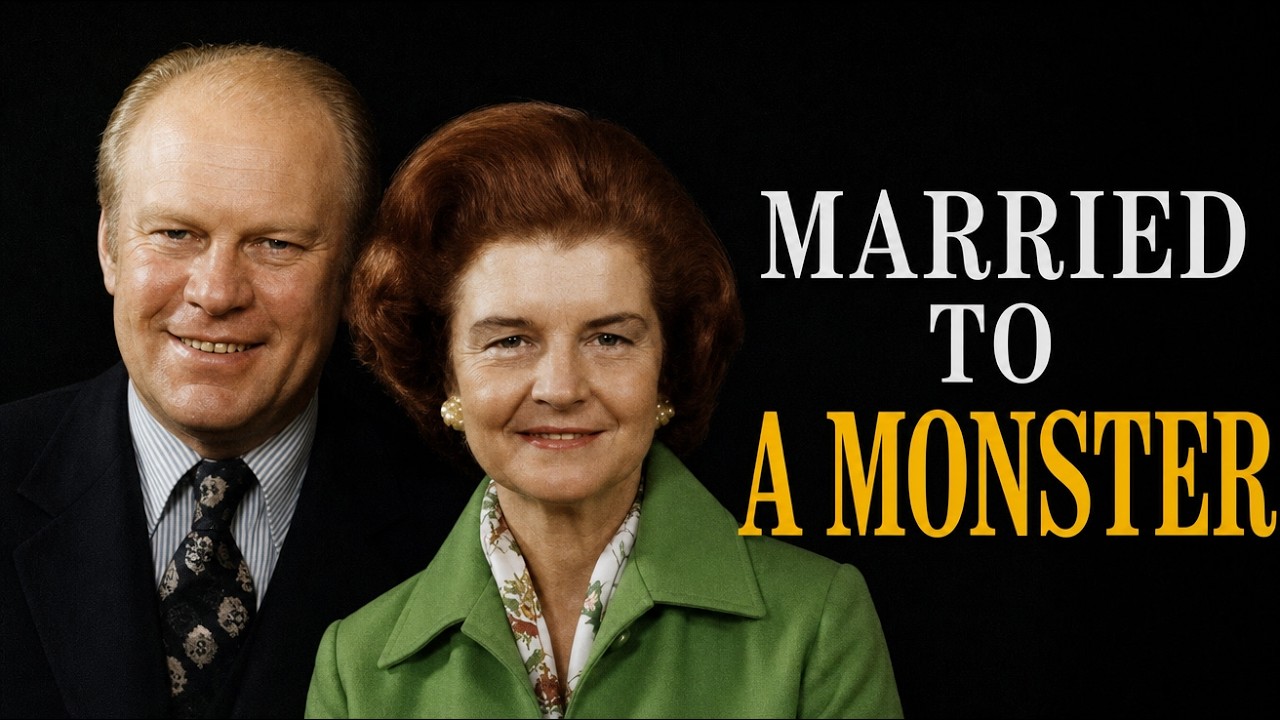
There were two reasons. He was secretly planning to challenge the sitting Republican congressman in the upcoming September primary, and he could not afford an early announcement. The second reason was her. She was a recently divorced former professional dancer from New York, a biography that was not an asset in western Michigan in 1948.
The wedding was scheduled for October 15, after the primary and shortly before the general election. Close enough to seem sincere, late enough to be safe. She said yes anyway. Understanding why requires knowing what she had survived.
Born in Chicago in April 1918, Elizabeth Bloomer was the third child and only daughter of a traveling salesman. In the summer of 1934, when she was sixteen, her father was found dead in the family garage. Carbon monoxide. The garage doors were open, a detail every account includes and none fully explains.
Decades later, she wrote that she had not known he was an alcoholic, not as a child, not as a teenager. She learned it later from her mother, in a household that had spent years organizing itself around a fact no one spoke aloud. The family coped by refusing to name the problem. She had trained in dance at Bennington, Vermont, where she studied under Martha Graham, then moved to New York, performed with Graham’s company at Carnegie Hall, and modeled to pay rent.
It was not enough. Her mother asked her to come home, and in 1941 she returned to Grand Rapids to manage the fashion department at a department store and teach dance. In 1942, she married William Warren, a salesman she had known since childhood. He was charming and always traveling.
The marriage collapsed by 1947, but when he fell seriously ill with a diabetic coma, she stayed, worked, cared for him, and waited until he recovered before filing for divorce so she would not appear to be abandoning a sick man. The divorce was granted in September 1947. In Grand Rapids at that time, divorce carried a permanent stigma. She met Gerald Ford about a month before the divorce decree was granted, introduced by a mutual friend.
He called and asked her out. She told him she was still legally married. He came anyway, saying he had only twenty minutes. He stayed an hour.
A Yale Law graduate, he had served in the Navy aboard the aircraft carrier Monterey in the Pacific. He was steady, did not drink much, and appeared when he said he would. After William Warren, stability looked like romance. There was an irony no one could enjoy at the time.
Ford was calculating the political cost of marrying a divorcee, but he was himself the product of a divorce, born as Leslie Lynch King Jr. , his mother having fled a violent first husband, remarried, and given her son the name of the man who raised him. Neither of them ever treated that as an insult, at least not publicly. But the calculation had been made, and she was the variable in it.
The rehearsal dinner ended early because Ford left to deliver a political speech. The reception functioned as a campaign event. The honeymoon lasted about a day, including a rally to hear Thomas Dewey and a football game in Ann Arbor. Three weeks later, Ford won the general election, the first of thirteen consecutive terms.
In December, they moved into a small apartment near Washington, then to Alexandria, Virginia. Betty Ford began the work she would do for the next twenty-five years, unpaid, unevaluated, never asked if she wanted it. She ran his congressional office, learned the names, committees, wives, seating charts, and the hierarchy of a city run on obligation. Between 1950 and 1957, she had four children.
Ford was chasing the office of Speaker of the House, which meant campaigning for other Republicans across the country. At his busiest, the family estimated he was gone 258 days a year. She wrote later that she could not say, wait until your father gets home, because he would not be home for a week. She never complained publicly, and for years those around her interpreted the silence as contentment.
It was not contentment. It was the same skill she had learned in Grand Rapids, where no one mentioned why the salesman drank. In 1964, she reached to open a window and suffered a neck injury that compressed nerves. The accounts differ on the exact year by about twelve months, but what followed is not disputed.
The injury became chronic pain, worsened by arthritis in her spine, and was treated the way American medicine treated a congressman’s wife in the mid-1960s, generously. She was prescribed opioids for pain and benzodiazepines for muscle spasms, with additional medications from more than one doctor, and no one in the chain was monitoring the amounts. Every pill she took was written on a legitimate prescription. For the next fourteen years, no one in that system asked the only question that mattered, what else she was drinking.
She was drinking, moderately at first, the usual end-of-day drink for a woman alone in a Virginia house with four children and a husband in another state. Then came the pills, and the two began to interact. In January 1965, Ford was elected House Minority Leader, his greatest career advance, which meant more absence, not less. She saw a psychiatrist weekly for almost two years.
What she told him was that she had lost her sense of self-worth. Thirty years had passed since Carnegie Hall. She was the person who drove the carpool, organized Sunday school, hosted constituents, and was introduced everywhere as Jerry’s wife. The psychiatrist told her she had to begin believing she had value as a person, not only as a wife and mother.
No one noticed the drinking. Not the psychiatrist. Not her internist. Not her husband, who was absent again.
The most important fact of the next decade of her life went unobserved for years because she was polite, functional, elegant, and married to a man everyone liked. The cruelty of this story is that there is no villain in it. It is a system in which no one was assigned to look at her. By the early 1970s, she had extracted a promise.
Ford had spent a quarter century pursuing the speakership, and Republicans kept losing the House. He agreed to run one final time in 1974 and then retire. She had a date on the calendar. Then, in October 1973, Vice President Spiro Agnew resigned amid a bribery scandal, and Richard Nixon chose Gerald Ford to replace him.
She said afterward that she had been happily counting the days until they could live a normal life. Instead, in December, she stood in the East Room and watched her husband take the oath as Vice President during Watergate, while everyone in Washington quietly understood what that job might become. Eight months later, on August 9, 1974, Nixon boarded the helicopter and Gerald Ford became President, and Betty Ford became First Lady. She had not been elected to anything and had not been consulted.
In September, a routine physical at Bethesda revealed a lump in her right breast. Within days, she had a modified radical mastectomy, and the country learned the details, the diagnosis, the surgery, the recovery, because she decided it would be that way. In 1974, the word breast was barely printed in family newspapers. The medical custom of the era was to anesthetize a woman for a biopsy and remove the breast in the same operation if the tissue was malignant, leaving many women to wake up without knowing what they had lost.
Betty Ford responded by describing her surgery to the press and urging American women to examine themselves. Clinics were flooded with appointments. Weeks later, Happy Rockefeller, wife of the incoming Vice President, discovered her own lump during a self-examination and had surgery as well. After twenty-six years of having her life scheduled, hidden, and shaped around what a Michigan district could tolerate, Betty Ford took the machinery and used it herself.
Her eighteen months in the White House were the strangest and best of her life. She lobbied state legislators on the Equal Rights Amendment by telephone from the White House. She pushed her husband to appoint women to positions. On July 21, 1975, she sat in the White House solarium with Morley Safer of CBS.
Her own staff had arranged the interview. It was broadcast on August 10 on 60 Minutes. She called the Roe v. Wade decision a great, great decision, and said abortion should be performed in hospitals rather than in primitive places.
She said that if marijuana had been around when she was young, she might have tried it, and assumed her children probably had. She talked about seeing a psychiatrist. Asked whether she had ever doubted her husband’s fidelity, she said she had complete trust in him, adding that she always enjoyed seeing him enjoy a beautiful woman and would only worry when he stopped looking. Asked what she would do if her daughter told her she was having an affair, she said she would not be surprised, and that Susan was a perfectly normal human being like all young girls.
The White House mailroom was flooded within days. Clergy denounced her from pulpits. The famous story that Ford threw a pillow at her and said she had cost him ten million votes, later revised to twenty million, comes down through later family accounts rather than contemporary record, and it is the kind of story that improves with each retelling. What is documented is that he spent the following days at press conferences carefully refusing to disagree with his wife publicly.
Her approval ratings dipped, then rose, and kept rising past his. By the 1976 campaign, supporters wore buttons reading, Vote for Betty’s Husband. His campaign staff began limiting her appearances, afraid the polls showed she was more liberal than the Democratic candidate’s wife. In 1948, she was the divorced dancer whose schedule he had to manage.
In 1976, she was the asset his aides had to manage. The November election was close and went the wrong way. Ford had campaigned himself, and by the end he had almost no voice left. The next morning, on camera, Betty Ford read her husband’s concession statement to the country while he stood beside her silent.
That is the final public image of this marriage in power. She spoke. He could not. Two months later, it was the turn of the Cabinet Room table.
She was passing through the empty room on her way out of the residence and thought about the fact that she had spent thirty years in Washington and never had a seat at that table. David Kennerly, the White House photographer, was with her. She took off her shoes, climbed onto the table, and posed for photos, which he took with a small Leica. He did not publish them, not that year, not for a long time.
Then they moved to California, to a house at the Thunderbird Country Club in Rancho Mirage, and the public left. The desert nearly killed her. Everything that had held her up had been structural: the schedule, the staff, the people who needed her. Remove those, and what remained was a woman in her late fifties in a California desert house, with neck pain, an empty nest, and a husband who immediately began traveling again.
Board seats, speeches, golf tournaments, and post-presidential tours kept the former president airborne two hundred days a year, the same absence in a new setting. She said later that they had campaigned to win, that losing by that margin was a deep wound, and that the desert had good friends but no cure for that pain. She had finally gotten the thing she had wanted since 1948, her husband retired from politics, stripped of everything that gave her life meaning. The medications increased.
The drinking increased. She was writing her memoirs with journalist Chris Chase, spending days telling her life to a tape recorder. Her speech slowed. She dragged her feet.
One night she fell in the bathroom when she was alone in the house. Her family, by their own later admission, spent a long time on the customary maneuvers, watering down her drinks, rationalizing missed lunches, explaining slurred speech as fatigue. The Bloomer method. Manage it.
Do not name it. Susan Ford broke the silence. She was twenty years old, living nearby in Palm Desert, seeing her mother more than anyone else. In the spring of 1978, she contacted a Navy doctor who worked on chemical dependency and began asking what could actually be done.
The first attempt was small, Susan, the family doctor, and Betty’s personal assistant. According to her family’s account, Betty had already taken her morning medication when they walked in and she threw them out of the house. Two days later, on April 1, 1978, they returned with everyone: Gerald Ford, their four children, and Dr. Joseph Pursch, who would oversee the treatment.
Ford spoke first, then the children took turns describing what they had seen. Susan told her mother she had grown up wanting to be a dancer because her mother was one, and that she was not that person anymore. The intervention lasted about two hours. Betty’s account of it was not grateful or orderly.
She said they accused her, one after another, of failing them, and that it hurt her, because she had devoted her life to them and now they were telling her she had failed. She agreed to go. Then she went to her room, dressed carefully to show how fine she was, took the four or five pills she always took at noon, and entered Long Beach Naval Hospital. She spent four weeks in a twelve-step based program on a shared ward, not a private one, sharing a room with other Navy patients at her own request.
The first public statement in early April admitted only to overuse of medication and tranquilizers, a respectable women’s problem that did not invite blame. She could have stopped there and no one would have pressed her. On April 21, 1978, she issued a second statement. She said she was addicted not only to medication but to alcohol.
No prominent American woman had done that before. The word alcoholic, applied to a wife and mother, was a moral judgment, not a medical diagnosis. Her family had refused to say that word about her father for sixteen years. Her memoirs were already in production.
She reopened them and added a final chapter about Long Beach, a book about being First Lady ending in a Navy substance abuse ward. It was published in October under the title she had chosen before any of this, The Times of My Life. In October 1982, the Betty Ford Center opened in Rancho Mirage. She raised the money herself with Leonard Firestone and chaired the board until 2005.
She insisted on features no one else had done. Equal beds for women, because treatment programs of that era had been designed for men. A family program, because she had learned personally that addiction is a household arrangement. A policy that made a construction worker and a movie star sit in the same group.
She greeted new patients herself. Hello, my name is Betty Ford, and I am an alcoholic and a drug addict. She said the sentence her mother never said. The marriage was not repaired in any conventional sense.
Gerald Ford kept traveling, kept his boards and speeches, and did not become a man who stayed home. But the arrangement had reversed. The center was hers. The money she raised was hers.
The name on the building was hers. For the first time since 1948, he was in a household that belonged to her. He also went on national television and described the intervention as the hardest thing his family had ever done, and he did not pretend he had noticed the problem himself. He had not noticed it.
That is the point. Kennerly kept the Cabinet Room photographs for seventeen years. In 1994, he asked her permission to publish them, and she agreed. Gerald Ford saw the photograph of his wife dancing on the Cabinet Room table for the first time as an old man in California.
He said something like, Betty, you never told me you did that. She said there was a lot she had never told him. She said it as a joke. Everyone laughed.
It was also the most precise sentence ever spoken about that marriage. He died on December 26, 2006. She outlived him by four and a half years and appeared in public almost nowhere after his funeral. When she died in July 2011, her casket was flown to Grand Rapids, lay in repose at the Gerald R.
Ford Presidential Museum, and she was buried beside him on July 14, what would have been his ninety-eighth birthday. Gerald Ford’s presidency lasted 895 days. He is remembered primarily for a pardon. Her institution treated tens of thousands of people and became part of a national foundation that still carries her name.
Ask an American under fifty about the name Ford, and there is a real chance they will think of a rehabilitation center before they think of a president. In 2024, the Postal Service put her image on a stamp, and her daughter Susan, the same daughter who walked into that house in Rancho Mirage and refused to accept the silence, stood in the East Room to unveil it. The photograph of the wedding in Grace Episcopal Church is in the same archive in Ann Arbor as the 60 Minutes tape. She put everything in one place and left it for historians, which is not what strong men’s wives usually do with the evidence.
She learned in a Grand Rapids house in the 1930s that a family survives by not saying the word. She spent the next forty years being scheduled, postponed, hidden, prescribed, and left alone by a man everyone agreed was decent, and he was decent, which is why no one looked closely. Then she said the word publicly, attached to her own name, and saying it became the thing she is remembered for. The photograph is not a joke.
It is a woman who was never given a seat at that table, taking one thirty years too late, and not telling anyone in her house about it for seventeen years. The marriage everyone envied survived on what it was allowed not to know. She ended it by telling us first.