In February 1983, on a wind-swept industrial lot in Queens, New York, FBI agents cut through the rusted chain of an abandoned refrigerated trailer. The sound of the bolt cutters echoed across the empty lot. Inside, sitting upright in a makeshift chair, was Richard Eaton, a 38-year-old hustler frozen solid. His skin was a waxy gray, coated in frost that glittered under the agents’ flashlights.
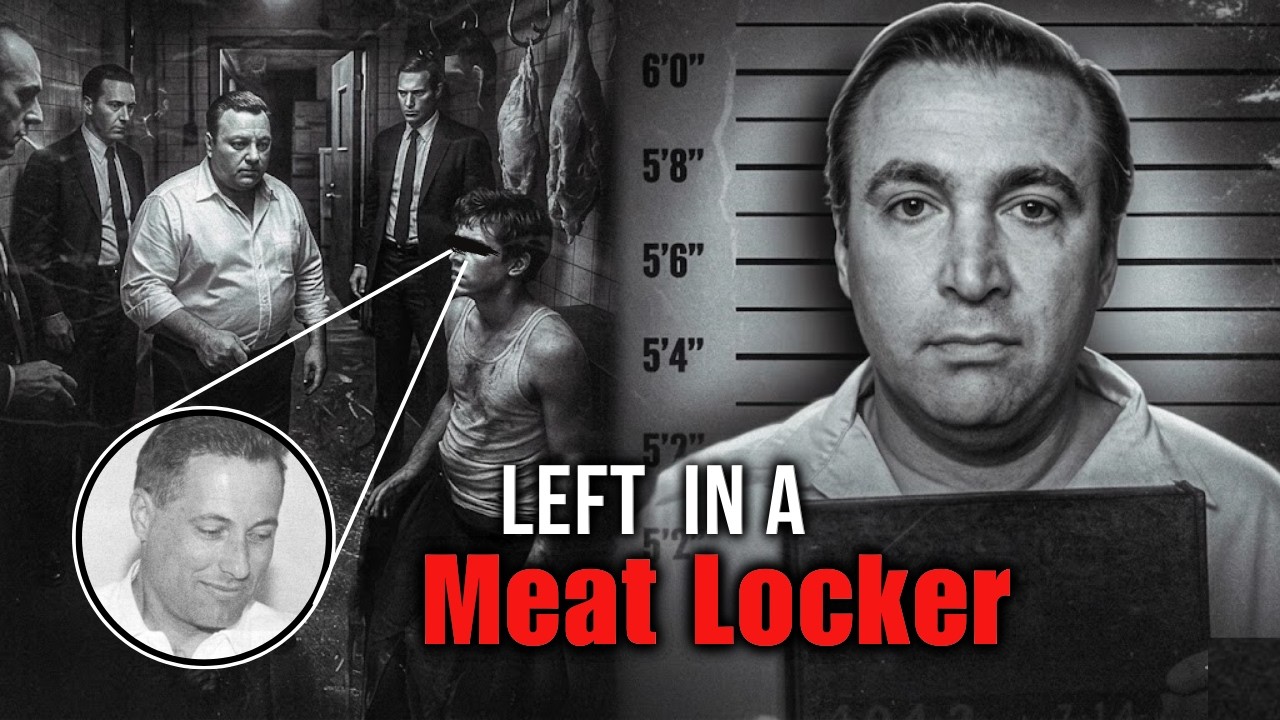
He looked like a human ice sculpture, captured in a final, silent scream. But the autopsy revealed something far worse than death by exposure. Richard Eaton had not simply frozen to death in the dark. He had been tied to that chair and kept alive long enough to feel his blood turn to slush, to feel his lungs crystallize as the cold overtook him.
He had been executed by the Gambino crime family, and the man who had orchestrated his death was Roy DeMeo, one of the most feared killers in the history of the American mafia. The chain of events that led to that frozen trailer began months earlier, 1,200 miles away in Fort Lauderdale, Florida. Richard Eaton was sitting on a hotel balcony, counting $60,000 in Gambino drug money. He had set up a front company, created a paper trail that led nowhere, and skimmed the cash from the top of a major cocaine shipment.
In his mind, he had outsmarted the mob. He believed he had pulled off the perfect heist, disappearing into the sunshine with money that belonged to one of the most dangerous crews in New York. He was wrong. Back in Brooklyn, Roy DeMeo was already preparing the response.
DeMeo was not a man of silk suits and flashy jewelry. He was a butcher by trade, and he understood the physics of flesh. He knew how long a man could scream before his throat froze over. While Eaton was ordering drinks by the pool, DeMeo was ordering a heavy-duty padlock from a local hardware store.
In the world of the Gambino family, there was no such thing as a clean getaway. There were only debts. And Roy DeMeo was the most efficient debt collector in New York. He did not simply want the money back.
He wanted to send a message that would be frozen in time. To understand what Eaton was about to face, it is necessary to understand the man hunting him. Roy DeMeo had turned murder into an assembly line. This was not the romanticized code of honor that Hollywood attached to the mafia.
This was clinical. By the early 1980s, the DeMeo crew was responsible for dozens, perhaps hundreds, of disappearances. Their headquarters, the Gemini Lounge in Brooklyn, looked like a neighborhood bar from the outside. Inside, it was a slaughterhouse.
DeMeo had perfected his method. A silenced shot to the head. A towel wrapped around the wound to prevent blood splatter. A knife to the heart to stop the pumping.
A bathtub to drain the remains. He did not simply kill people. He erased their existence. Eaton was eventually lured back to New York under the guise of a new business deal, a promise of even more money.
He thought he was coming home to finalize his retirement. Instead, he was walking into a workshop designed for his destruction. DeMeo was waiting, not with a handshake, but with a butcher’s apron. Inside the back room of the Gemini Lounge, the music was always turned up to a deafening volume.
Upbeat pop and classic jazz blurred together, creating a wall of sound that drowned out whatever happened behind the velvet curtains. DeMeo did not start with the freezer. That was the finale. He started with the questions.
Every cigarette burn on Eaton’s chest was a punctuation mark in the interrogation about the missing $60,000. Eaton pleaded. He offered to pay the money back. He offered to give up names.
DeMeo was not listening. For him, the money was already gone. What mattered now was the lesson. DeMeo directed his crew, men like Chris Rosenberg and the Senter brothers, with the precision of a surgeon.
They did not want Eaton to die quickly. They wanted him to understand the gravity of his disrespect. They spent hours breaking him down, physically and psychologically, until he was no longer a man. He was just a mass of nerves and fear.
By the time they hauled him to the industrial lot in Queens in the middle of the night, Eaton was not fighting. He was praying for the end. But the end was still miles away. The final act took place in the pitch black of that lot.
The temperature outside was freezing, but inside the trailer, DeMeo had turned the refrigeration down to a level that felt like liquid fire on the skin. They sat Eaton in a chair, tied his hands with industrial wire, and DeMeo looked him in the eye one last time. He did not say a word. He did not need to.
DeMeo stepped out, pulled the heavy steel door shut, and snapped the padlock. He walked away to have dinner with his family, leaving Eaton in a darkness so thick it felt like a physical weight. The final hours are difficult to imagine. The silence.
The way the air becomes a blade in the throat. Eaton watched his own breath turn into a white mist, slower and slower, until his heart could not fight the cold anymore. He became frozen solid, a monument to the Gambino family’s wrath. For weeks, Richard Eaton sat in that icebox, forgotten by the world.
But Roy DeMeo had made one critical mistake. He assumed that once a man was frozen, he could no longer speak. When the FBI processed Eaton’s body, they had to wait days for it to thaw before performing the autopsy. Inside the lining of his heavy winter coat, they found a small, handwritten notebook.
Knowing he was in trouble long before the end, Eaton had recorded names, addresses, and dates. It was a map of the DeMeo empire. Richard Eaton died in the cold, but his frozen notebook was the thing that finally began to melt the Gambino family’s wall of silence. His death helped trigger the investigation that eventually led to the downfall of the DeMeo crew and, ultimately, to the boss of bosses, Paul Castellano.
In the end, Richard Eaton learned the hardest lesson of the underworld. You can steal the mob’s money, but you can never steal their time. They will wait. They will plan.
And when the time is right, they will leave you in the dark, where the only thing left to hear is the sound of your own heart stopping.