The private chambers of Whitehall Palace were off-limits to nearly everyone. The only people allowed close to Elizabeth I’s body were a small circle of women who had served her since before she wore the crown. They called themselves the Ladies of the Privy Chamber. They knew something about their queen that the rest of the country did not. They knew how she really looked beneath the ruffs, the pearls, and the two-foot wigs. They knew how rarely the Virgin Queen took a full bath.
You may have heard the old claim that Elizabeth I bathed once a month, whether she needed it or not. Historians who searched for the source of that quote have been unable to find it anywhere before the early twentieth century. There is no diary entry from Elizabeth recording it. There is no ambassador’s letter repeating it. It appears to be a joke invented long after her death that somehow stuck to her name and never let go.
That does not mean the real story is dull. It means the real story is stranger, and in some ways far more revealing.
To understand what Elizabeth’s servants actually saw, you have to understand what bathing meant to a sixteenth-century English body. It was nothing like what you do in your bathroom today. Physicians of that era believed the human body was sealed by its skin, and that skin acted as armor against a hostile world. They taught that hot water opened the pores. Once the pores were open, contaminated air carrying plague and fever could slip directly into the blood. A popular health guide of the age warned readers clearly against baths and steam rooms. Full immersion in hot water was not a luxury. For many educated people, it was closer to self-harm.
So the richest and most powerful woman in England lived by rules that told her cleanliness itself might kill her.
Elizabeth was not indifferent to her body. She was obsessed with it. At Whitehall Palace, she ordered the construction of a private spa. Archaeological work at the site has uncovered fragments of decorated ceramic tile that were part of a bath built specifically for her comfort. Contemporary descriptions record a bathing chamber where water flowed from carved oyster shells and artificial rocks. Beside the bath was a room fitted with an organ so musicians could play for the queen while she bathed. Next to that was a heated room built in the style of a sauna, where steam and warmth could be enjoyed separately from full immersion.
This was not the home of someone who feared water. It was the home of someone who turned bathing into a private theater of luxury for the rare occasions she chose to use it.
The gap between how often the queen could bathe in luxury and how often she actually did was something her ladies understood better than anyone alive. Full immersion, even in a palace built for it, remained a slow, laborious, and risky process by the standards of the age. Servants had to haul and heat gallons of water over open fires, carry it up staircases, and fill a wooden or metal tub lined with cloth to protect the queen’s skin from splinters. The entire process could take hours of preparation for a soak that might last less than an hour.
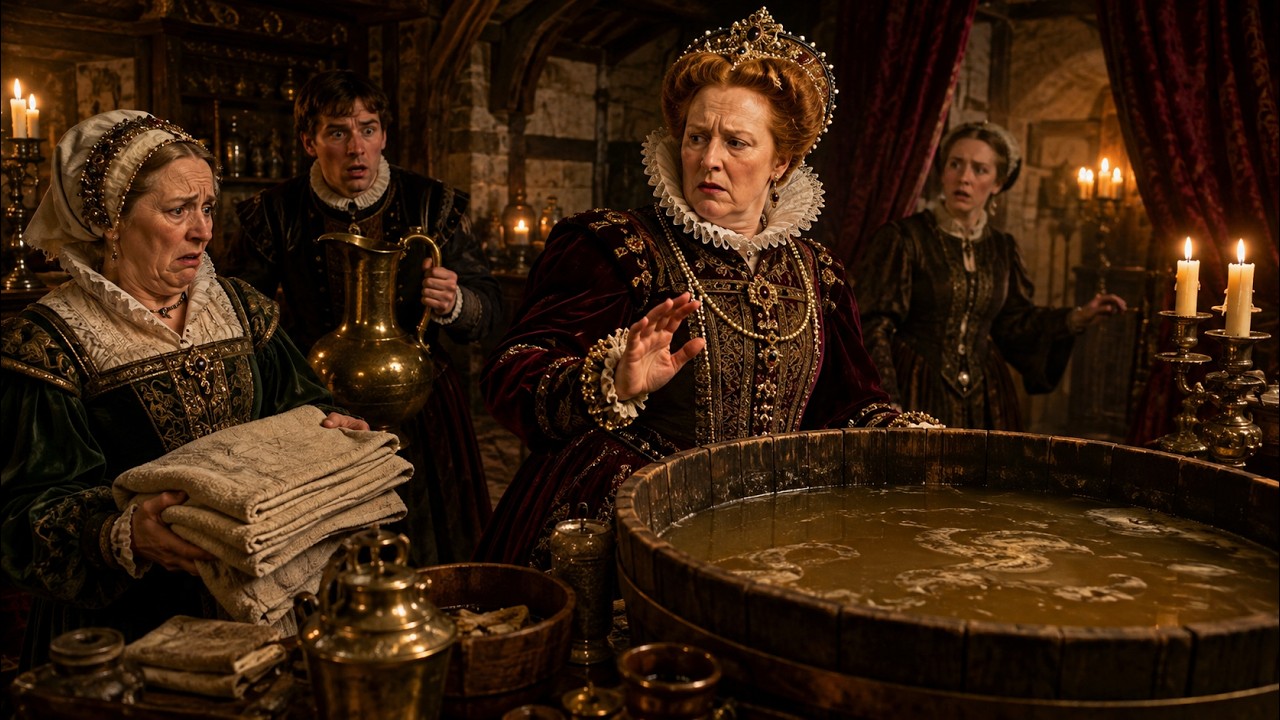
Multiple household sources from the period describe Elizabeth taking a full bath about once a month. Not because she was filthy, but because a full bath was closer to a planned court event than a daily habit.
What her ladies-in-waiting actually did every day was something different entirely. Every morning before the queen appeared in public, her most trusted maids performed a ritual modern hygiene historians call dry washing. A basin of water, sometimes scented with rosemary or orange blossom, was brought to her chamber. Pieces of soft linen were dipped in that water. Her maids wiped her face, neck, hands, armpits, and the creases of her knees, every place where oil and sweat naturally gathered. Some accounts describe a more vigorous method where bare or slightly damp skin was rubbed hard with coarse linen until it reddened, based on the theory that friction alone could remove dirt without exposing any pores.
Living history researchers who have tried the exact method with period materials report something that undercuts the myth. Done properly, dry washing is genuinely effective. It removes surface oils, sweat, and grime with surprising efficiency. The queen who did not fully immerse her body in water for weeks was still clean in the physical sense of the word.
The real secret behind Elizabeth’s bathing habits was never about how often she washed. It was about how much of her true self she had to hide every day to remain convincing as a queen who could never be seen aging, falling ill, or needing anything at all.
Every morning after her skin was cleaned with linen and herbal water, Elizabeth sat before her mirror and allowed her maids to begin the second ritual. This one damaged her body far more than dirty bathwater ever could. The substance they used was called Venetian ceruse, though it was known at court by the gentler name spirits of Saturn. It was a paste made of ground white lead mixed with vinegar, applied thickly to the face, neck, and chest to create the pale, glowing porcelain skin that became Elizabeth’s signature.
Pale skin meant something specific in Tudor England. It meant you had never worked outdoors under the sun. It meant you were nobility, untouched by common labor, elevated above the sun-burned faces of ordinary people. For a queen whose claim to the throne rested on displaying spotless, untouchable authority, that whiteness was not mere vanity. It was armor.
Her maids applied it in layers, smoothing each layer before the previous one dried completely. The mask grew thicker year after year as Elizabeth aged. What none of them fully understood, because the science did not exist then, was that lead is absorbed directly through the skin. Used daily over decades, it accumulates in the body’s tissues and blood. Modern toxicologists recognize the classic symptoms of chronic lead exposure: thinning hair and hair loss, memory problems, digestive disorders, severe fatigue, and muscle weakness. Every one of those symptoms appears in descriptions of Elizabeth’s final years.
Some historians now believe the cosmetics her maids applied with meticulous devotion may have been silently poisoning the very face they were meant to preserve.

Beneath the paint, Elizabeth carried an older wound. In October 1562, at only twenty-nine years old, she fell suddenly and violently ill at Hampton Court Palace. A German physician named Dr. Burcot was summoned and delivered a diagnosis she initially refused to believe: smallpox. Contemporary accounts describe her angrily dismissing him, unwilling to accept the word. Within days her fever worsened. She came close to death, and for several terrifying hours the men governing England genuinely believed they were about to lose their queen without a named heir.
She survived. But smallpox does not leave quietly. It scars. Her maids knew exactly how deep those scars were because they were the ones who saw her real face before the cosmetics were applied each morning. The rest of England saw a queen whose skin grew smoother and more radiant in painting after painting over the decades. That visual lie was built layer by layer by the women closest to her.
A weak or aging queen invited rebellion, foreign invasion, and forced marriage negotiations. A flawless queen invited none of that. Making her body appear perfect was the goal, regardless of what lay beneath.
The hair told a similar story. Records show Elizabeth owned a large collection of golden-red wigs, carefully styled and jeweled, which she relied on increasingly as her natural hair thinned with age. Styling the queen’s hair for a single day of public appearance took her maids over an hour. They pinned the wig over her own hair and placed pearls and wire ornaments among strands that were not originally hers.
Then there was her mouth. By the final decades of her reign, foreign visitors to the English court began noticing the condition of the queen’s teeth. Elizabeth had a documented fondness for sugar, a commodity so expensive that consuming it in large quantities was itself a display of status. A German traveler who saw her late in life noted her teeth had blackened and that she had difficulty being understood clearly when speaking.
Dentistry of that age offered nothing resembling relief. Extraction without any painkiller was the only treatment available, performed by barber-surgeons whose qualifications extended only to a steady hand and a sharp blade. Elizabeth was reportedly so terrified of the procedure that she endured decay for years rather than submit to it. She agreed to see a barber-surgeon only twice in her entire life.
The women who dressed her, powdered her, and washed her in secret held one of the most private and dangerous kinds of knowledge in Tudor England: knowledge of what their queen actually looked like beneath the mythic mask she had built for survival. For forty-five years, almost none of them let that secret out.
The little evidence that survived came indirectly. Palace expense records noting extraordinary quantities of rose water and orange blossom water. Clothing inventories listing dozens of wigs. Physicians’ notes hinting at symptoms no one dared name publicly. The rare foreign visitor bold enough to record what he actually saw.

That silence held almost to the end. But in the queen’s final weeks, as her body began to fail completely, something striking happened. The woman who had spent a lifetime enforcing the gap between image and reality lost the strength to maintain it. For the first time, those around her saw exactly what forty-five years of secrecy had cost her.
By the winter of 1602, Elizabeth was sixty-nine years old. The machinery that had supported her image for so long began failing in ways her maids could no longer hide with powders, pins, or perfumes. She had lost close friends who had known her since childhood. In February 1603, news arrived of the death of Katherine, Countess of Nottingham, one of her oldest and most trusted ladies. Elizabeth had known her for over forty years. According to those present, the news struck the queen with a force that seemed to break something inside her that never fully healed.
She stopped eating properly. She stopped sleeping. She became silent and withdrawn in a way that alarmed even the women who had served her for decades. Then, in the last weeks of her life, Elizabeth did something unthinkable at any earlier point in her reign. She simply stopped maintaining the rituals that had defined her public body for forty-five years. She refused her maids’ efforts to wash her. She refused to change her clothes for days at a time. According to later accounts, she would not allow a mirror anywhere near her chambers.
Witnesses close to the court describe her final month in fragments that are difficult to reconcile with the radiant queen of the portraits. She refused to lie down on her bed, reportedly from fear that if she allowed herself to rest, she would never rise again. For days on end she sat upright on cushions on the floor of her private chamber, sleepless, rarely speaking, staring at nothing her attendants could discern. Her council sent Robert Cecil to persuade her finally to go to bed. She was said to have replied sharply that the word must was not to be used to princes.
Eventually her strength gave out completely. Her ladies, fearing she would collapse and hurt herself, spread cushions on the floor to soften any fall. She lay there for days, mostly silent, before her attendants could finally move her to her bed. In the early hours of March 24, 1603, Elizabeth Tudor died.
What happened next reveals more clearly than anything else how protected her physical reality had been throughout her life. Elizabeth had explicitly refused to allow an autopsy of her body. Her lady of the bedchamber upheld that refusal after her death, likely to preserve, even in her absence, the image of the Virgin Queen touched by no one.
But some details leaked out, passed on by servants who prepared her body and could not stay entirely silent. Her coronation ring, worn constantly for over four decades, had become so deeply embedded in the flesh of her finger that it had to be cut off. The layers of lead-based paint on her face were so thick they cracked visibly when embalmers tried to prepare her for burial. In one particularly unsettling account passed on by a courtier named Elizabeth Southwell, it was claimed that gases accumulating inside her sealed lead coffin caused it to burst during the funeral procession itself. Historians treat that detail with caution because it comes from a single indirect source, but it captures something true about the gap between the queen’s controlled public death and the uncontrollable reality of her body.
The exact medical cause of her death has never been determined and likely never will be, because she herself ensured that. Some historians point to pneumonia worsened by exhaustion, grief, and refusal to eat or rest. Others point to the possible long-term effects of decades of lead exposure from her cosmetics, a slow poisoning she applied to her skin nearly every day of her adult life in service to an image she believed her throne could not survive without. Both explanations may be true at once. The body does not choose a single cause when it has been under that much pressure for that long.
The fragmented testimony of her servants, once pieced together, does not tell a story about a queen who was dirty, ignorant, or neglectful of her body. The real picture is the opposite. Elizabeth was intensely, obsessively attentive to her body in ways shaped entirely by the medical beliefs and political pressures of her age. She avoided full baths not out of indifference but out of a genuine and widely held conviction that immersion in water might kill her. She washed daily with cloth and herbal water with complete diligence. She built one of the most luxurious private bathing chambers in England and used it rarely, treating it as a ritual rather than a routine. She applied poison to her face every morning because a pale, ageless complexion was not decoration. It was visual proof that God had not withdrawn his favor from her reign and that England remained stable under an unconquerable queen.
Her closest women carried the true version of that body for forty-five years, and for the most part they carried it in silence. What survived instead is fragments: household accounts, foreign visitors’ letters, a scrap here, a rumor there, and finally the unguarded chaos of her final weeks when the woman who had spent a lifetime managing her image simply ran out of the strength to keep managing it.
That is the real secret behind Elizabeth I’s bathing habits. It was never about how often she washed. It was about how much she had to hide every day to remain convincing as a queen who could never be seen aging, falling ill, or needing anything at all.