In the fall of 1864, a Confederate general stood inside a tent lit by a single candle, holding a captured Union rifle, unable to process the figure written in the report before him. 32,000. That was the number of rifles produced by a single Northern factory in that month alone. Robert E.
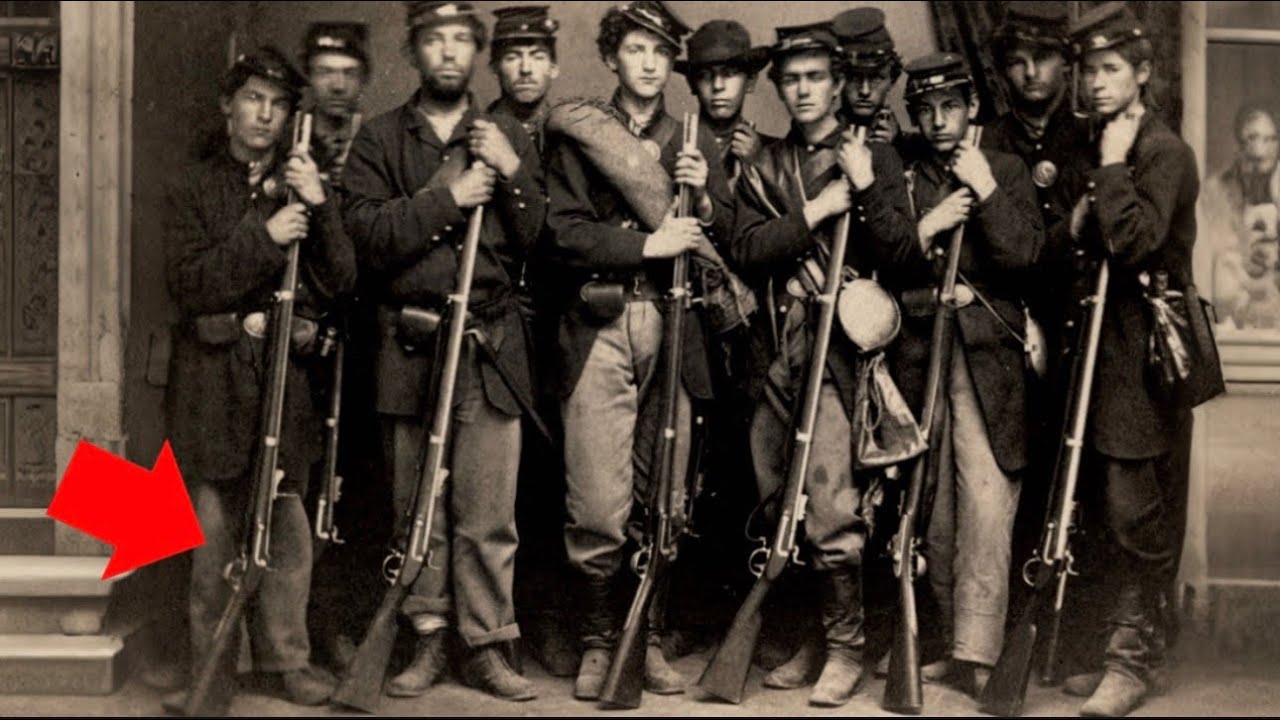
Lee had spent his entire career mastering the art of war on paper and on horseback, but this was a kind of warfare he had never trained for, a war measured not by courage but by machinery, and he was losing it before a single shot was fired. This is the story of how the Confederacy lost a war it never fully realized it was losing, and how a man who was a genius on every battlefield he commanded was defeated by something he could not outmaneuver, attack, or outthink: the assembly line. By 1864, Lee’s army depended for its survival on captured weapons, broken rifles, and guns so old that some had been used in the war with Mexico. Meanwhile, in the North, inside a red-brick building beside a river in Connecticut, workers were producing rifles faster than any army in history had ever done, using a method that had nothing to do with traditional gunsmithing and everything to do with clocks, sewing machines, and what was called interchangeable parts.
Lee understood infantry formations. He understood terrain. But he did not understand what a machine was, and that failure of understanding helped decide the fate of a nation. To understand how this happened, one must go back more than two decades before the first shot was fired at Fort Sumter, to a workshop in Hartford, where a young man named Samuel Colt was trying to solve a problem that had nothing to do with soldiers at all.
Colt wanted to make guns the same way a factory made clocks. Before him, a rifle was made by hand from start to finish by a single craftsman, and no two rifles were ever exactly alike. If a part broke on the battlefield, a soldier needed a gunsmith, not a spare part, because there was no such thing as a spare part that could fit in place of the broken one. Colt thought this was absurd.
He believed a rifle should be made the way any object meant to be repaired quickly and cheaply was made, from identical, machine-cut, interchangeable pieces. It seems obvious now. In the 1840s, it seemed like science fiction. The idea did not come from Colt’s imagination alone.
It came from a system that was quietly taking shape across New England, in places like the Springfield Armory in Massachusetts, where engineers had spent years perfecting machines capable of cutting metal with a precision no human hand could match. This system had a name. It was called the American system of manufacturing, and it would go on to change the entire world’s conception of what a factory could do. But in the years before the Civil War, almost no one in the South paid attention to it, because the South did not need it.
The Southern economy was built on cotton, on land, and on the enslavement of human beings, not on machine shops. And that choice, made decades before the war, would become more important than any decision Lee made on the battlefield. By the time war broke out in 1861, the numbers told a story neither side wanted to state openly. The North held roughly ninety percent of the country’s manufacturing capacity.
Firearms production, specifically, was even more lopsided. Northern factories, some already running around the clock making rifles for civilian and militia use, could convert to wartime production overnight. The South had almost nothing like this. Only a handful of small armories, some barely more than large workshops, and an economy that had spent generations investing in plantations rather than machine tools.
Lee knew the South was outnumbered in men. Every general on both sides knew that. What almost no one in the Confederate high command realized, at least at first, was that they were facing something more terrifying than just more soldiers. They were facing more rifles, produced faster, more reliably, and more cheaply than anything the South could hope to match, no matter how many hours its arsenals worked.
This is where the story becomes personal, because Lee was not a man who ignored problems. He was, by the testimony of everyone who served under him, one of the most precise, detail-obsessed commanders of the entire war. He read reports. He studied maps until his eyes ached.
He understood supply lines better than almost anyone in Richmond. Yet when it came to industrial production, there was something in his thinking that simply could not bridge the gap. Part of this was not Lee’s fault alone. It was rooted in the world he came from.
Lee grew up in a Virginia aristocracy that regarded manual labor and mechanical trades as beneath the understanding of a gentleman, let alone worthy of personal attention. His entire education, at home and then at West Point, trained him to think of war as a contest of maneuver, discipline, and character. Nothing in that education prepared him to think of war as a contest of machine tools and factory output. He could read a battlefield like an open book.
But he never learned to read a production line. Compare that with what was happening at Colt’s factory in Hartford, or at the Springfield Armory, or among the smaller contractors scattered across Massachusetts, Connecticut, and New York. These were not workshops where craftsmen slowly filed metal by hand. They were some of the most technologically advanced manufacturing operations on earth at the time.
Steam-powered lathes, precision milling machines, and trained workers whose job was not to build a complete rifle from start to finish, but to perform one single repetitive task on a moving sequence of parts, over and over, thousands of times a day. This was the part that would have truly baffled a man like Lee had he seen it up close. In these factories, no worker needed to be a master gunsmith. A worker might spend an entire shift doing nothing but shaping one small piece of the trigger mechanism, a highly specialized task that could be learned in days rather than years.
Multiply that worker by the hundreds across dozens of stations, each producing a part that fit perfectly into any other rifle coming off the same line, and you had something the Confederacy simply could not replicate: production that did not depend on rare, skilled craftsmen. The numbers make this abstract idea concrete very quickly. At certain stages of the war, Northern arms makers, together with government arsenals like Springfield, were able to produce more than a million small arms during the conflict, with individual factories reaching tens of thousands of rifles per month at peak output. The Confederacy, across its entire wartime existence, produced only a small fraction of that number domestically, and much of what reached Southern soldiers was captured on the battlefield, smuggled through the Union blockade, or bought from European suppliers at exorbitant prices.
Consider that for a moment. A significant percentage of the rifles carried by Confederate soldiers in some of the bloodiest battles of the war were not made in the South at all. They were British-made Enfields smuggled through the blockade, or Union rifles pulled from the dead and captured after battles. Lee’s army, in a very real sense, was partly arming itself from the industrial output of the enemy it was fighting.
Think about what a single Union arms contractor could accomplish in one week during the peak war years. Under full production, a well-run factory could turn raw material into a working rifle in a matter of days. Not because any one worker moved faster than a Southern gunsmith, but because the work itself was divided into dozens of small, repetitive movements, each performed by a specialist who did nothing else. The man who spent his entire day boring one barrel became very fast at boring barrels.
The man who spent his day fitting triggers became very fast at fitting triggers. None of them needed to understand the rifle as a whole. They only needed to understand their single piece of it perfectly, and repeat that thousands of times. This was a strange kind of expertise, narrow and repetitive, but it produced results no lone craftsman could match.
The Confederacy, in contrast, still relied largely on an older approach to arms making, where fewer, highly trained men hand-completed a larger share of the process, and where the loss of even a handful of those skilled workers at the front could quietly cripple production for months. There was a particular cruelty to this. The Confederacy needed its most capable young men on the battlefield, and it also needed skilled hands in its workshops, and it did not have enough of either to meet both demands at once. The North, with its larger population and a manufacturing base that did not depend heavily on any single irreplaceable craftsman, simply did not face the same brutal trade-off.
This created a strange and brutal paradox that shaped the entire course of the war. Every Confederate victory that captured Union supplies became, in effect, a resupply operation for Lee’s army. Second Manassas, Harpers Ferry, moments when Confederate troops swept through Union positions and seized weapons, ammunition, and equipment, were not just tactical victories. They were lifelines.
Lee’s supply officers became expert at recovering what the enemy left behind because they had to be. There was no factory back home that could simply replace what was lost. Now imagine the other side of that equation. In the North, when a rifle broke or wore out, or a soldier was killed and his weapon recovered, replacement was not a matter of weeks or months of delayed production.
Factories using interchangeable parts could turn out a perfectly identical rifle in a matter of days. And because the parts were standard, damaged rifles could sometimes be repaired in the field with spare components rather than being scrapped entirely. This was the hidden war Lee was fighting, one that never appeared on battle maps, fought not with infantry but with precise measurements measured in thousandths of an inch. There is a certain story, often told by historians who study Confederate weapons records, that captures the desperation of that disparity.
Confederate state arsenals, most notably the one in Richmond, tried to imitate Northern production methods late in the war. They imported the most skilled mechanics they could find and attempted to build their own interchangeable-parts systems, but they struggled constantly, not for lack of effort, but for lack of the machine tools, precision equipment, and trained technical workforce that the North had spent decades building before the first shot was fired. You cannot build in four years what an entire regional economy took forty years to develop. There is a specific passage in Southern arms correspondence, often cited by historians of Confederate logistics, in which officials openly admit that they simply did not have the trained mechanics needed to operate captured or imported machine tools anywhere near their intended capacity.
Machines are only as useful as the people who know how to run them. And the Confederacy had spent decades investing its human capital in agriculture, not precision engineering. You could smuggle in the finest lathe in the world, and it would still sit partially idle for lack of enough trained men to run it at full capacity. This was not a story of willpower or effort.
Confederate officials exhausted themselves trying to close the gap. It was a story of decades of earlier choices finally coming due all at once in the middle of a war that gave them no time to fix it. That, in fact, is the essence of what Lee could not fully grasp. To be fair to him, it was not really an individual failure.
It was a civilizational failure. The South had built an economy based on extracting value from the labor of enslaved people on the land. The North had built an economy, at least in its industrial centers, based on extracting efficiency from machines and free wage labor organized around precision manufacturing. When these two economies went to war, one had spent two generations building exactly the kind of infrastructure modern warfare required, almost by accident, while the other had spent those two generations building something entirely unsuited to it.
There is another layer to this story rarely seen in popular accounts of the war, and it concerns the ocean rather than the battlefield. Driven by desperation for weapons, the Confederacy turned to Europe, especially to Britain, where private manufacturers were willing to sell rifles to anyone who could pay. Ships loaded with Enfield rifles slipped out of ports like Nassau and Bermuda, trying to run the Union Navy’s blockade to reach Southern harbors. Some got through.
Many did not. Every ship captured or sunk was not just a financial loss, but the loss of thousands of rifles that would never reach Confederate hands. Weapons lost at sea instead of reaching the enemy. It was a strange kind of warfare, fought as much through naval blockade and high-seas risk as through infantry and artillery, and it was a war the Confederacy fought above all else simply to keep its army armed at all.
At the same time, the Union barely needed this kind of desperate improvisation. Its domestic production, combined with its ability to buy from European markets without the burden of running a blockade, meant Northern soldiers rarely faced the chronic weapons shortages that plagued their Southern counterparts for most of the war. It is easy to think of the Civil War as a story of leaders and battle lines only, but much of its outcome was silently determined by which side could reliably put a working rifle in a soldier’s hand, month after month, without interruption. Lee’s genius, and it was genuine genius, lay in making the most of what he had.
Despite being outnumbered and outgunned in production, he managed to win battle after battle in the early and middle years of the war through boldness, superior leadership, and an almost uncanny ability to read his opponents. Second Manassas and Chancellorsville were moments when any lesser commander facing the same disadvantages might have been crushed. Instead, Lee found ways to win with less, again and again, for years. But industrial capacity does not care how brilliant your tactics are.
It just keeps grinding. Month after month, rifle after rifle, factory after factory. By 1864, that grinding weight had become unbearable. Grant, who took command of Union forces that year, understood something Lee’s previous opponents had not fully exploited.
The North did not need to outmaneuver Lee in every engagement. It needed to out-produce and out-bleed him, trading losses at a rate the shrinking Southern population and under-supplied factories could not sustain. Grant could lose men and replace their rifles within days. Lee lost men and often could not replace their rifles at all.
There is a figure historians who study Union arms reports often return to because it captures the sheer scale of what was happening far from any battlefield. Across the entire war, Northern arsenals and private contractors managed to achieve production that dwarfed everything the South could produce, even when accounting for every captured weapon, every blockade run, and every European purchase. This was not a small advantage. It was a structural advantage, the kind no battlefield victory could ever fully repay, because the war was not really about winning or losing a single fight.
It was about how quickly each side could recover from a fight. Think about what that meant for an ordinary soldier on each side. A Union infantryman whose rifle jammed, cracked, or was damaged in a skirmish could expect a serviceable replacement within a short period, sometimes repaired on the spot using standard spare parts carried by army ordnance technicians. A Confederate infantryman facing the same problem might wait weeks, rely on patchwork repairs using used parts, or simply receive whatever was available regardless of caliber or condition.
When you multiply that difference across tens of thousands of soldiers, across years of continuous campaigning, you begin to understand why Confederate combat readiness steadily declined even as Lee continued winning tactical engagements in 1863 and 1864. That is why the last year of the war looked so different from the first. It was not that Lee suddenly became a worse general. It was that the arithmetic had finally caught up with him.
Every skirmish, every siege around Petersburg, every exchange of fire was quietly draining a resource the Confederacy had never had enough of in the first place. And there was no factory back home running around the clock to replace it. There is something almost tragic in imagining Lee holding that captured Union rifle, running his fingers over parts stamped with numbers rather than carved by a craftsman’s hand, realizing on some level that he was looking at the future of the war itself, and knowing his side had no answer to it. He had spent his life mastering an older kind of war, built on honor, maneuver, and personal command presence on the battlefield.
The war that actually decided the conflict’s outcome was being fought in places his feet never touched, in the factories of Hartford and Springfield, on production lines where teenage workers who never fired a single shot in anger were, in their own way, among the most decisive combatants of the entire Civil War. Some of Lee’s own officers seemed to sense the outline of this problem, even if they could not fully name it. Supply officers wrote increasingly desperate letters to Richmond throughout 1864, describing units armed with a hodgepodge of different calibers. Some soldiers carried weapons for which there was no longer any ammunition, forcing constant improvisation just to keep the minimum arming of a single company.
Imagine trying to coordinate ammunition supply for an army where no two regiments necessarily carried the same rifle. Where a supply wagon might hold entirely the wrong caliber for half the men waiting for it. This kind of chaos does not show up on the neat movement maps most people imagine when they think of the Civil War, but it was very real, and it was quietly draining Confederate combat effectiveness long before any decisive battle settled the outcome. By April 1865, when Lee finally surrendered at Appomattox, his army was not just outnumbered.
It was starving, barefoot, and critically short of serviceable weapons. A final material symbol of everything the South had failed to build in the decades before the first cannon sounded at Sumter. The war was not lost only on the battlefields of Virginia. It was lost years earlier in the machine shops most Confederate leaders never bothered to visit, built by a system most of them never took the time to understand.
It is worth pausing to consider how young many of those factory workers were. Teenagers, some barely out of childhood by today’s standards, spent their days operating precision machines that would have seemed almost magical to a soldier on the front lines. They never marched in military formations. They never heard a cannon fired in battle.
Yet the cumulative effect of their work, one small piece at a time, day after day, quietly shaped the outcomes of battles they never witnessed. History rarely gives them a name or a face. Most went home at the end of the war to lives no one thought worth documenting, unaware that the pieces they shaped helped determine whether the country would remain one nation or split into two. Battles are remembered, generals get statues, but wars, especially modern wars, are often decided in a quieter place: on a factory floor, inside a machine built years before its importance was known, by workers whose names no one ever wrote down.
Robert E. Lee was able to outthink nearly every general he ever faced on the battlefield. But he never stood a chance against an assembly line.