In 1010 AD, the most feared warriors on Earth met their match on American shores. They were not defeated by an empire or an army, but by canoes carrying native defenders who had never seen iron weapons. Within days, the unstoppable Norse expansion came to a permanent halt. These were men who had raided Paris and conquered England, yet they were running for their longboats through Newfoundland forests with arrows whistling past their heads.
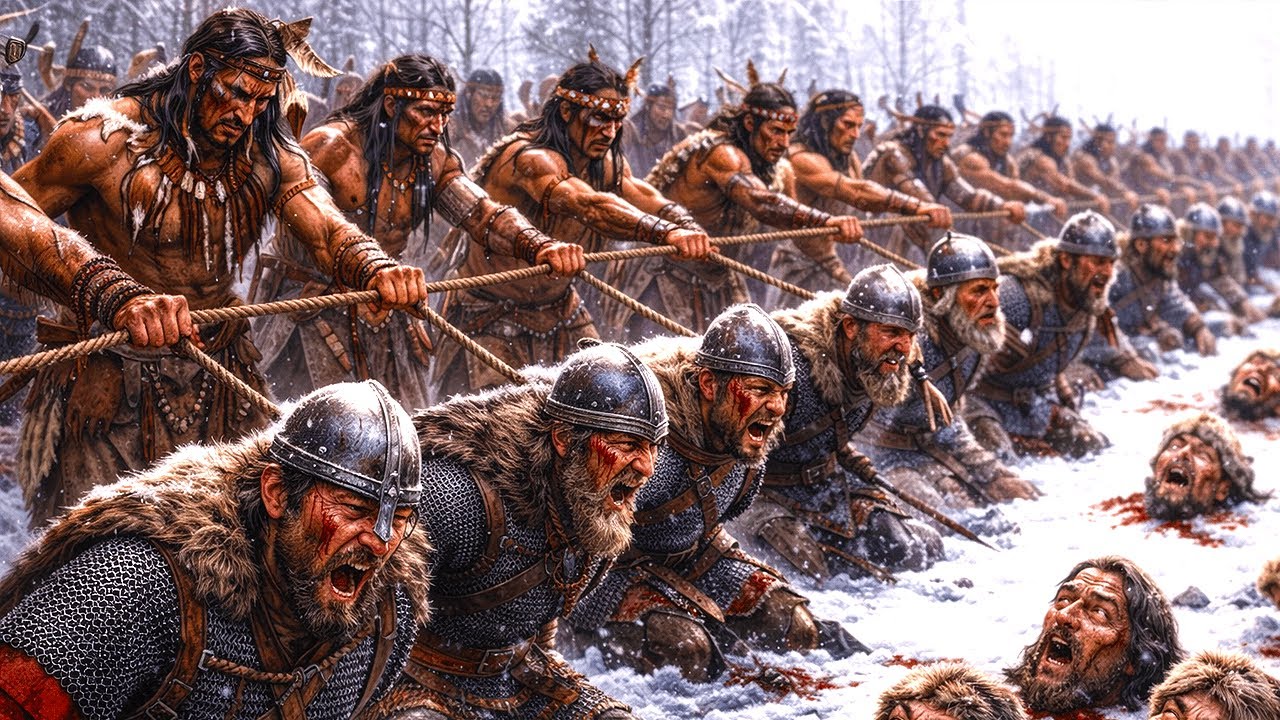
They fled from enemies they called skraelings, a term meaning wretched ones, 470 years before Columbus sailed west. The Vikings had already established colonies in North America. They named it Vinland, the land of wine, drawn by rich soil, endless timber, and wild grapes. It seemed a paradise compared to the Greenland settlements, an ice-bound existence where even wood for shipbuilding was scarce.
The Norse mindset demanded expansion. Their gods rewarded the bold, younger sons needed kingdoms, and ships needed timber. Vinland seemed to offer everything. The confrontation was set in motion years earlier when Leif Eriksson first landed and established a foothold.
The natives watched these pale strangers from the forest edges. They studied their iron tools, counted their numbers, and marked their habits. Where the Vikings saw empty wilderness, the natives saw a homeland under threat. Two worldviews were about to collide.
The first recorded violent encounter came when Thorvald Eriksson, son of Eric the Red, found nine natives sleeping under overturned canoes. Eight died before they could rise. One escaped into the forest. That single survivor warned every native group within miles about strangers who killed without warning.
As Thorvald’s men celebrated their easy victory, they noticed movement on the water. Skin boats approached fast. An arrow pierced the gap beneath Thorvald’s arm, where armor could not protect him. It was tipped with stone, crafted by hands that had never worked iron.
Drawing the point from his own flesh, Thorvald said, “This arrow will cause my death. ” He died within hours. The following year, Thorfinn Karlsefni arrived with the largest Norse expedition yet. He brought 160 settlers, including women and children, thirty battle-hardened warriors in chainmail, cattle, tools, and five longships loaded with everything needed to establish a permanent colony.
Karlsefni had learned from Thorvald’s reckless aggression. He chose a defensive position near the coast, built fortified longhouses, and posted sentries day and night. At first, the encounter seemed peaceful. Native canoes emerged from the morning mist, and after days of cautious observation, they returned bearing furs.
Trade began. The natives marveled at the strange white liquid the Vikings called milk, something they had never tasted. Laughter replaced suspicion. For a time, Vinland seemed destined to be shared.
Then came the moment that shattered everything. A young native, fascinated by a Viking steel axe, reached to touch it. A Viking moved to stop him. Hands grabbed.
The struggle lasted seconds. The axe fell, and blood sprayed across the trade goods. The sagas differ on whose blood it was, Viking or native, but the result was the same. Trust died in that moment.
The native grabbed the axe and fled into the forest. The peace was gone forever. The Vikings fortified frantically. Every adult was given a weapon.
The settlement transformed from a trading post into a military camp. But in the forest shadows, native councils convened. They had observed the Vikings closely during trading. They learned that their armor slowed them, their formations required open ground, and they relied on sight rather than sound.
Then came the vanishing. No natives appeared for days. The silence itself became a weapon. Every snapping branch became an enemy.
Nerves frayed. The waiting was a form of psychological warfare. On the fifth dawn, the attack came. Hundreds of canoes swept in from three directions simultaneously.
The Vikings counted thirty boats, then fifty, then stopped counting. Each carried five to eight warriors, meaning at least three hundred attackers against thirty armored Vikings and 130 settlers. The first volley darkened the sky. The Vikings raised their shields, forming the wall that had never failed them from England to Russia.
But the native bows fired high trajectories, dropping arrows from above, over the over-lapping shields and into gaps between helmets and neck guards. The unbreakable wall began breaking. The natives used false retreats. Groups would charge, throw tomahawks, and flee toward the forest.
Young Vikings, blood hot with battle fury, pursued. Several chased twenty natives into the tree line, where the trap snapped shut. Concealed warriors rose from the undergrowth, surrounding the isolated Vikings in a space too tight for their two-handed axes. In the heavy forest, the long axe handles caught on branches, and the chainmail exhausted its wearers.
The natives danced through familiar terrain, their tomahawks finding every gap in the armor. There was one moment that nearly turned the tide. Ragnar Ironside, Karlsefni’s champion, went berserk, entering the legendary state where pain vanished and strength doubled. He charged alone into the native ranks, his axe whirling, and bodies fell around him.
But the forest does not respect berserkers. He pursued fleeing natives into the undergrowth, did not see the rope stretched between trees, and fell. Twenty tomahawks found him simultaneously. Then came the impossible event that broke the native assault.
Karlsefni’s bull, brought for breeding stock, broke free from its pen. The massive animal, maddened by the battle sounds and the scent of blood, charged through the combat zone. To the Vikings, it was merely frightened livestock. To the natives, who had never seen cattle, it was a demon.
Warriors who had faced armored Vikings without flinching fled from this bellowing monster. The bull’s rampage bought the Vikings precious minutes to retreat behind the walls of the longhouse. The respite was brief. Arrows with burning points began falling on the wooden roof.
Bucket brigades formed. Women and children fought flames while men held the walls. The natives regrouped and planned through the night. By dawn, the mathematics were brutal.
Viking dead, eleven; wounded, nineteen; combat effective, fewer than twenty. Native casualties were real, but the forest seemed to disgorge endless fighters. Worse, the kill ratio was reversing. The natives lost fewer than twenty warriors, while the Vikings were being annihilated.
The battle was unwinnable. Karlsefni made the hardest decision of his life. He knew that staying would mean the death of every woman and child in the settlement. He gave the one order that saved Norse lives but ended Norse dreams: to the ships.
The retreat was a fighting withdrawal. The Vikings formed a hollow square with the civilians in the center and fought toward the beach. Five men volunteered to hold the rear, knowing it meant their deaths. They stood shield to shield and bought time with their lives.
The longboats pushed off blood-soaked beaches. Everything that could not be carried in one trip was abandoned: the forge, iron tools, an anvil, weapons, all left scattered in the mud. Even in escape, death followed. As the last boat pushed off, an arrow from the tree line caught the helmsman in the throat.
He toppled backward. But the boats kept going. Behind them, on the beach, the natives celebrated their victory. They had done the impossible.
They had defeated iron with stone and expelled the invaders without surrendering a foot of land. Viking losses were fifteen confirmed dead, twenty-three wounded, plus several more who died during the voyage home. One third of the fighting force was gone. The psychological impact outweighed the physical losses.
These Vikings had grown up with stories of invincibility. Their fathers had conquered England. Their grandfathers had terrorized France. They had planned to add America to the Norse dominions.
Instead, they fled from enemies they had dismissed as wretches, carrying memories of arrows curving around shields and warriors vanishing into trees. The wounded spoke in whispers. One said the natives fought like forest spirits. Another screamed about eyes in the trees.
Karlsefni made his decision before reaching open ocean. “This land wants us dead,” he told his council. No one debated. The survivors returned to Greenland with their lives instead of their honor.
The consequences were profound. The natives now possessed iron tools and weapons. They had observed Viking tactics, countered them, and defeated them. The abandoned settlement became a classroom where native warriors studied their enemy’s methods.
Viking artifacts became trophies and sacred objects. Stories spread through trade networks that the pale strangers could be beaten. When Europeans returned centuries later, they faced descendants of people who had already won this war once. The Viking attempt to settle North America was finished.
They would never return. The Atlantic became a barrier, not a highway. The expansion that had seemed unstoppable from Iceland to Greenland met its end in the forests of Newfoundland, at the hands of defenders who knew their land perfectly and were fighting for their homeland.
The stone arrowhead in Viking flesh proved that sometimes the old ways are stronger.