On July 4, 1863, Confederate General John C. Pemberton walked out of Vicksburg, Mississippi under a white flag to meet the man who had been tightening a ring around his army for forty-seven days. He had hoped the date might soften Ulysses Grant’s terms. Grant was not moved by occasion.
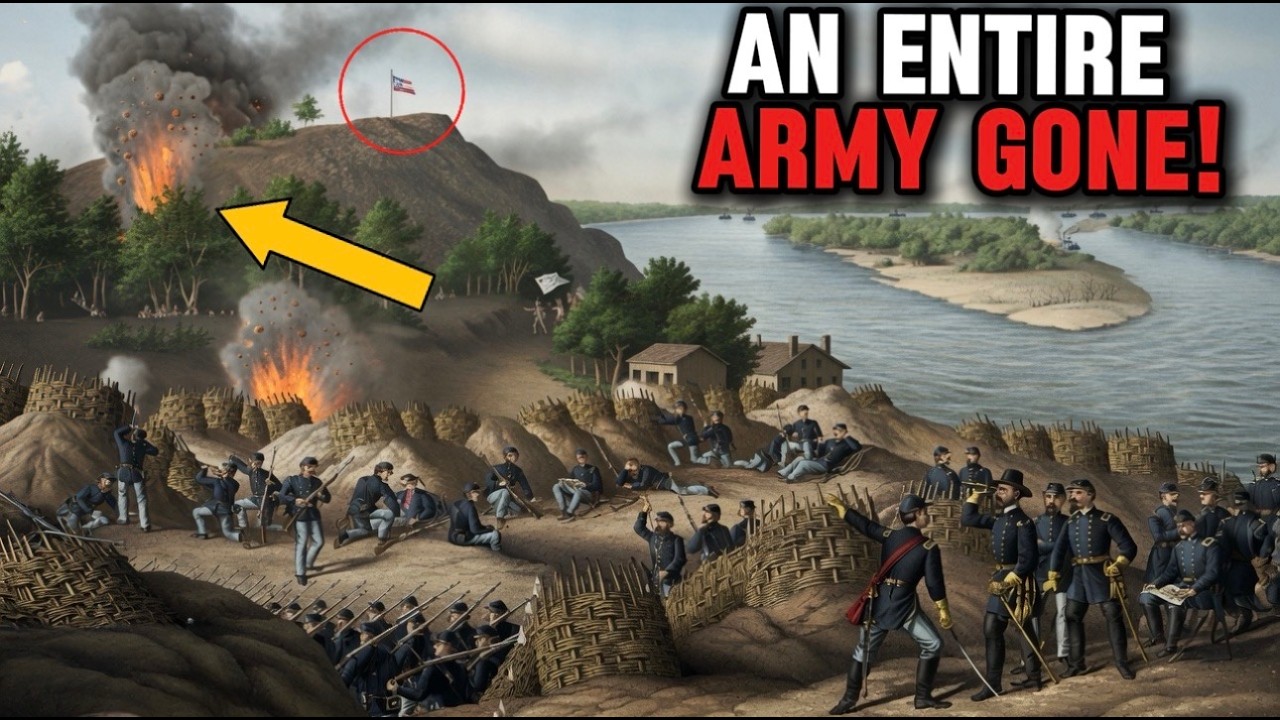
The military reality was plain: thirty thousand Confederate soldiers had nothing left to fight with and nowhere left to go. Vicksburg sat on a high bluff above the Mississippi River at a sharp bend that forced approaching vessels to slow and present themselves broadside to the guns on the heights. For most of the first two years of the war it had earned the name “Gibraltar of the Confederacy,” and the name was geographic fact as much as flattery. As long as Vicksburg held, the river was divided.
Below it, the water was Confederate. Above, the Union had made inroads. Without control of the river, the Western Confederacy remained viable. Texas cattle still moved east, cotton still reached markets through back channels, and men and material from Arkansas and Louisiana continued feeding the Confederate war effort.
Before the war, the Mississippi had been the economic spine of half a continent, and whoever controlled it controlled movement across the most productive agricultural region in North America. Jefferson Davis had invested enormous personal attention in Vicksburg. He had toured the city’s defenses the previous December and left convinced it was effectively impregnable from the water. Lincoln understood the city’s importance in the opposite direction: not as a fortress to be held, but as an obstacle to be removed.
Grant tried to get at Vicksburg four times before he found a way through. His first attempts came overland from the north, through territory the Mississippi Delta made nearly impassable in winter and spring. Engineers searched the bayous for navigable routes that could bring the army in behind the Confederate fortifications; a promising route through Yazoo Pass stalled when Confederate work parties spent two weeks felling trees across the channel. Another route through Steele’s Bayou nearly trapped a naval squadron when trees closed over the boats and Confederate riflemen appeared in the branches overhead.
Grant also tried cutting a canal across the peninsula opposite Vicksburg to redirect the river’s flow, but the Mississippi declined to be redirected by shovels. By spring 1863, Grant had been in front of Vicksburg for months with nothing but failed approaches to show for it. Northern newspapers were calling for his removal. Whisperings about his drinking reached the White House.
Lincoln refused to remove him. He had generals who didn’t drink; he needed one who fought. What Grant decided in April 1863 was, by any conventional measure, dangerous to the point of recklessness. His army was camped on the Louisiana side of the river below Vicksburg.
The only viable approach to the city was from the south and east, which required crossing the river, and getting vessels into position meant running them past the Vicksburg batteries in the dark through a bombardment lasting the entire length of the city’s waterfront. On the night of April 16, 1863, Admiral David Porter’s fleet moved downriver without lights. Coal fires were banked to reduce smoke. Wet bales of cotton and hay were packed along the sides of the transports to absorb shot.
Pilots were told to stay close to the western bank and maintain speed regardless of what happened around them. The Confederates spotted the fleet before it was halfway through. Bonfires appeared on the Louisiana shore to throw light on the water, and the batteries opened. The run lasted roughly two and a half hours.
When it was over, one transport had gone down. The rest were battered but below Vicksburg and moving. Grant ran additional transports past the batteries six nights later, losing a few but retaining enough to build a crossing force. He chose Bruinsburg, Mississippi, as his landing point, and on the last day of April his army began crossing.
Over the next two days, forty-five thousand men crossed the Mississippi with no established supply line behind them. Grant’s chief of staff was appalled. Sherman believed the operation would end in catastrophe. Henry Halleck sent orders telling Grant to stop, and Grant ignored them entirely.
His army moved northeast, feeding itself off the farms and granaries of central Mississippi. They fought at Port Gibson on May 1 and pushed the Confederate defenders back. They drove through the spring heat, fought at Raymond on May 12 against a brigade that contested the road harder than expected, and took the state capital of Jackson two days later, destroying the rail junction that connected Vicksburg to the Confederate supply network. In just over two weeks, Grant’s army had marched more than two hundred miles, fought five separate engagements, and severed the city’s last reliable supply line.
Then Grant turned west and came at Vicksburg from behind, which is precisely what its fortifications were not designed to resist. The critical engagement came at Champion Hill on May 16, where Pemberton brought his army out to try to stop the Union advance. The fighting lasted most of a long May afternoon. Around two o’clock it appeared the Confederate position might hold, but Alvin Hovey’s Union division found a gap in the line and drove through with enough force to unravel Pemberton’s entire right flank.
Pemberton tried to organize a stand at the Big Black River the following morning. Grant’s men hit the crossing before the Confederates could form their line, and the army came apart for the second time in two days. They retreated into Vicksburg in disorder, and Grant’s army followed and closed the ring. By May 18 the encirclement was complete.
Pemberton had roughly thirty thousand soldiers inside the fortifications. Joseph Johnston was somewhere to the east with a force too small to break through. Johnston had explicitly instructed Pemberton weeks earlier to abandon the city and combine their forces before Grant could complete his envelopment, but Jefferson Davis had ordered Pemberton to hold Vicksburg at all costs. Caught between two commanders who wanted opposite things, Pemberton chose to stay.
Now the gates were shut, and there was no undoing the choice. Grant did not want to wait. He threw his men at the Confederate works by direct assault on May 19 and was repulsed. He tried again on May 22 with a full-scale attack across the entire perimeter.
Sixteen thousand men went forward in a coordinated assault. The defenders held every point of the line. Three thousand Union soldiers fell that day in fighting that changed nothing except the casualty counts. Grant looked at the fortifications and ordered his men to start digging.
The siege that followed was unlike anything the American continent had witnessed since the Revolutionary War. Grant’s engineers pushed approach trenches steadily closer to the Confederate works, sometimes advancing only a few yards per night, dug under fire by men working in shifts through the Mississippi summer heat. They built artillery batteries and repositioned them progressively forward as the trenches advanced. They dug tunnels beneath Confederate strong points and packed them with gunpowder.
On June 25 they detonated a mine beneath a position called the Third Louisiana Redan, collapsing it and killing or burying the men inside, then rushed the crater with an assault column. The Confederate defenders sealed the breach and held. The crater filled with dead from both sides, and Grant’s men pulled back. The work resumed the next morning.
Inside the city, the arithmetic of survival was running out in every direction. Confederate soldiers were on half rations by early June, and by late June the rations available would not have sustained a man through a single day’s labor. They were eating mule meat. Lead was melted down and recast into bullets by hand.
Dysentery worked through the defensive positions, and men who had held the earthworks through weeks of bombardment were now too weak from hunger and illness to do more than remain at their posts. Morale was visibly breaking down. By the first days of July, petitions were circulating among the enlisted men asking Pemberton to consider surrender before the garrison ceased to function entirely. Civilians had already been living underground for months.
The city’s clay bluffs were honeycombed with caves residents had dug the previous summer when Union gunboats began their first systematic bombardment. Families furnished those caves with rugs and chairs and oil lamps carried out of their houses, installed wooden floors against the Mississippi mud, and learned to cook at the cave entrance when the shelling paused and retreat inside when it started again. A woman named Mary Loughborough, who spent the siege in one of those caves with her young daughter, wrote a memoir afterward capturing what it meant to manage a household in a hole in the ground while a city was dismantled above her. On July 3, Pemberton sent a note to Grant requesting a meeting to discuss terms.
He had received Johnston’s final word that no relief was coming. Grant’s first response demanded unconditional surrender, but he modified it after thinking through the practical consequences. Thirty thousand prisoners were a substantial logistics problem. He offered a parole instead.
The Confederate soldiers would stack their weapons, sign their paroles, and be released to go home. Pemberton accepted. On the morning of July 4, 1863, the Confederate garrison of Vicksburg marched out through gaps in the fortification line and stacked their rifles in long rows. The process was methodical and unhurried, the administrative conclusion of forty-seven days of killing and digging and waiting.
Confederate soldiers walked through the surrender in a silence that written accounts describe in nearly identical terms. Some Union soldiers began to cheer and were stopped, whether by their officers or by some collective instinct that the moment did not call for it. The silence felt more significant than any sound would have. Port Hudson, the last Confederate position on the river, surrendered five days later on July 9 when its garrison received word that Vicksburg was gone.
Lincoln received the combined news and wrote one of the most resonant lines of his presidency: “The father of waters again goes unvexed to the sea. ”
The consequences moved quickly across the map. The Confederate states west of the Mississippi, Texas, Louisiana, Arkansas, were severed from the main body of the Confederate nation. The Texas cattle trade, the reinforcements that had crossed into Mississippi and Tennessee, the cotton moving through improvised back channels, all of it depended on crossing a waterway that was now a Union highway from the upper Midwest to the Gulf of Mexico.
The Trans-Mississippi Confederacy would fight on for nearly two more years, but as something closer to an isolated garrison than a participating member of a national war effort. John Pemberton never commanded at that level again. He was offered a lower rank, declined it on principle, and spent the remainder of the war as a lieutenant colonel inspecting ordnance. A man who had commanded thirty thousand soldiers reduced to writing reports about cannon and powder.
After the war he returned to Pennsylvania, the state he had abandoned to fight for the South. Newspapers blamed his northern birth for the disaster. Jefferson Davis defended him in his memoirs and privately acknowledged that the contradictory orders Pemberton had received were part of the problem. Pemberton died in 1881 without ever escaping the shadow of that July morning.
Grant went on to command the Army of the Potomac, then the entire Union military, and ultimately the presidency. He wrote about Vicksburg in his memoirs, composed as throat cancer was killing him, with a warmth unusual for a man who reported his own accomplishments with characteristic understatement. He understood what the campaign had meant. Vicksburg refused to celebrate Independence Day for eighty-one years.
Not until 1945, after a second World War had ended, did the city formally restore July 4 to its civic calendar. The day after the Vicksburg surrender, Gettysburg was already forty-eight hours old. Lee’s army had shattered itself against the Union position at Cemetery Ridge on July 3, the same day Pemberton sent his note requesting terms, and was now pulling back through Pennsylvania. Two Confederate armies had been broken within hours of each other on opposite ends of the Confederacy.
Neither would recover their offensive capacity. The South would fight on with a ferocity that would cost the Union another hundred thousand casualties over the next twenty-two months, but it would fight a different war than the one it had been waging in the spring of 1863. It would fight a war of diminishing reserves and shrinking territory against an opponent whose reserves were not diminishing and whose territory was growing.