In the late summer of 1900, the newspapers of two states announced the arrival of a single baby as though a monarch had been crowned.
On August 22, in a second-floor bedroom decorated in the style of a French king, a girl was born to George Vanderbilt and his wife, Edith. The attending doctor carried the news out of a house so large that the birth of one child inside it was a matter of public record.
The child was named Cornelia Stuyvesant Vanderbilt. Through her father, she descended from Commodore Cornelius Vanderbilt, who had built one of the great American fortunes out of steamboats and railroads. Through her mother, she reached back to Peter Stuyvesant, the last Dutch governor of the island that became New York.
She was, from her first breath, the sole heir presumptive to the largest private house ever raised on the continent.
Somewhere near the estate’s base pond, the family planted a magnolia sapling 12 feet high, a young tree meant to grow along with the girl. Local reporters wrote that the magnolia would stand 60 feet tall by the time Cornelia reached her 20th birthday.
It was the sort of gesture the age adored, a living thing set into the earth to root a child to a place forever.
Biltmore was not a large house in the way that other rich men’s houses were large. It had 250 rooms. It held some four acres of floor beneath its roofs. At its full working strength, it required around 80 servants simply to function.
It sat at the center of an estate that had once run to more than 125,000 acres of Carolina mountain and forest, a private domain larger than some American cities, with its own village, its own church, and its own railway spur.
And all of it, every room and every acre, would one day come down to the small girl asleep in the French bedroom.
The house had been built for a dynasty, for generations of Vanderbilts stretching out into a future without end. What it actually contained in the year Cornelia was born was a family of three, rattling like three coins in the largest strongbox in America.
Cornelia would grow up as the only child in a house built to hold a court. That fact, more than the money, more than the name, is the seed of everything that came after.
George Vanderbilt was not the sort of man the Gilded Age usually produced from its great fortunes. He was shy, bookish, and private. A collector of paintings and languages rather than of companies.
He found what he wanted in the mountains of western North Carolina. Beginning in the late 1880s, he set out to raise a French chateau in the American wilderness.
He hired Richard Morris Hunt, the most celebrated architect in America, and told him to model the house on the great chateaux of the Loire Valley in France. He hired Frederick Law Olmsted, the man who had designed Central Park, to shape the grounds and the forests around it.
Construction ran through the first half of the 1890s. On Christmas Eve of 1895, the house opened its doors at last, blazing with light, the largest private residence the country had ever seen or would ever see again.
He filled it with art, tapestries, and tens of thousands of books. There was a banquet hall beneath a ceiling 70 feet high, an indoor swimming pool, a bowling alley below the main floors, and old master paintings on the walls.
Everything about the place was built to endure for centuries, to seat a line of Vanderbilts stretching out beyond anyone’s power to imagine.
It was a magnificent wager on the future, and the future it wagered on was one crowded with Vanderbilts to fill the rooms.
Even in its early years, the estate cost something on the order of $6,000 a month merely to keep running. An enormous sum in the money of the time, spent not on luxury but simply on survival, on coal and wages, and the endless upkeep of four acres of floor.
Into this vast and beautiful and demanding place came Cornelia. Her playmates were the children of the estate staff. Her nursery was a suite in a palace. She was tutored privately and in time sent away to school in Virginia and later to the University of North Carolina for a year.
But the fixed point of her world was always the house. She was the little chatelaine of Biltmore, the girl the whole valley knew. And she was, in the plainest sense, alone in a way that only an only child in an enormous house can be.
George Vanderbilt adored his daughter. She was the heir to everything he had made. He had built her a kingdom. What he could not give her was time.
In the early spring of 1914, George Vanderbilt traveled to Washington and underwent an appendectomy. For a few days, he seemed to be recovering well. Then, about ten days after the surgery, a blood clot reached his lungs.
On March 6, he died suddenly and without warning at the age of 51. Cornelia was 13 years old.
In a single afternoon, she went from being the cherished only child of a living father to being the heiress of the largest house in America.
There was an estate to settle, and it was a colossal and complicated one. George Vanderbilt had poured his fortune into stone and land. On paper, the family remained enormously wealthy. In practice, they had inherited a beautiful problem the size of a small county.
The person who took up the weight of it was not the 13-year-old girl, but her mother. Edith Vanderbilt now showed what she was made of. Widowed at 41, left with a half-grown daughter and the most demanding house in the country, she did not flee it, and she did not let it fall.
In the years after George’s death, she sold roughly 86,000 acres of the estate’s forest to the United States government at something close to $5 an acre. That great tract of Carolina mountain became the core of the Pisgah National Forest, public land to this day.
Piece by piece, she cut the great domain down to something a family might actually sustain until only some 8,000 acres remained around the house.
Her husband had left an estate reported at something on the order of $50 million, a colossal figure, and yet so much of it was locked into stone and land that ready money was a constant anxiety.
Cornelia grew up watching her mother perform that hard arithmetic, sail by sail.
There is a particular loneliness in being made an heiress at 13. Cornelia lost her father and gained a monument in the same season. She was now the reason Biltmore existed, the single thread from which a whole dynasty’s dream still hung.
When she turned 21, she came into an annuity of $2 million. At 25, she would receive the full inheritance, some $5 million more. But even those great sums existed in the shadow of the house, which would always want more than any income could comfortably give.
Her mother had remarried by the middle of the 1920s, taking as her second husband a United States senator and beginning a new life largely away from the mountain. The house was passing, in fact and in feeling, to Cornelia.
On April 29, 1924, 500 guests filled a mountain church, and 2,500 more waited at the house. The whole of western North Carolina turned out to watch the heiress of Biltmore marry a stranger from England.
It was the largest social event the region had ever seen.
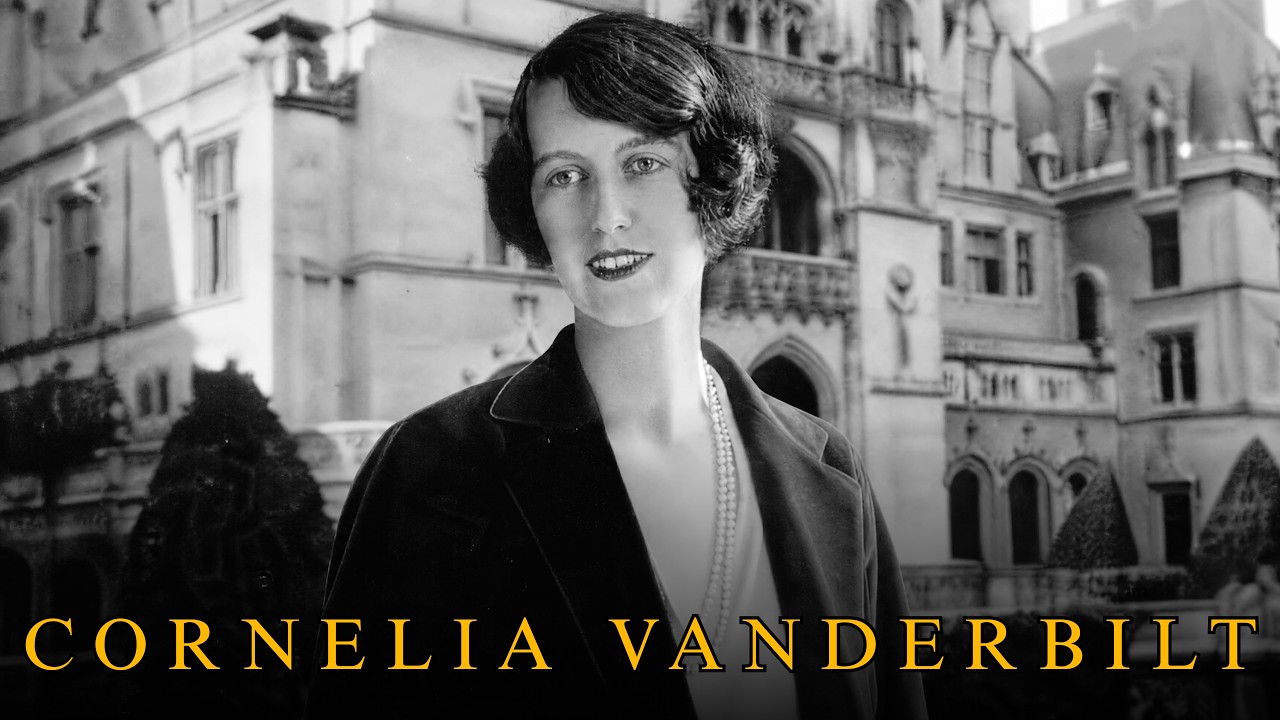
The man she was marrying was the Honorable John Francis Amherst Cecil, a British diplomat. The ceremony was held at noon in All Souls Church, the parish church in the village her father had built at the foot of the estate.
The church had been dressed for her with palms, dogwood branches, and azaleas cut from the grounds. A celebrated organist had come all the way from St. Louis to play.
Among the guests were a former American ambassador to France, the ambassador of Spain, and a former director of the United States Mint.
Her gown was white satin, long-sleeved and cut very straight in the clean line of the 1920s. Her veil was four full yards of tulle and lace, caught at her brow with orange blossoms sent up from Florida for the day.
Eight bridesmaids attended her, led by her maid of honor, a friend she called Bunchie. Eight ushers stood with the groom, headed by his best man.
As the couple came out of the church into the spring light, 44 children, all of them the sons and daughters of Biltmore’s workers, stood waiting in two lines and lifted spring blossoms over their heads to make an arch for the bride and groom to pass beneath.
A very small girl dressed as Cupid was there to greet them.
The reception filled the house. The bridal party sat at a table that curved around the marble fountain in the Palm Court. Forty-three family members and close friends were staying in the house for the occasion, spread across 35 of its bedrooms.
The gifts included 70 pieces of silver, 53 pieces of china, 25 pieces of jewelry, 20 books, and two pieces of Tiffany glass. Alongside the treasure came fishing tackle, a shotgun, and an English setter puppy.
When the newlyweds left, their car had been decorated with streamers and, in a private joke the whole crowd understood, with a pair of white slippers whose heels had been deliberately smeared with tar.
It was a nod to her nickname, Tarheel Nell, the name the mountain had given its own daughter.
For a single spring afternoon, Cornelia Vanderbilt stood at the very summit of the life she had been born into, adored, envied, and watched by thousands. It was the peak of her rise.
It was also, though no one in the cheering crowds could have known it, the last time she would ever look entirely at home in her own inheritance.
John Cecil surrendered a diplomatic career to become the manager of a house that would never truly be his.
Cecil came from the deep end of the British aristocracy. He had been born in London in the summer of 1890, the third son of Lord William Cecil. He had been educated at Eton and at Oxford, and he had entered the diplomatic service, arriving in Washington in 1923 as the first secretary of the British Embassy.
He was, in short, exactly the kind of titled European that American money had been buying for its daughters for two generations.
For his part, John Cecil took up the work of the house with a will. Running Biltmore meant overseeing an estate that still ran to thousands of acres, with its farms, its dairies, its forests, its staff, and its endless repairs.
He gave himself to it, this English aristocrat, far from his own country, and by every account he was good at it.
In October of 1925, a little more than a year after giving her daughter away at the altar, Edith Vanderbilt remarried. Her second husband was Peter Goelet Gerry, a United States senator from Rhode Island. The wedding took place in London.
With that marriage, Edith moved the center of her life away from the mountain.
Weigh what that meant for Cornelia. Her mother had been the true keeper of Biltmore since George Vanderbilt’s death. Now she was gone, not dead, but departed, off to a new marriage and a new life.
Within the space of about 18 months, Cornelia had gained a husband and lost the mother who had stood beside her at Biltmore. She was at last the sole mistress of the largest house in America, and she had never been more alone inside it.
The great rooms that had felt like a lonely kingdom in her childhood now felt like a lonely kingdom she was expected to run.
The French bedroom on the second floor had witnessed her first breath, and now it witnessed the first breaths of her children.
In 1925, in the same Louis XV room where Cornelia herself had been born, she gave birth to her first son, George Henry Vanderbilt Cecil. Three years later, in 1928, in that same bed in that same room, she bore her second, William Amherst Vanderbilt Cecil.
Three generations of one family now traced their first moment to a single bedroom in the largest house in America.
It ought to have been the very image of a dynasty securing itself forever. Set against everything that came after, it reads instead as something quieter and sadder. A room that kept its faithful appointment with each generation, while the family it served was already invisibly coming apart.
The costs of Biltmore never stopped. Four acres of floor still had to be heated and lit and staffed. The grounds still had to be tended, the roofs kept, and the bill came due every single month in good years and bad.
What did not keep pace was the family’s liquid wealth. The great fortune was real, but so much of it was locked up in the house and the land, in objects and acres that cost money to hold and produced very little.
A new federal income tax now reached into great fortunes in a way that had been unimaginable when George Vanderbilt laid his first stone. The age of the enormous private household staffed by scores of servants was passing quietly but unmistakably.
Biltmore was the largest of them all, and so it felt the change first and hardest.
Cornelia was living inside the gap between the photograph and the ledger. To the world, she was the luckiest woman in the South, mistress of Biltmore, mother of its heirs. To herself, more and more, she was the keeper of an enormous and hungry thing.
She was still young, not yet 30, and she was clever and restless and used to the wider world of school and travel and society. And she was watching her whole future narrow to a single shape, the shape of the house.
In the spring of 1930, the family home became a business with a ticket booth.
Faced with a house that cost a fortune to run and an economy that had just collapsed into the Great Depression, Cornelia and John Cecil made a decision that would define Biltmore for the next century. They opened the largest private house in America to the paying public.
The stock market had collapsed in the autumn of 1929. By 1930, the whole country was sliding into the long misery of the Great Depression. Asheville, a mountain city that had grown comfortable on tourists, was hit hard.

Into that ruin, the great house on the hill went on costing exactly what it had always cost.
The leaders of Asheville came to the family with a request that Biltmore open its doors to tourists and become an attraction that might bring the wider country to western North Carolina.
And so in the spring of 1930, Biltmore House opened to the public for the first time and began its long second life as what it is still called today, America’s largest home.
Of the decision, Cornelia said that she and her husband hoped that through opening Biltmore to the public, Asheville and Western North Carolina would derive all the benefit they deserved. She called the opening of her father’s house “a fitting memorial to my father.”
Hold on to that phrase, because it is the key to her. And because by the end of this story, it will have turned completely inside out.
Read one way, it is an act of grace. A daughter takes the impossible inheritance her father left her and finds a way to make it serve, to keep it alive, to turn it into something that honors him and helps a struggling town at the same time.
Read another way, it is the precise moment the home stopped being a home. On the day the ticket booth opened, Biltmore ceased to be the private world Cornelia had been born into and became a public building.
The family still lived there, but they now lived inside their own attraction.
Within two years of the ticket booth opening, Cornelia Vanderbilt began quietly and deliberately to leave.
Around 1932, the mistress of Biltmore began spending her time far from her own front door. She went first to New York, and she went there to study art.
It was a small thing on its face, a wealthy woman taking up painting, but it was the first visible sign of a hunger the house could not feed. She had been the keeper of a monument since she was a girl. Now, approaching her 30s, she wanted to make something of her own.
Painting was a door out of the role she had been handed at birth. It let her be a student rather than a symbol, a beginner at something rather than the finished monument to a fortune.
From New York, she went to Paris. And in Paris, something in her seemed to loosen.
She had spent her entire life inside other people’s ideas of who she was. In Paris, she was for the first time simply a woman in a city, one of thousands, unremarkable on the street.
For a person raised as a public monument, that ordinary anonymity must have felt less like exile than like oxygen.
Meanwhile, the marriage cooled. The record is quiet and discreet about exactly how and why. A wife who spends more and more of her time an ocean away from her husband and her house is a wife on her way out.
There was no explosion, no public rupture, none of the sensational scandal that usually attends the end of a great marriage.
What was happening to her had no name in the usual vocabulary of ruined heiresses. Nobody had pushed her. She had simply looked at the grandest life America could offer a woman and decided quietly that she did not want it.
The divorce was granted quietly in 1934. With it, Cornelia Cecil stepped out of the only world she had ever been given.
There was no great public scandal attached to it. Biltmore’s own account calls the parting amicable.
She simply obtained her divorce that year, and she left Asheville, and she never came back. Not that year, not the next, not in the four decades of life that remained to her.
She was 33 years old, and she was walking away from the largest private house in America, a house she owned outright.
From 1934 until her death in the 1970s, through a Second World War and the whole remaking of the century, she never once crossed back to the country of her birth or set foot in the house that carried her name.
John Cecil did not follow her back to Europe. He stayed. He remained at Biltmore and went on managing the estate, and he did so for the rest of his life until his death in 1954, 20 years after his wife had gone.
There were the children. George was about 9 years old in the year his mother left, and William about six. Two small boys whose mother crossed an ocean and did not return.
In Paris, the heiress of Biltmore cut her hair, dyed it a shade no Vanderbilt had ever worn, and began to tell people that her name was Nilchaure.
The color was startling, a vivid, unnatural brightness that the accounts remember as pink. And the name was an invention, a word that belonged to no family tree and no christening register.
Cornelia Stuyvesant Vanderbilt, the little chatelaine, the new star at famous Biltmore, put on bright pink hair and a made-up name and stepped out into a Paris street as someone else entirely.
This was not a woman letting herself go or drifting into eccentricity by accident. She chose the new color and the new name the way she chose everything now, on purpose, as acts of will.
She took the most famous private identity in the country and painted over it.
The fortune that had chained her to the house was also, in the end, the key that let her leave it. She used the inheritance not to sustain the monument as everyone had expected, but to walk away from it and pay for her own disappearance.
For most women of her time, escape on this scale was simply impossible. Cornelia could do what almost no woman of her century could do for one reason only: she held in her own name a fortune large enough to buy a life of total independence.
She had been assigned from birth the single most enviable identity in her country, and she found it unlivable. And she had the money and the nerve to simply set it down and become a stranger.
She settled in England and lived there with real independence.
In October of 1949, she married a man styled Captain Vivian Francis Bulkeley-Johnson. That marriage lasted until his death in 1968.
Then, in 1972, when she was past 70, she married again, a man named William Robert Goodier, known as Bill, who was some 26 years younger than she was.
Look at the arc of those three marriages, and a pattern comes clear. The first, to John Cecil, had been the grand dynastic match her world expected of her. The two that followed were entirely her own, chosen quietly on no one’s terms but hers.
She also became a patron of a quiet revolution in medicine. She supported the work of Edward Adamson, a pioneering British art therapist who used painting and drawing to reach patients in psychiatric hospitals.
She gave through a charitable trust that she ran under a deliberately plain and ordinary name.
The heiress who had spent her girlhood as a spectacle spent part of her fortune helping the unseen and the forgotten find some way to be seen. And she did it with her famous name kept carefully out of it.
Around that documented outline swirls a fog of rumor. Various later accounts have attached to her claims of an affair with the poet Robert Graves, a fourth marriage, and a death with no certificate ever issued. None of this rests on solid ground.
But the fog itself is worth noticing. A woman who deliberately erases her own name becomes a blank that other people fill in with invention. The rumors are not evidence of a wild life. They are evidence of a successful disappearance.
Three thousand miles from where she now lived, the house went on without her, and it did more than survive. It flourished.
The man who held it together at first was the husband she had left. John Cecil stayed at Biltmore for 20 years after Cornelia’s departure, managing the estate until his death in 1954.
But the real rescue came in the next generation, from one of the two small boys who had watched their mother go.
William Cecil, the younger son, born in that same French bedroom in 1928, grew up and came back. Where his mother had seen a cage, he saw a calling.
He made the preservation of Biltmore his life’s work. Under his care, the house became a thriving attraction, drawing something on the order of a million visitors a year, one of the most visited historic homes in the entire country.
He married a woman named Mary Lee Ryan, herself a first cousin of Jacqueline Kennedy, and he and his descendants carried Biltmore into a prosperous future.
The turnaround was total. A house that had nearly broken the family in the 1930s became under William Cecil’s long stewardship a thriving concern that supported itself, employed the region, and drew visitors from across the world.
The rooms Cornelia had fled filled year after year with people who paid gladly for the privilege of walking through them.
What Cornelia experienced as a sentence, William embraced as a purpose. The very same walls held both feelings. A cage to the one who was given no choice about them. A life’s work to the one who chose them freely.
George Vanderbilt’s great dream stands today at the end of its long approach drive, gleaming, restored, visited, and admired by more people every year than the whole population of the county it sits in.
The house won. The one who lost herself in the bargain, quietly by her own choice, was the daughter.
On February 7, 1976, in an English town far from any Vanderbilt, Cornelia died. She was 75 years old.
The girl whose single birth had been proclaimed across two American states slipped out of the world in Oxfordshire so quietly that the plain facts of her ending are uncertain to this day.
The loudest birth in Carolina had become the softest death in England.
Even the resting place is disputed. Some accounts, including the family’s own, say her ashes were laid at a church near her farm, a place called The Mount in the village of Churchill in Oxfordshire. Another account places her in the churchyard of a different English village altogether.
Wherever exactly her ashes rest, they rest in the English countryside, an ocean away from the Vanderbilt mausoleum on Staten Island and an ocean away from Biltmore.
She did not go home to be buried. She stayed away in the quiet foreign country she had chosen.
There was none of the ceremony her station had once commanded. For Cornelia, there was almost nothing of the kind, and that was her own doing.
She had spent 40 years dismantling the public person she had been born as. By the time she died, there was very little of that person left for the world to mourn.
Biltmore was built to hold a family forever, and forever was exactly what she refused.
Cornelia Vanderbilt was handed the single most valuable inheritance in America. And she spent her life demonstrating that the most valuable thing a Vanderbilt could own was the freedom to stop being one.
She gave away the largest private house ever built in her country. She gave away a fortune of millions. She gave away the name, one of the greatest in America. She gave away her marriage, her country, her hair, her face, her very self.
The freedom she bought with all of that giving was not the freedom to have more. It was the freedom to have nothing that could hold her and to be no one that anyone could name.
She had once said of opening Biltmore to the public that she hoped it would be a fitting memorial to her father. She was right, more right than she could have known. The house became precisely that, a memorial to George Vanderbilt, so enduring that a million people a year still walk through it.
And she left herself none. There is no great tomb for Cornelia, no monument, no crowd of pilgrims, not even a grave the sources can agree on.
There is a temptation to call it a tragedy and a temptation to call it a triumph. The truth is that it refuses to settle into either.
A tragedy needs a victim, and she was nobody’s victim. A triumph needs a prize, and it is hard to say what exactly she won beyond the bare right to be no one in particular in a country far from home.
The house survived. The name survived, carried on by the son who loved it. The fortune in its way survived. The father’s memorial survived and gleams at the end of its long drive and draws its million visitors still.
Only the woman it was all built for chose not to survive as herself.
Somewhere near the estate’s base pond, a magnolia had once been planted to grow with her. That tree was finally taken down in 2008, decayed and done.
By then, the woman it was meant to honor had been dead for more than 30 years and gone from the house for more than 70.
The tree that was planted to hold her there outlived her by decades, and it never held her at all.
She had walked out from under it in 1934 and never come back, down the long drive, past the great bright house, and out of the only world she had ever been given, into a freedom that cost her everything and that she seems, to the end, to have believed was worth the price.