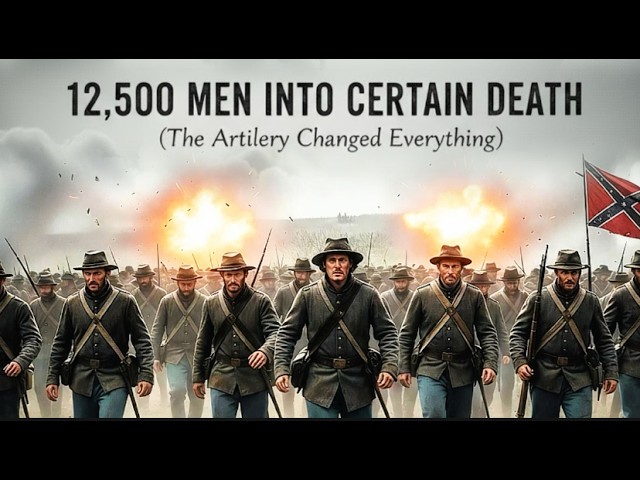
On July 3rd, 1863, nearly 13,000 Confederate soldiers stepped out of the woods on Seminary Ridge and began walking across three-quarters of a mile of open Pennsylvania farmland. By the time the smoke cleared, more than half of them would be casualties.
This wasn't just a failed military assault. It was the turning point that ended the Confederacy's last real chance to win independence. But most accounts miss a crucial detail. This disaster wasn't the result of poor planning or bad luck. It was the inevitable conclusion of strategic decisions made days earlier, cultural assumptions about warfare that no longer matched reality, and a fundamental misunderstanding of what modern artillery could do to infantry in the open field.
To understand why Lee ordered this assault, we need to back up three days. By July 1863, the Confederacy was facing a crisis. The Union blockade was strangling Southern ports. Federal forces controlled the Mississippi River, splitting the Confederacy in two. European powers who might have recognized Confederate independence were waiting to see if the South could actually win battles on Northern soil.
Robert E. Lee's invasion of Pennsylvania wasn't just about tactics. It was political theater with military means. A decisive victory near a major Northern city might convince Britain or France to intervene. It would certainly demoralize Northern civilians and strengthen peace Democrats arguing for a negotiated settlement.
But time was running out. Lee's army was far from its supply base, operating in hostile territory, and couldn't sustain a prolonged campaign.
When the Battle of Gettysburg erupted on July 1st, it was initially an accidental encounter. Confederate forces stumbled into Union cavalry while searching for supplies. But the battle quickly escalated, and by July 2nd, both armies had converged on this small Pennsylvania town. Lee had won significant tactical victories on the first two days, pushing Union forces back onto Cemetery Ridge and Cemetery Hill.
Here's where Lee faced his critical decision. He could withdraw back to Virginia with his army intact, or he could attempt one more decisive assault to break the Union army and achieve that war-winning victory he needed. Lee chose to attack, and not just anywhere. He chose to assault the center of the Union line, the strongest point, with a frontal assault across open ground.
There's a persistent myth that needs addressing. The idea that Civil War generals were incompetent butchers who didn't understand that rifles had made frontal assaults obsolete oversimplifies both the technology and the tactical thinking of the era. The reality is more nuanced.
Rifled muskets had indeed increased infantry range from about 100 yards to 300 to 400 yards. But artillery was still smoothbore in many cases, and defenders behind fortifications were still vulnerable to a mass charge if the attacking force could close the distance quickly and reach hand-to-hand combat.
Lee had seen this work before. At Chancellorsville, just two months earlier, aggressive Confederate assaults had shattered larger Union forces. The tactical doctrine of the era still held that determined infantry could overcome defensive positions through shock action and momentum.
What Lee may not have fully appreciated was how much the defensive situation at Gettysburg differed from previous battles. The Union center wasn't just defended by infantry with rifles. It was supported by massed artillery with clear fields of fire positioned on elevated ground, with infantry protected by a stone wall that provided perfect cover while allowing them to fire freely.
This brings us to July 3rd and the crucial preliminary bombardment. At 1:07 p.m., Confederate artillery opened fire with what witnesses described as the largest bombardment ever seen in the Western Hemisphere. Over 140 Confederate guns fired continuously for nearly two hours, attempting to destroy Union artillery and demoralize Union infantry before the infantry assault began.
The plan was sound in theory. Suppress the defenders, destroy their artillery, and then send in the infantry to finish the job. But the execution revealed a critical limitation of 1860s artillery technology. Accuracy at long range was extremely poor.
Most Confederate shells overshot their targets. Instead of hitting the Union guns positioned along Cemetery Ridge, they struck the rear areas where they destroyed wagons, killed horses, and created chaos, but did little damage to the actual defensive positions.
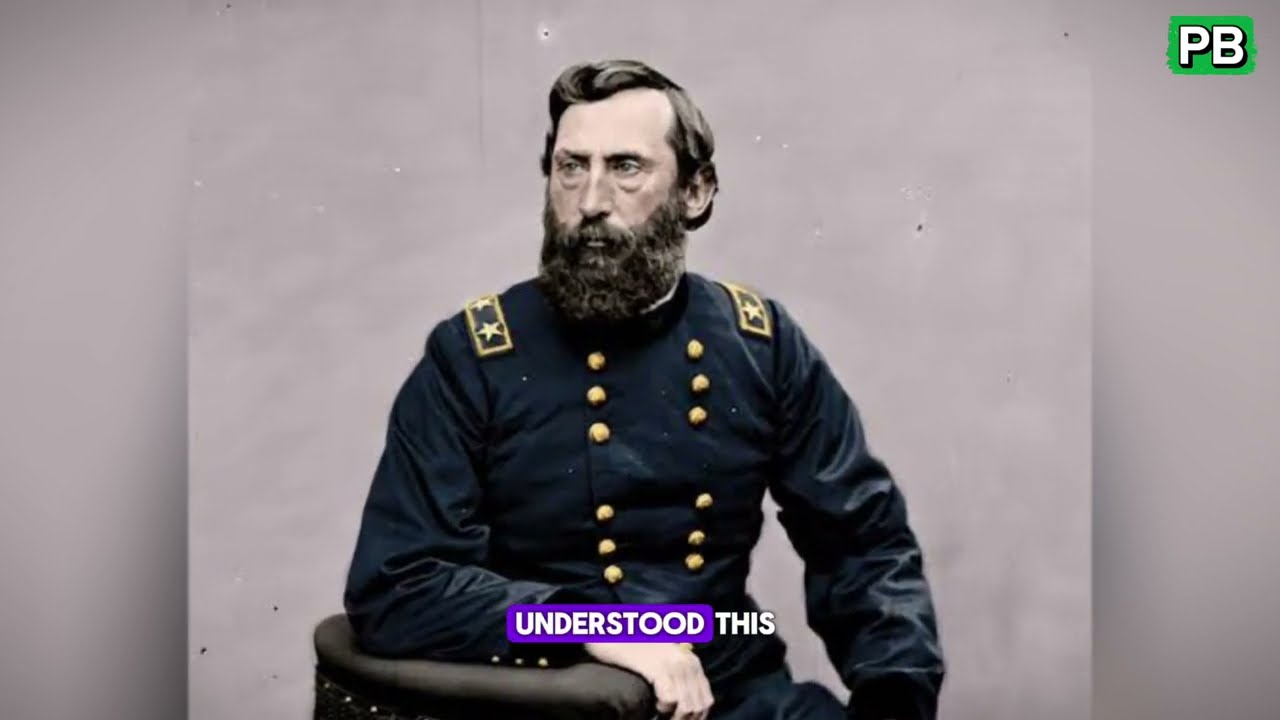
Union artillery chief Brigadier General Henry Hunt understood this. He ordered his batteries to slow their fire, conserving ammunition for the real fight, the infantry assault he knew was coming. This created an optical illusion. From Confederate positions, it appeared that the Union artillery had been silenced.
Lee's artillery commander, Colonel Edward Porter Alexander, sent word that the infantry should advance quickly while Union guns were supposedly neutralized. In reality, dozens of Union batteries were simply waiting, loaded with canister, essentially giant shotgun shells filled with metal balls, devastating at close range.
The infantry that stepped out of the woods at around 3:00 p.m. was walking into a trap that their own bombardment had actually made worse. The smoke from two hours of artillery fire hadn't cleared. It hung in the valley, obscuring the true position and strength of Union defenses.
What happened next wasn't chaos or confusion. It was methodical slaughter conducted by soldiers on both sides doing exactly what their training required. The Confederate formations, Pickett's fresh division on the right, Pettigrew's and Trimble's divisions in the center and left, stepped out in textbook parade ground formation, colors flying, lines dressed, officers maintaining spacing.
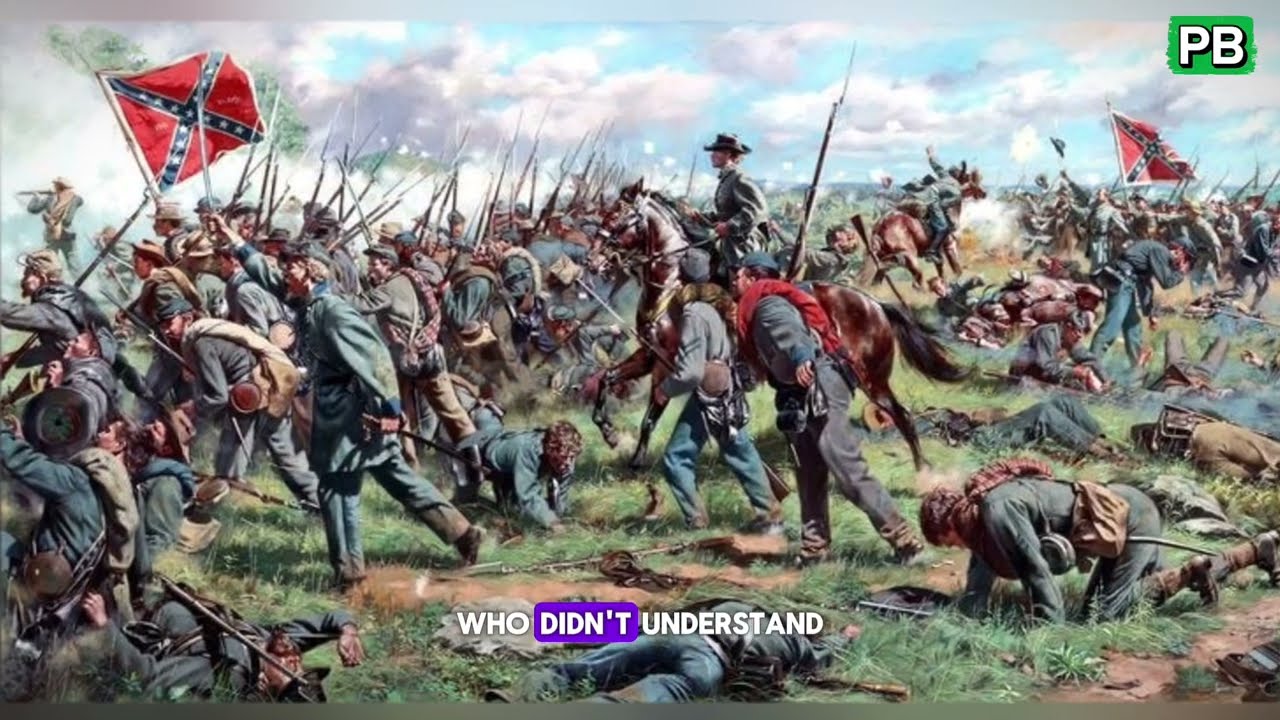
They had to cross nearly three-quarters of a mile of open ground, all of it uphill, all of it under observation. The first shells that struck them were solid shot, iron cannonballs that bounded through the ranks at waist height. These created horrific casualties but didn't break the formation. Officers closed the gaps. The advance continued.
As they reached about 500 yards, Union artillery switched to explosive shells. These burst overhead, sending shrapnel raining down on the packed formations. Still they came on. Men fell, others stepped forward to fill the ranks.
At 250 yards, the Union infantry opened fire. Not a ragged individual fire, but organized volleys by regiment. Each unit firing in sequence to maintain continuous fire. Confederate soldiers described it as walking into a hailstorm of lead.
And then came the canister. At 100 yards, Union artillery fired directly into the Confederate formations at point-blank range. Each canister round contained roughly 80 iron balls. A single discharge could cut down an entire company. Batteries fired as fast as crews could load, sometimes achieving three rounds per minute.
The Confederate advance didn't break all at once. Elements actually reached the Union line at a point that came to be called the high-water mark of the Confederacy. A cops of trees near a stone wall, where for about 15 minutes hand-to-hand combat raged. Confederate soldiers planted battle flags on the Union breastworks. Officers fought with swords. Men wrestled over cannon.
But Union reinforcements arrived quickly. Fresh regiments wheeled into position. The Confederate penetration was sealed off, then driven back. And once the retreat began, it became catastrophic. Men who had advanced in disciplined lines now fell back in disorder, still under artillery fire. The ground they had to cross was now littered with their own wounded.
Of the roughly 12,500 men who began the assault, approximately 6,500 became casualties, killed, wounded, or captured. That's a casualty rate of over 50 percent. Some individual units lost 75 percent or more. Pickett's division, which led the assault, was effectively destroyed as a fighting force.
The failure of Pickett's Charge ended the Battle of Gettysburg. Lee had no reserves left for another attack. On July 4th, he began the long, painful retreat back to Virginia.
But the consequences extended far beyond the tactical situation. The political impact was immediate. News of the victory at Gettysburg arrived in Washington almost simultaneously with word of the fall of Vicksburg on July 4th, where Union forces captured an entire Confederate Army on the Mississippi River. The one-two punch revitalized northern morale and effectively ended any chance of European recognition of the Confederacy.
It also marked a fundamental shift in Confederate strategy. Never again would Lee attempt a major invasion of the north. The Army of Northern Virginia had lost not just men, but its offensive capability. From July 1863 forward, Confederate strategy became fundamentally defensive, trying to hold territory and prolong the war in hopes that northern willpower would collapse.
Perhaps most important, Gettysburg demonstrated that the tactical balance had shifted decisively in favor of the defender. Infantry assaulting prepared positions with artillery support would suffer unsustainable casualties. This lesson would be relearned tragically in World War I, but the evidence was clear at Gettysburg in 1863.
Some historians argue about what might have happened if Lee had attacked elsewhere or if he had never fought at Gettysburg at all. But these what-ifs miss the fundamental point. By July 1863, the Confederacy was in a strategic situation where only a decisive battlefield victory in the north could change the war's trajectory, and the technology and tactics of the era made such a victory nearly impossible to achieve.
The numbers tell part of the story, but they can't capture the human reality. Lieutenant Frank Haskell, a Union staff officer who witnessed the assault and helped organize the defense, wrote one of the most detailed accounts we have of these events. His letters, written days after the battle, describe not just the tactical details, but the emotional aftermath.
He wrote about Union soldiers who had been fighting desperately just minutes before now offering water to wounded Confederate prisoners. About the field after the battle covered so thickly with dead and wounded that you could walk across it stepping only on bodies. About the cries of the wounded that continued through the night.
The Battle of Gettysburg produced roughly 51,000 total casualties over three days, killed, wounded, captured, or missing. The town of Gettysburg, population 2,400, suddenly had to cope with nearly 22,000 wounded soldiers. Every church, school, and home became a hospital. Residents would find wounded soldiers in their barns and yards for weeks afterward.
Pickett's Charge has become the iconic image of the Civil War. Brave men marching in perfect formation toward certain death. But understanding why this happened, the strategic pressures that drove Lee to attack, the tactical assumptions that made the assault seem viable, and the technological realities that made it suicidal, gives us insight not just into one battle, but into how warfare was changing in the mid-19th century.
The same factors that doomed Pickett's Charge would reappear 50 years later in the trenches of World War I. The increased lethality of defensive firepower, the difficulty of coordinating attacks across open ground, and the terrible human cost when military doctrine lagged behind military technology.
The high-water mark of the Confederacy wasn't just a spot on a battlefield. It was the point where one vision of how the war could be won died, replaced by the grim reality of a conflict that would continue for nearly two more years, but with the outcome increasingly inevitable.
That's the real lesson of July 3rd, 1863. Not that the Confederate soldiers lacked courage or that Lee was incompetent, but that wars aren't won by bravery alone when the strategic situation and tactical realities are working against you.