Etheldrada Malt stood beside Elizabeth Tudor as the princess was taken by barge to the Tower of London on March 18, 1554. Elizabeth, the daughter of Henry VIII and Anne Boleyn, was entering the fortress under suspicion of treason during the reign of her half-sister, Mary I. The Tower carried grim meaning for Elizabeth; her mother had been imprisoned there before her execution in 1536. Among the small group of women permitted to accompany her was Etheldrada, a woman later rumored to be another daughter of Henry VIII, born outside marriage and never publicly acknowledged.
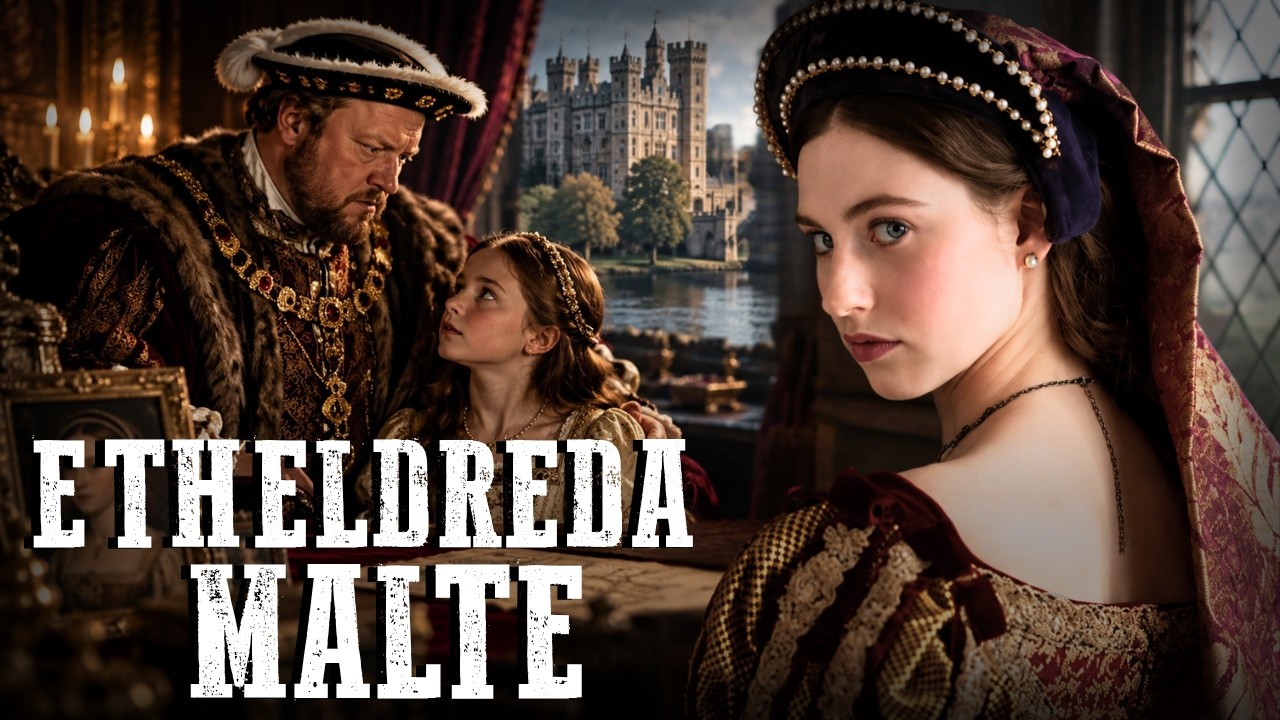
Two possible daughters of the same king now faced danger together under the rule of their elder half-sister. It is an image that has fueled one of the strangest mysteries of the Tudor era, yet the documentary record tells a far more complicated story. Etheldrada was likely born between the late 1520s and early 1530s, during one of the most unstable periods of Henry VIII’s reign. The king was seeking to annul his marriage to Catherine of Aragon in order to marry Anne Boleyn, and what began as a marital dispute triggered a national crisis that ultimately led Henry to break with the Catholic Church.
The Tudor court offered little privacy. Foreign diplomats and rival noble families monitored the king’s daily life, and imperial ambassadors filed detailed reports on his private affairs. In such an environment, a long-term hidden relationship would have been difficult to conceal. Henry’s other known mistresses left clear traces in diplomatic and financial records.
For Etheldrada, no such evidence exists to prove a secret royal romance. The identity under which she lived was firmly that of the Malt family. She bore the surname of John Malt, a royal tailor who served Henry VIII personally. Some writers have wondered whether her name, apparently shortened to Audrey, might indicate the date of her birth, since children were sometimes named after saints connected to their baptism.
St. Etheldreda’s feast day fell on June 23. It is an interesting possibility, but it cannot identify her parents. More significant is the legal context of her birth.
Under sixteenth-century law, an illegitimate child was filius nullius, a child of no one, holding no automatic inheritance rights. Without deliberate legal intervention, an illegitimate daughter faced a future stripped of both wealth and social status. This legal background is essential, because much of the mystery surrounding Etheldrada is actually a mystery about property. Later tradition usually names her mother as Joan Dingley, sometimes written Joan Dingley, a low-ranking woman connected with the royal household.
Some accounts state that Joan later married a man named Dobson. The story goes that Joan met the king, became his mistress, gave birth to a daughter, and the child was quietly placed in the household of one of Henry’s trusted servants. The problem is that the contemporary evidence for the first part of that chain is extremely weak. No surviving source from Henry’s lifetime clearly establishes Joan Dingley as his mistress.
Her name does not appear among the best-documented women connected romantically with the king. There is no surviving letter, no known payment explicitly connected to an affair, and no diplomatic report describing her as favored by Henry. The argument often becomes circular: Etheldrada is described as Henry’s daughter because Joan is said to have been his mistress, and Joan is identified as his mistress because Etheldrada is believed to have been his daughter. Remove either assumption and the argument supporting the other becomes much weaker.
The man who does appear clearly in the records is John Malt. Popular versions of the story sometimes reduce him to “Henry’s tailor,” creating a misleading impression of a modest tradesman far from political power. In reality, a royal tailor worked within a highly specialized household structure and had access to the king that most ordinary subjects could never obtain. Henry VIII used clothing as part of royal display, and his garments required expensive fabrics, skilled labor, and substantial financial administration.
A servant trusted by the king could petition for leases, land, offices, and legal arrangements. Royal generosity toward Malt was not unusual; by May 1541 he had received royal lands in Berkshire, and in July 1544 he obtained further valuable property in Somerset. These grants demonstrate that he had already accumulated property through royal favor before Etheldrada was directly inserted into any settlement. In 1546, John Malt prepared his will.
He did not describe Etheldrada vaguely. He referred to her as his bastard daughter. He did not call himself her guardian. He did not describe her as a child entrusted to him by another man.
The document uses straightforward language recognizing her as his illegitimate daughter. Supporters of the royal paternity theory respond that Malt’s statement could have been part of a deliberate arrangement, that if Henry wanted Etheldrada’s true identity concealed, Malt would naturally be expected to call her his daughter in legal records. That argument cannot be completely disproved, but it creates a methodological problem: once every document contradicting a theory is treated as evidence that a cover-up was successful, the theory becomes extremely difficult to test. The crucial development came in September 1546, only months before Henry VIII died.
By that stage, the king’s health had deteriorated badly, and political attention was focused on what would happen after his death. His only legitimate son, Edward, was still a child, and the court was divided among competing factions. In this environment, a grant was issued involving valuable lands at Watchfield, Shivenham, and Kelston. Instead of granting the estates to John Malt alone and leaving him to decide later what happened to them, the crown named Etheldrada directly within the arrangement.
She was explicitly identified as Malt’s illegitimate daughter, and father and daughter were incorporated into the ownership structure through a form of joint tenancy. Under this arrangement, if John Malt died, Etheldrada would continue to hold the estates. Her position was built into the original legal instrument, removing a major layer of uncertainty. Had Henry simply given the property to Malt, Etheldrada’s future would still have depended heavily on her father’s will and on disputes after his death.
By placing her directly into the grant, the settlement made her interest much more secure. For supporters of the royal paternity theory, the timing is crucial. They argue that Henry may have been attempting to settle unfinished personal affairs before his death, providing for a biological daughter while avoiding any public acknowledgement that would create a dynastic problem. The property could be granted through John Malt, who already had a legitimate reason to receive royal favor, and Etheldrada could be inserted into the settlement as Malt’s daughter, allowing royal wealth to reach her without requiring the king to acknowledge any biological connection.
But there is no surviving royal memorandum stating that the land was intended for Henry VIII’s natural daughter. There is no private instruction explaining that Malt was serving as a proxy. There is no letter from a courtier identifying the arrangement as a disguised provision for royal blood. The grant itself describes Etheldrada as John Malt’s illegitimate daughter rather than Henry’s.
The comparison with Henry’s acknowledged illegitimate son, Henry Fitzroy, is instructive. Born in 1519 to Elizabeth Blount, Fitzroy was publicly acknowledged by the king. Henry gave him the surname Fitzroy, literally marking him as the son of a king, and in 1525 created him Duke of Richmond and Somerset. Fitzroy received major offices, lands, household staff, and status appropriate to someone occupying an exceptional position near the royal family.
Nothing remotely comparable happened to Etheldrada. She was never publicly acknowledged, never received a royal surname, never received a title marking her relationship to Henry. Supporters of the royal theory answer by pointing to gender. Fitzroy was male, and in a monarchy obsessed with producing a male heir, an illegitimate son could have dynastic value.
An illegitimate daughter offered much less. There is some internal logic to that argument, but again, possibility is not proof. The marriage of Etheldrada sometime around late 1546 or 1547 to John Harrington of Stepney connected her to a politically ambitious family and to circles far closer to national politics than the description “tailor’s daughter” might suggest. The secure property arrangement and her marriage occurred within a very short period.
By the time Henry VIII died in January 1547, the woman once legally disadvantaged by illegitimacy had become both a substantial property holder and the wife of a politically connected gentleman. Yet her new position exposed her to dangers. John Harrington moved within circles connected to Thomas Seymour, the ambitious younger brother of Jane Seymour and maternal uncle of the young King Edward VI. Thomas Seymour’s political ambitions ultimately ended in disaster.
In 1549 he was accused of treason and arrested, and his associates were examined. John Harrington was among those affected and was imprisoned in the Tower of London. There is no surviving evidence that Etheldrada invoked secret royal kinship to protect him. The crown did not treat Harrington’s marriage to her as a reason to exempt him from investigation.
Her presence beside Elizabeth in the Tower in 1554 demonstrates genuine loyalty and political value. The Harrington family already had political and personal connections to Elizabeth’s circle, and Etheldrada’s presence can be explained through loyalty, household association, and the network of relationships surrounding Elizabeth. There is no surviving record indicating Elizabeth ever recognized her as a sister, either in the Tower or later as queen. Etheldrada could move through circles touched by succession crises, treason investigations, and religious conflict while still being legally and socially identified through the Malt and Harrington families.
In January 1559, Etheldrada was present at Elizabeth’s coronation, placing her physically among the elite at the beginning of the new reign. Only days after the coronation, she died, still a relatively young woman. She left behind a daughter, Hester, and the complicated property history that had followed her since the final months of Henry VIII’s reign. If Etheldrada had believed herself to be Henry’s daughter, no surviving declaration from her establishes it.
There was no dramatic statement at the end of her life, no surviving will in which she asserted a hidden Tudor identity. Elizabeth I, who now possessed the power to change the situation, did not acknowledge any relationship. There is no surviving royal declaration identifying Etheldrada as Henry VIII’s child. Her daughter was not publicly treated as the descendant of a Tudor princess.
The estates associated with the 1546 settlement did not return to the crown after Etheldrada’s death. They continued according to the legal structure that had been established. John Harrington retained control of Kelston and later married Isabella Markham, and the property became part of the lasting economic foundation of the Harrington family. The more the property history is examined, the more the issue returns to the same fundamental problem.
Etheldrada’s exceptional financial settlement fueled centuries of royal rumors, but it more likely stands as a masterful example of Tudor patronage. Rather than hiding a royal secret, John Malt leveraged his lifelong proximity to the king to engineer a legal safety net for a vulnerable child. That interpretation requires no secret affairs, no hidden agreements, and no conspiracy of silence at court. Etheldrada began life with a serious legal disadvantage and ended it as a wealthy woman whose property became part of the foundation of an important family.
The central figure in that transformation was not Henry VIII as a hidden father, but John Malt, turning years of royal service into lasting protection. Etheldrada Malt was never royal, yet she lived near royalty. She possessed crown-derived wealth, yet that wealth became private family property. She stood beside Elizabeth in moments of danger, yet Elizabeth never identified her as a sister.
She did not need to be Henry VIII’s daughter to become an exceptional figure in Tudor history, which explains why nearly five centuries later her name has not disappeared.