On the morning of October 25, 1957, Albert Anastasia settled into the barber’s chair at the Grasso Barber Shop inside the Park Sheraton Hotel in Midtown Manhattan. He was fifty-five years old, the boss of what would later be known as the Gambino crime family, the founder and operational director of Murder Incorporated, and a man responsible, by conservative estimates, for between four hundred and one thousand contract killings across America. He was called the Lord High Executioner. He was called the Mad Hatter.
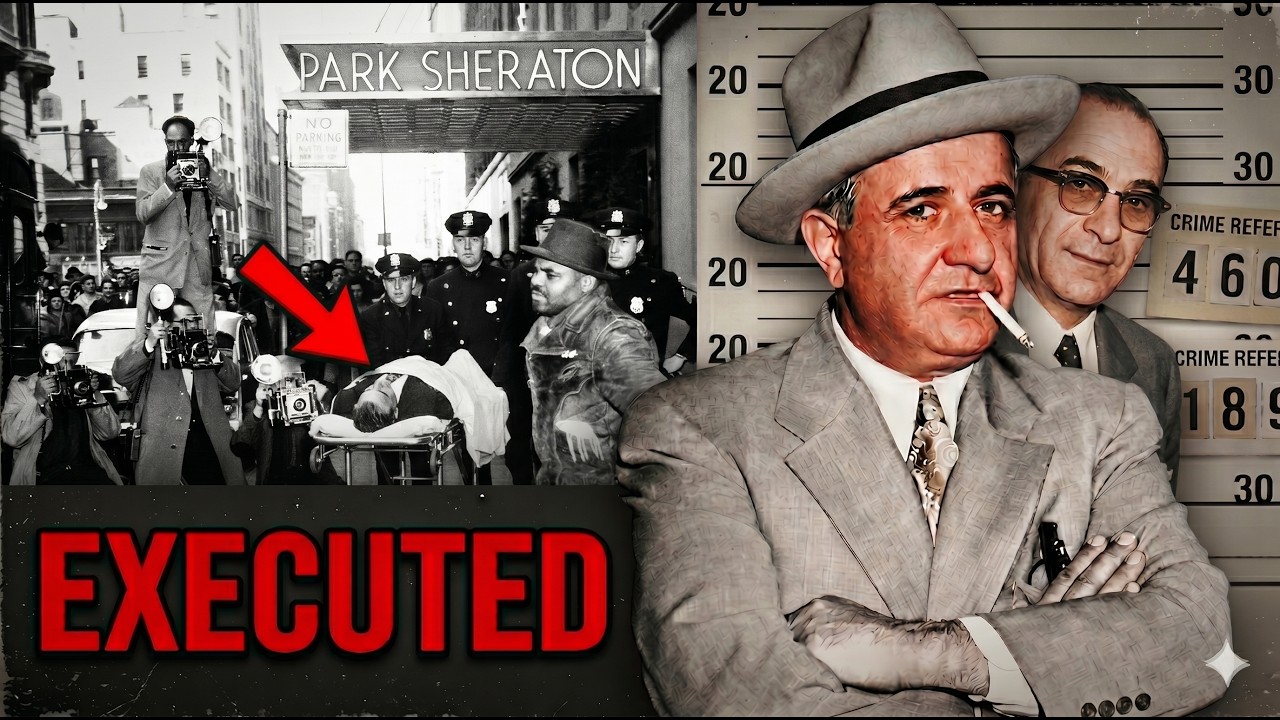
The FBI considered him one of the deadliest criminals in American history. He was getting a haircut. His bodyguard, Anthony Coppola, was not in the shop. He had stepped outside.
Why he left, whether he was bribed or told to leave, whether his absence was arranged as part of what was about to happen, was never definitively established. The barber draped a hot towel over Anastasia’s face. He reclined, blind to the room. Two masked men walked through the front door, shoved the barber aside, and opened fire.
Ten shots. Anastasia was hit multiple times. He rose from the chair, wounded and disoriented, and lunged at his attackers, but he attacked their reflections in the mirror instead of the men themselves. He fell to the floor.
Fourteen witnesses were in the shop that morning. One hundred detectives were assigned to the case. No one was ever charged. The murder was never officially solved.
But to anyone who understood what was happening inside the American Mafia in 1957, the answer was never a genuine mystery. The barber’s chair was not the beginning of this story. It was the final destination of a man whose decisions over the previous five years had made him more enemies than he could manage. Anastasia was born Umberto Anastasio on September 26, 1902, in Tropea, a coastal town in Calabria, in the southernmost region of mainland Italy.
He came to America as a teenager working on cargo ships. He jumped ship in Brooklyn. He was fifteen, with no money, no English, and no legal standing. Within a few years he had a criminal record and a reputation as someone who would kill without hesitation.
In 1920, he was convicted of murdering a longshoreman on the Brooklyn waterfront and sentenced to death. He spent eighteen months on death row at Sing Sing. Then the four witnesses against him disappeared before his retrial. No witnesses.
No conviction. He walked. For the next thirty years, Anastasia ensured that people who could put him away found reasons to be unavailable when courts came calling. In the 1930s, he became the operational director of Murder Incorporated, the enforcement arm used by Lucky Luciano, Meyer Lansky, and the heads of the five New York families to manage disciplinary problems across the National Crime Syndicate.
Murder Inc. operated out of a candy store in Brownsville, Brooklyn, and carried out hundreds of killings across its operational lifespan. Anastasia ran the killers and participated directly when the situation required it. He was one of the four gunmen who killed Joe the Boss Masseria at the Nuova Villa Tammaro Restaurant in Coney Island in April 1931, the murder that ended the Castellammare War and cleared the way for Luciano’s commission.
He was present. He fired. He walked away. In 1951, he decided he was done being the underboss.
Vincent Mangano had led what would become the Gambino family since the early 1930s, with Anastasia as his second-in-command. The specific nature of their conflict is not fully documented, but its resolution is. In April 1951, Mangano’s brother Philip was found shot to death on a Brooklyn beach. Vincent Mangano disappeared the same day and was never found.
Anastasia presented himself to the commission and claimed the boss’s chair, arguing that Mangano had been plotting against him and that self-defense had required preemptive action. The commission, facing the reality that Anastasia was now running the family whether they approved or not, ratified his position. The first years of his rule were relatively stable. He was allied with Frank Costello, the most politically powerful figure in the New York underworld, a man known for his connections to judges and politicians rather than his willingness to commit violence personally.
Costello provided the political infrastructure. Anastasia provided the muscle. Their mutual enemy was Vito Genovese. Genovese had fled America in 1937 to escape a murder charge.
He spent the war years in Italy, where he donated to Mussolini’s fascist party, was knighted as Commendatore, and supplied cocaine to Mussolini’s son. He returned in 1945 after two key witnesses in the original murder case were found dead before trial, was acquitted, and went back to work. He wanted power, specifically control of the Luciano family that Costello was running in Luciano’s absence. Genovese had been the family’s underboss before his flight.
He believed the top position was his by right of seniority. Costello stood between him and that position. Anastasia stood beside Costello. Since 1946, Genovese had been building toward a move against Costello, and the consistent obstacle was Anastasia.
Nobody in the New York underworld was eager to move against Costello while Anastasia was positioned as his protector. But by 1956 and 1957, Anastasia had begun accumulating enemies with an efficiency that suggested he was not thinking clearly about long-term consequences. The first and most publicly damaging problem was the Arnold Schuster affair. On February 18, 1952, Schuster, a twenty-four-year-old textile worker and amateur detective, spotted Willie Sutton, the famous bank robber who had escaped from prison and was on the FBI’s Ten Most Wanted list, on a Brooklyn subway car.
Schuster followed him, confirmed his identity, and contacted police. Sutton was arrested. Schuster was featured on the news as a civic hero. Anastasia was watching the coverage from his home.
He flew into a rage. He hated squealers. The fact that Sutton had no connection to organized crime was irrelevant. The principle of someone talking to the authorities was enough.
He ordered Schuster killed. Three weeks later, on March 9, 1952, Schuster was shot twice in the groin and once in each eye on a Brooklyn street. He was twenty-four, had no criminal record, and had done something most people would consider civic virtue. The murder shocked the entire structure of American organized crime, not for moral reasons but for practical ones.
Every major organized crime figure understood what the killing represented. It was an attack on a civilian who had cooperated with law enforcement in a completely unrelated matter. If mob bosses started killing civilians who talked to police about ordinary crimes, the backlash from law enforcement and politicians would be exponentially more aggressive than anything the organizations had previously faced. Luciano, managing his American interests from Italian exile, was reportedly furious.
Lansky, who had built carefully calibrated relationships with police and politicians that depended on discretion, was furious. The commission was furious. Anastasia had acted dangerously and irrationally, threatening the entire organizational structure. Nobody forgot it.
His second problem was more directly operational. He was selling Mafia membership. Formal induction into La Cosa Nostra was supposed to be one of the most carefully controlled processes in the organization. Candidates had to be Italian, had to have demonstrated loyalty over years of association, had to be vouched for by existing members, and had to be approved by the commission.
Anastasia was accepting cash payments reported at fifty thousand dollars per induction regardless of the vetting requirements. His underboss, Frank Scalise, was suspected of running the actual payments while Anastasia provided the authorization. In 1957, Scalise was shot to death on a Bronx street. When his brother Joe threatened revenge, he was killed too.
But the damage was done. Men who had earned their positions through years of service watched their status being sold to strangers. The institutional credibility of the membership structure had been compromised. The third problem was Meyer Lansky.
Anastasia had moved to expand into the Cuban casino market, opening gambling interests in Havana in direct competition with operations Lansky had spent years building on behalf of Luciano’s interests. Lansky was the financial architect of the National Crime Syndicate, and his Cuban operations were central to the revenue structure he managed. Having Anastasia set up competing casinos was not simply a business problem. It was a declaration that Anastasia considered himself outside the normal rules of territorial arrangement.
Lansky went to Genovese. The specific conversation that produced the conspiracy is not documented in the way courtroom testimony or FBI surveillance would have documented it. What is documented is the outcome. Lansky, Genovese, and Carlo Gambino, Anastasia’s own underboss, reached an agreement that Anastasia needed to be removed.
The mechanism was elegant in the way the most effective mob politics are elegant. Genovese needed Anastasia removed to clear his path to Costello. Gambino needed Anastasia removed to get the boss’s chair for himself. Lansky needed Anastasia removed to protect the Cuban casino interests.
Three different men with three different motivations had arrived at the same conclusion. The coalition that formed was sufficiently powerful that the relevant members of the commission approved the operation. The inducement Genovese offered Gambino was simple. Help arrange the killing of your own boss, and the family will be yours.
Gambino accepted and switched sides. He gave the contract to caporegime Joseph Biondo, who gave it to a squad of Gambino-connected shooters led by Stephen Armone and Stephen Grammauta. The identity of the triggermen on the morning of October 25 has been debated for decades. Joey Gallo, the unpredictable Brooklyn gangster who would later be shot to death himself at Umberto’s Clam House, is the most commonly cited name.
It has never been conclusively proven. What is not disputed is the morning itself. Coppola stepped outside. The barber applied the hot towel.
Anastasia reclined with his eyes covered and his face wrapped in warm linen, in a state of relaxed vulnerability. Two masked men walked through the door. They fired. He rose and attacked the mirror.
He died on the floor. The barber’s chair is now in the Mob Museum in Las Vegas, the blood stains still visible on the upholstery. The barber shop is now a Starbucks. No one was charged.
No trial was held. What happened next tells you everything about who arranged it and whether the decision was considered a success. Carlo Gambino became the boss of the family that now bore his name. He ran it for the next nineteen years with disciplined intelligence that Anastasia had never possessed.
He discouraged drug trafficking, kept his profile low, drove a Buick, attended mass, and died in his bed in Massapequa, Long Island, in October 1976 at age seventy-four. Vito Genovese achieved his immediate goal. Frank Costello resigned the family leadership after an assassination attempt in May 1957, and Genovese took control of what became the Genovese crime family. His celebration was short-lived.
The Apalachin meeting he organized to formalize his new standing, held at Joseph Barbara’s estate in upstate New York on November 14, 1957, just twenty days after the Anastasia murder, turned into a catastrophe when state troopers discovered it and identified over sixty of the most powerful organized crime figures in America in a single afternoon. The public exposure and law enforcement scrutiny that followed were precisely what everyone had feared from the Schuster murder five years earlier. Genovese was arrested in 1958 on narcotics charges, a prosecution his former allies, including Gambino, Costello, and Lansky, reportedly helped arrange by luring him into a drug deal with a government informant. He died in federal prison in February 1969.
Meyer Lansky retained his Cuban operations until Fidel Castro’s revolution eliminated them in 1959. He spent the rest of his life navigating between the United States and Israel, dying in 1983 at age eighty-one.