By 1936, when the state hospital named Camarillo opened its doors in the foothills of the Santa Monica Mountains, California had spent roughly a decade building something unprecedented. The institution was designed as a complete community: a working dairy, farmland, a gas station, a credit union, and rows of tile-roofed buildings styled after the old Spanish missions, complete with heavy arches and a bell tower. The state called it the largest mental hospital in the world, built to hold thousands of patients across hundreds of acres. For decades, it would be filled well beyond its limits.
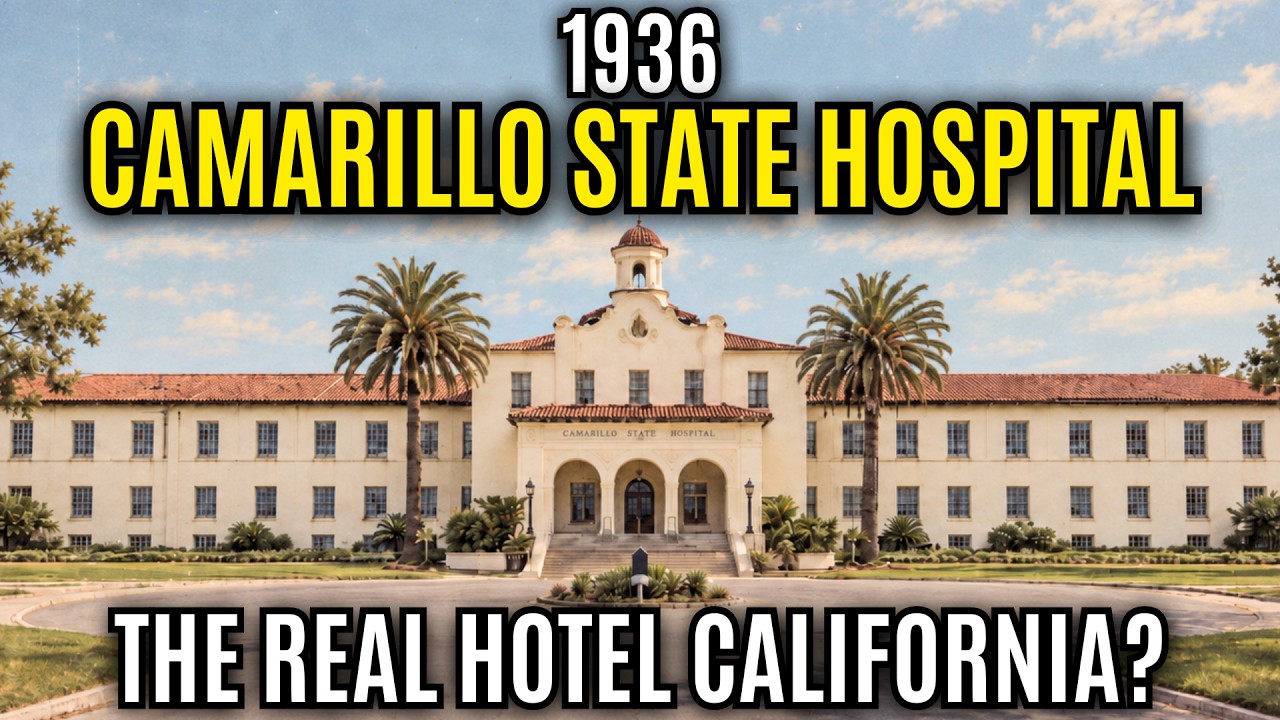
And in time, a rock song about a luxury hotel would give the place a fame it never earned, while the people who could not leave were quietly forgotten. The ground itself had a long history before any hospital stood on it. In 1836, California was Mexican territory, and the land was open and unclaimed. A widow named Isabel Yorba petitioned the governor for it because she had 500 head of cattle, 40 tamed horses, and mares, with nowhere to keep them.
Governor Mariano Chico granted her Rancho Guadalasca, more than 30,000 acres. She ran the ranch for 35 years, until her death in 1871. The land then passed through several owners, eventually becoming a bean and sugar beet farm owned by the Lewis family, who kept it until 1931. By then, the state was facing a crisis it could not solve with farmland.
Its six institutions already held 16,000 patients, and the legislature was spending money on a seventh. In 1929, it allocated one million dollars for land and buildings. In 1932, the state bought roughly 1,500 acres from the Lewis farm for $415,000. The idea behind the new hospital was humane and specific: a functioning town, with fields to work and animals to tend, where daily routine would be part of the treatment.
In September 1939, a doctor named Jacob Frestig arrived to put the second half of that idea into practice. He had studied insulin shock therapy in Warsaw and came to Camarillo to apply it. The principle was simple: lower a patient’s blood sugar until they entered a coma, then wake them, and hope their mind returned changed. In his first six months, Frestig reported treating 29 patients and discharging 23 as cured, with four others partially recovered.
The numbers came from the doctor who administered the treatment and were published in a newspaper article, with no independent follow-up. Construction began in 1933, with the official name Camarillo State Hospital, shortened by staff to just Cam. The buildings rose in stages through the 1930s and into the 1950s. In April 1936, the state appointed its medical director, psychiatrist Thomas Haggerty.
The hospital formally opened in October of that year. The first patients were adult men housed in the bell tower complex. Over the following years, Camarillo grew into something like a small city, with its own gardens, ice plant, dairy and butcher shop, fire department, police force, beauty salons, petting zoo, clothing store, swimming pool, and a bowling alley where pins were still set by hand. The patient population ballooned far beyond what the planners had imagined.
From 410 patients in 1936, the numbers rose to nearly 5,000 by 1950 and over 7,000 by 1957, roughly 18 times the population of the first year. Staff did not grow at the same pace. Around 1949, there were about 1,500 employees for nearly 5,000 patients, roughly one worker for every three people, and that number counted all staff, not just those working on the wards. Patients slept on mattresses in hallways.
They waited in lines for bathrooms. One photograph from 1949 showed a women’s ward with beds lined against the walls and women sitting in a row of chairs in the middle of the room because there were not enough beds. A 1955 photo showed a girls’ ward with 30 girls in a single sparsely furnished room. There was no air conditioning, and water was in constant demand.
Patients wore colored shirts according to their units; one woman remembered hers as bright yellow. The treatments that defined Camarillo came in four forms. The first was water: a warm bath followed by wraps in ice-cold towels, which one former patient described simply as hydrotherapy. The second was insulin, administered in a ward where about 40 beds filled the room.
Patients received injections of 10 to 500 units of insulin, and over five hours, they drifted into deep comas, sometimes crying out or convulsing, while staff held mouth guards to keep them from biting their tongues. Anesthesia was passed through the nose, then a solution of sugar and salt was pumped into the stomach to wake them. This was repeated for five days, with one day of observation and one of rest, and the minimum treatment was 15 comas, the maximum 50. The third tool was electricity.
Patients were restrained, electrodes placed on their heads, and current sent through their bodies. One woman received shock treatments twice a week, biting on a sanitary pad so she would not break her teeth. Another former patient said he received shock therapy 100 times over the years, though no hospital record confirms that figure. The fourth tool was chemistry.
By the 1970s, new patients were routinely given what staff called number one, an institutional shorthand for a cocktail of injected drugs: Thorazine, Stelazine, and Hyoscine or Serentil, three medications at once as a welcome. The practice was stopped in March 1976, while patients were dying and a grand jury had begun asking questions. Everyone who entered Camarillo was admitted by decision of someone else: parents whose money had run out, a relative holding a pen, a court with a form. Once the papers were signed, the burden of proving they did not belong there fell on the people least able to carry it.
Many were teenagers committed alongside adults. One woman was sent to the hospital at 17 in 1966, and in the 1970s, her aunt, acting as conservator, signed an order for her to receive electroshock treatment. Another patient, committed in 1982, spent nine months there and was forced to wear shackles at her own commitment hearings. Most could not leave without permission, and when they ran, the words Camarillo State Hospital stitched into their clothing gave them away.
One woman escaped three times. Every time, workers brought her back in a bus with iron bars, restrained with leather straps, and once, she recalled, the nurses spent 24 hours trying to convince a doctor to examine a dying patient. The patient died. By the 1950s, the hospital was described in the Los Angeles Times as a huge warehouse for the mentally ill.
In 1959, the state attorney general placed two investigators inside Camarillo as undercover employees, looking into accusations of drug abuse, sexual misconduct, and brutality toward patients. The outcome of that investigation is not recorded in available documents. In 1974, a 20-year-old patient named Michael Rogers died after five staff members held him down to stitch his wounds; the autopsy reported he choked on his vomit. That September, a 33-year-old patient, Stephen Miller, died of starvation.
In the same month, a 35-year-old patient identified only as Cross died from smoke inhalation in a seclusion room; the technician on duty testified that he and one other worker were monitoring 45 patients that night, when the rules required four. In June 1975, a 30-year-old woman died after nurses spent 24 hours trying to convince a doctor to see her. In November 1976, Thomas Riddle, 37, entered Camarillo for detoxification and was dead within two hours, restrained in a seclusion room. The autopsy noted pressure on the neck and an overdose of multiple drugs.
When asked about strangulation techniques, one technician invoked the Fifth Amendment twice. In October 1976, an assistant district attorney stated that his office was seriously reviewing 79 deaths and that murder or manslaughter charges could be filed by year’s end. A grand jury examined 13 suspicious deaths dating back to 1973. Whether anyone was ever charged in any of these deaths, the available records do not show.
The hospital itself was not closed because of riot or fire. It was closed by paperwork. In 1985, it adopted a new motto: promoting independence through innovation. Its accreditation remained high through the 1980s and into the 1990s.
It seemed permanent. It was not. In January 1996, Governor Pete Wilson announced that the hospital would close by July 1997. Families, staff, and neighbors fought to keep the doors open, but the governor held firm.
The patients were transferred to other state facilities, and the records simply faded away. A declaration, then a task force, then a transfer, then an empty unit, then the remainder. After the last patients left, the empty buildings stood alone. They were used as a film set, drawing crews for music videos, horror films, and television shows.
In 2002, a reporter walked through the unrenewed parts of the campus: long hallways with dirty linoleum, small rooms with peeling wallpaper, rusty supply cabinets, and medical sinks. The old bowling alley still held musty bowling shoes in the racks. The buildings needed no maintenance to keep standing. The concrete had been poured to outlast any patient, any doctor, any law.
And it did. One of the most famous cultural references to the hospital came from Charlie Parker, the jazz saxophonist, who was committed to Camarillo in 1946 after setting his hotel bed on fire. After his stay, he released a song called Relaxin’ at Camarillo, although according to his biographer, Parker had wanted to name it Past Due. The title was chosen by his producer.
But the legend that stuck came later. In 1977, the Eagles won a Grammy for their song Hotel California, and a rumor spread that the title was a nickname for Camarillo State Hospital. The words were explained as the hallucinations of a patient. No record at the hospital supports the claim.
The band itself said otherwise. Don Henley described the song as about the excess of its era, the loss of innocence, and the dark side of the American dream. In 2017, the Eagles sued a small hotel in Mexico for claiming the song had been inspired by its property, and the case was dismissed. The hospital was never the subject of the song, and the legend was built on what the actual record kept by the hospital’s patients contradicted.
The documented history is darker than the legend, and the legend is what spread. It spread around patients whose deaths were examined by a grand jury. It spread around a dancer who wrote the real book. Her name was Wilma Kearns, known as Billie.
Born in 1908, she was a dancer and swimmer who performed water ballets and worked as a body double in Hollywood films. In 1939, after a week-long drinking binge that ended with a large dose of sleeping pills, her mother had her committed. She was sent to Camarillo for alcoholism and stayed four months. Inside, she petitioned for a jury trial to challenge her confinement and was told only insane patients had that right.
She was not considered sick enough to deserve it. She was just an alcoholic. After her release, conditions followed her home: she was barred from working anywhere alcohol was served, and she had earned her living as a waitress. She was barred from entering any home containing alcohol.
Under the name Wilma Wilson, she published a book in 1940 called They Call Them Camisoles. In 1943, she was found in her apartment with a fractured skull. A neighbor reported that she had stood outside at midnight asking for help. No one went to her.
She seemed drunk. She went back inside. A soldier was convicted in a military court, and the exact circumstances of her death were never explained. She was in her mid-thirties.
The world remembers a song about a hotel. Wilma Wilson wrote a book directly about this place, and almost no one knows her name. Camarillo was not an exceptional case. Mendocino, Stockton, Agnews: one state hospital after another followed the same path, built on the same confident promise, filled beyond the same limits, and emptied by the same combination of new laws and old calculations.
The buildings outlived the justifications for their existence. But the people did not disappear when the hospitals closed, and the need that filled those wards for six decades did not evaporate because a governor signed a closure order. It moved elsewhere. Today, the county jail in Los Angeles holds thousands of people with mental illness.
In 2025, the Christian Science Monitor counted nearly 6,000, roughly half the jail’s population, describing some shackled to metal tables in padded gowns. The restraints did not disappear either. The site today is California State University, Channel Islands. The campus grew out of the old hospital grounds, and in the fall of 2024, it enrolled about 4,900 students, fewer than the number of patients the hospital once held.
The bell tower still stands. The concrete still stands. The arches, the roofs, the small rooms. The hospital held 7,000 people, then held no one, and its shape did not change in either case.
If California closed its great hospitals because locking up the mentally ill was wrong, then why does the country still send so many of its sickest people to buildings with bars on the windows? The concrete does not answer. It simply stands.