In September 1941, at the age of eighty-six, Sara Delano Roosevelt died at Springwood, the Hyde Park estate she had ruled for decades. Franklin Roosevelt, president of the United States, was at her bedside. He wore a black mourning band for weeks afterward, and he was still wearing it that December when he signed the declaration of war against Japan after Pearl Harbor. The grief of the son was total.
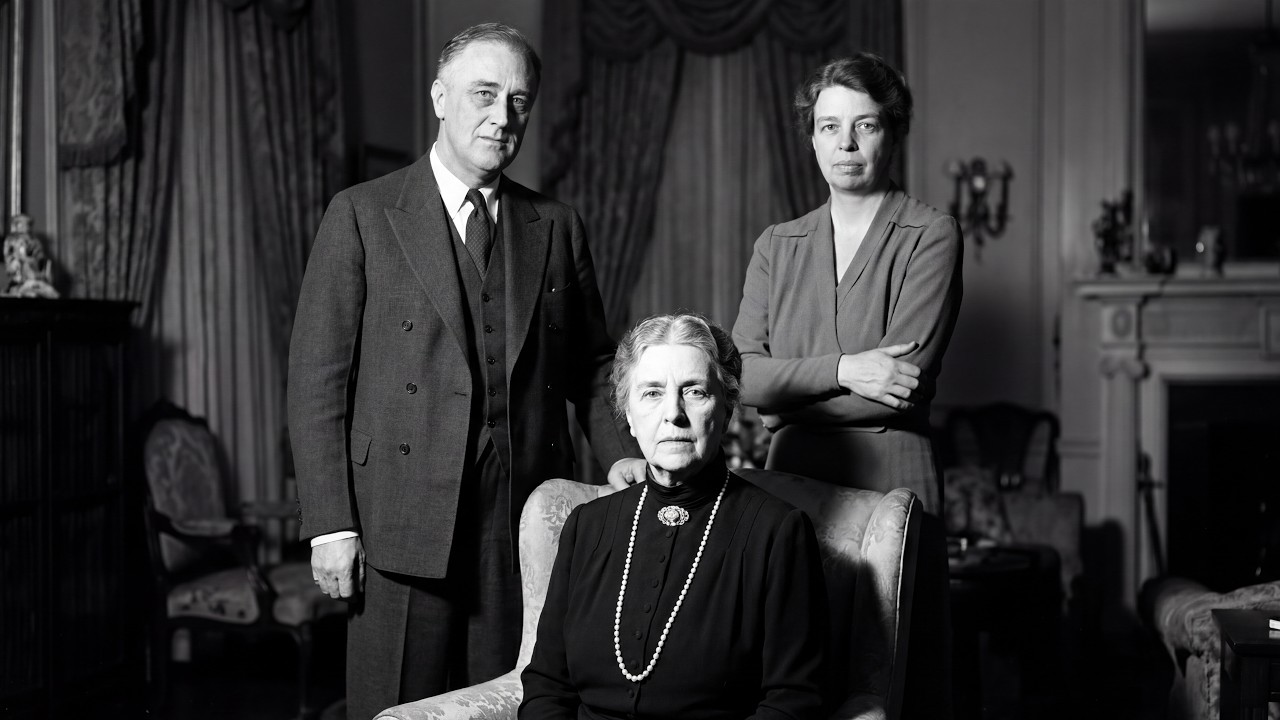
The grief of the daughter-in-law was something else entirely. In a private letter to a friend, Eleanor Roosevelt wrote that it was dreadful to have lived so close to someone for thirty-six years and to feel no deep affection and no real sense of loss. That single confession, hidden from the public, captures the entire architecture of a family built on a mother’s power. Sara Delano was born in 1854 into a fortune that came from the China trade.
Her father, Warren Delano II, was a senior partner in Russell and Company, the largest American firm doing business with China. He grew wealthy on tea and opium, lost much of it in the panic of 1857, and then, in his fifties, returned to China and rebuilt the fortune a second time. When he died in 1898, he left an estate of roughly two million dollars. Sara inherited close to a million in her own name.
Money, in her world, was not something to fear losing. It was the water she swam in, and she understood from childhood that money was not for spending. It was for control. She married James Roosevelt, a Hudson Valley squire twenty-six years her senior, in 1880.
She was twenty-five. He was a widower with a fine estate at Hyde Park called Springwood, a man of horses and railroads and country dignity. In 1882 she gave birth to a son, Franklin Delano Roosevelt. The birth was difficult, and afterward the doctors told her she should not have another child.
From that moment, her life had a single object. She refused the customary arrangement of wealthy mothers, who handed their children to nurses and governesses. She kept Franklin close, taught him to read herself, supervised his lessons, chose his tutors, and kept him out of conventional school for years. She kept his hair and his first shoes and documented his boyhood like a curator.
Her love for him was fierce and genuine, but love and control grew from the same root. When James died in 1900, Franklin was eighteen and about to enter Harvard. Sara moved to Boston to be near him, and she kept him within reach for the rest of her life. Franklin grew up believing he stood at the center of the universe because, in the universe his mother built, he did.
The first time he tried to decide something for himself, he chose a wife. In the autumn of 1903, he proposed to Eleanor Roosevelt, his own distant cousin, a tall, shy, serious girl who had lost her mother at eight and her father not long after. Sara was appalled. She demanded secrecy for a full year, then took Franklin on a long Caribbean cruise to cool the romance.
It did not work. Franklin was as stubborn as she was. On March 17, 1905, the couple married in New York, given away by Eleanor’s uncle, President Theodore Roosevelt. Sara had lost the battle to prevent the marriage, so she changed her objective.
If she could not stop Franklin from having a wife, she would make certain the marriage happened inside her world, under her roof, within her reach. Her wedding gift told them everything. She commissioned a matched pair of town houses on East 65th Street in Manhattan, finished in 1908. One was for the young couple.
The other was for Sara, pressed wall-to-wall against it. The two buildings shared a single front entrance, and inside, on several floors, connecting doors allowed Sara to pass from her drawing room into theirs, from her landing to the floor where the children slept. There was no lock that kept her out. The house was a machine for surveillance, built of good brick and fine plaster, and the unspoken understanding that the older woman was always entitled to be present.
Franklin found the arrangement perfectly agreeable. The closeness that suffocated his wife was simply air to him. The family lived under that shared roof with those connecting doors for twenty-five years, until Franklin entered the White House in 1933. Eleanor, who had no fortune of her own, was a guest in her own home.
Sara chose the furniture, hired the servants, and the servants understood whose authority truly ran the house. Sara had opinions about how the grandchildren should be raised, and she had the confidence to override a nervous young mother. Eleanor would give an instruction and find it quietly reversed. The children learned quickly which adult to run toward.
Their grandmother had the treats and the loosened rules. Their mother had the anxieties and the corrections. Sara told one of her grandsons that his mother only bore him, that she herself was more his mother than his mother was. It was offered, apparently, as a kind of loving truth.
The future president did not control his own money. When James Roosevelt died, he left the family resources largely in the control of his widow, and Sara’s own Delano fortune was hers alone. She did not hand Franklin his independence in one clean gift. She gave him money in a long series of large gifts spread across the decades, a sum here for a house, a sum there for a debt.
Each gift was generous. Each gift was also a renewal of the same lesson. The money came from her, and what comes from her can be given again or can, if she chooses, stop coming. Franklin ran for the New York State Senate in 1910, became assistant secretary of the Navy in 1913, and moved through the world as a rising man.
And still his household ran on his mother’s money. In the autumn of 1918, Eleanor opened her husband’s luggage as he lay ill with pneumonia and influenza and found a bundle of love letters. They were written to Franklin by Lucy Mercer, Eleanor’s own social secretary, a beautiful, gracious woman who had moved through the family’s Washington life as a trusted friend. Eleanor understood in an instant what the letters meant.
She did not swallow the betrayal in silence. She went to Franklin and offered him his freedom. If he wanted Lucy Mercer, she would give him a divorce. It was an act of shattering dignity, and it put the future of the entire family into play.
The crisis passed out of the hands of the husband and wife and into the hands of the mother. Sara did not plead. She reached for the one weapon he could not ignore. She told Franklin that if he left Eleanor for Lucy Mercer, she would cut him off from the family fortune, the money that had housed him and funded him every day of his adult life.
She reinforced the financial threat with the political one. Divorce would end everything he had worked for. Franklin, deeply ambitious and raised to believe he was destined for greatness, made the calculation an ambitious man always makes. He chose the future over the feeling.
He agreed to end the affair and stay married. Because he stayed married, his career survived. Because his career survived, he became governor of New York and then president of the United States four times, leading the country through the Great Depression and a world war. The presidency that history credits to Franklin rests, at least in part, on a mother’s threat to close her purse.
Sara did not save the marriage for Eleanor’s sake or for love’s sake. She saved it for the family name and her son’s destiny. Eleanor stayed married, but the marriage that survived was never again a true romance. It became a partnership, and Eleanor began to build a life of her own.
Three years later, in August 1921, Franklin was vacationing at Campobello Island off the coast of Maine. After a long day of sailing and swimming in the chilly bay, he felt a chill and an ache. Within days a fever took hold, then his legs weakened and went still. He was paralyzed from the waist down, diagnosed with polio.
He was thirty-nine years old, and no one knew if he would ever walk or return to public life again. Into this catastrophe came Sara, and she reached a conclusion that was, from her point of view, entirely loving. Franklin should stop. He should give up politics and come home to Hyde Park, to the estate she controlled, and live out his life quietly as a country gentleman, cared for and protected.
But two other people in that house saw the paralyzed man and reached the opposite conclusion. One was Eleanor. The other was Louis Howe, Franklin’s fiercely devoted political adviser, who had staked his own life on the belief that Franklin Roosevelt would one day be president. They understood that for a man like Franklin, retirement would not be safety.
It would be a slow death of the spirit. Howe moved into the household, handled correspondence, and kept Franklin’s name alive in party circles. Eleanor forced herself onto public platforms, keeping the Roosevelt name active while her husband could not, and in the process becoming a formidable public figure in her own right. Franklin himself chose the fight.
He found his way to the warm mineral waters of a run-down resort in Georgia called Warm Springs, and he spent years and a fortune rebuilding his body. He learned to appear to walk by gripping a strong arm and swinging his locked and braced legs forward in a punishing performance of normalcy that hid the full extent of his paralysis from the public for the rest of his life. This was not the behavior of a man retiring to a quiet estate. In 1928, Franklin ran for governor of New York and won.
In 1932, in the depths of the Great Depression, he was elected president of the United States. Sara’s argument for retirement had been overturned. She had made Franklin too large for the small, safe life she wanted to give him. The ambition she herself had lit in him from birth carried him away from her and into history.
In 1933, Franklin and Eleanor moved into the first house of his adult life that his mother did not own. There were no connecting doors. But Sara simply adjusted. She remained the absolute mistress of Springwood, which she kept in her own name and ran exactly as she pleased.
When the president came home to Hyde Park, he came home to his mother’s house, furnished by his mother, on land that belonged to her. She embraced the role of the president’s mother with complete relish, and in 1932 she achieved a small distinction. She became the first mother in American history to cast a vote for her own son for the presidency. Women had only won the vote nationally a little more than a decade before.
Sara had spent her whole life exercising power without a ballot. Now she spent one on Franklin. When she died in 1941, she left a fortune estimated at between twelve and thirteen million dollars. She left a son who was president.
She left grandchildren she had spoiled and a daughter-in-law she had shadowed. And Eleanor, the woman Sara spent thirty-six years trying to contain, walked out of that fortress of connecting doors and became the most influential first lady in the history of the United States, a champion of the poor and the powerless, a force on the world stage. She became that person in part because of Sara, in reaction against the airless controlled world the older woman had built around her. The matriarch who ruled from inside the home helped create the very woman who broke the mold of the woman in the home.
Sara never held an office. She never ran a company. In a country that gave women like her no throne, she took the one that was left. She ruled the house.
She ruled the money. She ruled the man the whole world believed was in charge. Her own daughter-in-law said it best in a private letter no one was meant to read. It is dreadful to have lived so close to someone for thirty-six years.
Closeness was Sara’s whole method, and closeness was her whole power. She built her life on being unavoidable, and she made possible, in ways she would never have understood or approved, the freer and larger lives of the women who came after her, starting with the very daughter-in-law who could not wait to be free of her.