In the spring of 1882, few men in the American West carried a reputation as formidable as John Henry “Doc” Holliday. A trained dentist from Georgia turned gambler, Holliday had earned his name through sharp wit, unshakable nerve, and a fierce loyalty to the Earp brothers in Tombstone, Arizona Territory. His legend had been cemented on October 26, 1881, when he stood beside Wyatt, Virgil, and Morgan Earp in the famous gunfight near the O. K.
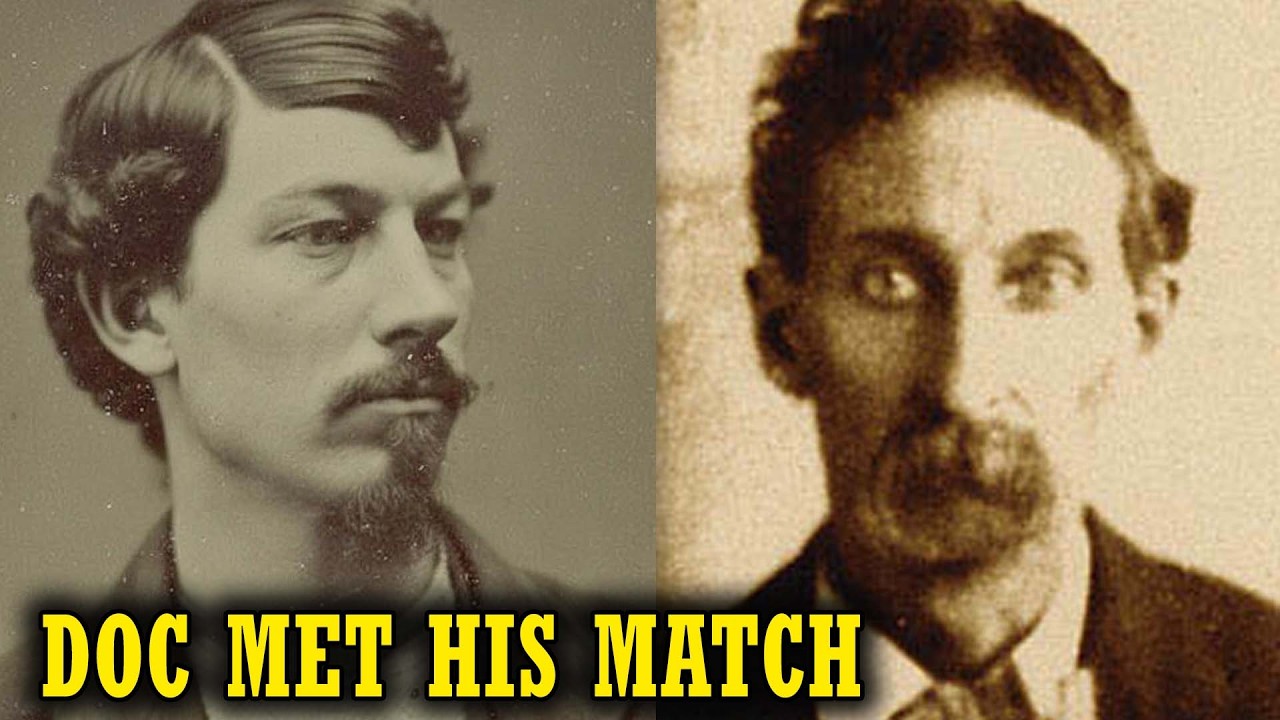
Corral. Newspaper coverage spread the story far beyond Arizona, transforming the participants into some of the most talked-about figures in the West. In the months that followed, tensions in Tombstone escalated, and after attacks on members of the Earp family and their associates, Wyatt Earp organized a group of trusted allies, Holliday among them. Their actions drew widespread attention and eventually led to legal warrants against several members of the group.
Facing mounting pressure from authorities, the men left Arizona Territory in early April 1882, traveling east through New Mexico Territory before settling in Colorado, which they considered a safer place to begin again. Holliday’s path took him to Pueblo, Colorado, in early May 1882. There, a persistent con man named Perry Mallon approached him at the Comique Theatre. Mallon, a bearded stranger, warned Holliday that the brother of Frank Stilwell was looking for him, intending to settle an old score.
The warning carried weight given recent events. Holliday had ridden with the Earp party in the aftermath of Morgan Earp’s killing, and the group’s actions had made them wanted men across the Southwest. Instead of showing concern, Holliday asked Mallon to identify the man supposedly seeking him. Mallon refused.
As the conversation continued, Holliday grew increasingly suspicious. He believed Mallon had gathered much of his information from newspaper reports and was using it to gain attention or influence. Mallon also claimed Holliday had once helped him in Santa Fe, New Mexico Territory, and said he wished to return the favor. But his story contained contradictions, and the encounter ended without further incident.
The mysterious relative Mallon spoke of never appeared. A few days later, the two men met again in another Pueblo saloon. This time, Holliday decided to learn more about the man who had approached him with such dramatic stories. Through inquiries, he discovered that Mallon was presenting himself as a prosperous ranch owner who had recently sold his property and was looking for new business opportunities.
A local bartender shared information that raised doubts about Mallon’s credibility. According to the bartender, Mallon had borrowed money and never repaid it, leaving a poor impression. The more Holliday learned, the more convinced he became that Mallon was exaggerating his background and fabricating stories to impress those around him. One example involved a scar Mallon displayed as proof of an adventurous past.
Mallon claimed it resulted from a dramatic incident on the frontier, but Holliday rejected that explanation and suggested the mark had a far less significant origin. Newspaper investigations soon uncovered more information about Perry Mallon. The Pueblo Daily Chieftain reported that visitors from Akron, Ohio, recognized him and claimed he had obtained money from locals through deceptive schemes. Depending on his audience, Mallon presented himself differently.
To some people, he said he was traveling on business; to others, he claimed to work as a detective. The paper traced his last residence to Ogden, Utah Territory, and painted an unflattering portrait of the man. Reporters described him as a small individual with a reddish beard and sharp features, someone who left a bad impression on many who met him. Additional details from the Denver Tribune indicated that Mallon had previously worked as a train brakeman and was missing the little finger on his left hand.
By that point, Holliday had concluded that Mallon was untrustworthy. The stories he told kept changing, and his background seemed full of contradictions. Thinking the man unworthy of further attention, Holliday left Pueblo and traveled north to Denver, hoping to focus on gambling opportunities and the horse racing season. What he did not realize was that Mallon had no intention of letting the matter end there.
Seeing a chance for fame and potential financial gain, Mallon followed Holliday to Colorado’s largest city. On May 15, 1882, as Holliday walked near the corner of Sixteenth and Lawrence Streets in Denver, Mallon confronted him unexpectedly. Presenting himself as a law officer from California, Mallon insisted that Holliday was a wanted man and enlisted the help of a local deputy sheriff named Charles Linton. Mallon convinced Linton that authorities in Arizona Territory were searching for Holliday and that a reward had been offered for his capture.
Based on those claims, Holliday was taken to the sheriff’s office for questioning. During the proceedings, Holliday expressed concern about Mallon’s behavior, believing the supposed officer was acting unpredictably. Deputy Linton arranged for his transfer to the county jail while the allegations were reviewed. Mallon continued adding new claims to his story.
He alleged that Holliday was also wanted in Utah Territory in connection with the disappearance of a man named Harry White, whom Mallon described as a former associate. According to his account, the incident had occurred in a Utah saloon where Holliday had once worked as a faro dealer. The accusations grew increasingly dramatic. Mallon claimed to have spent years pursuing Holliday and attributed many personal misfortunes to him.
He even pointed to his missing finger as supposed evidence of a previous confrontation. However, many of his statements lacked supporting evidence and changed over time, raising doubts among more careful observers. For Mallon, the arrest brought immediate attention. Newspapers eager for dramatic frontier stories interviewed him, and he willingly provided detailed accounts of his supposed pursuit of Holliday.
Each telling of the story seemed stranger than the last, helping him gain temporary fame. Communication between territories was often slow, records were not always readily available, and sensational newspaper stories attracted readers. Mallon appeared to exploit these conditions by presenting himself as a man of authority while embellishing his role in events. Not everyone in Denver accepted Mallon’s claims.
Journalists at the Denver Tribune remained skeptical from the start, questioning his stories and his qualifications. The paper noted that Mallon behaved more like a nervous, insecure individual than an experienced law officer as he claimed. Holliday later expressed a similar view. He reportedly dismissed Mallon’s image as a man of the frontier, noting that his appearance and behavior did not match the seasoned lawmen and adventurers common in the West.
One Denver journalist even observed that Mallon seemed uncomfortable handling his pistol, appearing more anxious than the man he had arrested. Despite these doubts, many newspapers embraced the dramatic narrative. Sensational stories sold papers, and Mallon’s version of events offered plenty of excitement. Some publications portrayed Holliday as a dangerous fugitive while presenting Mallon as a brave officer seeking justice and the reward offered by Arizona authorities.
The Denver Tribune distinguished itself from many competitors. Instead of accepting Mallon’s claims at face value, its correspondents examined the contradictions in his story and openly questioned whether he possessed any real official authority. Their doubts would eventually prove justified. Meanwhile, Mallon continued presenting himself as a commissioned officer.
On May 22, 1882, he even claimed to have seen Wyatt Earp in Denver. According to Tribune reports, a man named Greenleaf bore a strong resemblance to Earp and nearly attracted Mallon’s attention because of the similarity. Historical evidence indicates that Wyatt Earp was not in Denver at that time. Reliable accounts place Wyatt and his younger brother Warren near Gunnison, Colorado, where they camped alongside their associates Dan Tipton and Texas Jack Vermillion.
One of the figures connected to this circle was Bat Masterson, a respected lawman and former marshal. Masterson happened to be in Denver for the horse races when Holliday was arrested. Thanks to his reputation and connections, he quickly became an important ally in helping clarify the facts surrounding the case. As media interest intensified, Mallon seemed to enjoy being in the spotlight.
He expanded his claims, even asserting that Cochise County Sheriff Johnny Behan had personally authorized him to arrest Holliday. Such statements generated headlines, but they also invited closer scrutiny from reporters determined to verify details. That scrutiny eventually worked against him. As Tribune journalists interviewed Holliday and investigated the story more thoroughly, numerous contradictions emerged.
Holliday stated he had never been in Utah Territory, directly challenging one of Mallon’s key accusations. He also explained that his first meeting with Mallon had occurred only recently in Pueblo. Damaging Mallon’s account further was the fact that records and witnesses placed Holliday in Denver during the period the alleged Utah incident supposedly occurred. As correspondents compared dates and testimonies, Mallon’s carefully crafted story began to crumble.
While efforts were underway to return Holliday to Arizona Territory, where authorities wanted to question him regarding the Frank Stilwell case, legal complications quickly arose. Bob Paul, the sheriff of Pima County, traveled to Denver to facilitate the transfer. But the necessary extradition documents had not yet arrived, forcing Paul to remain in Colorado awaiting the required paperwork. This delay created an opportunity for Holliday’s supporters to organize a response.
Several of Doc’s friends, including the influential Bat Masterson, spoke publicly on his behalf. They also worked behind the scenes to slow down the extradition process. As part of that effort, a questionable fraud charge was filed against Holliday in Pueblo. A writ of habeas corpus was then obtained, allowing him to be transferred from Denver custody to answer the Pueblo claims instead.
Doubt remains about whether that charge had any real basis, but it effectively complicated efforts to send Holliday back to Arizona. As these legal maneuvers unfolded, attention shifted back toward Perry Mallon. Sheriff Paul stated he had never heard of Mallon, a revelation that further weakened the credibility of the supposed officer. Under mounting pressure, Mallon decided to defend himself in the press.
On May 23, 1882, he submitted a long letter to the Rocky Mountain News. He criticized the Tribune’s reporting and insisted his motives were noble. He assured readers he was conducting legitimate business and hinted that those who doubted him would soon discover the truth. The letter did little to restore his reputation.
By that time, journalists and members of the public had begun uncovering evidence contradicting many of his statements. Instead of strengthening his position, the publicity invited even closer scrutiny. Ironically, the extensive newspaper coverage that brought attention to Mallon also revealed his whereabouts to people from his past. One such individual was Hiram W.
Roblee, an elderly businessman who claimed Mallon had cheated him out of one hundred dollars in Omaha two years earlier. After reading reports about Mallon in Denver newspapers, Roblee came forward and shared details of his experience with Tribune reporters. The matter reached its peak when Roblee confronted Mallon in Sheriff Linton’s office. Roblee demanded the return of the money he claimed to have lost and was accompanied by a witness.
According to newspaper reports, Mallon tried to discuss the matter privately, but Roblee refused to leave the office. The pressure proved difficult for Mallon to avoid. The Tribune later reported that he eventually repaid the full amount Roblee demanded. Whether motivated by guilt, embarrassment, or a desire to avoid further public scandal, the repayment significantly damaged his credibility.
From the beginning, Perry Mallon’s pursuit of Doc Holliday appeared driven by two goals: the possibility of a substantial reward and the public attention that would accompany such a prominent arrest. For a time, his plan seemed successful as newspapers across Colorado rushed to cover the story. But events did not unfold as Mallon had expected. Legal complications delayed proceedings, and it gradually became clear that neither an immediate reward nor a quick resolution was likely.
As the possibility of material gain faded and the likelihood of Holliday’s release grew, Mallon found himself looking for a new opportunity. At the same time, Hiram Roblee’s arrival in Denver caused additional problems. The public accusations damaged Mallon’s reputation and exposed aspects of his past he would have preferred to keep hidden. Facing increased scrutiny, Mallon decided it was time to leave the city.
Unfortunately, he lacked the money needed to start over. As he had done before, he turned to deception to obtain funds. This time, his focus centered on Julius Schwaigart, a former partner and hotel employee at the Great West Hotel in Denver, where both men were staying. According to reports in the Denver Republican, Mallon presented letters of introduction from individuals in California who were known to Schwaigart.
Schwaigart had recently sold his share in the hotel and was impressed by the extensive publicity surrounding Holliday’s arrest. Mallon skillfully exploited that admiration to build trust. He shared stories of past successes, claimed to have received large rewards in previous cases, and portrayed himself as a highly capable law officer. As their friendship developed, Mallon began borrowing money frequently from the trusting employee.
Schwaigart willingly provided financial assistance whenever Mallon claimed to need it. Mallon also borrowed a valuable coat and even obtained a pistol from another hotel guest, relying heavily on the credibility he had gained from newspaper coverage. Once confident he had won Schwaigart’s trust, Mallon made a new proposal. He claimed there was a wanted man living in Kansas City under a false identity, with a reward of fifteen hundred dollars offered for information leading to his capture.
Mallon promised Schwaigart a share of the reward if he helped finance the trip and provided money for investigation expenses. He even claimed a woman possessed important information about the suspect’s whereabouts and would need to be compensated for her assistance. Believing the story, Schwaigart agreed. On May 27, 1882, the two men boarded a train and left Denver for Kansas City.
After arriving, Mallon announced he needed to travel alone to nearby Wyandotte to verify information about the suspect. He assured Schwaigart he would return soon. He never did. A railroad employee later reported seeing Mallon board a train heading west that same evening.
Realizing he had been abandoned, Schwaigart eventually returned to Denver and reported the matter to authorities. By that time, Mallon had disappeared with approximately three hundred dollars belonging to the former hotel employee. When Julius Schwaigart returned to Denver, he learned he was not the only victim of Perry Mallon’s schemes. Another guest at the Great West Hotel, Charles Morgan, discovered that Mallon had obtained an additional one hundred thirty dollars from him through similar deceptive methods.
Schwaigart and Morgan later learned that Mallon had also persuaded a former mayor of Alamosa to part with fifty dollars and a pistol. The pattern had become familiar. Mallon built trust, invented convincing stories, and then disappeared before his victims realized what had happened. Morgan was particularly frustrated by the experience.
Convinced Mallon had fled to New Mexico Territory, he took a train to Albuquerque on June 1, 1882, hoping to find him. His efforts were unsuccessful. By that time, Mallon had already moved on to his next destination. Holliday’s own legal troubles had begun to fade.
Arizona Territory sought his return on charges stemming from the Earp vendetta period, but Colorado Governor Frederick Pitkin ultimately refused the extradition request. Instead, Holliday was transferred to Pueblo to answer the questionable fraud charge filed there. On June 1, 1882, he was released on bail and wasted no time leaving Pueblo. He traveled to Gunnison, Colorado, where he rejoined Wyatt Earp, Warren Earp, Dan Tipton, and Texas Jack Vermillion, seeking a fresh start in Colorado’s booming mining region.
During an interview with a Gunnison correspondent on June 18, 1882, Holliday was asked about Perry Mallon. Consistent with the image of the noble Southern gentleman he often tried to project, Holliday stated he had no intention of pursuing the matter personally. He indicated that as long as Mallon left him alone, he would do the same. At the same time, Holliday acknowledged that some of his associates felt differently.
He reportedly possessed correspondence from a Denver firm indicating that individuals there were prepared to spend considerable resources to see Mallon brought to justice for his activities. Ultimately, however, such an opportunity never materialized. Contrary to reports that he had traveled west after leaving Kansas City, Mallon had actually headed in the opposite direction. Remaining true to the habits of an experienced con man, he continued moving from place to place, rarely staying in one location long enough to attract sustained attention.
Before long, he resurfaced in his home state of Ohio and attempted another scheme. That attempt proved less successful than previous ventures. In late July 1882, authorities in Toledo detained him as a suspicious person. After spending about three months in the county jail, he was released and faded from view once again.
Holliday’s path was entirely different. He remained in Colorado, spending some time in Leadville during its mining boom and eventually settling in Glenwood Springs. There, after years of suffering from tuberculosis, he died in 1887 at the age of thirty-six. During the spring and summer of 1882, Denver newspapers had eagerly circulated Mallon’s sensational stories, many of which contained exaggerations, inaccuracies, and dramatic flourishes.
Other papers across the country soon repeated those accounts, helping define Holliday’s name far beyond the Southwest. Today, Perry Mallon is almost forgotten, remembered only by historians who have studied the incident in detail. Ironically, this obscure con man, who sought fame for himself, ultimately contributed far more to the legend of Doc Holliday than he ever did to his own personal renown. The story of the only man known to have arrested Doc Holliday is stranger than most Old West legends, revealing a world where reputation, deception, and newspaper headlines often blurred the line between truth and fiction.
In the end, Mallon’s name faded into obscurity while the legend of Doc Holliday only grew stronger.