On a hot summer night in Rome, a 16-year-old boy walked through Piazza Farnese, a place known for its mix of artists, aristocrats, and hustlers. That boy was John Paul Getty III, heir to one of the largest oil fortunes in the world. He was handsome, with long hair, and preferred bohemian nights to the offices of his grandfather’s empire.
Suddenly, a van pulled up beside him. Doors opened, several figures grabbed him, and within seconds, the Getty heir disappeared into the narrow streets of Rome. He was no longer a free teenager. He had become human merchandise.
Inside the van, he struggled and screamed. They covered his eyes, struck him, and told him his life now belonged to them. The Getty surname had become a giant lottery ticket, and that ticket was heading south, toward poor villages and men who lived off the fear of others.
At that moment, the rest of the Getty family continued with their routines across Europe and the United States. No one yet imagined that the news about to arrive would unleash a moral storm. It would question not only a grandfather’s love for his grandson, but also the true price of wealth.
To understand what came next, one must look at the family patriarch. John Paul Getty, the grandfather, was one of the richest men on the planet. He built his oil empire through fierce discipline, cold decisions, and a sickly obsession with control. He lived surrounded by art and luxury, but human warmth seemed scarce in his world.
He had been married several times and had many children. Family relationships were distant, sometimes openly hostile. Instead of a united family, the name Getty described a constellation of people orbiting the patriarch’s money. He saw himself as a strategist protecting his fortune, not just from banks and states, but also from his own blood.
John Paul Getty III was one of his grandsons. In the patriarch’s eyes, he was a troubled boy who overspent, sought media attention, and flirted with danger. The grandfather was annoyed by photos of the teenager at parties, his bohemian friends, and his reputation as a pretty boy living off the family name.
Back in Rome, the hours passed and the boy did not appear. His mother, Gale, began to notice that something was wrong. It was not unusual for her son to go out at night, but the silence was too long. There were calls that never came, friends who knew nothing, and a foreboding feeling that grew heavier by the minute.
Finally, the phone rang. An unknown voice announced that John Paul Getty III was in the hands of an armed group. They demanded a colossal sum to release him. They spoke of millions of dollars, an amount that any normal person would consider unreachable, but which for the Getty family seemed theoretically possible.
However, nothing in that family was so simple. The news spread like lightning among relatives, lawyers, and assistants. In a few days, Italian newspapers and then international media echoed the kidnapping. The young heir’s image began to appear in headlines that mixed glamour and tragedy.
Gale lived separated from the boy’s father, John Paul Getty II, a man who carried his own demons. The family was already fragmented long before the kidnapping. That fragility became even more visible when the moment came to decide who should pay and how much.
The kidnappers insisted the boy was alive, but warned that their patience had limits. In their messages, they mixed threats with cold descriptions of the value they placed on their hostage’s life. The figure they demanded was enormous, a clear attempt to exploit the Getty family’s fame for infinite wealth.
The mother begged for help. She called, wrote, and insisted. She did not have that money. Her only real hope lay with the millionaire grandfather, who could pay the sum without losing control of his empire. For almost any mother in the world, the answer would be obvious. But in this story, love and money did not speak the same language.
Meanwhile, John Paul Getty III was hidden in a rural area of southern Italy. He was locked in precarious huts or damp caves, watched by armed men who treated him like an investment. Time stretched out between fear and exhaustion. He did not know if his family was negotiating yet, or if anyone would really risk anything for him.
The kidnappers kept telling him his grandfather was the richest man in the world and would pay without hesitation. The young man tried to believe it. The surname had become his only protection, the only shield between him and death.
Far away, the patriarch watched the case from another perspective, almost as if it were just another business transaction. As the weeks passed, the case stopped being a simple police matter and became a public mirror of the Getty family’s soul. Everyone asked the same question. What would a grandfather who could buy almost anything do when his own grandson’s life was at stake?
The patriarch responded with coldness. He repeated to anyone who would listen that he was not going to pay the demanded amount. He claimed that if he gave in once, all his other grandchildren would become targets. He argued that financial prudence was more important than emotional pressure.
His words spread through the media and caused outrage. Headlines began to highlight the brutal contrast between the Getty fortune and the refusal to pay the full ransom. For public opinion, it was not just about numbers. It was about an uncomfortable moral question. What was the point of being so rich if you were not willing to save a direct family member?
The hostage’s mother felt increasingly trapped. She was caught in the middle of a crossfire. On one side were the kidnappers, sending messages and threats that were escalating in tone. On the other was a grandfather who calculated, hesitated, and hid behind advisors and lawyers. In the center of it all was a boy slowly consuming away amidst fear and uncertainty.
In the south, the captors were getting tired of waiting. Keeping a hostage alive cost money and created risks. The pressure on the family translated into violence against the hostage’s body. They moved him from one hideout to another, tied him up tighter, and hardened their treatment. The idea that the patriarch might never pay began to seem like a real and dangerous possibility.
The Getty name echoed on the radio, on television news, and in bars. The tragedy of a wealthy family became a collective spectacle where everyone had an opinion. Some said the grandfather was right not to give in to blackmail. Others felt a visceral rejection of such coldness. Almost no one could imagine the next step the kidnappers would take.
The kidnappers decided to cross a line that would forever mark the life of John Paul Getty III and his grandfather’s reputation. After weeks of waiting, without seeing any clear progress in the negotiations, they opted for an extreme gesture. On a night of terror, the boy was held down. They warned him that this was the punishment for having a grandfather who loved money more than his own blood.
They cut off his ear and kept it as proof of authenticity. Days later, a package arrived at a newspaper office. Inside was a piece of human flesh wrapped rudimentarily and a note addressed to the family. The message indicated that it was the boy’s ear and warned that if the money did not appear, they would send other parts of his body.
Doctors confirmed that the ear was real. Journalists spread the news with a tone that blended horror and fascination. The story stopped being just a conflict between a millionaire and some criminals. Now there was blood, physical suffering, and a young body marked forever by the decisions of others.
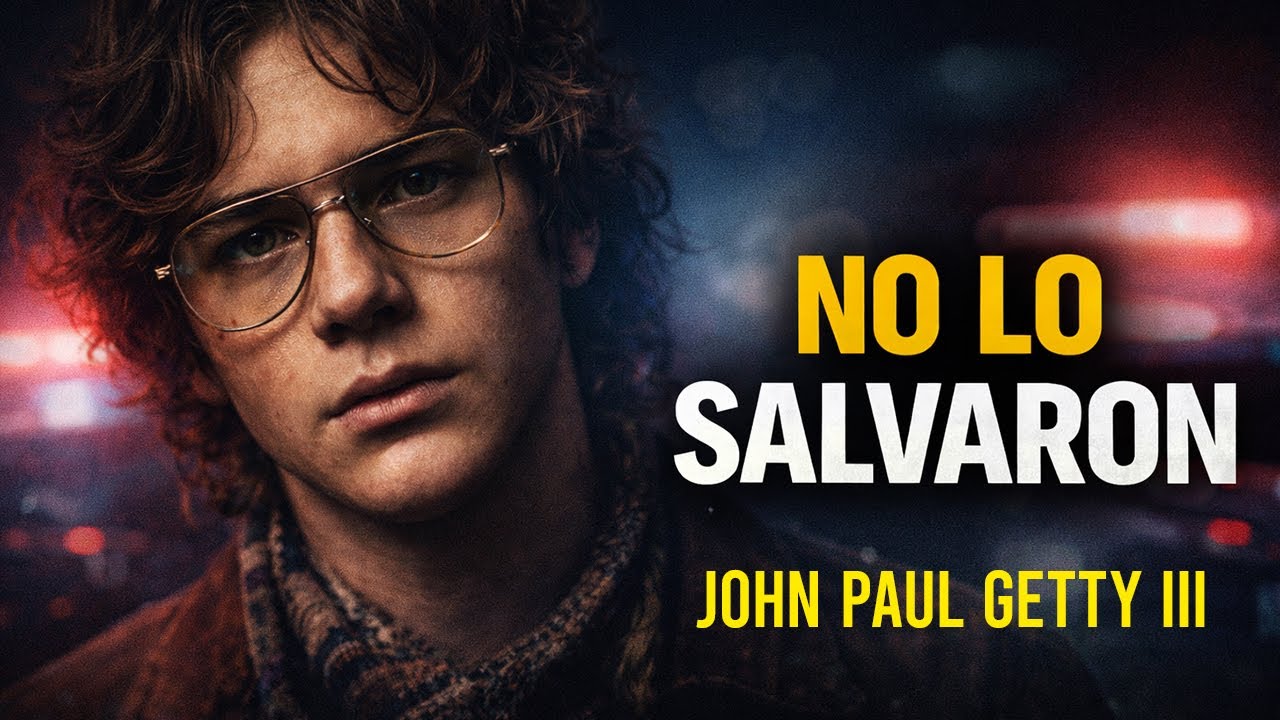
Public opinion became even more hostile toward the grandfather. It was almost impossible for many to understand how, after such brutal proof of the danger his grandson was in, the man could continue haggling. The severed ear became a symbol. It was a reminder that money in this story was not just an abstract figure, but a force capable of deciding to what extent a body and a family bond could be destroyed.
The pressure on the patriarch reached unsustainable levels. Politicians, journalists, and ordinary citizens commented on the case relentlessly. The image of the tycoon locked in his mansion, surrounded by art and luxury, contrasted with that of his grandson bleeding somewhere in southern Italy.
Faced with the evidence of the mutilated ear, the grandfather began to take small steps toward a possible solution. But even then, his mind was calculating. He refused to pay the initial sum demanded. He looked for a way to reduce the amount while simultaneously protecting his personal finances.
Meanwhile, the boy’s father was fighting his own battles. He had been overwhelmed by addictions, internal conflicts, and emotional distance. He was not in a position to gather such a large amount of money on his own. A fragile bridge of cooperation was built between him and his ex-wife, marked by reproaches and the shadow of the patriarch who dominated everything.
The kidnappers, tired but also afraid of losing everything, finally accepted a significant reduction in the ransom. What was once an astronomical figure now became an amount that, while still large, was no longer impossible. That reduction opened the door to an agreement.
With the new amount on the table, the grandfather agreed to contribute only a part of the ransom. The rest had to be covered by the hostage’s father through a loan that would also accrue interest. Even the act of saving a life thus became a financial transaction. Instead of a pure gesture of family love, the boy’s release was tainted by a debt contract that would extend over time.
The ransom delivery was organized in a mountainous area of southern Italy. Trusted family men transported suitcases full of cash, following vague and changing instructions to avoid any police intervention. The journey was a mix of a spy movie and family drama. Dark roads, imprecise signs, waiting in empty places. No one knew for sure if the boy would still be alive at the end of the road.
When the money finally changed hands, the tension did not disappear entirely. It remained to be seen if the kidnappers would keep their promise. In many historical cases, even after paying, hostages did not return alive. The family and the intermediaries held their breath.
Before long, someone found the young man on a rural road. He was alive, but extremely weakened. He was thin, dirty, with a vacant stare and a bandage where his ear used to be. His body told the story of those months of captivity better than any report. He had survived, but he had left a part of himself forever in those mountains.
Photographs of the gaunt boy contrasted with previous images of a youthful, handsome, and carefree heir. What money failed to do to prevent his suffering was now exposed on every face, in every gesture. The rescue was over, but the tragedy was only entering its next phase.
John Paul Getty III’s return to public life was no fairy tale. His body, mind, and spirit had gone through a hell from which one does not return unscathed. Although he had been freed, he remained a hostage to what happened. His name was forever associated with the word kidnapping, the severed ear, and his grandfather’s initial refusal to pay the ransom.
The family tried to restore an image of normalcy. There were doctors, psychologists, lawyers, and communications consultants. But at the center of all those technical layers was a young man struggling with deep trauma. The nights in captivity, the screams, the death threats, the sound of metal and pain returned again and again in his memory.
His relationship with his grandfather was marked by a coldness that was almost impossible to repair. The boy knew that the man who could have saved him from the very first moment chose to haggle, to calculate, to wait for physical proof of his suffering. It was not just a matter of money, but an emotional wound that undid any notion of family protection.
The outside world remained fascinated by the story. Articles were written, books were prepared, future films were planned. The Getty case became synonymous with a millionaire kidnapping, with moral dilemmas associated with extreme wealth. The surname took on a dark tint. It no longer just represented economic power, but also human sacrifices made in the name of that fortune.
For John Paul Getty III, every interview and every curious glance was a reminder of what he lived through. Fame, which once might have been fun or even profitable, now weighed like an invisible chain. Tragedy had made him famous in the cruelest way possible.
After the kidnapping, the young man tried to rebuild his life, but the ground was full of cracks. Rome and other cities still offered him intense nights, bohemian friendships, and spaces to forget what happened for a few hours. However, the feeling of emptiness did not go away.
He approached the world of art, photography, and film. There was in him a mix of natural charisma and internal darkness that made him a magnetic figure for certain cultural circles. Some sought him out for his last name, others for the legend surrounding him, and a few saw in him a broken human being trying to express himself as best he could.
In parallel, drugs and alcohol began to appear as emotional anesthesia. It was not just about fun. They were also a way to silence memories, to turn off internal voices that repeated scenes of the kidnapping. Each substance promised a few moments of relief, but it exacted an increasingly high price.
His relationship with his father remained marked by conflict and distance. Two damaged men, pierced by addictions and resentments, found it difficult to support one another. His mother tried to offer a more stable love, but the family structure was already too broken.
The Getty name, far from protecting him, kept him forever under an unforgiving spotlight. Where other young men might make mistakes in silence, every fall of his became news. The mix of money, trauma, and addiction began to draw a dangerous path. The kidnapping was not the end of the tragedy. It was merely the starting point of a slow and painful decline.
While John Paul Getty III sank bit by bit into his own labyrinth, the grandfather continued to manage his empire with the same cold strategy as always. The fortune grew, investments multiplied, and art collections expanded. From the outside, his life seemed like the culmination of a dream of absolute success.
But within the family, the patriarch’s figure became a symbol of emotional absence. Many of his descendants felt their primary bond with him was through bank accounts and legal provisions, not hugs or words of comfort. Money had become the dominant language, displacing other ways of expressing affection.
The kidnapping case was discussed in hushed tones during family gatherings. The severed ear, the negotiations, the loan to the victim’s father. All of this built a narrative in which love always seemed conditioned by accounting. The younger ones grew up knowing that in this dynasty, the value of a life was also measured in columns of figures.
John Paul Getty III sensed that atmosphere and resisted becoming a docile piece in that machinery. His rebellion took on self-destructive forms. It was not just a rejection of discipline. It was also a silent cry against a system that turned him into bargaining chips. The more he tried to flee from his grandfather’s shadow, the more he got tangled in behaviors that harmed him.

Years passed, and the consequences of the kidnapping became increasingly visible in John Paul Getty III’s body. Addictions undermined his health. What began as a way to momentarily escape pain turned into a dangerous dependency. His body began to suffer from the accumulation of excesses and neglect.
At times, the young man tried to straighten his path. He sought creative projects, healthier relationships, and spaces of calm. But the weight of history did not disappear. The feeling of having been betrayed by his own powerful kin, of having been used as a pawn on a board of economic interests, continued to burn within him.
The family, for its part, oscillated between gestures of help and distance. There was genuine concern, but also fatigue, moral judgments, and misunderstanding. In some relatives, the boy’s suffering activated guilt they would prefer not to face. In others, it reinforced the idea that even with all the money in the world, one could not control the destiny of every descendant.
The figure of the grandfather continued to dominate the story. His reputation as a stingy and calculating man had solidified. For many observers, the initial refusal to pay the full ransom had become the definitive episode that defined his character. The kidnapping made it clear that extreme wealth could isolate just as much as it could protect.
Other shadows began to appear in the life of the Getty family. Several members of the clan experienced addiction issues, bitter divorces, legal conflicts, and depression. Public perception of the dynasty changed. They were no longer seen just as successful wealthy people, but as an example of a fortune that brought a long chain of misfortunes.
The myth of the cursed family gained ground in the media. Articles and chronicles spoke of a kind of curse associated with Getty money. Premature deaths, broken relationships, and children growing up without a stable emotional framework were mentioned. Wealth, which should guarantee a carefree life, seemed to drag many of its heirs into a void.
In that context, the kidnapping of John Paul Getty III stood out as the centerpiece of a broader narrative. It was the episode that condensed all the elements of the Getty tragedy. Money as the main objective, the divided family, the external violence that penetrated the bubble of privilege, and the patriarch’s decision that revealed uncomfortable priorities.
For John Paul Getty III himself, seeing himself turned into a symbol of that story had a devastating effect. His personal identity was diluted in a plot that others told for him. Film directors, journalists, and writers used his name to explore the dark side of wealth. Without wanting it, he became a mirror where an entire era looked at its own moral dilemmas.
The young heir felt that his life no longer entirely belonged to him. He was not only a hostage of his kidnappers, but also of a public narrative that always presented him as a victim. That feeling of not being able to escape an imposed role further fueled his risky behaviors and his desperate search for relief.
John Paul Getty III’s body paid a very high price for years of excess. Drugs and alcohol affected his nervous system, his heart, and his physical endurance. What for other young people might still be reversible, in him was combined with the emotional wear and tear he had carried since adolescence.
At a crucial moment, he suffered a serious episode that changed his life permanently. A mixture of drug use and physical fragility triggered a severe neurological accident. His brain was damaged, and his mobility was drastically reduced. What was once a young body capable of moving through parties and cities was now limited to a wheelchair and constant care.
The heir who was once kidnapped for his economic value became a dependent man. He needed help with the most basic tasks. His autonomy was reduced to minimal gestures. Tragedy took on a new form, less noisy than the kidnapping, but equally devastating.
The family then faced another economic and moral dilemma. The medical and nursing care that John Paul Getty needed was very expensive. Discussions about who should pay were reopened. How were family funds used? What part of the immense fortune should be allocated to sustain the life of a severely disabled member?
Once again, money stood between people and their bonds, arbitrating decisions, setting limits, and igniting conflicts. In this clan, it became once again an administrative and emotional battlefield. The boy who suffered his grandfather’s indecision during the kidnapping now depended on the same system to continue breathing with dignity.
John Paul Getty’s situation forced the family to make long-term decisions. It was no longer about a one-time ransom, but about sustaining a whole life of complex care. Discussions arose about trusts, insurance, and allowances. Lawyers and accountants returned to center stage, as they had so many times in the Getty history.
The idea that a man so long considered heir to one of the planet’s greatest fortunes now depended on accounting calculations for his daily care was difficult for many observers to grasp. Headlines insisted on the contrast between gigantic sums destined for museums, collections, and grandiose projects, and the struggle to finance the needs of a single person.
John Paul Getty III, within his limitations, perceived the weight of those decisions. Although he could no longer move with the freedom he once had, nor make all his own decisions, he remained aware that his well-being was subject to hands that moved numbers in distant offices. The feeling of being an object to be managed rather than a loved subject was accentuated.
In parallel, the family name continued to appear at the top of lists of wealth, cultural influence, and economic power. The Gettys funded prestigious institutions, built museums, and participated in major business operations. From the outside, they seemed like undisputed winners. From the inside, John Paul Getty’s story belied any notion of happiness guaranteed by money.
With each passing year, the contrast between the monumentality of the clan’s public work and the intimate fragility of some of its most vulnerable members became more visible. The kidnapping and its consequences were no longer just a distant memory. They had become a sort of common thread that explained why, in this family, material abundance never managed to translate into lasting peace.
While John Paul Getty III’s life unfolded between hospitals, adapted homes, and care routines, the outside world changed. New generations grew up knowing his story, not through the press of the time, but through documentaries, books, and film versions. His tragedy became narrative material for an audience that didn’t live through the events, but rediscovered them as if they were modern mythology.
Each new work that addressed the Getty case provided nuances, interpreted motivations, and reconstructed scenes. However, in all of them there was a common core. A billionaire grandfather, a kidnapped grandson, a severed ear sent by mail, and a negotiation where love always seemed conditioned by money.
In that process, the figure of John Paul Getty III distanced himself from the real person suffering in silence through his physical limitations. He was seen as a character, a symbol, a case study. Many argued about what should have been done, who was primarily to blame, and what they would do in a similar situation. Few thought about the daily life of that man trapped in a body that no longer responded.
The family, although it benefited in terms of cultural prestige through its foundations and collections, could not shake off the moral stigma of the kidnapping. Every time the surname appeared in the news, sooner or later, someone remembered the story of the grandson abandoned to his fate for months, until a severed ear finally forced the money to move.
At that point, the Getty tragedy had gone from being a current scandal to becoming a historical warning. It was proof that without strong emotional ties, extreme wealth could amplify mistakes and cowardice instead of hiding them. What was decided in those months of 1973 continued to resonate decades later.

As time passed, the patriarch John Paul Getty died, leaving behind an immense inheritance divided among cultural institutions, companies, and descendants. His figure was cemented as that of a man who completely transformed the oil industry, but also as someone who put family love in the background in favor of preserving his fortune.
In his testamentary provisions there were grand gestures of patronage, donations to museums, and investments intended to ensure the Getty name remained linked to art and knowledge for generations. However, the way he treated his grandson’s kidnapping did not disappear from the historical evaluation of his character. It became a dark spot impossible to erase.
For John Paul Getty III, his grandfather’s death brought no real liberation. The power structure that man built remained alive in trusts, administrators, and internal family rules. Although some decisions could be made with more flexibility, the general logic of control through money remained.
In family meetings, the younger ones heard conflicting stories. On one hand, they were told of the patriarch’s business genius, his ability to anticipate market movements. On the other, stories of pain and abandonment floated in the air. Each member of the clan had to decide which version of that symbolic legacy to adopt as a guide, or if they preferred to build their own path, detached from both.
The figure of John Paul Getty III functioned as an uncomfortable reminder of what happens when economic calculation almost completely displaces empathy. His frail body, his gaze from the wheelchair, synthesized decades of poor decisions and absences. To understand how money destroyed the Getty family, one need only observe what became of that teenager who once dreamed of a different life on the streets of Rome.
As the story progressed, other dramas shook the Getty clan. There were deaths by overdose, suicides, and emotional breakdowns. Each of those episodes reinforced the idea that the fortune had been so heavy that many had not known how to carry it. Instead of security, money seemed to have brought constant pressure to live up to a surname laden with expectations and shadows.
In this framework, the tragedy of John Paul Getty III was perceived as the first major visible explosion of a conflict that had been brewing long before. The way the patriarch lived his relationships, the distance from his children, the rigid organization of wealth. All that had created a breeding ground for future disasters.
The family history showed a chain of men and women who, despite having access to almost everything material, unsuccessfully sought something deeper that never quite arrived. Some lost themselves in excess, others in artistic or spiritual causes, others fled the public eye. In all cases, money was present as a backdrop that conditioned choices and possible paths.
Analysts of the history of great fortunes began to use the Getty case as an example of the dangers of wealth poorly integrated into emotional life. They spoke of the lack of clear boundaries, the difficulty in building individual identities outside the surname, and the tendency to resolve conflicts with money instead of listening and presence.
Amidst those debates, the silent figure of John Paul Getty III remained the broken heart of the narrative. A boy whose adolescence was snatched away in a brutal kidnapping and whom the family dynamic later pushed into an abyss from which he emerged with a body damaged forever. His story was at once personal and symbolic.
The end of John Paul Getty III’s life unfolded far from the glitter that surrounded his early years. He lived dependent on caregivers, family members, and a medical and support network that allowed him to carry on despite his severe physical limitations. The cameras no longer pursued him with the same intensity, but his name remained a subject of analysis when reviewing the Getty saga.
Those who treated him in that stage spoke of a man who carried a mixture of sadness and lucidity. He knew his destiny was marked by the decisions of others and by circumstances he could never fully control. At the same time, he was conscious of his own mistakes, of the times he sought relief in paths that ended up worsening his suffering.
The family maintained a complex bond with him, made of real affection and uncomfortable silences. Some relatives felt guilt, others preferred not to stir up the past. The system of money and power surrounding the surname continued to function, but no one could ignore the human cost it had on certain lives.
Worldwide, the story of the kidnapping was revisited periodically whenever a new work inspired by it was released. Film and documentary directors wondered what drove the grandfather to act as he did, and what the kidnappers felt. How did the hostage live each day in captivity? The public was moved once again by the image of the long-haired teenager who lost an ear to force a ransom payment.
The idea that money destroyed the Getty family was not a cliché, but a conclusion reached when observing the sum of tragedies. Instead of serving as a tool to build strong bonds, the fortune became a battlefield where the value of each person was measured. Few lives illustrated that reality as clearly as that of John Paul Getty III.
When John Paul Getty III finally died as an adult, his passing became a new chapter in the family’s long chronicle. The obituaries remembered his kidnapping. The severed ear, the grandfather’s initial refusal, his fall into drugs, the neurological accident, the years in a wheelchair. The narrative was marked by the word tragedy from beginning to end.
They also mentioned his attempts to find his own voice, his interest in art, and the moments when, despite everything, he managed to express sensitivity and talent. But the shadow of what happened in his adolescence never fully dissipated. It was like an indelible mark on his biography that conditioned any attempt to remember him in another way.
Within the family, his death reactivated old questions. What was done right? What was done wrong? What would have become of that boy if, in 1973, his grandfather had responded differently to the kidnappers’ call? There were no definitive answers, only hypotheses and regrets. Time did not erase the ethical dimension of those decisions.
The economic empire moved forward. The Getty foundations continued to fund cultural projects around the world. Museums and universities benefited from money whose origin was associated as much with business success as with a long series of moral dilemmas. In silent halls where masterpieces were displayed, few thought of the grandson who paid such a high price for bearing that same last name.
The story of John Paul Getty III remained a warning and a mirror. It warned of the dangers of placing money above human bonds. It reflected the extent to which a family could crumble from within, even while building palaces on the outside.
Looking at the whole story together, from the night of the kidnapping in Rome to the death of John Paul Getty III, a clear line ran through every episode. Money always seemed to be at the center of crucial decisions, not as a simple neutral tool, but as a force that conditioned affections, priorities, and entire lives.
The grandfather who built an empire chose to protect his fortune rather than respond immediately to his grandson’s suffering. The kidnappers turned a human being into a bargaining figure. The family debated loans, interest, and trusts while a teenager lost an ear and broke down inside. Later, the medical care for the disabled man was again subjected to accounting calculations.
The tragedy of the Gettys lay not only in the extreme events, but in the normalization of that logic. In the idea that it was acceptable to measure the value of a life based on the economic impact of protecting it or not. In the habit of translating pain into numbers, of hiding guilt under layers of contracts and legal provisions.
However, behind the famous surnames and astronomical figures, this story spoke of something deeply human. A young man who wanted to be seen and loved beyond his fortune. A mother who fought against a system larger than herself. And a family that lost the ability to care for one another in a simple, direct way. These were elements that could be found on a smaller scale in many other stories.
As this narrative concluded, a question remained open. What is a life really worth when no one measures it in money? And what place should money have within a family?