In the spring of 1864, a Confederate officer on the Petersburg lines began counting the shells falling on his position and stopped only when he lost the ability to track time itself. Union artillery had been firing for days without pause, without rationing, and without any of the usual signs that told experienced soldiers the enemy’s ammunition was running low. James Longstreet started asking a question that had never seriously occurred to him before that siege. Not how Grant’s army kept winning, but how it kept firing.
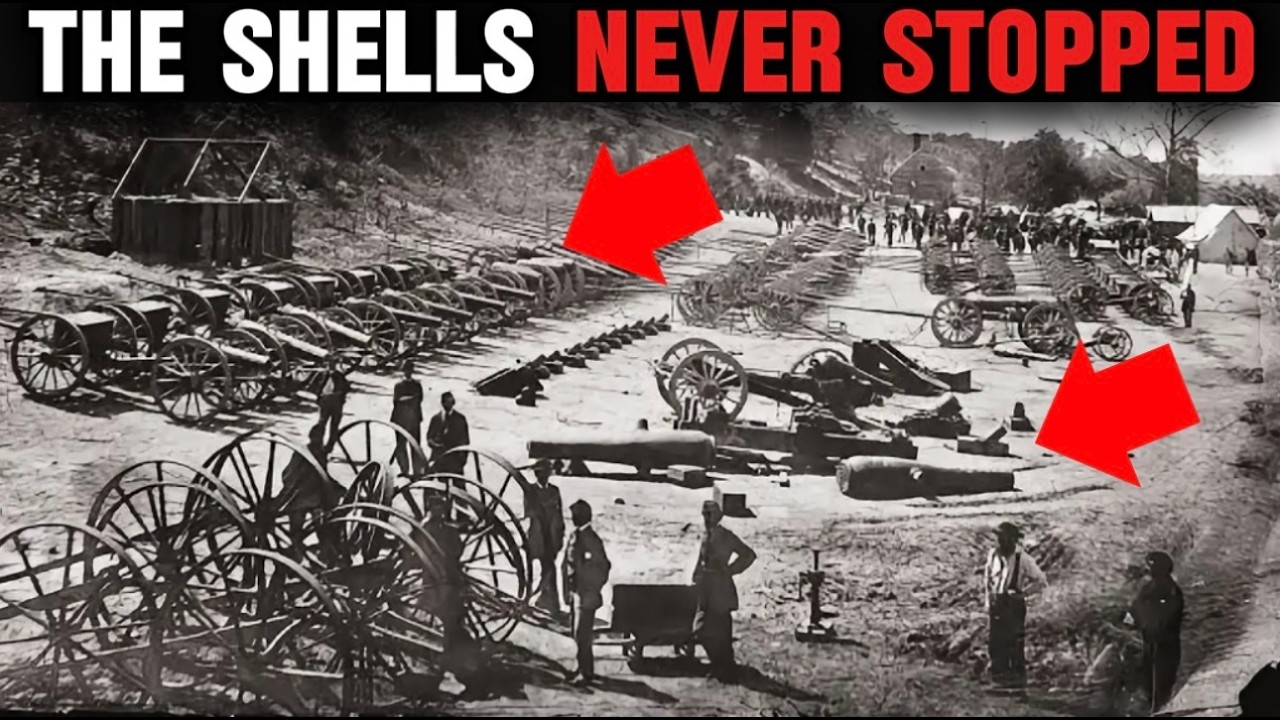
While Confederates counted powder scraped from cave floors and melted church bells, the Union army in front of him seemed to have found a way to make ammunition never run out. To understand what Longstreet was actually watching, it helps to know what ammunition supply meant for an army in practical terms during the Civil War. This war was fought at a moment when industrial capacity to support mass combat was becoming possible, and only one side had the machines required to do it. A single infantry regiment engaged in sustained fighting could burn through tens of thousands of small-arms rounds in one day of combat.
Artillery batteries consumed shells and powder at a rate that demanded continuous resupply from depots often hundreds of miles behind the front. The Overland Campaign, which put Grant and Lee in direct confrontation from May to June 1864, saw nearly uninterrupted fighting over six weeks. Every day of that fighting required fresh ammunition for men who had already exhausted what they carried into battle that morning. For the Union army, those supplies arrived.
For the Confederate army, they arrived less and less. The gap did not begin with the Overland Campaign. It began four years earlier in the industrial geography of the country from which both armies drew their resources. At the outbreak of the war, the northern states controlled roughly ninety percent of the nation’s manufacturing capacity.
They held the overwhelming majority of iron production, machine-tool manufacturing, railroad mileage, and most importantly, the ability to produce gunpowder and small-arms ammunition on an industrial scale. The Confederate economy, by contrast, was agricultural, built on cotton, tobacco, and the export of raw materials to the manufacturing centers of the North and Europe. When the war started, the Confederacy did not merely lack ammunition. It largely lacked the industrial infrastructure needed to produce it in the quantities modern war demanded.
Everything the Confederate government accomplished over the next four years was, in a sense, an attempt to improvise that infrastructure from almost nothing while fighting a war at the same time. The Confederacy’s most remarkable achievement in this field was the Augusta Powder Works in Georgia, built almost entirely from scratch beginning in 1862 under a young ordnance officer named George Washington Rains. Rains was given a nearly impossible assignment: build a facility capable of producing the powder an entire army needed, in a region with virtually no existing gunpowder manufacturing industry, using imported machinery that had to run the Union naval blockade to reach Confederate ports. What Rains had built by 1863 was, by any honest assessment, an extraordinary engineering accomplishment.
The Augusta Powder Works became one of the largest gunpowder mills in the world at the time and kept supplying Confederate armies for most of the remaining war years. But the facility depended entirely on imported potassium nitrate, the essential ingredient in gunpowder for which the Confederacy had almost no domestic source. Every pound of it had to cross a blockade that grew tighter and more effective with each passing year. Rains’s plant was a genuine triumph of Confederate industrial improvisation.
It was also, by its very design, permanently dependent on a supply chain the Union navy was actively strangling. Small-arms ammunition told a similar story of improvisation hitting hard limits. The Confederacy ran arsenals in Richmond, Selma, and several other cities, staffed by workers who by 1863 and 1864 were producing millions of rifle and pistol cartridges annually. Those numbers look impressive in isolation, and they represent a real achievement given the conditions the Confederacy faced in 1861.
But Union ammunition production dwarfed them by a margin that made comparison almost meaningless. Federal arsenals and the private contractors supplying them produced ammunition on a scale that allowed Union commanders to plan operations based on effectively unlimited supplies. That was a luxury no Confederate commander could assume. Lee’s artillery officers had to calculate not only how many shells a position needed, but how many the Confederacy could actually afford to send there without draining reserves required elsewhere.
Union artillery officers, as the war progressed, never had to make that calculation at all. What Longstreet was watching at Petersburg was the end product of a Union logistics system that had been steadily refined since 1861. That system was nowhere more visible than at City Point, Virginia, the supply base Grant established at the junction of the Appomattox and James Rivers in June 1864. Within weeks of Grant’s arrival, City Point transformed from a quiet river anchorage into one of the busiest ports in the Western Hemisphere, handling more shipping during the siege than most established American cities did in peacetime.
Union engineers built miles of railroad connecting City Point directly to the front lines around Petersburg, allowing ammunition, food, and equipment to move from ocean-going supply ships to the men in the trenches in hours rather than the days or weeks required by ordinary wagon transport. Warehouses stretched along the riverbank holding reserves of ammunition, rations, and equipment on a scale Confederate quartermasters, working with a fraction of that infrastructure, could not have matched even if they had possessed the raw materials to fill comparable depots of their own. The railroads themselves deserve attention because they represented something the Confederacy could never adequately imitate, no matter how skilled its engineers. The United States Military Railroad, the organization responsible for building and operating rail lines to support Union field armies, constructed and maintained track with a speed and reliability that amazed observers on both sides.
Confederate officers, accustomed to the steady deterioration of their own rail network, worn-out rails that could not be replaced, mismatched gauges, and locomotives breaking down without spare parts, watched Union engineers lay new track, repair damaged bridges, and rebuild destroyed lines at a pace that seemed to belong to a different war entirely. When Confederate cavalry raids succeeded in destroying sections of Union track, work crews had the line back in service within days. When Union cavalry raids destroyed Confederate rail lines, the damage often went unrepaired for the rest of the war because the rails, equipment, and skilled labor needed to fix them simply were not available in sufficient quantity behind Confederate lines. The Union naval blockade compounded every one of these Confederate deficiencies, and it did so with an effectiveness that grew worse for the Confederacy as the war continued.
In 1861, the blockade was porous enough to allow blockade runners to move through it with relative freedom, bringing in weapons, ammunition, and manufacturing equipment at low risk of interception. By 1864, the Union navy had grown into a force capable of patrolling the Confederate coast with a density that made successful blockade running rare and increasingly expensive. The ships that did get through prioritized cargoes yielding the highest profit margins for the private merchants operating them, which meant luxury goods often took precedence over the raw materials the Confederate war effort desperately needed. Potassium nitrate, machine tools, and specialized industrial equipment needed to expand domestic ammunition production competed for cargo space with goods that had nothing to do with supplying Confederate soldiers.
And the Confederate government’s ability to control what crossed the blockade was limited by the simple fact that most blockade running was private commercial enterprise, not state-directed. Against this background, the scale of what the Union army expended during the Overland Campaign and the subsequent siege of Petersburg becomes almost impossible for a modern audience to fully absorb. Union artillery alone fired hundreds of thousands of shells during the Petersburg siege, over roughly nine months of nearly continuous operations, enough to have exhausted any Confederate arsenal in a fraction of that time. Small-arms ammunition expenditure reached tens of millions of rounds, and crucially, this expenditure placed no tangible strain on Union supply capability.
Confederate officers watching from the trenches, men who had spent years learning to calculate how many shells their batteries could fire in any given battle, were watching an army that no longer needed to make those calculations at all. The absence of that visible strain was disturbing in its own way, more so than any single Union battlefield victory, because it pointed to a reality in the fundamental arithmetic of the war that no Confederate tactical success could change. Longstreet’s particular experience gave him a unique perspective on what that meant. He had spent the first three years of the war watching Confederate artillery officers operate under an entirely different set of constraints.
At Fredericksburg in December 1862, Confederate guns under Longstreet’s command delivered a concentrated, destructive fire that shattered successive waves of Union attacks. But that bombardment was carefully rationed, planned around specific, pre-calculated ammunition quotas. At Gettysburg in July 1863, the Confederate artillery bombardment preceding Pickett’s Charge was constrained precisely by ammunition shortages, forcing gunners to make difficult decisions about rates of fire because reserves were not being replaced fast enough to sustain the barrage. Longstreet understood better than most Confederate officers what it meant to fight a war in which every shell had to be counted before it was fired.
That understanding is what made the disparity at Petersburg so hard for him to accept. He was not simply watching an enemy with more guns. He was watching an enemy that had apparently solved a problem the Confederacy had never been able to solve at all. The psychological weight of this realization mattered as much as the physical reality behind it.
Soldiers and officers on both sides understood, to some degree, that the war was a contest of resources as much as of tactics and courage. But there is a difference between understanding that theoretically and watching it embodied day after day in the form of artillery fire that never seemed to diminish. Confederate soldiers in the Petersburg trenches grimly accustomed themselves to the density of Union bombardment, but officers who had fought since 1861 and understood the real productive capacity of the Confederacy carried a different kind of knowledge alongside that familiarity. Knowledge that what they faced was not a temporary wave that would eventually exhaust itself, but a stable output of an industrial system built to sustain this kind of consumption indefinitely.
That knowledge required no official report or captured document. It arrived simply through counting shells and noticing that the count never noticeably slowed. The Confederate response to ammunition scarcity produced some of the most ingenious, and in retrospect almost desperate, improvisations of the war. Authorities issued public appeals for civilians to collect any nitrate-bearing material they could find, including dirt from cave floors and outbuildings where bat guano and other nitrate sources had accumulated over the years, because that soil could be processed to extract the saltpeter needed for gunpowder.
Church bells across the Confederacy were melted down and converted into cannons, a symbolic sacrifice that provided desperately needed material but also signaled to anyone watching how thin the Confederacy’s real industrial reserves were. Confederate ordnance officers experimented with substitute materials for percussion caps and other components normally made from imported metals, accepting lower reliability in exchange for mere availability. None of this improvisation was foolish or poorly planned. Confederate ordnance officers, particularly Josiah Gorgas, who headed the Confederate Ordnance Bureau throughout the war, did genuinely impressive work in keeping Confederate armies supplied against odds that should have produced catastrophic failure much earlier than it actually did.
But improvisation, no matter how skilled, has a ceiling set by industrial capacity. By 1864, the Confederacy was operating near that ceiling on every front at once. Gorgas himself understood this dynamic with a clarity matched by few Confederate officials, and his own wartime writings reflect an awareness of the resource gap that rarely appeared in the Confederacy’s public discourse, which tended toward optimism regardless of material reality. In 1861, Gorgas inherited an ordnance system barely adequate to equip the Confederate army for a single major battle.
Through continuous improvisation and genuine technical skill, he built a network of arsenals and powder works that kept Confederate armies operating for four years longer than initial conditions should have allowed. His achievement deserves to be remembered on its own terms. But Gorgas also knew better than almost anyone in the Confederate government how narrow the margin was between what his bureau could produce and what Confederate armies actually needed. That narrow margin meant that every Union advance seizing Confederate industrial infrastructure, every blockade runner intercepted before reaching port, every railroad line pushed beyond repair, brought the Confederacy measurably closer to the moment when improvisation would no longer be enough.
On the Union side, the man directly responsible for building the supply system that supported Grant’s campaigns was Montgomery Meigs, Quartermaster General of the United States Army throughout the war. Meigs approached military logistics with the precision of an engineer and the determination of a bureaucrat, building a supply and transportation system capable of moving enormous quantities of material across vast distances with a reliability that had no real precedent in American military history up to that point. Meigs recognized early in the war that Union victory would depend less on any single battlefield triumph and more on the Union’s ability to sustain its armies in the field indefinitely while Confederate resources steadily drained away. Under his administration, the Union supply system developed standardized purchasing, built and maintained the railroad and river transportation networks that kept armies supplied deep in enemy territory, and coordinated with the Ordnance Department to ensure ammunition production and distribution kept pace with whatever consumption Union field commanders required.
Grant’s ability to fight a continuous campaign through the summer of 1864, absorbing losses that would have forced any earlier Union commander to halt and regroup, rested directly on the logistical foundation Meigs had spent three years building before Grant arrived to use it. The specific numbers involved in supplying Grant’s army during the Overland Campaign illustrate the scale of what Meigs’s system had to accomplish. The Army of the Potomac, combined with the forces operating under Benjamin Butler beside it, numbered over one hundred thousand men by the time the campaign reached Petersburg. Every one of those men required daily rations, ammunition, medical supplies, and equipment delivered without interruption through a campaign that was constantly moving south through hostile territory.
The horses and mules, numbering in the tens of thousands, required their own supplies of fodder delivered in quantities that outweighed the ammunition tonnage in sheer volume, though they received far less historical attention. The docks at City Point processed this enormous flow of material continuously, unloading supply ships and loading railroad cars in a coordinated operation that effectively ran around the clock. Confederate observers who caught glimpses of this operation, through prisoners, deserters bringing reports, or direct observation from Confederate positions overlooking parts of the Union supply network, consistently described a scale of activity unmatched anywhere behind Confederate lines. Robert E.
Lee himself reached a conclusion similar to Longstreet’s, though he expressed it in the cautious, restrained language he typically used in official correspondence rather than the direct astonishment attributed to his subordinate. Lee’s letters to Jefferson Davis during the Petersburg siege focused increasingly on the physical constraints facing his army, not only ammunition, though it was a constant concern, but food, horses, and the basic equipment needed to keep the army functioning in the field. Lee understood the arithmetic of the situation with complete clarity. His army was losing men in combat and desertion at a rate his dwindling recruiting base could not replace, while facing an opponent whose material resources appeared, from Lee’s perspective, functionally unlimited.
The Confederate strategy for whatever time remained, insofar as one existed by late 1864, was to hold out as long as possible in hopes that northern political will would collapse before Confederate material resources ran out entirely. By any honest assessment, it was a strategy based on exhausting the opponent’s patience because there was no longer any realistic path to out-supplying that opponent. This is the context that makes Longstreet’s reaction to Grant’s seemingly endless ammunition supply worth taking seriously as more than a passing observation. Longstreet was not simply noting an interesting fact about Union logistics.
He was watching, in the most direct and personal terms available to a corps commander in the trenches, the specific mechanism by which the war would actually end. Confederate tactical skill had produced remarkable victories throughout the war. Chancellorsville, Second Manassas, and the defense at Fredericksburg that Longstreet himself had commanded. But tactical skill operates within the constraints available to the force deploying it.
By 1864, the most important constraint was no longer how well Confederate soldiers fought. It was how long they could keep fighting before running out of the material means to do so, against an opponent that had solved that problem so completely the question no longer arose for Union commanders at all. A direct comparison of the main weapons production facilities of the two sides makes the disparity tangible in a way abstract percentages cannot fully capture. The Springfield Armory in Massachusetts, the Union’s primary small-arms manufacturing facility, had been producing rifles with standardized, interchangeable parts and mechanical production methods for decades before the war began, and expanded that production significantly once demand created the need.
Private contractors in the northern states augmented Springfield’s output, creating a manufacturing network capable of arming and re-supplying Union armies at a pace nothing in the Confederacy could realistically match. The comparable Confederate facilities, built almost from nothing after 1861, depended heavily on skilled workers who had to be trained from scratch on machines that were in many cases salvaged or improvised rather than purpose-built, and on raw materials that arrived late, in insufficient quantities, or not at all. The Richmond Arsenal, the Confederacy’s largest facility of this kind, did genuinely impressive work under these conditions, but it never approached the scale or reliability of its northern counterparts. Everyone involved in Confederate ammunition production understood this gap even as they worked to narrow it as much as conditions allowed.
What makes this entire story worth returning to today is not merely the historical detail of who produced more gunpowder or who built better railroads, though those details matter. It is what these disparities reveal about how modern industrial wars are actually won and lost, a lesson that extended beyond the Civil War and shaped how military planners in subsequent conflicts thought about the relationship between battlefield tactics and industrial capacity. Confederate soldiers were, by and large, no less brave and no less skilled in combat than their Union counterparts, and Confederate officers were rarely less competent in the field than the men leading Union forces against them. What distinguished the two sides by 1864 was not the quality of the men who fought the war.
It was the quality and scale of the industrial systems supporting them. Systems built over decades of pre-war economic development that neither side could materially change once fighting began. Longstreet’s astonishment at Petersburg was, in this sense, astonishment at watching a structural reality that had finally become impossible to ignore after three years in which battlefield tactics had been able to conceal it.
Longstreet carried that realization with him for the rest of his life, and it shaped his post-war views in ways that made him deeply unpopular among former Confederates who preferred to remember the war as a conflict decided by Union numbers alone, rather than as a war in which, by Longstreet’s clear assessment, the Confederacy had never possessed the industrial foundation to win it decisively once the North fully committed to fighting it.