On the night of May 1, 1945, as Soviet artillery pounded the ruined heart of Berlin, a desperate column of soldiers and civilians slipped out of the Reich Chancellery bunker complex. Their objective was almost certainly hopeless: to fight through the Red Army’s encircling lines and reach German forces supposedly still holding out to the west. Leading that breakout was SS-Brigadeführer Wilhelm Mohnke, a man who had been present at the creation of Hitler’s personal guard and was now witnessing the final collapse of everything that guard had served. Within hours, the group was surrounded and captured.
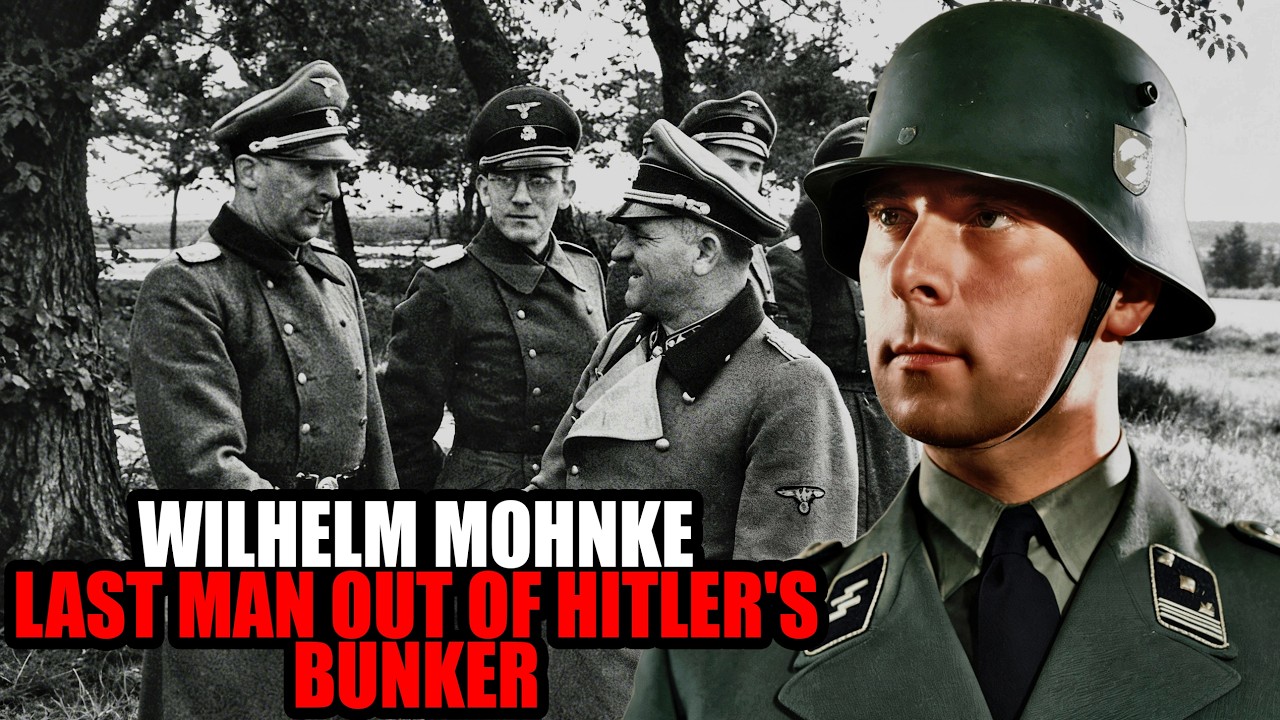
For Mohnke, the war was over. But the legal reckoning that many believed he owed would never arrive. Mohnke’s long association with the Nazi regime began early. Born on March 15, 1911, in the northern port city of Lübeck, he came from a working-class family with no notable connections.
At twenty-two, in the first surge of Nazi power, he joined the SS and was accepted into the Leibstandarte SS Adolf Hitler, the elite bodyguard regiment that served as the most prestigious formation in the entire SS. Admission was strictly controlled, requiring exacting physical standards and unquestioned ideological commitment. Mohnke met those standards and spent the 1930s rising within the unit as it transformed from a ceremonial guard into a genuine military force. When war broke out in September 1939, he had nearly six years of service behind him.
He went through the early campaigns with the Leibstandarte, fighting in Poland, France, and the Balkans. On the battlefield, he built a reputation as exactly the kind of aggressive, frontline officer the Waffen-SS prized above all else. But it was during the French campaign that his name became permanently attached to one of the most infamous atrocities of the war. On May 28, 1940, in the small Belgian town of Wormhoudt, a detachment of soldiers under Mohnke’s command herded roughly ninety British and French prisoners of war into a barn on the edge of town.
Stick grenades were thrown inside. When the explosions failed to kill everyone, the survivors were shot. Around eighty men died. A handful survived by hiding beneath the bodies of their dead comrades and were discovered the next day by regular German army troops.
The surviving prisoners gave consistent, detailed accounts that left little room for alternative interpretations. The massacre was never seriously disputed by historians. Mohnke always denied ordering it, denied knowing about it, and denied any involvement whatsoever. He maintained that denial without variation for the rest of his life.
He was never charged, never tried, and never convicted of anything connected to Wormhoudt. The war continued. In 1941, he was wounded in Yugoslavia, losing part of a foot to a grenade. The injury kept him away from the front for a significant period, and it may well have saved his life, given what awaited on the Eastern Front that summer.
Once recovered, he returned to combat with the Leibstandarte and fought through some of the most brutal campaigns of the entire war. His tactical leadership in the most difficult situations consistently earned him promotion. By 1943 and 1944, as the German position in the East deteriorated from bad to catastrophic, he was commanding at regimental and brigade level through grinding defensive battles. After the Allied landings in Normandy in June 1944, he commanded SS forces in the savage hedgerow fighting that cost both sides enormous casualties.
There, further allegations emerged: more reports of prisoners shot after surrender, more incidents that investigators would spend years trying to untangle without ever producing charges that held. He was wounded again in Normandy, seriously enough to remove him from combat for months. He was still recovering when the war entered its final phase in early 1945. The Red Army was driving into Germany from the east; the Western Allies were closing in from the west.
In April, Mohnke was given command of the Zitadelle, the innermost defensive sector of Berlin. This was the area containing the Reich Chancellery and, beneath its garden, Adolf Hitler’s bunker. There was no military logic left in the defense of Berlin. The city was surrounded, its defenders a mix of exhausted veterans and terrified teenagers and elderly men who had never fought before.
The outcome was not in doubt to anyone thinking clearly. But Mohnke accepted the appointment and organized the defense with the same professional thoroughness he had brought to everything else. At that point in the war, there was nothing else to do. He remained in the bunker complex during the final days, one of the small group of senior officers who stayed with Hitler as the Soviets closed the ring.
He was present for the suicide of Hitler on April 30, the burning of the bodies in the Chancellery Garden, and the disintegration of any remaining military coherence as the men inside tried to decide what to do next. On the night of May 1, he led the breakout. The attempt failed, as it was always going to fail. There was nowhere left to go and nothing left to fight with.
But Mohnke led it anyway, moving through the ruins in the darkness with soldiers and civilians, including some of the most senior surviving figures of the Nazi state. By the morning of May 2, the group was surrounded and captured by Soviet forces. Wilhelm Mohnke, who had been at the very heart of the Third Reich from its earliest days to its final hours, became a prisoner of the Red Army. He spent ten years in Soviet captivity, far longer than most German officers, who were released in the late 1940s and early 1950s.
The Soviets held him until 1955, most likely because his proximity to Hitler in the final days made him valuable for their ongoing investigations into what had happened in the bunker. He was interrogated extensively about Hitler’s last days, the breakout attempt, and everything he had witnessed in the Chancellery. The accounts he gave became part of the historical record that researchers have used ever since to reconstruct the final weeks of the war in Berlin. He came home to West Germany in 1955 as a free man.
British investigators had been trying for fifteen years to build a case against him for Wormhoudt, but they had never managed to produce charges strong enough for trial. The difficulties were evidentiary and legal: proving the command responsibility of a specific officer, and prosecuting a German citizen in a British court for crimes committed in Belgium against British soldiers. His return to Germany made the prospect even more complicated. Mohnke settled into civilian life, working in the automobile business and building a quiet, comfortable existence.
The decades passed. The investigators who had tried to hold him accountable aged, retired, and died without obtaining the verdict they had sought. British investigations continued off and on for decades, with renewed efforts in the 1980s and again in the 1990s as surviving witnesses were located and new evidence examined. None of it produced a prosecution.
Mohnke was interviewed multiple times and each time gave the same answers, denying everything and walking away without charges. The survivors of Wormhoudt who were still alive died waiting for justice that never came. Mohnke outlived most of them. In his final years, he gave occasional interviews that provoked controversy.
His tone was unapologetic. He continued to refuse any responsibility for what had happened under his command, and he discussed the war and his role in it with a calm comfort that many found deeply offensive given what the historical record suggested. He never expressed regret in any form that satisfied the people who believed he owed them regret. Whether he was incapable of it or unwilling to show it publicly was a question no one who knew him well was prepared to answer on the record.
Wilhelm Mohnke died on August 6, 2001, in a nursing home in Damp, a small town in Schleswig-Holstein in northern Germany, not far from where he had been born ninety years earlier. He had outlived the Third Reich by fifty-six years, outlived the men who had tried to prosecute him, outlived the Soviet Union that had held him prisoner for a decade, and outlived the controversy that had surrounded him for most of his adult life without it ever producing the legal consequences his critics believed it should have. He died in his bed, which is more than can be said for the men whose deaths his soldiers had been responsible for at Wormhoudt, in Normandy, and on the Eastern Front.