For more than seventy years, the world watched Prince Philip perform a single role with absolute precision. He walked two steps behind his wife and never stepped out of place. He carried out 22,219 solo engagements and delivered 5,493 speeches. He was a decorated war hero, a modernizer, and the model of a royal consort who knew his duty and performed it flawlessly. That was the man the cameras captured.
But the people paid to stand close to him saw someone else entirely. The valets who dressed him, the pages who served him, and the private secretaries who managed his daily affairs witnessed a different man. They saw the anger beneath the courtesy. They learned to read his moods before he spoke. They understood something the public never did: the perfect man in the photographs and the difficult man behind closed doors were not two separate people. They were one wounded boy who was never allowed to break.
The public saw discipline. They saw a naval officer who understood hierarchy and accepted his place within it. The record seemed to prove it. By the time he retired from public duties in August 1997, and again in his final withdrawal in the summer of 2017, the numbers had become almost mythical. He made 637 solo overseas visits. He served as patron, president, or member of more than 780 organizations. He was consort for 69 years, the longest tenure of anyone in the history of the British crown.
But there was a second story never told on camera. It was told in the corridors of Buckingham Palace and the private apartments of Windsor Castle, among the men and women who dressed him, fed him, drove him, and organized his daily life. For them, preparing the perfect consort for public appearances was a daily challenge. They learned, as sailors learn weather patterns, to sense changes in atmospheric pressure before the storm arrived. A valet knew from the set of his shoulders whether the morning would be easy or dangerous. A page knew which questions to answer quickly and which to ignore entirely. A private secretary knew the report had to be accurate the first time, because a second chance rarely came.
The public saw a man who had accepted his position. The staff served a man who never accepted it at all, and who discharged his frustration at a life spent in second place onto the small daily machinery of palaces he had no authority over. Imagine the scale of the world he managed behind the scenes. The royal household in his era numbered hundreds of people spread across Buckingham Palace, Windsor Castle, Sandringham, and Balmoral. An army of servants, cooks, cleaners, drivers, gardeners, clerks, and pages. Some served for thirty or forty years without their names ever appearing in a newspaper. These were the people who truly knew Prince Philip. They saw him as he was before he put on his official mask and after he took it off.
To understand that sharpness, the brutal frankness, the flashes of temper, one must go back far beyond the wedding, beyond the war, beyond the naval college that instilled his principles. One must go back to a villa on a Greek island, to a night when a family fled for their lives, and to a wooden box that carried an infant prince from the ruins of one of Europe's oldest thrones. The man who stood perfectly still for seventy years had spent his earliest years being torn from everything he owned. That stillness was not peace. It was armor.
Before he was two years old, he had lost his homeland, and the losses were only beginning. Philip was born on June 10, 1921, on the dining table of the faded Villa Mon Repos on the Greek island of Corfu. He was a prince of Greece and Denmark, the only son and youngest child of Prince Andrew of Greece and Princess Alice of Battenberg. On his mother's side, he was a great-grandson of Queen Victoria herself. On the surface, he was born at the heart of European royalty. In reality, he was born amid its collapse.
Greece in the early 1920s was a nation at war and a monarchy on the brink of collapse. His father, a professional soldier, was commanding troops in a disastrous campaign against Turkey. When the campaign failed, the officers who led it were blamed. Prince Andrew was arrested. Many of his fellow commanders were court-martialed and executed by firing squad. Andrew was tried before a revolutionary court, stripped of his rank, and banished from Greece for life. In December 1922, the family had only days, sometimes hours, to save themselves. A British warship, HMS Calypso, carried them from Greece into exile.
The infant prince, too young to walk, was carried aboard in a makeshift crib made from a wooden fruit box. The future consort of the British throne left his homeland in a box meant for oranges. It is the kind of detail that seems invented, but it was not. It is simply what exile does. Rank means nothing to a family on the run.
The family settled on the outskirts of Paris in a borrowed house at St-Cloud, living on the charity and money of wealthy relatives. There, in those years that should have been a safe haven for a happy childhood, the boy's world quietly collapsed for the second time. His mother, Princess Alice, had been born deaf and taught herself to read lips in several languages. She was intelligent, deeply religious, and fragile. In the late 1920s, her mind began to deteriorate. She suffered a severe religious crisis. She believed she was receiving divine messages. In 1930, she was taken from her family, diagnosed with schizophrenia, and committed to a sanatorium in Switzerland. Philip was eight years old. He did not see her for years.
There were no holiday visits home to a mother's arms, because there was no mother at home. There was no home at all. His four older sisters, all considerably older than him, married German princes and nobles one after another and scattered across a Germany sliding toward the Nazi era. The family that had fled Greece together fragmented into separate lives in different countries. His father, weighed down by exile and a marriage that had effectively ended, drifted south to Monte Carlo, where he sat at gambling tables, enjoying the warm sun, in the company of a mistress. He and his son met only rarely for the rest of Andrew's life.
Imagine what this boy owned by the age of ten. No country, for he was a stateless exile. No stable home, for he moved between relatives' houses across Europe. No mother, for she was in a distant sanatorium. No father in any meaningful sense, for Andrew had gone to the Riviera. No fixed nationality, no guaranteed income, no roof he could call his own. He kept his possessions in a small box. When later asked what language his family spoke at home, he answered with the absolute frankness that would become his trademark: the question was meaningless, because there had been no home.
A child learns from what the world does to him. The lesson this world taught him was brutally simple: everything can be lost. People disappear. Places are taken away. The only thing that cannot be taken from you is what you build inside yourself. So the boy began building very early. He became self-reliant to a degree that astonished the adults around him. He became practical, quick-witted, and averse to self-pity, because self-pity was a luxury for children who still had something to lose. He learned to charm without attachment, to be liked without needing love, and to suppress his emotions like cargo lashed down on a stormy sea. This was the beginning of the armor. Not cruelty, not innate coldness, but a survival system built by a frightened, abandoned, extraordinarily capable child.
At Gordonstoun, the strict school on the cold northern coast of Scotland founded by educator Kurt Hahn, Philip found the one thing that had never let him down: a system that rewarded control. Hahn believed in hardship as a moral tool. Cold showers before dawn, long runs, sailing in rough seas, and responsibility given to boys before they felt ready for it. For most children, it was an ordeal. For a boy who had survived exile and abandonment, it was salvation. Here at last was a world with fixed rules. Here effort was rewarded and weakness was forged away, and everyone stood on the same cold, equal ground. Philip did not merely endure Gordonstoun. He thrived. He led teams. He was a leader.
He moved from Gordonstoun to the Royal Naval College at Dartmouth, where the navy refined him. He graduated as the best cadet in his class. The service gave him everything his childhood had denied him. It gave him a logical hierarchy, a uniform that conferred identity, a ship that would not drift off to Monte Carlo, and a purpose measured by duty rather than emotion. In the navy, a man is judged by what he does, not by who abandoned him. For the first time, the self-reliance he had built in his frightened childhood found a useful place.
Then came the war, and the armor proved itself not merely defensive but, in the right field, a form of greatness. Philip served with genuine distinction. In March 1941, aboard HMS Valiant in the Mediterranean, he was given charge of the ship's searchlights during night operations off Cape Matapan. When the lights were switched on, they illuminated enemy ships, and British guns did the rest. He was mentioned in dispatches for his coolness under enemy fire, one of the highest honors a young officer could receive. He was nineteen years old.
Two years later, off the coast of Sicily, he showed the same courage in a different form. His destroyer, HMS Wallace, was under repeated night attack from German aircraft, and the situation seemed hopeless. Philip devised a plan on the spot. The crew built a raft loaded with smoke floats and launched it to drift on the water, burning. The bombers saw the flames and smoke and attacked the raft instead of the ship. Wallace slipped away in the darkness. The men aboard that night said plainly that the young officer had saved their lives. By the end of the war, he was one of the youngest officers in the Royal Navy, and he was present in Tokyo Bay when Japan signed its surrender and the world's guns finally fell silent.
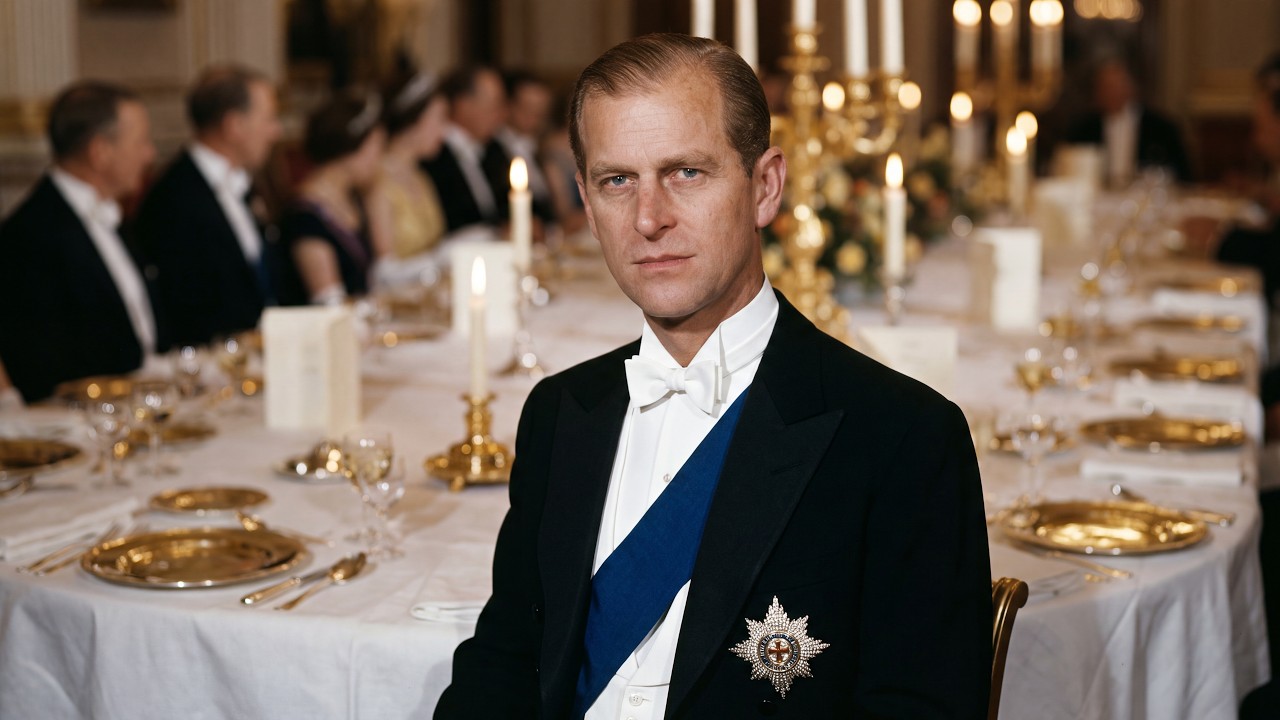
He was a tall, blond, strikingly handsome young officer in his mid-twenties, a decorated war hero who had earned his honors on merit rather than inheritance. He was intelligent, energetic, and physically brave, a man who had built himself entirely from the wreckage of a broken family and asked no one's pity along the way. He had no money and no country, but he had made himself formidable through sheer will. He fell in love with, or something very close to it, the most famous young woman in the world.
He had first met Princess Elizabeth, heir to the British throne, when she was thirteen and he, a handsome cadet, was showing the royal party around Dartmouth. She never wavered in her feelings for him afterward. Despite some quiet resistance from courtiers who distrusted his foreign origins, his poverty, his exile, and his bluntness, the marriage went ahead. He gave up much, and he gave it up without visible complaint, because giving things up was the one skill his childhood had honed more than any other. He renounced his Greek and Danish royal titles. He gave up his naval career, the only institution that had ever truly embraced him. He became a naturalized British citizen. He took a new surname, Mountbatten, from his mother's family, because a stateless prince had no surname of his own. He married her on November 20, 1947, in Westminster Abbey before a radio audience estimated at 200 million people around the world.
The king made him Duke of Edinburgh, Earl of Merioneth, and Baron Greenwich. The exiled boy from the fruit box had risen from a crate on a warship to a royal wedding watched by a fifth of the world's population. That was the peak. That was the last moment before the descent. Everything he had given up to reach this point was a generous sacrifice built on an unspoken understanding: that in his own home, as husband and father, he would at least be master of his own household. Within a few years, the crown would take even that from him.
For a few brief years after the wedding, Philip tasted the ordinary married life he had hoped for. The couple lived in Malta while he served with the Mediterranean Fleet, and by all accounts, those were the happiest years of their lives. Elizabeth was, for a brief and precious time, simply a naval officer's wife. Philip commanded his own frigate, HMS Magpie. He had his ship, his career, his growing family, and a wife who was not yet queen. He was finally master of his own house. That would never happen again.
On February 6, 1952, King George VI died in his sleep at Sandringham. Elizabeth was in Kenya at the time, having climbed up a tree a princess and climbed down a queen. The news reached Philip first, and one of his aides who was present said the young husband looked as though half the world had fallen on his shoulders. He understood immediately what the world did not yet know. His wife's accession to the throne was, for him, a demotion. The navy was over. Independent life was over. From that day forward, every room he entered he would enter second. Every honor would go to her. He would spend the rest of his life as an appendage to a job that was never his.
The loss of the navy alone would have broken a lesser man. The sea was his only true home, the institution that had embraced him when nothing else would. Naval officers who served with him believed he could have risen to the very top of the service and become First Sea Lord had fate not given his wife the crown. Instead, at thirty, he took off his uniform for good and moved into a role with no rank, no command, and no clear purpose. His career was over, and he accepted it as he accepted everything else. This time, there was no summit waiting after the sacrifice. There was only the long, vague second place for the rest of his life.
The first blow came almost immediately, and it fell on the one thing his childhood had taught him to protect: his name. Philip had taken the name Mountbatten for the marriage. It was not even his real name, but it was what he had, and he logically assumed his children and the royal family would bear it. His uncle, Lord Mountbatten, boasted a little too loudly that the Mountbattens were now on the throne. The old guard at court recoiled. The queen's grandmother, Queen Mary, was horrified. The prime minister, Winston Churchill, moved quickly to crush the idea. They insisted the royal house would remain Windsor, as it had been. Philip's name would not touch the throne, not even through his children.
His reaction was among the most revealing of his life. He raged that he was nothing but a bloody amoeba. He said he was the only man in the country not allowed to give his name to his own children. Read those words carefully, and you will find the wound of his entire life between the lines. A man who lost his country, his mother, and his father in childhood; who rebuilt himself from nothing; who gave up his titles and his career for this marriage, and was now told he could not even, in the simplest human sense, be the father of his own family. The one thing exile had left him, the ability to pass on his name, was taken from him by the crown as well.
The resentment did not fade. It festered for nearly a decade. The queen did not issue a compromise decision until February 1960, days before the birth of their third child, Prince Andrew. By royal decree, the surname Mountbatten-Windsor would be used by their descendants who needed a surname and did not hold the title of Royal Highness. It was a partial victory after eight years of suppressed resentment, and it changed nothing in practice. In public, Philip was the crown's most loyal servant. In private, he was a proud man who had been told from the start how little of his own household he would be allowed to own.
A man does not swallow an insult like that and simply surrender. Frustration must find an outlet. Philip could not argue with Churchill. He could not defy his wife, who was now queen. He could not control the government, the court, or the old order of precedence that placed him perpetually behind the monarch. All of that was beyond his reach. The palace itself, the servants, the kitchens, the estates, the small kingdom of the royal household, was the only domain where a frustrated, formidable, immensely capable man could still be in charge of something. The staff became, though they could never name it, the victims of a pressure that had nothing to do with them. When a report was inaccurate, the sharpness it met carried the weight of a life spent in second place. When a system was inefficient, the impatience that fell on it was the impatience of a man who had commanded a warship at nineteen and was now not even allowed to bear his own name.
There is a hard truth here that no amount of gentle retelling can ignore. The very qualities that made Philip a hero, the self-control, the refusal to complain, the armor that never cracked in public, all meant the pressure had no proper outlet. He would not cry. He would not confide. He would not process anything, in the language of the modern age. So he erupted indirectly, in flashes, at the people least able to answer back. The nation saw a man who had simply accepted his fate. The household served a man who had accepted nothing, and carried the disappointment of a lifetime into every corridor he walked.
The staff had a special skill that appeared in no job description: the ability to sense his mood before he entered the room. It was written nowhere, but every valet, page, footman, and equerry who lasted in the service of the Duke of Edinburgh acquired it the way anyone acquires a survival skill, through necessity. They learned the sound of his footsteps in the corridor. They learned the set of his jaw at breakfast. They learned which mornings his questions would be curious and warm, and which mornings the wrong answer would bring a torrent of harsh words that could shake a grown man for an hour. In short, they learned to read his weather and prepare before the storm hit.
Reading his weather was a genuine craft, passed quietly from one generation of servants to the next. A new valet would be taken aside by an older one and taught the signals the way a young man is taught to operate a sensitive machine. Answer his questions directly without rambling. Never say something was always done a certain way. Make sure the information he wants is ready before he asks. Do not hover, do not flatter, and above all do not lie, because he could smell deception from a distance, and there was nothing on earth he hated more. Those who mastered the craft could serve him happily for their entire careers. Those who did not lasted weeks. The quiet reassignment of certain roles told its own story about what it took to stand beside him day after day without being destroyed.
Those who spoke about it afterward were careful, and their care spoke volumes. Grant Harrold, who worked as a royal butler at the palace, described the atmosphere plainly. He said the staff were a bit wary of the Duke because he was outspoken and, in Harrold's phrase, not everyone's cup of tea. Harrold tells a short story that captures the entire dynamic. When he once suggested going to check on Philip, the reaction of the other staff around him was something close to panic, saying no, no, no. As if he had proposed walking into weather they knew well enough to avoid. To someone new to the household, it seemed an overreaction. To the old staff, it was simply caution.
What made him difficult was not malice but a refusal to accept the smooth machinery of deference that the rest of the royal family moved through without hesitation. Harrold noticed this specifically. He said other royals simply tended to go along with things as they were. Philip did not. Philip always asked why. Why is this done this way? Why has no one questioned it? Why am I being given an unconvincing answer? For a servant whose entire training revolved around the art of smooth facilitation, a boss who questioned everything was exhausting and sometimes frightening. He did not want to be managed. He wanted to be told the truth quickly and correctly, and he held anyone who wasted his time with less than that in utter contempt.
His bluntness could turn sharper. Royal photographer Ian Bell-Turner, who worked with the family, was the least diplomatic of all, describing Philip as dangerous at times and plainly calling him the least popular member of the royal family among those who worked with him. Others softened the same core observation. Broadcaster and photographer Helena Chard said there was never a dull moment with him, that he was always in trouble for his outspoken remarks, and yet, at the same time, great fun to be around. Read those testimonies side by side, and you find one consistent man. Not a monster but a force, someone whose presence changed the atmosphere of a room, capable of wounding with one word and charming with the next, someone no one was entirely comfortable around.
But here is the side that the simple version of this story misses, and the household knew it better than anyone. This same man inspired fierce loyalty. Many of his closest servants stayed for decades and defended him to the end. Grant Harrold, despite speaking of the staff's wariness, stated plainly that he adored Prince Philip, that he admired a man who could not suffer fools and spoke his mind in a world of evasion. Harrold even described the swearing as a strange kind of intimacy. If the Duke swore at you, Harrold said, it meant you were seeing the real Prince Philip, which many admired. In a court built on masks, his rudeness was at least honest. You always knew where you stood, even when it was uncomfortable.
This is the paradox at the heart of the household's experience, and the paradox at the heart of the man. He was feared and loved at once, often by the same people, on the same day. The valet who steeled himself before a difficult morning was often the same valet who would never have dreamed of leaving his service, because behind the harshness there was fairness. He played no favorites. He held no petty grudges. He valued competence wherever he found it, whether in a duchess or a cleaner. And he had no time for rank as an excuse for laziness. The servant who did his job perfectly and told the truth had nothing to fear from him. The servant who deceived or wasted time had everything to fear, and knew it.
Serving Prince Philip was like living with a master whose weather changed in an instant, and the household's skill lay in sensing the coming change and adjusting their sails before it arrived. It sounds like a hard way to earn a living, and often it was. But those who could do it, who could tell the truth quickly and absorb the lash without collapsing, found on the other side of the fear a man worth serving, honest, exacting, and in his own way, fiercely loyal to those who were loyal to him. The tragedy, as the coming years would show, is that those who could not simply do their job and leave, those who were his own flesh and blood, could never find that safe harbor on the other side of the storm.
He could not run the country, so he ran the one thing left to him: the household itself. From the moment his wife became queen, Philip sought a function within a life that offered him no real work, and he found it in the vast, creaking, tradition-bound machinery of the royal estates. If he would always be second in great affairs of state, he would be first in the management of the houses. He threw himself at the task with all his restless energy, as a man who could not bear idleness and could not bear being useless.
What he found when he looked closely horrified the naval officer within him. The royal houses in the early 1950s were a museum of waste, run by overlapping departments that had not communicated in living memory, relying on customs no one remembered the original purpose of. Servants still wore powdered wigs. Duties were divided among staff according to rules laid down generations earlier. For a man who had run a warship where every rope and every hand had a clear purpose, it was unbearable. So he did what a commander does. He inspected. He asked questions. He reorganized. He toured kitchens, cellars, and boiler rooms that no royal had bothered to visit in decades. He introduced new methods and new machines. He merged overlapping roles. He slowly pushed the palaces, against immense resistance, toward something closer to the twentieth century.
He tightened his grip on the private estates, the farms at Sandringham and the lands at Balmoral, running them as working enterprises rather than ornaments, raising their efficiency, and showing genuine, expert interest in agriculture, forestry, and livestock. At last, he was in command, and the results were tangible. Estate management improved, and the household changed, reluctantly. The scale of what he took on was vast. The Sandringham estate extended to about 20,000 acres of farmland, woodland, and marsh in Norfolk, and the Balmoral estate in Scotland to more than 50,000 acres of hills and forest. The royal family employed hundreds of people across all its palaces, run on budgets and customs that had barely changed in a century.
Philip treated this sprawling entity as a captain treats a ship inherited from a negligent predecessor. He read the accounts. He walked the land. He learned the names of tenant farmers, the crops in the fields, the condition of the herds. He brought modern methods to the Sandringham farms and went through the household records line by line, hunting for waste wherever it existed. Where his predecessors had seen ornamental estates, he saw working enterprises that could be made profitable, and under his management, they slowly were. But leadership had its edge, and his was sharp. The same drive that reformed the kitchens also terrorized them when they fell short. He wanted things done perfectly, quickly, and he had no patience for the answer that it had always been done a certain way. That answer was not a justification to Philip. It was an admission of laziness.
He did not shout for the sake of shouting. He shouted when he shouted because something was wrong and no one had bothered to fix it. Yet set against this sharpness is a body of testimony that complicates the picture, and fairness demands it be heard. To staff who worked closely with him and competently, Philip was strikingly considerate. On a visit to the White House in 1976, the American head butler was astonished when the Duke of Edinburgh engaged the house staff in friendly conversation and even poured their drinks himself, a simple gesture those servants had never received from visiting dignitaries. He remembered names. He asked about families. He noticed when a long-serving member of staff was ill or grieving, and he acted quietly, without fuss, and without any desire for recognition.
The truth the household understood, and the outside world found hard to believe, was that these were not two different men taking turns. They were one man. The consideration and the sharpness came from the same source. He valued work and valued those who did it well, and his kindness and his cruelty were ultimately both derived from competence and honesty rather than status. He was kind to the servant who did his job honestly and cruel to the one who deceived. He applied this standard to everyone in the household, from the top to the bottom, with a consistency that was itself a form of justice. He did not treat dukes differently from dishwashers. He treated everyone the same way.
This was the working world Philip built for himself, a small kingdom of estates and houses he ran with firmness and patience because it was the only kingdom the crown allowed him. It gave him purpose and provided an outlet for his frustration at his position. It explains more than any single anecdote why the staff remembered him first as a commander and only second as a courtier. But no man can fill his inner life with kitchen inspections and farm accounts. There were parts of Philip's character the household could not reach and his estates could not satisfy. In the mid-1950s, those parts led him toward a separate life, a private circle, and a long journey away from home that nearly exposed the carefully preserved gap between the public man and the private man.
Despite being married to the most watched family on earth, Philip guarded a private space of his own, and he guarded it with the stubbornness of a man who had learned young that anything shared could be taken away. At the heart of this space was a lunch club. It met at a fish restaurant in Soho called Wheeler's, called itself the Thursday Club, and its members were a group of clever, informal men, photographers, actors, writers, and naval friends. Here, for a few hours, Philip could be not the queen's consort but simply a witty, intelligent man among peers, telling stories that could never be told at court and laughing at jokes that would have frozen the palace.
At the heart of this circle was his closest friend and private secretary, an Australian naval officer named Mike Parker. Parker had served alongside Philip in the war, shared his humor and his restlessness, and understood more than anyone the pressure of the gilded cage they now moved within. He was more than a courtier. He was a companion, the friend who kept Philip steady in a role that gave a proud man nothing meaningful to do. And Parker, and the world the two men shared, would ignite the perfect image of the royal marriage that had been so carefully maintained.
In the autumn of 1956, Philip left on a solo tour that took him away from his wife for nearly five months. The official purpose was sound. He would open the Olympic Games in Melbourne, then continue aboard the royal yacht Britannia to some of the most remote corners of the Commonwealth, places a reigning queen could not easily reach. It was the kind of duty that suited him perfectly, filling the vacuum of a powerless position. But a separation of nearly five months between a young husband and his young wife, in an era when royal marriages were supposed to run smoothly, was unusual enough to attract attention, and it did.
The tour itself was a strange mixture of great duty and gilded exile. Britannia was a floating palace, over 400 feet of gleaming dark blue, crewed by more than 200 officers and men. Aboard her, Philip traveled to places few royals had ever seen. From frozen research stations in the far south to the most isolated islands of the Pacific, he performed the work he was made for, carrying the crown to the ends of the earth where the queen could not go. Yet he did it alone, month after month, half a world away from his wife and young children, and the grandeur of it could not hide the fact that it was, in its own way, a long separation the marriage had to survive.
What turned the long absence into scandal was what happened at home while he was away. During the tour, Mike Parker's wife, Eileen, began divorce proceedings against him, and details leaked to the press. Parker resigned his post and left royal service rather than let the scandal touch the crown. But the damage was done. The press drew its own conclusions, without evidence, from the collapse of a trusted friend's marriage to the prince being alone at sea for months, and the conclusion it reached was that all was not well between the queen and the duke. The gap the royal family had protected for years was suddenly threatening to open before the world.

It is necessary to be precise here, because this kind of story turns into myth. No affair was ever proven against Prince Philip. Not then, not later, not ever. Every specific claim attached to his name over the decades was denied, and none was supported by evidence. There had been an earlier flutter in 1948 when his name was linked to actress Pat Kirkwood after a single night out. Both denied it absolutely, and Philip's recorded response was a weary observation that there was nothing to be done unless a libel action was brought. The pattern continued for the rest of his life, endless smoke and no fire. What is documented is not infidelity. What is documented is the separation, the friend's divorce, and the storm of rumor that surrounded them.
The household lived the difference between rumor and truth as a daily reality. And rumor alone was enough to change the atmosphere inside the palaces. A proud man like Philip, seeing his marriage discussed in the tabloid press, watching his closest friend driven from royal service, feeling the court's suspicious glances turn toward him, did not become easier to serve. The frustration that filled him found new fuel. The armor, now tested not by exile but by scandal, closed a little tighter, and the staff read his weather as always and prepared.
There is something deeper worth noting in this chapter because it recurs throughout his life. Philip's insistence on his own world, the club, the friendships, the long tours, was not the behavior of a neglectful husband. It was the behavior of a man taught by loss that he must always keep some ground that was his alone, some territory the crown and the court could not colonize. He had given up his name, his career, his country, his place at the front of every room. The Thursday Club and the deck of Britannia were the last ground he had, and he defended them fiercely, even at the cost of whispers. That tells you how little he had left to hold.
For centuries, the crown had survived scandal by one unbreakable rule: never comment. Rumors were left to wither in the press while the palace maintained a stony silence, on the sound principle that denying a story was an admission that it deserved denial. Silence was the fortress. And in the early months of 1957, for the first time in the young queen's reign, the fortress opened its gates and answered, thereby telling the world that something was wrong. The pressure had become too great to ignore. With Philip still finishing his long tour and Parker's divorce splashed across the newspapers, speculation about the state of the royal marriage had moved from foreign gossip columns to the British press. It was no longer a whisper. It was a headline.
So the palace made an unprecedented decision. The queen's press secretary, a reserved man known for his silence, Commander Richard Colville, issued a formal statement. He announced that it was quite untrue that there was any rift between the queen and the duke. Eleven words, cold and dry, intended to end the matter. They succeeded in one sense, for no respectable newspaper could push further against a direct denial from the palace. But in another sense, those eleven words were an unprecedented admission. The fortress that never answered had answered. The institution that dismissed gossip had been forced to publicly defend the integrity of the queen's marriage. The very existence of the denial confirmed the scale of what it was denying.
To understand how strange this was, it helps to remember the man who issued it. Commander Richard Colville was so reticent with the press that Fleet Street called him the Abominable No-Man. A courtier whose entire philosophy was that the royal family and the press should have as little to do with each other as possible. For a press secretary of this temperament to issue any statement at all was remarkable. For him to confirm, even by denying, and to speak publicly about the state of the queen's marriage, was extraordinary. The palace was a fortress of silence, and it had just been forced to come out from behind its walls entirely. Everyone who understood the court understood the signal. The gap had nearly shown, and the highest walls in the kingdom had rushed to hide it again.
To end the speculation definitively, the queen and her advisers went further. When Philip finally returned home, a public reunion was arranged. And a few weeks later, in the spring of 1957 itself, the queen granted her husband the official title of Prince of the United Kingdom, an honor he had oddly lacked until then. The message was clear and public. Whatever the press had hinted, the queen was elevating her husband, not discarding him. It was a gesture of confidence disguised as an honor, designed to smother the rumors under the appearance of unity.
Here, the observer must hold two things at once. The marriage was not, in fact, on the verge of ending. Whatever tensions it contained, and they were real, it would last another 64 years and become one of the longest and most enduring marriages in royal history. But the crisis of 1957 was real, and its meaning was real. For a moment, the carefully maintained gap between the public Philip and the private Philip had nearly been exposed to everyone, and the royal institution, from its press secretary to the staged reunion and the princely title, had been forced to marshal all its tools to close it again. The household that managed his daily affairs watched the institution spend weeks managing his image. What did it cost him to be defended this way? That was the question the cameras did not ask, and the staff did not need to ask.
A proud man watched his marriage discussed in the newspapers, watched his closest friend driven away, watched his private character weighed in public and found wanting, and was then given a title as a kind of public reassurance that he was still wanted. For a man whose self was built on self-sufficiency and owing nothing to anyone, being rescued so publicly, having his status propped up by decree and photo opportunity, must have been its own kind of humiliation. He accepted it, of course. He spent his life accepting things. But the armor, now tested by the indignity of being defended, hardened further.
There is a scale to what the monarchy was protecting that is easy to miss in the human drama. This was an institution that had survived a thousand years by controlling what the public was allowed to see. It had managed a king's madness, another king's abdication, and the death of heirs, all behind the same wall of silence and stagecraft. In 1957, that ancient wall had bent slightly around the marriage of Elizabeth and Philip, and the speed and force with which the palace moved to straighten it showed how much was at stake. The gap between public and private was not a personal matter. It was, literally, a matter of state.
The rumors faded, as rumors do. The marriage endured, as it would for decades. But something had settled into place that would shape the rest of Philip's life at court. The institution now knew, as the household already knew, that the man standing beside the queen was more complicated, more volatile, and harder to contain than his perfect public surface suggested. The work of containing him, of keeping the private man from threatening the public man again, continued quietly for the next half century. But the hardest containment of all was not the work of press secretaries or palace machinery. It happened within his own family, in a nursery, then in a boarding school. And it concerned a small, sensitive child who could not understand his father's moods and could not withstand his storms.
Prince Charles, born in November 1948, was the opposite of his father in almost every way. Where Philip was tough, practical, and impatient, Charles was tender-hearted, sensitive, easily wounded, and given to the kind of self-reflection his father despised. Where Philip, the abandoned child, had learned to need no one, Charles was a boy who desperately needed, craving warmth and reassurance and the constant affection that neither of his busy, dutiful parents was able to give. From the start, father and son were profoundly mismatched, and the friction between them would become the deepest and most painful of Philip's failures.
Philip looked at his delicate son and saw a problem to be solved. The boy was too soft. The world he would one day have to master, the world of the monarchy, was hard, and a soft prince would be eaten alive in it. So Philip set out to toughen him, to do for Charles what Gordonstoun and the navy had done for him, to burn away the softness and forge something harder in its place. It was, in Philip's mind, an act of love. He was preparing his son for a cruel fate in the only way he knew. He could not see, because his own armor prevented him from seeing, that the very treatment that had saved a stateless orphan might destroy a small, anxious child who had never known real deprivation and who desperately needed to feel safe.
The decision that expressed all of this was the choice of school. Philip sent Charles to Gordonstoun, the same harsh Scottish institution that had been Philip's own salvation. For Philip, it was rescue. For Charles, it was a sentence. The cold showers, the runs, the rough games, and the culture of toughness in which the young Philip had thrived became daily misery for his fragile son. Charles was not naturally athletic or naturally a leader. He was bookish and shy, and in a school that prized toughness, he was a target. He was bullied, sometimes cruelly, and the letters he wrote home from Scotland were letters of plain unhappiness, letters from a boy counting the days.
He would later describe the place in terms that left no doubt about his suffering, and the contrast with his father's fond memories was stark. The same walls, the same cold sea, the same system that saved the father broke the son. Charles, the shy, gentle boy, found himself in dormitories where weakness was hunted, and by all accounts of those years, he was an easy target. He was pushed and mocked, and the very sensitivity that made him suffer made him unable to hide his suffering, which in a harsh school only brought more of it. He retreated into solitary things, into books and drawing and long walks, the inner life his father never trusted.
He would say in later years that the warmest moments of his childhood were spent not with his parents but with his grandmother and among the palace staff, the gardeners and gamekeepers who showed him a kindness his father seemed incapable of offering. The future king found more warmth downstairs than he ever did at his own family's table. What the outside world did not know, and what was later documented in precise and careful detail, was the nature of the relationship between them. In the 1990s, journalist Jonathan Dimbleby wrote Charles's biography in cooperation with the prince himself, and it revealed aspects of family life never before seen. The portrait of Philip as a father was painful precisely because it was balanced.
Dimbleby wrote that Philip often seemed determined not just to correct the boy's behavior but to mock him, tease him, and belittle him, sometimes in front of others, until he dissolved into tears. One close family relative, quoted in the same book, described the approach as ruthless bullying and said it drove Charles further and further into himself. Every attempt to toughen the boy taught him, in reality, to hide. And where was his mother in all this? The same account is cruel and painful. Dimbleby wrote that the queen was not so much indifferent to her son as detached from him, and in domestic matters she deferred entirely to her husband's will. The only parent who could have softened Philip's verdict stood aside.
Charles grew up with a father who mocked him and a mother who, out of her own nature, her duty, and her emotional reticence, stood aside. The boy found the warmth he craved in his grandmother, the Queen Mother, and later in nannies and staff, in his own home, the future King of England, in the matters that mattered to one small child. It is important to be fair to Philip even here, because this story is a tragedy and not a simple case of a cruel man and an innocent boy. Philip genuinely believed he was helping. He was not a father who neglected his son out of indifference. He was a father who pressed down on his son out of a sincere and mistaken conviction that harshness was love. He believed the greatest thing he could do for the boy was to prepare him for the ordeal ahead. He was trying to do that in a terrible way.
The tragedy is that the armor that had enabled him to survive his own childhood also blinded him to the needs of a child who was nothing like him. He could not bridge the gap between them because he could not imagine a person different from himself. And so the wound the palace publicly denied, the rumors of 1957, healed and faded. But this wound, the wound of the nursery and the cold Scottish dormitory, never healed. It shaped the future king for the rest of his life and shaped the family for generations. The servants who worked in the palace saw what was happening, saw the small boy flinch and the great man frown, and could do nothing. It raised the question that hangs over the second half of Philip's life: if the armor he had built could not build his son, then what exactly was the price of that armor, and who would pay it?
To understand the tragedy of Philip and Charles, one must understand that Philip was living by a creed, a complete philosophy of how men are made, and that this creed was not madness but the prevailing wisdom of his time, his class, and his service. The creed held that character is forged by hardship, that comfort makes men soft, and that softness is fatal. That a boy becomes a man through testing, deprivation, hardening, and being pushed beyond his limits. That love, real love, is not indulgence but preparation. Philip believed this absolutely, and he had the most powerful possible evidence for it, because it had worked on him. His own life was the proof. He had been an abandoned, stateless, penniless child, and hardship had not destroyed him. It had built him. Gordonstoun had saved him. The navy had given him identity. War had proved his worth. Every hardship Philip had endured had made him stronger, more capable, more real.
So when he looked at his weak, frightened son, the creed gave him a clear and confident answer: the boy needed more hardship, not less. He was weak because he had been spared. Apply the harshness, and he would grow strong, as the harsh years had forged his father. It was logical, it was sincere, and it was catastrophically wrong, because Charles was not Philip, and the same fire that tempers one metal shatters another. The difference was that Philip's suffering was real and involuntary. He had lost everything, and he had built his armor from the inside as a free response to a world that had abandoned him. Charles's suffering was artificial and imposed. It was suffering inflicted by a father who had everything the boy lacked, most importantly his father's approval. A child deprived by fate may gain strength. A child deprived by the parent whose love he craves learns something entirely different. He learns that he is not enough. He learns to associate his own gentleness with shame.
So every effort Philip made to toughen his son backfired completely, driving the boy deeper into the very sensitivity and self-doubt his father was trying to burn away. The household saw the outlines of this dysfunction even when they could not explain its psychology. They saw a father incapable of praise and a son living for praise. They saw a boy who lit up in the company of his grandmother and shrank in the company of his father. They saw the small dramas played out at family dinner tables, where a single cutting word from the head of the family could silence the prince for the rest of the evening. This was the family dysfunction behind the smiling photographs. It was not loud or violent. It was quiet, constant, and corrosive. It was a boy slowly learning that the one man whose good opinion he wanted was the one man determined never to give it.
There is a broader historical truth here that goes beyond one unhappy family. Philip's creed was not his invention. It was the creed of an entire ruling class and an entire generation. Men who ran an empire and fought two world wars, sent away from home at seven, beaten at school, and taught that feeling was weakness and duty was everything. That creed produced extraordinary men, brave, dutiful, self-sacrificing, and it also produced an immense amount of suppressed misery, entire generations of people who could serve brilliantly and love only with difficulty. Philip was one of its finest products, and in the person of his son, he was among the first fathers to watch that creed collapse in the light of a newer, gentler age that no longer believed in it.
There is a grim symmetry in this that the household could see even if it could not name it. Philip's parents had failed him without any real fault of their own, a sick mother and an absent father, and he had responded by building a self that needed no parenting at all. Now he was failing his son, not through absence but through its opposite, through a presence so demanding and so critical that the boy could never measure up. The wound had simply changed shape as it passed through the generations. Alice had wounded Philip by disappearing, and Philip wounded Charles by always being there. Both boys learned, in their own ways, that the love they needed would not come, and both spent their lives building around its absence. The cruelest part was that neither father nor son could break the circle. Philip could not give the warmth he had never received, just as Charles could not stop wanting it. And so they circled the same absence for decades while the household set the table in silence.

Charles, in his quiet way, became the man who ended this pattern in his family. Wounded by his upbringing, he was determined that his own children would know a warmth he had never felt. He would be affectionate where his father had been distant, compassionate where his father had been mocking. Whatever is said about Charles as a father, the impulse behind it was a direct answer to his own childhood, a determination that the wound would end with him. The armor Philip had forged in a fruit box on a fleeing warship, inherited through a harsh Scottish school, reached its limit in his son's tears, and there it finally began to crack.
None of this softness ever reached the public during Philip's life, and it changed nothing about the image he presented to the world. To the nation, he remained the jovial, witty, sometimes reckless old sailor, and the hidden harshness that broke his son leaked out, when it leaked at all, in ways the public found almost endearing. It leaked as gaffes. And the gaffes, those blunt, caustic, often offensive remarks that followed him for 60 years, were the one place where the man the staff knew broke through the mask of the public man.
Throughout most of his life, Philip maintained a strict separation between his two selves, the public and the private. The public saw courtesy and duty. The household felt the tension. But the barrier between them was not complete, and through its cracks, the private man emerged. He emerged through his gaffes, his spontaneous, unpolished, often shocking remarks that made AIDS patients freeze in horror and headline writers cheer, and that became over the decades as much a part of his public persona as the medals and the plaque unveilings. The list of his remarks is long, read coldly, and often indefensible. During a royal visit to China in 1986, he told a group of British students that if they stayed there much longer, they would all be slitty-eyed. He once observed that the way to tell if something was edible by Chinese standards was whether it had four legs and was not a chair, or had wings and was not an airplane, or swam and was not a submarine. When he met a young man who had lost his sight in an IRA bombing, he joked about his tie. When presented to Aboriginal Australians, he asked whether they were still throwing spears at each other.
The list goes on for years, a continuous stream of remarks that would have ended the career of any lesser public figure many times over. For the private secretaries and press officers who accompanied him on his travels, these gaffes were a professional hazard they handled with a mixture of dread and black humor. They learned to brace for certain types of encounters, a hospital, a school for children with special needs, a meeting with a community far from his world, any place where a stray remark could ignite a crisis. Sometimes they stopped him. More often they cleaned up afterward, drafting careful clarifications, absorbing angry letters, and steering coverage back toward calmer waters. Yet even they admitted that the very frankness that caused the trouble was what made him formidable. The man who says exactly what he thinks also asks the questions no one else dares to ask. Behind the headlines, Philip was, by broad consensus, one of the sharpest and most curious minds the modern monarchy has ever produced.
What is striking is how the public chose to interpret his remarks. The very frankness that worried the staff, that could wound a servant or silence a son, was received by the public, most of the time, as humor. Philip became the royal who said the unsayable, the blunt sailor who punctured the stuffiness of official life, and a large part of the public loved him for it. They felt he was the only honest royal, the one who refused to be scripted, who said to a stranger's face what everyone was thinking. Philip himself was aware of this effect and had a wry, self-aware phrase for it. He once described the whole business, in a term of his own invention, as don'topedics, the science of not falling over. He added that he had been practicing it for many years.
But it would be a mistake to dismiss his gaffes as merely charming frankness, a mistake the staff never made. The gaffe was a slip of the mask. It was his buried impatience, his contempt for fuss, his refusal to soften the truth, breaking through the surface of a man whose entire public existence was supposed to be self-control. Every one of those remarks came from the same source as the cutting word in the corridor and the sarcastic comment at the family dinner table. Philip was, for a moment, refusing to perform the courtesy his position demanded, and saying instead exactly what he thought, consequences be damned. To the public, it looked like refreshing honesty. To the people who knew him, it looked like the same sharpness they lived with every day, aimed this time at a visiting dignitary or a stunned stranger instead of at them.
There is something poignant in the fact that the only part of his private self the public ever saw, they decided to love. The nation never saw the anger that shook a valet or the mockery that drove a prince into himself. It saw only the gentler, more quotable version of that same harshness, and it laughed, and loved him for it. The gap held even here. The public was allowed a glimpse of the real man, but only through a keyhole, and only the part that could be passed off as humor. The heavier weight behind the frankness, the frustration, the loss, the armor, remained exactly where it had always been, out of sight.
Then, slowly, his sharpness began to fade. Age does to a hard man what no argument ever could. As the decades passed, as the losses of his youth receded, as the marriage settled into something deep and unshakeable, Philip gradually softened. The anger became less frequent. The temper became easier. His staff in his later years described him as gentler than the staff of the 1950s ever knew him, a man who had mellowed, if not into serenity, then at least into a lesser struggle with his position. He had spent his life walking behind, and somewhere in the middle of that long life, he made peace with it.
This side of him, when it fully emerged, emerged in private, and the two most revealing glimpses of the tender man, the tenderness his armor had so long concealed, came not from public appearances or official duties but from a few private letters and a quiet moment of remembrance. To see the whole man, the man his staff served and his son feared and his public mocked, the story must follow him past his anger and his gaffes into the final chapters of his life, and into the small, unguarded moments of love he never intended the world to see.
The marriage that the press had declared in crisis in 1957 did not collapse. It deepened. Year after year, it became one of the longest and most durable royal marriages in all of British history. By its end, it had lasted 73 years, a nearly unbelievable span for two people who lived their entire adult lives under the most intense scrutiny in the world. Whatever pressures the early decades had contained, they had outlasted them. And what survived was not a truce but a genuine union, tested and proven through adversity.
What made it work in the end was the same thing that made Philip difficult. He was honest, and he was not a flatterer. And so the queen possessed something almost no other monarch has ever had: one person in the entire world who would tell her the truth. Everyone else bowed, deferred, agreed, and softened their edges. Philip did not. He argued with her, teased her, contradicted her, and treated her at home as a wife rather than a queen. In a life spent deferring to everyone, he was the one voice that pushed back, and that made him irreplaceable to her. The frankness the servants feared was the most valuable thing he gave to the woman he married. It kept her human.
The household watched their relationship in his later years and understood its nature. They saw their private jokes, their ease, the way they had come to speak a shared language as a couple who had been together since they were young. They saw him walk two steps behind her in public and stand as her equal the moment the doors closed. And they saw how his temper softened with age, and how their own memory of their difficult master softened with it. The men and women who had feared his manner at first had, over the decades, turned into people who genuinely and deeply loved him. People who had endured his worst, stayed with him, and found in him a man worth staying for.
The queen herself gave the defining words for the marriage, and she gave them in public, which was in itself a miracle for two such reserved people. It was at a lunch marking their golden wedding anniversary on November 20, 1997, exactly fifty years after their wedding in the Abbey. She spoke of him in terms she had never used before and would rarely use again. She said he was someone who did not take easily to compliments, but he had, quite simply, been her strength and stay all these years. And she added that she, and his whole family, and this and many other countries, owed him a debt greater than he would ever claim or they would ever know.
Strength and stay. Consider what those two simple words point to. Behind the throne, for half a century, the constant figure was not a courtier or a minister or a piece of state machinery. It was him, the difficult man, the blunt man, the man his staff feared and his son flinched from. The woman who carried the heaviest public burden in the world had leaned, all that time, on the one person who refused to treat her as anything but a wife. The armor that made him so hard to live with also made him strong enough to lean on. And she, more than anyone, understood the difference between the two, and was grateful for both.
There is a measure of this endurance in the numbers: 73 years of marriage, 69 years as consort, the longest tenure in the thousand-year history of the crown, and ten years of her reign before he was even granted the compromise over his name. Four children, eight grandchildren, and a growing family that by the end of his life included great-grandchildren he lived to hold. Through all of it, through the rumors and the pressures and the long, grinding adjustment to a role that gave a proud man almost nothing, the marriage held. Perhaps this was the greatest achievement of his life. And it was achieved not despite his difficult nature but partly because of it.
Yet a marriage, however deep, is a thing shared between two people, and it did not show the world the tenderest parts of the man. Those remained hidden, as everything tender in Philip remained hidden behind a lifetime of discipline. They had to be searched for, glimpses of the warmth the armor had guarded for eighty years. The story should not look at his greatest relationship but at one of his most unexpected, and at a set of letters he wrote to a young woman the rest of the family found very difficult to help.
In the early 1990s, as Charles and Diana's marriage collapsed in slow, public agony, the royal family faced a crisis it was constitutionally and temperamentally unequipped to handle. Diana was unhappy, isolated, and growing more warlike with the institution she had married into. Most of the family retreated, unsure how to reach her, wary of the storm around her. And into that silence stepped the most unexpected peacemaker of all: the blunt old husband whose own son was at the heart of the disaster. Philip began writing to his daughter-in-law. The letters were not published until years later, when they were read aloud at the inquest into Diana's death, and they astonished those who thought they knew him. They were kind, patient letters. They were the letters of a wise, sympathetic man genuinely trying to help a drowning young woman and to save his son's marriage if he could.
Diana, who had every right to consider the family cold, did not address these letters to a distant old gentleman. She began them tenderly, with the words Darling Philip. And Philip, the man who could not reach his own son, reached her. He wrote that if she wanted it, he would do his very best to help her and Charles as much as he could. He signed with love, Pa. He took no side. He delivered no lecture. He drew, without saying so, on the only experience that gave him the right to speak: he, too, had been an outsider who married into this ancient institution and had to find a way to live within it. He understood, better than anyone, what it meant to give up an ordinary life for the crown, and to feel swallowed by it. That understanding gave his letters a gentleness that never appeared in his public manner. Diana felt it, and wrote back to him that he was far too modest about his skills as a marriage counselor, and that she, for her part, did not agree with him. It is one of the most moving correspondences in modern family history, and almost no one knew of it until after both of them were gone.
The same buried tenderness appeared in his slow reconciliation with the memory of his mother. Princess Alice, who had been taken from him by illness when he was a boy, lived an extraordinary life in her later years. During the Second World War in occupied Athens, she sheltered a Jewish family in her home, risking her life. After the war, she founded a nursing order and lived in near-destitution, giving away the little she had. She spent her final years, at Prince Philip's insistence, under the roof of Buckingham Palace. When she died, she left almost nothing, for she had given everything away. For decades, her son carried the wound of her absence in silence, as he carried everything. Then, in October 1994, Philip did a quiet and remarkable thing. He became the first member of the British royal family to make an official visit to Israel. His visit was not for a state occasion. It was to honor his mother. At Yad Vashem, the Holocaust memorial, Princess Alice was honored for saving her family, and her son stood in the place where her courage was commemorated. Later, her remains were moved, as she had requested, to a convent on the Mount of Olives in Jerusalem. The boy who had lost his mother to a sanatorium at eight years old had spent his life unable to express his grief. In the end, he answered her not with words, which were never his medium, but with an act. He went and stood and honored her. It was as close as a man of such hardness could come to saying the words he never spoke: that he had loved her and missed her all his life.
These are glimpses, and they are only glimpses, because Philip protected his tenderness to the end as fiercely as he protected everything else. But they are enough to see. The man who could not praise his son could comfort his daughter-in-law. The man who could not weep for his mother could cross the world to honor her. The warmth was there all along, real and deep, sealed inside an armor built by a frightened child, and a disciplined man never learned how to open it. He loved in the only currency he had, in actions rather than words, in duty rather than declarations. And if the people closest to him sometimes had to guess, that was the price of the armor, and the price was high.
Prince Philip died at Windsor Castle on April 9, 2021, two months before his hundredth birthday. He had lived through the fall of thrones and two world wars and the entire span of the modern monarchy. He died quietly in his bed in the castle that had become his home. His daughter-in-law Sophie, who was close to the family, described his passing in a simple, unforgettable image. She said it was so gentle. It was just like somebody took him by the hand and off he went. Very, very peaceful. For a man whose life had been hard, whose beginnings had been violent, and who had never dropped his armor for anyone, those words carry an almost unbearable mercy. The frightened boy, carried from a burning country in a fruit box, who lost his mother and father and home before he was ten, who built himself from the ruins and stood two steps behind for seventy years, was finally taken gently, like a child led by the hand. In the end, the armor was simply set down, and the nation that loved the blunt old sailor, and never knew the wounded child beneath, mourned him with a depth of feeling that surprised even those who expected it.
And in the morning, the household understood. The men and women who had served him, who had read his weather and stood at his door and absorbed the lash of his tongue, looked back across the years and finally saw what they had truly been serving. Not a difficult man for the sake of difficulty, but a wounded man. Every flash of temper was an overflow of a loss he could not name. Every demand for competence was the discipline of a boy who had learned that only the strong survive. Every harsh word came from an armor built piece by piece by a child who owned nothing and no one, on a fleeing warship, in a box meant for fruit. They had not been standing in the path of cruelty. They had been standing in the blast radius of a grief that was never allowed to be spoken.
Consider his whole arc: a prince born on a dining table on a Greek island. A child carried into exile in a box. A stateless, motherless boy, barely a father, who kept his entire life in a single trunk. The best cadet. A war hero. A man who saved a ship with a burning raft. A husband who gave up his name, his country, his career, and was told he could not even give his name to his children. A father who broke the son he was trying to save. A wife standing two steps behind for seventy years without ever stepping into the light. A blunt old man the nation mocked and loved at once. And beneath every one of those men was that small boy holding everything in, needing no one, clinging to his armor because he had learned before he could speak that any feeling he released could be taken from him.
This is the truth this story has tried to uncover, and it is worth stating plainly. The perfect man in public and the brutal man in private were not two separate people. They were one wounded boy from Corfu, and the same armor that made him formidable in public is what made him harsh in private. It was not possible to have one without the other. The discipline that inspired the nation and the sharpness that frightened the valet came from the same source. The strength his wife leaned on and the coldness his son fled from were the same strength and the same coldness, forged in the same fire, worn as a single suit of armor for his entire life. He could not give it up for those who needed him most, because he needed it himself, more than they could imagine, simply to survive.
The queen, who knew him best, issued the fairest judgment any of them ever gave. He was not a man who took compliments easily, but he had been her strength and stay all these years, and the debt was greater than he would ever claim or they would ever know. The family had weathered a seventy-year storm. And in the end, they had been sheltering, without knowing it, the boy who came out of the fruit box, who never learned to love except by being needed, and who was finally brought home gently, as if nothing had ever happened.