On January 7, 1945, at his tactical headquarters near Zonhoven, Belgium, Field Marshal Bernard Montgomery stood before a room of war correspondents and described the Battle of the Bulge as though he alone had stopped it. Wearing two cap badges, he called it one of the most interesting and tricky battles he had ever handled and spoke of marshalling the full power of the British Army Group to save an American line that had, in his telling, come close to collapse. Within forty-eight hours, German radio had seized the transcript, rewritten it, and broadcast it back across the front as proof that American soldiers could not fight without a British field marshal to rescue them. Omar Bradley read the coverage and seriously considered resigning his command.
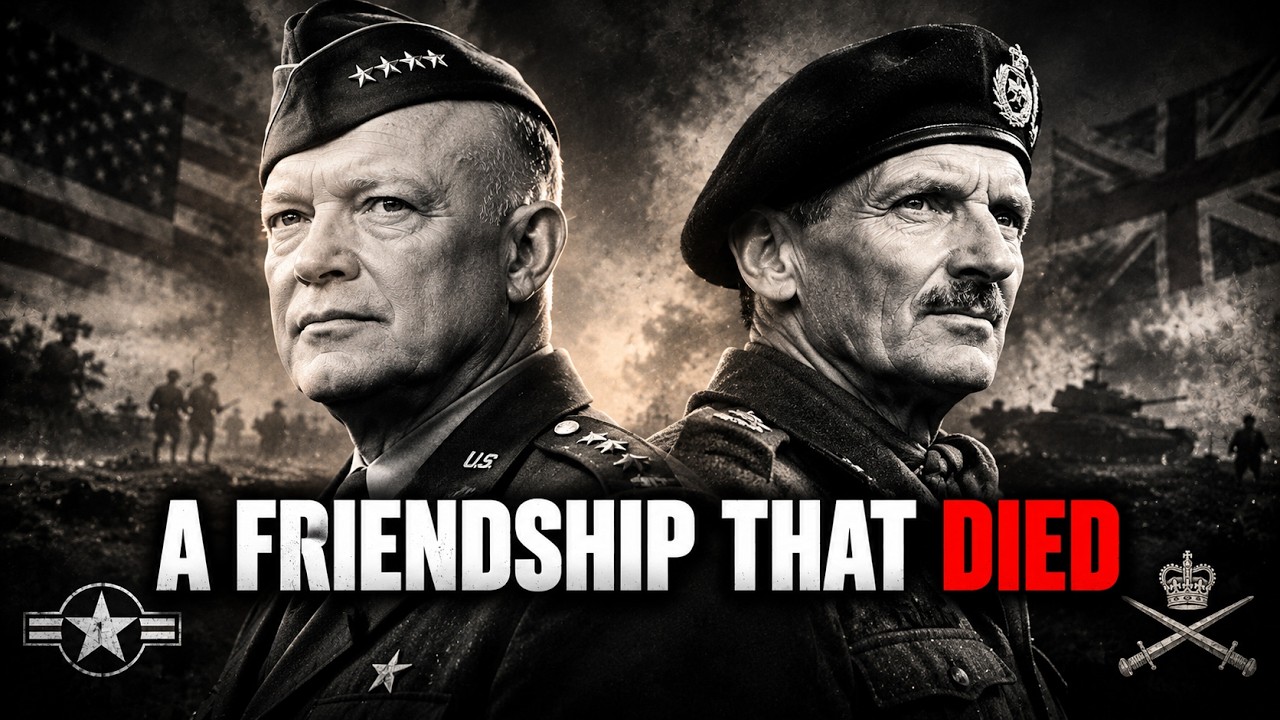
George Patton wanted Montgomery removed outright. Dwight Eisenhower, the Supreme Allied Commander, sat down afterward and began drafting a cable that could have ended Montgomery’s career within the month. He did not send it. But something that had survived El Alamein, Sicily, Normandy, and Arnhem did not survive that press conference.
Eisenhower and Montgomery would never again work together without a witness in the room. The crisis at Zonhoven did not begin there. It began twenty-six months earlier, with a decision nobody at the time recorded as important. In the autumn of 1942, Dwight Eisenhower was fifty-one years old.
He had graduated from West Point in 1915, but he had spent the First World War training tank crews in Pennsylvania, never deploying overseas. Through the interwar years he built his reputation at a desk, as an aide to Fox Conner, as a planner under Douglas MacArthur in the Philippines, and as the officer George Marshall trusted to write clean orders under pressure. When Marshall chose him in June 1942 to command the European theater and then in November to command Operation Torch, the landings in French North Africa, Eisenhower had never once led troops into combat. Bernard Montgomery had.
Commissioned into the infantry in 1908, wounded twice in 1914, decorated for pulling a wounded sergeant to cover while a bullet passed through his chest, he had commanded a division at Dunkirk in 1940. By August 1942, when Churchill sent him to Egypt to take command of the Eighth Army, Montgomery was already certain that command belonged to men who had personally been shot at. Two months later, at the Second Battle of El Alamein, he proved it. Eighth Army broke Rommel’s line in twelve days and took roughly thirty thousand Axis prisoners, delivering Britain its first unambiguous land victory of the entire war.
Church bells rang across the United Kingdom for the first time since 1940. Those two records did not have to occupy the same headquarters until the spring of 1943, when Montgomery’s Eighth Army linked up in Tunisia with the force Eisenhower had landed in North Africa. Along the way, Eisenhower’s inexperience had already cost something concrete. In February 1943, the American II Corps had been mauled at Kasserine Pass by Rommel’s Afrika Korps, a defeat that had everything to do with green American troops and a command structure still finding its footing.
Montgomery heard the reports and filed them away as confirmation of what he already believed about American generalship. By the planning stage for Operation Overlord in early 1944, Montgomery was the obvious choice to command the initial land campaign in Normandy, with Eisenhower directing the war from above and Montgomery running the battle on the ground. Montgomery had the backing of General Sir Alan Brooke, Chief of the Imperial General Staff, and the public loyalty of Winston Churchill. By September 1944 he held a promotion to field marshal that made him senior in rank to Eisenhower, who would not receive his own fifth star until December.
And he had a method, deliberate, resource-heavy, allergic to improvisation, honed at El Alamein, that he was certain had never failed him. He also had a habit that came bundled with all of it. He briefed superiors as though they were students. He sent Eisenhower unprompted memoranda on grand strategy, several pages long, written in the tone of a headmaster correcting an essay.
Eisenhower’s authority on paper was total. In practice, it was the thinnest kind of command there is, a coalition command built on consent that could be withdrawn by governments on either side. He was not managing an army; he was managing two governments, two publics, and two military establishments. He could not, in any practical sense, fire Montgomery.
Sacking Britain’s most popular general would have handed Goebbels a propaganda victory and risked the alliance itself. That constraint showed itself in the weeks after D-Day. Montgomery’s own pre-invasion plan called for the capture of Caen within the first twenty-four hours of the landings. Caen did not fall until July 9th, more than a month later.
Air Chief Marshal Arthur Tedder pressed Eisenhower to consider replacing Montgomery over the delay. Eisenhower absorbed the pressure from his own air commanders instead and said nothing publicly that Montgomery could later point to as betrayal. The decision that would detonate hardest in September 1944 had been made almost a year earlier. The SHAEF planners who drafted the command structure for Overlord built in a transition.
Montgomery would command all Allied ground forces through the invasion and the initial battle for Normandy. Once the armies broke out and the front grew too wide, Eisenhower would move his headquarters to the continent and take personal command, with Montgomery reverting to command of 21st Army Group alone. Montgomery agreed to it at the planning stage, on paper, without recorded objection. Nobody minute it as a fuse.
On September 1st, 1944, Eisenhower formally assumed direct command of the ground campaign. The same day, Montgomery was promoted to field marshal, a five-star rank that made him on paper senior to the American who had just taken his job. It was a real honor and a real consolation prize, and both headquarters understood it as both at once. It did not work.
Within days Montgomery began pressing Eisenhower to reverse the decision and to name a single ground forces commander for the drive into Germany, making it clear without saying so outright that the obvious candidate was himself. On September 10th, the argument came to a head aboard Eisenhower’s aircraft on the tarmac at Brussels. Eisenhower, recovering from a knee injury, sat and listened to Montgomery describe his directives as, in Montgomery’s own words, sheer balls, rubbish. Eisenhower did not shout back.
He put a hand on Montgomery’s knee and told him he could not speak to his superior officer that way, that Eisenhower was the boss. Montgomery, by his own later account, realized he had gone too far and apologized on the spot. The apology ended the shouting but not the argument. Eisenhower offered Montgomery something short of what he had demanded: priority of supply for a limited window to support a single ambitious operation into the Netherlands.
It was a narrow gamble built around three airborne divisions and one armored corps aimed at a string of bridges running sixty-four miles north to a town called Arnhem. Eisenhower approved it within days. The operation launched on the morning of September 17th, 1944. Nearly thirty-five thousand men went in by parachute and glider in a single day.
On the ground, Lieutenant General Brian Horrocks’s XXX Corps, spearheaded by the Guards Armoured Division, was to drive up a single road to link every division in turn. For the first day, the operation went almost exactly to plan. That was the last day it would. At Arnhem, the farthest and most exposed drop of all, only a portion of the British First Airborne Division reached the town.
Lieutenant Colonel John Frost led roughly seven hundred men to the northern end of the road bridge and dug in. The rest of the division, scattered by poor drop zones and slowed by German resistance, could not reach him. Frost’s men held the bridge until September 21st, when the position finally collapsed and the survivors, fewer than 150 still able to fight, were forced to surrender. The rest of the division held a shrinking perimeter for four more days, waiting for relief that could not arrive in time.
On the night of September 25th, what remained of the division, roughly 2,400 men out of the 10,000 who had dropped nine days earlier, withdrew across the Lower Rhine in small boats under fire. The bridge at Arnhem remained in German hands. Montgomery called the operation ninety percent successful. Eisenhower did not publicly contradict him.
But Arnhem settled the question of who had been right on that tarmac in Brussels. The doubt Eisenhower had voiced only privately had been correct. The reckoning for Arnhem came as a bill, and the First Canadian Army paid it. With the drive to Arnhem broken off, the approaches to Antwerp, the deep-water port captured intact on September 4th, had to be cleared by force.
The fighting cost the Allies close to thirteen thousand casualties before the port finally opened to shipping on November 28th, eighty-five days after Antwerp itself had fallen. Eisenhower had told Montgomery in September that Antwerp could not wait. Montgomery had made it wait anyway. Through October and November, Montgomery returned to pressing his old argument for a single ground commander, and Brooke, reading the exchanges from London, recorded in his diary a man behaving like his own worst enemy.
Then on December 16th, 1944, the argument over strategy stopped mattering for exactly nine days. The German army launched an offensive through the Ardennes forest that neither strategy had anticipated. The Battle of the Bulge became the costliest single battle the United States Army fought in the entire war. American forces suffered roughly eighty-nine thousand casualties.
German losses ran close to one hundred thousand for territory that changed nothing about the war’s final outcome. On December 20th, with Bradley’s headquarters cut off from direct communication with the American First and Ninth Armies fighting north of the German penetration, Eisenhower made a decision that was on its face purely a matter of battlefield logistics. He gave Montgomery temporary operational control of both armies because Montgomery’s headquarters had the communications lines to reach them. Bradley took it as a vote of no confidence.
Montgomery arrived at First Army’s headquarters projecting the manner of a commander come to rescue a defense his hosts believed they had already stabilized without him. That was the state of affairs when Montgomery stood before the war correspondents at Zonhoven and described saving the American line himself. Eisenhower drafted, though he did not send, a message to the Combined Chiefs of Staff that officers who saw it later described as close to an ultimatum: resolve the command question or accept his resignation. It was the closest the Western Allies came at any point in the war to an open command rupture between their two largest armies.
It did not happen, and the man most responsible was neither Eisenhower nor Montgomery. It was Major General Francis de Guingand, Montgomery’s own chief of staff, who learned of the brewing crisis, flew to Eisenhower’s headquarters without being asked, and persuaded the Supreme Commander to hold the cable. De Guingand then flew back to Montgomery’s headquarters and persuaded the field marshal to send a short conciliatory signal to Eisenhower on January 9th, withdrawing his demand for a single ground commander and pledging that Eisenhower could rely on him. The working relationship survived.
The two men worked together once more at NATO in 1951, when Eisenhower became the alliance’s first Supreme Allied Commander Europe and Montgomery served as his deputy, a working arrangement both managed correctly and without warmth. But the partnership as it had existed during the war never relaxed again. Eisenhower never wrote the book that settled the argument in his own favor while Montgomery was still alive to answer it. Montgomery did write that book, his memoirs published in 1958, sharply critical of Eisenhower’s wartime generalship.
It cost Montgomery the one thing twenty-six months of managed friction had never quite destroyed. The two men barely spoke again. Bernard Montgomery died in 1976 at his home in Hampshire, having outlived Eisenhower by seven years. Dwight Eisenhower died in 1969 in Washington, two terms removed from a presidency he had won partly on the strength of a war record Montgomery’s memoirs had spent their final chapters trying to diminish.
Neither man ever publicly conceded the argument. What survives instead, in the archives of both countries, is the paper trail: the memoranda, the after-action reports, the January 7th transcript, and Montgomery’s short signal of January 9th, 1945, still cataloged today in both nations’ records.