On the morning of June 4, 1942, the Imperial Japanese Navy’s first strike was returning from Midway Atoll, and Vice Admiral Chuichi Nagumo’s carriers had to recover their aircraft and rearm for a second strike against the island. The deadline was 09:00. In the hangars below the flight decks, the second wave was being rearmed with land-attack bombs. Then a scout plane reported an American carrier to the northeast, and the order changed.
Torpedoes had to come back up. The deadline passed without a launch, and the aircraft were still in the hangars when the American dive bombers arrived. The difference between the two navies was not skill but doctrine. The Japanese had built their carriers with enclosed hangars, fueled and armed their aircraft below deck, and refused to park ready planes topside.
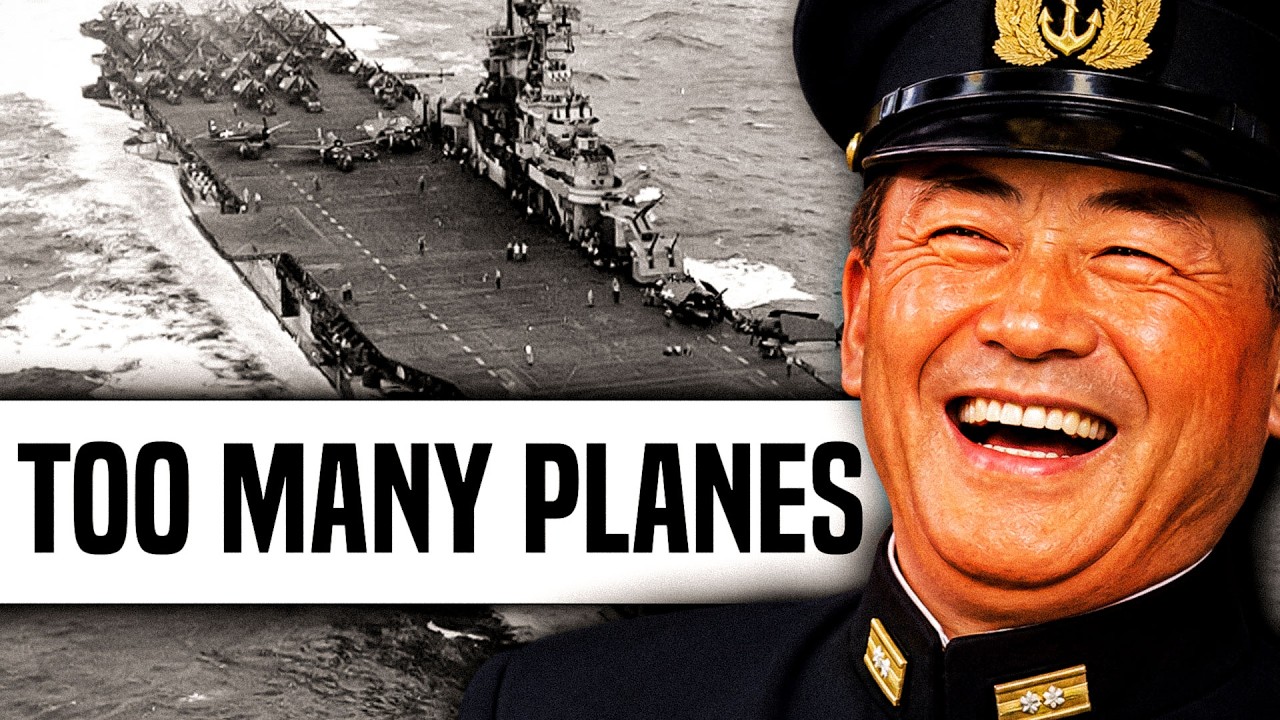
An American Yorktown-class carrier routinely carried 72 aircraft against a Japanese fleet carrier’s 54, and the difference was made up entirely by the deck park: planes armed and fueled, parked in rows on the open flight deck, exposed to weather and enemy bombs. The Japanese considered the practice reckless. The risk was real, but so was the arithmetic. The American flight deck was built to absorb that risk.
Below it sat a single hangar with rolling steel partitions that could be cranked open to the sea air, allowing engines to be warmed below and burning fuel to vent upward. The Imperial Navy could do neither. A Japanese carrier kept its air group armed, fueled, and serviced in an enclosed space that vented poorly and could not be opened to the weather. Every rearm required each machine to come up to the flight deck and go back down again, measured against the small spot of deck that could be cleared at any one time.
That hangar cycle governed everything Nagumo’s fleet did that morning. At 07:00, the Americans had spotted their full deck-load strikes. Enterprise and Hornet pushed 90 aircraft off their decks in nearly an hour. The Japanese, working from four flat-tops, had launched 108 in seven minutes.
The Japanese system was built around the rapid coordination of multi-carrier strikes, with aircraft armed and warmed below. The American system was slower, less elegant, and riskier to operate, but it carried twenty percent more aircraft per ship. Lieutenant Commander Wade McClusky of Enterprise could not find the Japanese carriers when he arrived at the expected position. His air group had been airborne for hours, and fuel was running low.
Then he spotted a single destroyer below, racing across the water with a white wake visible from the air. She was the Arashi, and she had broken formation to depth-charge the American submarine Nautilus, which had surfaced after a failed torpedo attack on the battleship Kirishima. McClusky turned his bombers to follow the wake. The same ship that would later put torpedoes into Akagi at sundown had led the bombers to her that morning.
At 10:22, Lieutenant Commander Dick Best rolled his SBD Dauntless into a seventy-degree dive on the nearest flat-top. Best had flown into the morning launch with a faulty oxygen canister leaking caustic soda into his mask. He had coughed blood for much of the climb to 20,000 feet and had been told to stay down. He went anyway, leading fifteen SBDs from VB-6 and a parallel squadron from Yorktown toward the carriers that Hornet’s air group had failed to find.
His thousand-pound bomb punched through the flight deck of Akagi and exploded in the hangar below, where fueled and armed aircraft were stacked wing to wing. His wingmen put two more bombs into the ship in the same minute. The blast had gone in twenty feet from the bridge. Akagi carried fifty-four aircraft that morning.
Within ninety seconds, none of them were flight-ready, and the hangar deck was burning from bow to stern. The same minute, Kaga took four hits from Enterprise planes and Soryu took three from Yorktown. All three were scuttled before sundown: Akagi by torpedoes from the destroyers Arashi, Hagikaze, Kazagumo, and Nowaki. The fourth carrier, Hiryu, followed the next morning.
What killed the four Japanese carriers was not the American bombs. It was the hangar. The Imperial Navy had known about the hangar problem. Shokaku, hit at Coral Sea a month earlier, had been saved only because her air group was below unarmed and her crew fought the fire for hours.
The after-action report was written up, but it was not passed on. The next four carriers burned anyway, each in the same enclosed hangar, in the same unvented heat, with the same fueled aircraft stacked below the flight deck. The lesson cost nothing to write down and nothing to circulate. The Imperial Navy did neither.
American pragmatism produced its own catastrophes. Lexington had been lost at Coral Sea to aviation vapor that the deck park did nothing to prevent. But her crew learned that flooding the aviation gasoline lines with carbon dioxide could stop a secondary explosion. Yorktown, hit twice by Hiryu’s aircraft that same afternoon, flooded her own lines with carbon dioxide.
She took a third bomb and two aerial torpedoes before sundown and still floated until a Japanese submarine found her on June 7. The carbon dioxide trick had been learned from Lexington’s loss, written up, and passed on. The Japanese had not learned the equivalent lesson from Shokaku. Hiryu had survived the morning and launched a counterstrike of eighteen dive bombers and ten torpedo bombers against Yorktown at 11:00.
They found her around noon, and two bomb hits plus a single torpedo took out her boilers and put her dead in the water. A second strike put three more torpedoes into her port side. Yorktown’s crew abandoned ship, came back, then abandoned her again the next morning when the listing made her unrecoverable. Enterprise aircraft found Hiryu at 17:00 that same afternoon.
Four bomb hits set her ablaze. The enclosed hangar that had killed Akagi, Kaga, and Soryu now killed Hiryu. She went down at 09:00 the next morning with 240 men still below decks. The pattern was recognizable.
A single American bomb into a Japanese hangar produced a fire no crew could put out because the hangar had been built without a way to vent the heat. The same fire on an American flat-top would have rolled the steel partitions open and let the heat climb into the sky. The Imperial Navy had designed the venting out of its carriers in 1927 and never corrected it. The exact words Dick Best spoke on the radio that morning do not appear in any log he kept, and he kept none.
Three other VB-6 pilots wrote postwar accounts; none agreed on what he said. One pilot contradicted himself between a 1966 letter and a 1983 oral history. Best himself, in a 1996 interview, said only that he remembered the dive and nothing before it. By 1944, the arithmetic had changed.
Fourteen Essex-class carriers reached the Pacific before the war ended, each carrying ninety aircraft parked in rows on a flight deck the United States Navy had no intention of clearing. The Independence-class light carriers added nine more hulls. The Imperial Navy, working from the same enclosed hangar doctrine, had commissioned one new fleet carrier, Taiho, and three converted light carriers. Taiho sailed once, to the Philippine Sea, where a single torpedo from the submarine Albacore cracked her aviation fuel tanks on the morning of June 19, 1944.
Her captain ordered the hangar ventilated by running the aircraft engines, which spread the vapor through the ship instead of clearing it. The enclosed hangar did the rest. She sank seven hours after the hit. Her crew knew what had killed Akagi, but they did not know how to stop it killing Taiho.
On that same morning, Vice Admiral Jisaburo Ozawa put nine flat-tops and roughly 450 aircraft into the air against fifteen American carriers under Marc Mitscher carrying about twice that number. The Japanese raids took an hour to assemble and were picked up on American radar an hour before they arrived. Hellcats met them forty miles out. Of the 423 carrier planes Ozawa committed that day, 315 did not come back.
American losses were twenty-nine aircraft, most of them lost to fuel exhaustion while chasing retreating Japanese air groups past their effective combat radius. The deck park had put more than twice as many fighters over the strike as the strike had aircraft aboard. By sundown, it was being called the Marianas Turkey Shoot, the only major carrier battle of the Pacific War in which the Japanese side lost more aircraft in a single day than the Americans lost in the entire engagement. Mitscher launched a dusk strike on June 20 at extreme range, knowing the planes would have to come back in the dark.
Most of them did. Many ditched in the water alongside the carriers because the decks could not be lit. Hellcats were shoved overboard to clear the landing area. Destroyers went in among the ditchings with searchlights that Japanese submarines could see.
The decision was a deliberate trade: planes and aircrew against the chance to finish Ozawa’s fleet. The carrier Hiyo was torpedoed and sunk, going down with 250 of her crew. Mitscher’s decision cost him 78 aircraft and 50 aircrew in a single evening. The Japanese had lost more than 300 aircraft that day.
Dick Best, whose lungs never recovered from the oxygen canister, retired from the Navy as a lieutenant commander in 1944 and spent the rest of his working life as a researcher at a medical research laboratory in Los Angeles. He received the Navy Cross and the Distinguished Flying Cross for the morning over Akagi and never flew a Navy aircraft again. Nagumo shot himself on Saipan in July 1944. Captain Taijiro Kaku, Akagi’s captain, went down with the ship.
Best outlived both of them by more than half a century. He died at his home in Santa Monica on October 28, 2001, at the age of ninety-one. The Japanese had been right that an armed and fueled aircraft on an open flight deck was a bomb waiting for a fuse. The Americans had understood the same thing and concluded that the answer was more aircraft, more flat-tops, and faster damage control.
The bomb would go off, but the deck next door would still be flying. By the Philippine Sea, when the Imperial Navy counted the planes over their formation, there were enough decks next door to settle the argument. The argument had been settled two years earlier at Midway, by the same aircraft on the same kind of open deck.
It had just taken that long for the count to come in.