Barbara “Babe” Paley was, for decades, the most imitated woman in America. Photographed, studied, and envied, she was the wife of William S. Paley, the founder of CBS, and the center of a glittering social world.
But beneath the perfect surface lay a marriage of quiet endurance, a friendship that became a betrayal, and a loneliness that defined her final years.
She was born Barbara Cushing in Boston, the youngest of three daughters of a celebrated neurosurgeon. Her mother, Kate, was the family’s architect of ambition, and her single wish for her daughters was that they marry upward. The eldest, Minnie, married Vincent Astor.
The middle daughter, Betsy, married James Roosevelt. Barbara, called Babe because she was the baby of the family, absorbed the lesson early: a woman’s worth was measured by the man she married.
At 17, a car accident left her with scars and knocked out her front teeth. Surgery repaired the damage, and she emerged, if anything, even lovelier. The experience taught her that beauty was not a gift but a material, something to be molded and deployed.
She went to work as a fashion editor at Vogue, learning the grammar of desire and the art of presentation.
Her first marriage, to oil heir Stanley Mortimer Jr. , lasted six years. The war changed him, and he returned with a cruel drinking habit and cold moods.
They had two children, but the marriage collapsed. She divorced him in 1946.
She had already met someone else. William S. Paley had built CBS into the most powerful communications company in the country.
He was a man of prodigious appetites, for art, influence, and beautiful women, but he lacked the social pedigree that Babe possessed. Her sisters had married a Roosevelt and an Astor. She moved among old money as easily as breathing.
She was, as one biographer put it, the key to a door Bill Paley had been waiting in front of for years.
They married on July 28, 1947. She left Vogue that week and never returned. She built her world instead.
She decorated the apartment at the St. Regis, transformed the 32-acre estate at Kiluna Farm into a place guests remembered for the rest of their lives, and hired Russell Page to design the gardens. She filed away the menus for every dinner party so no guest would be served the same dish twice.
She remembered names and birthdays. From the outside, it was the image of everything her mother had ever wanted. From the inside, it was a beautiful prison.
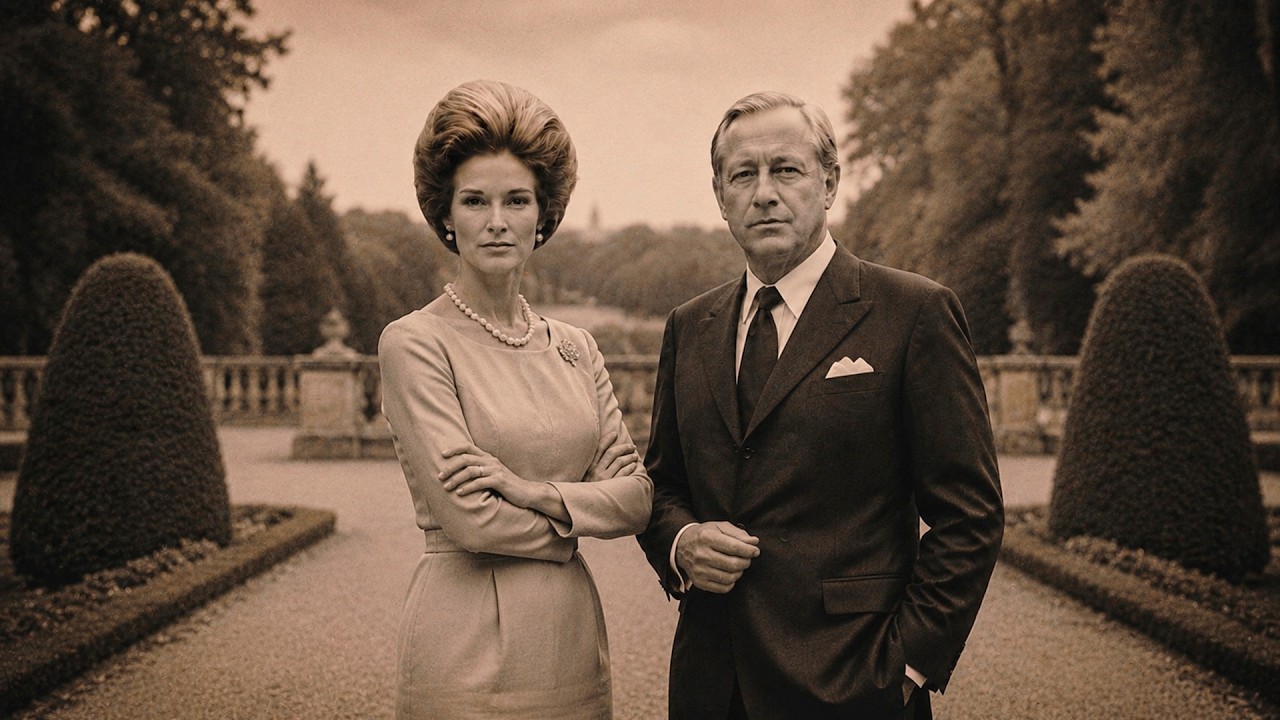
Bill Paley was not faithful. He frequented bars and private clubs, with a preference for blondes and models. Babe knew.
She was a doctor’s daughter, trained in observing symptoms. She said nothing.
In the summer of 1955, a private plane carried a small group to the Paleys’ Jamaican home. Among the guests was a short, slightly built writer in his early 30s named Truman Capote. Babe looked at him.
He looked at her. They fell in love instantly, in the way that matters most between friends.
Capote became the best thing in her life. He called her every morning, showed up unannounced with flowers and gossip, and made every table he sat at seem like the only table in the world. She told him things she had never told anyone else: Bill’s infidelities, the humiliations, the distance between the life she seemed to be living and the one she actually lived.
He called her the most important person in his life. She believed him.
What neither of them discussed was the book he called Answered Prayers. He had been working on it since the early 1960s. He told his publisher it would be the definitive literary event of the decade.
He told his friends it would be the definitive portrait of their world. He did not tell them that their secrets were already in his notebooks, sentences in the process of becoming.
In November 1966, Capote organized the party of the century, the Black and White Ball at the Plaza Hotel. Five hundred guests attended, the most talked-about gathering of New York society that year. The Paleys held a small dinner beforehand, with Capote among the guests.
It was the pinnacle of it all. The machinery of their social universe was spinning at full speed.
Nine years later, the machinery had begun to devour itself. In 1974, Babe was diagnosed with lung cancer. She had smoked two packs a day for most of her adult life.
She received the news directly, without breaking down. She began chemotherapy, and her hair fell out. She wore silk turbans, and women across New York noticed and began wearing them too.
She had turned dying, as one witness observed, into an accessory.
That same year, Capote was under pressure from his publisher to deliver something from Answered Prayers. He agreed to give one chapter to Esquire magazine. He chose a chapter called “La Côte Basque, 1965,” named after the restaurant where a certain kind of New York woman lunched.

The names were changed. The characters were said to be composites. But the details were not imagined.
They came from conversation, from the private, intimate confidences Babe had given him over 20 years.
One story concerned a media executive named Sydney Dillon, a thin disguise for Bill Paley. The details of his infidelities were specific enough that several people put down the magazine and picked up the phone immediately. Another story concerned a woman named Ann Woodward, who had shot and killed her husband in 1955 under circumstances a grand jury had ruled accidental.
She received her advance copy, read it, and took a handful of barbiturates. She did not wake.
Babe picked up the November 1975 issue of Esquire. She read a sentence she recognized, then another, then a small, intimate detail that could only have come from one source. She read it a second time.
There was no mistake. She called Slim Keith, another of Capote’s swans. Slim told her about Ann Woodward.
Babe’s response was very calm. “Well,” she said, “I want to die too.”
She never spoke to Truman Capote again. Not that day, not the following week, not for the remaining three years of her life. Not a single word.
Capote tried to explain himself. He wrote letters, made phone calls, deployed his charm and his remorse. He told anyone who would listen, “I am a writer.”
It explained nothing. The other swans cut him off too. The rooms he had occupied, the tables he had sat at, the whole glittering architecture of his social life closed in on him.
But Babe’s silence was the one that mattered most. She gave him her absence, completely, and went on living.
She was dying. The chemotherapy went on, the turban stayed on, and she showed up at events perfectly, because that was what she knew how to do. Bill Paley was still there, still her husband.
She had read the chapter, recognized the character of Sydney Dillon, and said nothing. She had not said how she felt about Bill’s behavior for 30 years. There was no reason to start now.
In the last year of her life, she sat in the apartment at 820 Fifth Avenue and wrapped her jewelry in tissue paper. She slipped a small card into each package with a name written in her handwriting. She was distributing the material version of herself to the people who had not abandoned her.

Not to Truman. Not to him.
On the morning of July 6, 1978, Barbara Cushing Paley died of lung cancer. She was 63. She had turned 63 the day before.
The packages were already wrapped. The instructions for the funeral, and for the wine to be served at the reception afterward, were filed in a system her staff could follow without confusion.
Her funeral was held at Christ Episcopal Church in Manhasset, Long Island, the closest church to Kiluna Farm. The mourners arrived in the kind of clothes she would have approved of. The wine was her own selection, French, expensive, proper.
Truman Capote was not there. He had not been invited.
It was C. Z. Guest who told him.
She called and told him Babe was gone, and that he was not invited to the funeral. Capote had been carrying around an unfinished text for months that he called “Beautiful Babe,” a eulogy he could not finish. He read what was left of it alone, then put it away.
Answered Prayers was never finished. He died in August 1984, and the manuscript remained incomplete.
Bill Paley attended the funeral. According to those present, he wept openly. In 1985, Cosmopolitan magazine published a list of the 10 most eligible bachelors in the country.
William S. Paley was on it. He was 83.
He died in October 1990 from kidney failure at the age of 89. His estate was valued at $500 million. His art collection went to the Museum of Modern Art.
He was buried next to Babe.
Truman Capote had once said of her, “Mrs. P. had only one flaw.
She was perfect. Otherwise, she was perfect.” He had loved her, and he had used her.
These two facts coexist and do not cancel each other out.
What remains of Babe Paley is what she intended to remain: the photographs, the style, the memory of a woman who moved through a room with such composure that no one saw the cost. The turban is gone. The secret garden is gone.
Kiluna Farm burned down and was demolished around 1990. What has not dissolved is the question she carried, the one she never answered aloud: whether she had ever been truly loved, or whether she had given everything and received in return a husband who used her, a friend who sold her, and a world that admired her enormously and did not know her at all.