In mid-December 1944, the German offensive in the Ardennes—known to the Allies as the Battle of the Bulge—had been underway for three days. It had succeeded beyond what most German planners considered realistic. The Allied defensive line was fractured.
American units were surrounded. The town of Bastogne was cut off and holding, but no one could confidently say how long it could survive without relief.
At Allied headquarters, a response was being organized. But organizing a response to a breakthrough of this size took time—time for assessment, time for redirection, and time to move units from where they were to where they needed to be.
General George S. Patton did not wait for the assessment to be completed.
On December 19, at a commanders' conference in Verdun, Patton told General Dwight Eisenhower that he could send a relief column moving toward Bastogne within 24 hours. Eisenhower asked how that was possible. Patton said he had already started moving.
He had issued the orders before leaving for the conference.
While other generals were still discussing what to do, Patton had already done it. He turned three divisions—roughly 90,000 men—from an eastward advance and redirected them north through winter conditions and unimproved roads within 72 hours. The relief column reached Bastogne on December 26.
When German intelligence confirmed what had happened—that Patton had shifted an entire army in midwinter in three days—the reaction at German High Command was not anger. It was astonishment.
—
The German offensive in the Ardennes, codenamed Operation Watch on the Rhine, was planned around a specific assumption about Allied response time. German planners understood that the Allies would eventually redirect forces to contain the breakthrough. The question was how long that would take.
The plan required enough time to reach the Meuse River and possibly threaten Antwerp before an effective Allied response could be organized and deployed. German military doctrine, based on operational experience and their assessment of Allied command flexibility, assumed this would take roughly a week to ten days from the moment the breakthrough was confirmed.
The entire logistical structure for the western part of the offensive was built around that assumption. Patton compressed that window to 72 hours.
—
The three divisions Patton redirected were the 4th Armored Division, the 26th Infantry Division, and the 80th Infantry Division. Each was in the middle of its operational mission when orders arrived on the evening of December 18.
Each division had to stop its ongoing operations, reorient its command structure and supply lines, and begin moving in a completely different direction—north instead of east—over roads clogged with winter movement traffic, in conditions that severely reduced visibility and vehicle performance compared to summer rates, toward a destination deeper in hostile territory than their previous objectives.
Military doctrine at the time held that a large formation—a corps or larger—could not execute a 90-degree turn in less than a week under field conditions. The planning assumptions behind that doctrine were based on several factors: the logistics of moving large numbers of vehicles and men over road networks that could only handle limited traffic at once, the time required to transmit and coordinate complex orders across multiple command levels, and the practical difficulties of changing the direction of an advance that already had its own momentum and supply structure oriented toward its original path.
The one-week estimate was not considered conservative. It was considered realistic by officers who had spent years learning how large military formations actually moved.
—
Patton had anticipated the need for this turn before the German offensive began. In the weeks before December 16, his staff had quietly developed contingency plans for several different scenarios involving a German move in the Ardennes—an area Patton had identified as vulnerable based on his assessment of the German forces positioned opposite it and the relative weakness of the American line in that sector.
The contingency plans had not been formally submitted or approved through the standard planning process. They had been prepared in advance and kept ready because Patton's view of the operational situation told him there was a strong possibility something would happen in the Ardennes requiring exactly this kind of rapid response. He had no intention of being caught designing a plan while he should have been executing one.
This was the source of the 24-hour commitment he made to Eisenhower at Verdun. When Eisenhower expressed doubt—and records of the Verdun conference indicate he was not the only senior officer present who questioned the timeline—Patton was able to say with confidence that the movement was already underway because it literally was.
The orders had been issued the previous night based on the contingency plans his staff had prepared, and the first elements of the three divisions were already moving when he walked into the conference room.
—
German intelligence assessment of the Allied response reached Army Group B headquarters on December 22, three days after the Verdun conference and four days after Patton issued his orders. The assessment identified the movement of three American divisions and their direction of advance, which was clearly oriented toward the southern flank of the German salient and the Bastogne corridor.
The intelligence officers who prepared the initial assessment classified it as possibly inaccurate—not because the data was ambiguous, but because the speed of movement was inconsistent with what their operational models predicted for a formation of that size under the field conditions of late December. The road network in the sector was not designed to handle the volume of simultaneous traffic required to move three divisions. Winter conditions were hampering vehicle performance on both sides of the front line.
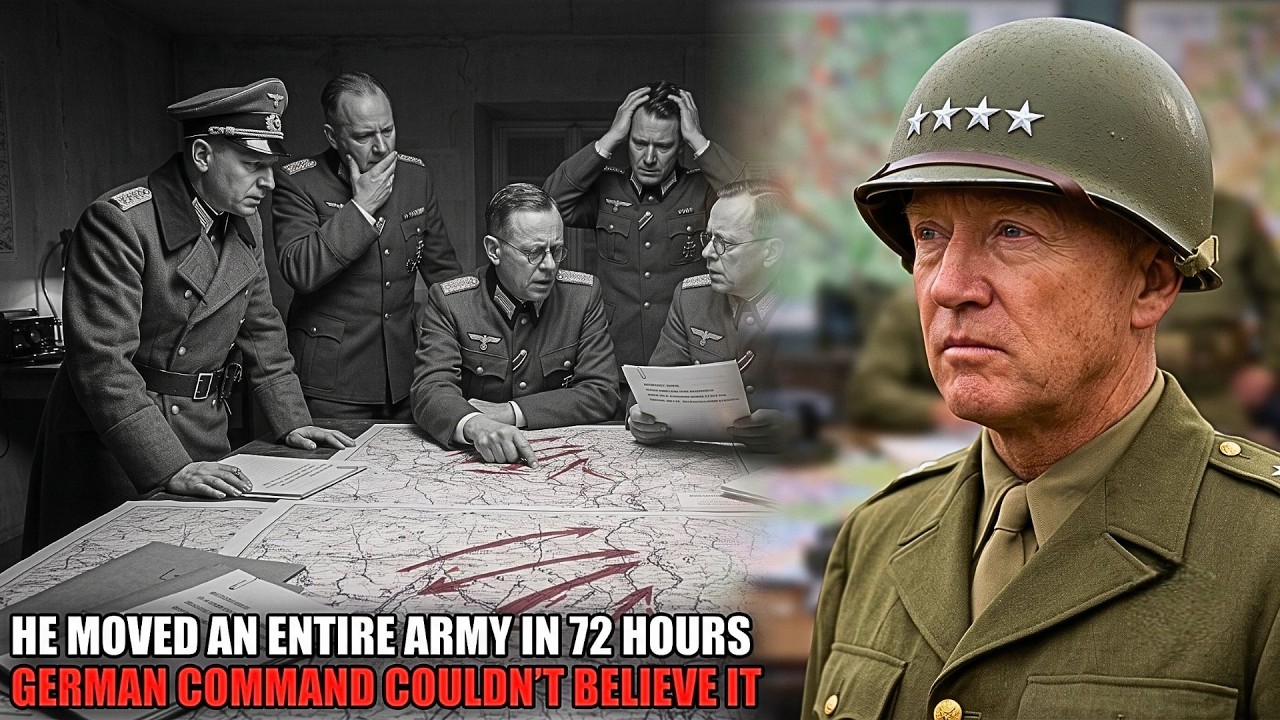
The officers requested additional confirmation before sending the assessment to Field Marshal Walter Model's headquarters. Confirmation came the same day. The movement was real.
The speed was as reported, and the leading elements of the 4th Armored Division had already advanced much farther north than the models predicted.
—
Model, commander of Army Group B, received the confirmed assessment on the evening of December 22 and immediately understood its implications for the offensive timeline. The assumption that the Allies would need a week to ten days to respond was the planning foundation for the logistics of the western part of the offensive.
Supply allocations, fuel reserves, and the timing of subsequent operations had all been calculated based on a picture of Allied response time that assumed standard planning and coordination cycles would govern how quickly a force of this size could be redirected.
If Patton was approaching Bastogne within three to four days of the Verdun conference—which intelligence now indicated was not a prediction but an observation of what was already happening—then the southern flank of the German salient would come under severe pressure days earlier than planned.
Model's assessment, sent to Hitler's headquarters at the Wolf's Lair that evening, was measured in its official language but blunt in its meaning. The Allied response was demonstrably faster than planning assumptions had predicted, primarily due to the speed of movement achieved by the forces under Patton's command. This compression of the available operational window had created a situation the original design of the offensive had not anticipated.
—
The reaction at Hitler's headquarters was less measured. Several accounts from German officers present during that period describe discussions in which the confirmed intelligence assessment was met with a particular kind of skepticism, different from ordinary disbelief. It was not doubt about the accuracy of the data—that had been settled—but an almost involuntary resistance to accepting that the operational reality described by the data was consistent with what they believed possible.
One staff officer's postwar report described a colleague saying that what Patton had done could not be reconciled with standard assessments of what a formation of that size could achieve at that time under those conditions. The point was not that Patton had violated the laws of physics, but that standard assessments had failed to account for something specific about how Patton commanded, planned, and anticipated—and that this failure now had costs visible on the map.
—
The 4th Armored Division's relief column reached the outskirts of Bastogne on December 26, creating a corridor through which supplies and reinforcements could be moved into the town. The siege was broken after nine days.
The 101st Airborne Division and the other American units defending Bastogne were no longer isolated. The question of how long the town could hold out without relief—a question that had been genuinely unanswerable on December 19—was resolved by the column's arrival before the situation inside the perimeter reached a breaking point.
The 4th Armored Division covered roughly 150 miles in the seven days between Patton issuing his orders and the column reaching the Bastogne perimeter, in conditions that included snow, ice, congested roads, and intermittent German resistance.
The divisions that followed—the 26th and 80th Infantry—reached the Bastogne area in the following days and expanded the corridor, turning what had initially been a narrow relief route into a more defensible position that could be maintained and supplied through the remaining weeks of the battle.
—
The Battle of the Bulge continued through January 1945, with heavy fighting on multiple fronts as the German offensive was gradually contained and then reversed. The final Allied response involved many units, many decisions, and many commanders working in a campaign with dozens of moving parts.
But the compression of the most critical phase of the German offensive—the days when it had the most momentum and the most realistic chance of reaching its objectives before effective opposition could be organized—was determined largely by the speed with which the southern threat to Bastogne emerged.
That speed was not accidental. It was the result of contingency planning done before the crisis began, orders issued before authorization was received, and an operational tempo that surprised German High Command precisely because it fell outside the standards their models were built to predict.
—
Patton wrote about the Bastogne movement in his diary with a brevity that distinguished it from his other entries. He described the turn as a straightforward operational decision that required more preparation than improvisation. The key, he said, was the advance planning done by his staff—they had completed the essential work before the crisis occurred, so that when the crisis arrived, the remaining task was execution, not design.
He said his 24-hour commitment to Eisenhower at Verdun was not bravado. It was simple arithmetic. He knew what his staff had prepared.
He knew what his units could do. He made the commitment because the numbers were already in his head before Eisenhower asked the question.
—
German assessments of Patton's reaction in the Ardennes, compiled in the postwar period from Army Group B records and interviews with German officers who had been at Hitler's headquarters during those days, consistently identified the speed of the turn as the factor that directly disrupted the offensive's operational assumptions.
Many of those assessments noted, in terms that varied in precision but agreed in conclusion, that this disruption was possible not because Patton possessed resources or capabilities that other Allied commanders lacked, but because he anticipated the situation before it developed and used the time before the crisis to do work that other commanders would have had to do after it began.