On a cold morning in late September of 52 BC, a young farmer from the Senones tribe stood on a slope in the heart of Gaul, staring at something that should not have existed. Before him stretched a wall of wood and earth, taller than three men, running left and right until it vanished into the mist. Behind that wall, another wall. And beyond it, on the summit of the hill, lay the town they had come to save.
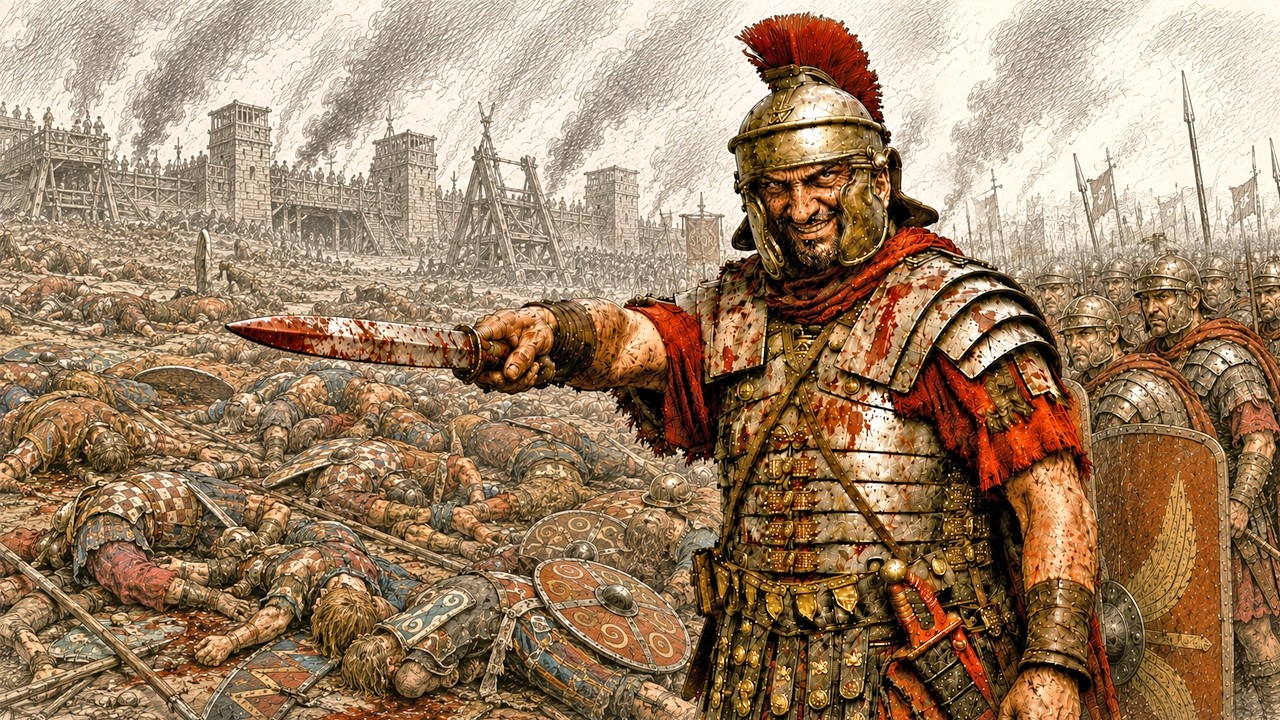
Between him and that town stretched twenty miles of Roman engineering built to destroy him. Around him, a quarter of a million warriors from the Gallic relief army formed up for the largest coordinated attack in the history of the Celtic world. Inside the hilltop town of Alesia, eighty thousand warriors and their leader, Vercingetorix, prepared to strike from the other side. And between the two Gallic armies stood fifty thousand Romans under a middle-aged politician from an aristocratic Roman family who had decided he would not lose this day.
The man was Julius Caesar, and the siege of Alesia would become one of the most consequential military events of the ancient world. What unfolded there in the autumn of 52 BC effectively ended organized Gallic resistance to Rome. It also produced one of the darkest, most deliberately forgotten episodes in the history of ancient warfare, the expulsion of Alesia’s civilian population, and a final act that historians still debate two thousand years later. The Gallic leader who had brought his people to this point was Vercingetorix, a young Arvernian nobleman in his late twenties.
His father, Celtillus, had been executed by his own tribe for attempting to make himself king, and Vercingetorix grew up in the shadow of that death, watching his people remain divided by tribal jealousy while Caesar conquered Gaul tribe by tribe. By early 52 BC, he had accomplished what no one had thought possible. He united the Arverni, the Aedui, the Senones, and the Parisii, tribes that had hated each other for generations, under a single command. His strategy was scorched earth: burn every town that could not be defended, deny the Romans shelter and supplies, and starve them out.
For a time, it worked. Caesar was fifty years old, deep in debt, politically weak in Rome, and staking his entire future on this campaign. He presented himself as a civilizer bringing order to barbarians. In reality, he was running one of the largest mass enslavement operations in Roman history.
Among his officers was a thirty-year-old cavalry commander named Marcus Antonius, the man history would remember as Mark Antony. He had not yet destroyed himself over an Egyptian queen, nor had he yet become Augustus’s rival. He was simply a reckless, battle-hardened cavalryman with a gift for winning soldiers’ loyalty. By late summer, Vercingetorix was exhausted.
The scorched earth strategy had failed to starve the Romans, and Caesar had adapted, drawing grain from friendly tribes. The war had entered a new phase, and Vercingetorix made the worst decision of his life. He withdrew to what he believed was the safest ground in Gaul: a hilltop stronghold called Alesia. It was high, defensible, and a fixed point.
For a man who had spent months urging his tribes to burn their towns and refuse open battle, it was a catastrophic choice. He would now defend one hill against the finest siege engineers in history, with his entire army trapped inside. Caesar looked at Alesia and did not attack. He did something worse.
He decided to build a wall around it. Not one wall, but two. An inner circumvallation, eleven miles long, facing Alesia to contain Vercingetorix, and an outer contravallation, fourteen miles long, facing outward to stop the Gallic relief army when it arrived. Two rings of fortifications, with the Roman army in between.
Caesar had decided to fight two battles at once, in opposite directions, and win both. The specifications were terrifying. Two parallel ditches, each fifteen feet wide and equally deep, with the nearer one flooded by diverting local rivers. Behind them, an earth rampart topped with a wooden palisade and parapets.
Watchtowers every eighty feet, and twenty-three fortified camps connecting the fortifications. In front of the walls, three layers of hidden traps: pits three feet deep with sharpened stakes fixed in their floors and covered with brush, rows of sharpened branches, and iron caltrops designed to pierce the feet of any man running toward the wall. Miles and miles of it, built not by machines but by men with shovels. Forty thousand Roman soldiers worked in shifts, digging night and day for weeks.
The forests around Alesia were stripped bare, and the courses of local rivers were altered. Two thousand years later, archaeologists would find the remains of those ditches, the trap fields, and the iron caltrops still lying in the earth. While the Romans dug, Vercingetorix made his decision. He sent twelve thousand cavalry out of Alesia at night, through unfinished sectors of the Roman line, to ride across Gaul and summon every tribe to raise an army.
The horsemen escaped. Once they were gone, Vercingetorix faced an even grimmer reality. His food supply, already insufficient, now had to feed not just warriors but civilians who could not fight and could not defend the walls. He rationed grain strictly, then more strictly.
According to Caesar’s text, the civilians suffered before the warriors. Mothers watched their children waste away, and elderly men, who had known decades of Arvernian history, sat silently in dark rooms, aware that the grain they consumed was needed by warriors on the walls. Then Vercingetorix made the decision that history would bury for two thousand years. The civilians of Alesia, the elderly, the women, and the children of families who had lived on that hill for generations, were pushed out of the gates and sent toward the Roman lines.
Caesar ordered that they not be admitted, fed, enslaved, or killed. They were simply left in the no-man’s-land between the two armies. As the fighting began around them, thousands of civilians were trapped in a strip of ground between two walls, with no one coming to save them. No numbers survive for how many were expelled, and no names.
Caesar’s account never records a single survivor. Meanwhile, the Gallic relief army assembled. Caesar recorded its strength at roughly 250,000 infantry and 8,000 cavalry, though modern historians argue he exaggerated for propaganda purposes. Even halving that figure leaves the largest army ever gathered in the Celtic world.
Villages were emptied, farmers left their fields unharvested, and blacksmiths abandoned their forges. Warriors from tribes that had fought each other within living memory marched together to save Alesia, because they understood, as Caesar did, that this was their last chance. When the relief force finally arrived in late September, it did not attack immediately. The leaders surveyed the outer Roman wall and searched for weaknesses.
They found one, a sector on rough, sloping ground where the Romans had not been able to complete their fortifications fully. Inside Alesia, Vercingetorix saw the campfires of the relief army on the horizon, and for the first time in weeks, hope flickered within the fortress. He prepared his men for a coordinated attack against the inner wall while the relief force struck the outer wall from the opposite side. The first coordinated attack came at dawn.
The relief army advanced in disciplined formations, tribes fighting side by side that had hated each other for centuries. Inside the oppidum, Vercingetorix’s warriors rushed the inner Roman wall, throwing fascines into the ditches and slapping ladders against the palisade. Then they reached the trap fields. Warriors fell into hidden pits lined with sharpened stakes, impaled their feet on iron caltrops, and crashed into rows of sharpened branches.
From the towers, Roman artillery threw javelins, stones, and lead bullets capable of shattering a human skull. The Gallic attack stalled but did not break. They came again and again, wave after wave, over the bodies of their own dead. As darkness fell, the relief army withdrew to regroup.
The first day ended in stalemate. That night, the Gallic commanders decided to concentrate their next attack on the weak sector they had identified. At dawn, the second assault began: the heaviest forces they could muster thrown at the vulnerable stretch of the outer wall, while Vercingetorix struck the inner wall from the other side. Roman cohorts moved rapidly between the walls, pulled from quieter sectors to reinforce the weak point.
Mark Antony shifted units to the threatened section. Reserves ran out, and still the Gauls kept coming. Then, in the middle of the second day, the outer wall collapsed. Gallic warriors poured through a breach where fascines had filled the ditch.
Roman defenders were killed in hand-to-hand fighting inside the passage. Reports raced along the line to Caesar’s command post: a fortification had been broken on the right flank, the enemy was inside the fortifications. If the breach widened, the entire Roman position would collapse. The Gauls would attack the inner wall from behind while Vercingetorix’s men hit it from the front.
Fifty thousand Romans would be surrounded on both sides by a force outnumbering them five to one. At that moment, Caesar did what historians still argue about. He did not send an officer. He did not delegate.
He walked to the lines himself, pulling cohorts from every position he could spare and assembling, by modern estimates, roughly sixty-five hundred men in an improvised reserve. Then, according to later Roman accounts, he did something no commander of his rank was supposed to do. He took up a shield, placed himself at the head of that reserve, and led them into the breach. His red cloak, deliberately worn so his soldiers would always see him, was visible in the thick of the fighting.
The soldiers who were on the verge of collapse saw their fifty-year-old commander standing among them. The line held. Then it moved forward. While his improvised infantry sealed the breach, Caesar ordered his Germanic cavalry, his best-mounted force, to ride around the fortifications.
They appeared behind the Gallic relief army, which was still pressing against the wall, and attacked from the rear. The relief army, believing it was on the verge of breaking through, suddenly faced cavalry in its midst. There was no line to fall back to, no formation to hold. The army that had gathered the strength of all Gaul collapsed within hours.
From the walls of Alesia, Vercingetorix watched the plain. He saw the campfires of the relief army being plundered. He saw his allies dying or fleeing in every direction. The warriors on the ladders stopped and watched the relief force vanish into the horizon, and they understood that no one was coming.
Six days later, Vercingetorix called his final council. The leaders discussed three options: fight to the last man, take their own lives, or surrender. The choice was the Arvernian nobleman’s to make, and he chose surrender. According to modern sources, it happened on October 3, 52 BC.
He emerged from the gates of Alesia in full armor, dismounted, and laid his sword, shield, and helmet at Caesar’s feet. No speech of his survives. He was taken in chains. The scale of what followed was staggering.
Caesar recorded that every Roman soldier was permitted to take one Gallic warrior as a personal slave. Approximately forty to fifty thousand men were sold or distributed as slaves to Caesar’s soldiers alone. Thousands more were killed in the aftermath of the relief army’s collapse. The survivors of the great alliance returned to villages that had lost fathers, sons, and brothers.
Some tribes lost entire generations of men. Roman casualties were in the low thousands, with several times that number wounded. Vercingetorix was taken to Rome and imprisoned in the Tullianum, a stone chamber beneath the city used for high-status captives. He remained there for six years.
In 46 BC, Caesar, now dictator, celebrated his triumph over Gaul and paraded his captive through the streets of Rome in chains. That same day, in the darkness of the Tullianum, the man who had united Gaul was executed by a Roman strangler. He was still in his thirties. Three years after Alesia, Caesar crossed the Rubicon and plunged Rome into civil war.
Three years after that, in 44 BC, he was assassinated in the Senate by men who feared the power Alesia had given him. Mark Antony spent the next decade climbing Roman politics, lost to Octavian, and ended his life in Egypt in 30 BC beside Cleopatra. But the reputation he built at places like Alesia was the foundation of everything he became. The Senate voted twenty days of public thanksgiving for Caesar’s victory, the longest in Roman history at that time.
Across Gaul, the news spread slowly and painfully, village by village. The great alliance was destroyed, and regions that had been on the verge of open revolt submitted quietly. There was nothing left to fight for. Within a generation, Gaul had become a Roman province.
Within a century, it was thoroughly Latinized. The tribes that marched to Alesia, the Aedui, the Arverni, the Senones, the Parisii, became names of Roman administrative districts. Paris, the capital of modern France, takes its name from the Parisii. What Caesar achieved at Alesia was not merely a military victory.
It was the absorption of a civilization, and the erasure of its independent history. The civilians who died in the strip of land between the two walls appear in no Roman monument, no French statue, and no popular account of the battle. But they were there. They died between two civilizations fighting over the inheritance of the land, and neither civilization remembered them.
The story of Alesia is not just a battle, it is a warning about how history is written, and about the people who are left out of it.