On a September morning in 1918, Eleanor Roosevelt knelt on a bedroom floor unpacking her husband’s suitcase. Franklin Roosevelt, assistant secretary of the Navy, lay upstairs, sick with the influenza he had carried home from his inspection tour of the European front. At the bottom of the case, tied together, she found letters in a handwriting she knew well. It belonged to Lucy Mercer, the young woman Eleanor herself had hired as her social secretary.
The affair was real, and the marriage Eleanor had built her identity upon revealed itself as a lie. She was born in New York City in 1884 into the highest circles of old society, a niece of Theodore Roosevelt. But the name brought no safety. Her mother, a celebrated beauty, called her plain little daughter “Granny.
” Her adored father was an alcoholic, mostly kept away. Her mother died when Eleanor was eight, her father when she was ten, and the child learned early that love was something that left. Raised by a strict grandmother in a joyless house, she was rescued at fifteen by a school outside London, where a formidable headmistress taught her to think, to argue, and to believe she might matter. Then she was called home to make her debut.
She thought herself ugly and expected to be passed over. Instead, she was courted by the most dazzling young man in her world. Franklin Delano Roosevelt was her distant cousin, handsome, charming, and confident. They married in March 1905, and her uncle, now president, gave the bride away.
But the marriage was never a household of two. Franklin’s mother, Sara Delano Roosevelt, was a widow of enormous will and money, and she did not release her son when he married. She built a pair of joined townhouses in Manhattan with connecting doors so she could pass into the young couple’s rooms whenever she wished. She chose the furniture, hired the servants, and managed the nursery.
She once told one of the children that Eleanor had merely borne them, and that she, Sara, was their real mother. Eleanor owned nothing, decided nothing, and had no room that was truly hers. In 1914, drowning in the social correspondence of a rising political family, Eleanor hired Lucy Mercer as her social secretary. Lucy was gentle, warm, discreet, and strikingly lovely, and the children adored her.
She fit so naturally into the household that Eleanor never imagined the danger. Franklin’s star was rising fast. In 1913 he had been made assistant secretary of the Navy, and the family moved to Washington. As the First World War filled the capital with urgency, Eleanor took the children north to the family retreat at Campobello each summer to escape the heat.
Franklin stayed behind in Washington, and Lucy Mercer stayed too. By 1916, according to historians who have studied the surviving record, the romance had begun. In 1917, when the United States entered the war, Lucy enlisted in the Navy and was assigned to Franklin’s own office. The discovery of the letters in September 1918 ended the secrecy.
Years later, Eleanor described the moment in words that never lost their edge: the bottom dropped out of her own particular world. What happened in the days that followed is known mostly through the account the Roosevelt children gave many years later. By that account, Eleanor confronted Franklin and offered him a divorce if that was what he truly wanted, an extraordinary offer for a woman of her position in an era when divorce meant scandal and ruin. It was said that Franklin’s mother Sarah intervened and threatened to cut off the family money if he left his wife and children for Lucy Mercer, though that specific threat comes down from a single family memoir published in 1973, a book Eleanor’s own other children publicly disowned.
The letters themselves were later destroyed, and Eleanor never described the scene in print. What is certain is the outcome. Franklin agreed to end the affair and promised never to see Lucy again. Lucy, a devout Catholic who would not have married a divorced man with children, withdrew.
The marriage was preserved in form, but as a romance it was over. One of the Roosevelt sons later described what remained between his parents as an armed truce, a partnership that endured without ever again becoming a love. From that autumn, Eleanor and Franklin would be allies and colleagues. They would not again be husband and wife in the way she had once believed.
Eleanor chose not to disappear into bitterness. Slowly, deliberately, she turned the ruin into a foundation. She needed the one thing she had never possessed: a space of her own. In the mid-1920s, on a stretch of the Hyde Park estate a couple of miles from the great house where Sara reigned, Eleanor and a small circle of close women friends built a retreat of fieldstone beside a stream called Val-Kill.
Franklin helped arrange the land, but the life inside was hers. At Val-Kill she set her own table, kept her own hours, and filled her own rooms with independent women, teachers, organizers, and reformers. She would later call it the only home that was ever truly her own. Then she began to earn.
She co-founded a furniture workshop on the estate. She bought a financial interest in a private girls’ school in New York and taught there herself several days a week. She turned professional on the lecture circuit, and in 1935 she began a daily newspaper column called My Day, syndicated across the nation six days a week, which she would keep writing for more than a quarter century. She broadcast on national radio under commercial sponsorship.
By the height of the 1930s, the woman who at thirty-four had not owned a stick of furniture was earning sums that by several accounts rivaled, and in some years may have exceeded, the president’s own salary of seventy-five thousand dollars a year. She gave much of it away to causes on her own authority. A woman who stays by choice, she understood, is standing on solid ground for the first time. In August 1921, Franklin was struck by the paralytic illness long called polio that would cost him the use of his legs.
In the long years of his convalescence, someone had to keep the Roosevelt name alive in Democratic politics, and that someone became Eleanor. Through the 1920s she threw herself into the organized political life of women that had opened up after women won the vote in 1920. She worked with the League of Women Voters, joined the Women’s Trade Union League, and became a leading figure in the women’s division of the New York State Democratic Committee. She built a network of politically active women loyal to her personally.
When Franklin returned to public life, winning the governorship of New York in 1928, he inherited an entire political organization his wife had built while he was learning to walk again. When Franklin reached the White House in 1933, Eleanor did something no first lady had done. She held her own press conferences and admitted only women reporters. In the depths of the Depression, newspapers were cutting staff and women reporters were the first to go.
By creating a source of national news only women could cover, she forced every paper that wanted her words to keep a woman on the payroll. She traveled constantly, tens of thousands of miles a year, going down into coal mines, walking through relief camps and tenements, sitting deliberately on the wrong side of the aisle in the segregated South. She carried what she saw back to her husband and pressed him on civil rights, on the rights of workers, on opening America’s doors to refugees fleeing Nazi persecution. She did not always win, but she made herself the voice in the room that would not let the hardest questions be ignored.
The country that loved her also learned to hate her. She was mocked as a meddling busybody, caricatured for her looks, and viciously attacked by segregationists, isolationists, and conservatives for the causes she chose. When the Daughters of the American Revolution refused to let the great black contralto Marian Anderson sing in their concert hall, Eleanor resigned from the organization in public protest. She drew fire from every direction, and she absorbed it all while carrying a private grief the public knew nothing about.
The marriage behind the doors had remained an armed truce, and the deepest secret was about to return. Franklin had promised in 1918 never to see Lucy Mercer again. He had not kept the promise. Lucy had married a wealthy widower in 1920 and lived quietly far from Washington, but the tie had never fully broken.
In 1944 Lucy’s husband died, and Franklin, a dying man carrying the weight of a world war, wanted the comfort of the woman he had loved as a young man. Meetings were arranged between them. The person who arranged many of them, with Eleanor kept unaware, was Eleanor and Franklin’s own daughter, Anna. On April 12, 1945, Franklin Roosevelt died in the cottage at Warm Springs, Georgia.
Lucy Mercer Rutherford was in the room. The news reached Eleanor in Washington, and in the hours that followed, she learned that Lucy had been with Franklin when he died, that this was not the only such visit, and that her own daughter had helped arrange them behind her back. In the same terrible day, Eleanor lost her husband and discovered the wound of 1918 had never truly closed. She kept the secret, folded it inward, and carried on with the enormous public duties the president’s death demanded.
She rode the funeral train north through crowds weeping along the tracks, and she buried Franklin in the Rose Garden at Hyde Park. The country saw grief and dignity. It did not see the double weight she carried. A woman of sixty who had just buried the man who wronged her was expected to retire into memory.
Eleanor declined. Within months, President Harry Truman asked her to serve as a delegate to the first General Assembly of the newly created United Nations. Some of the men around Truman thought of it as a gesture to honor the widow. They badly misjudged her.
She read every document, mastered every brief, and outworked the other delegates. When the UN created a commission to draft an international statement of human rights, she was elected its chair. For two years she shepherded the Universal Declaration of Human Rights through a room full of governments that agreed on almost nothing, holding the meetings together through the dawn of the Cold War, refusing to let the great powers grind it into meaninglessness. On December 10, 1948, the General Assembly adopted the Universal Declaration of Human Rights.
The delegates rose and gave Eleanor Roosevelt a standing ovation. She died in New York City on November 7, 1962, at the age of seventy-eight. The cottage at Val-Kill is preserved as the Eleanor Roosevelt National Historic Site, the only such site in the country dedicated to a first lady. The Universal Declaration stands as the founding document of the modern human rights system.
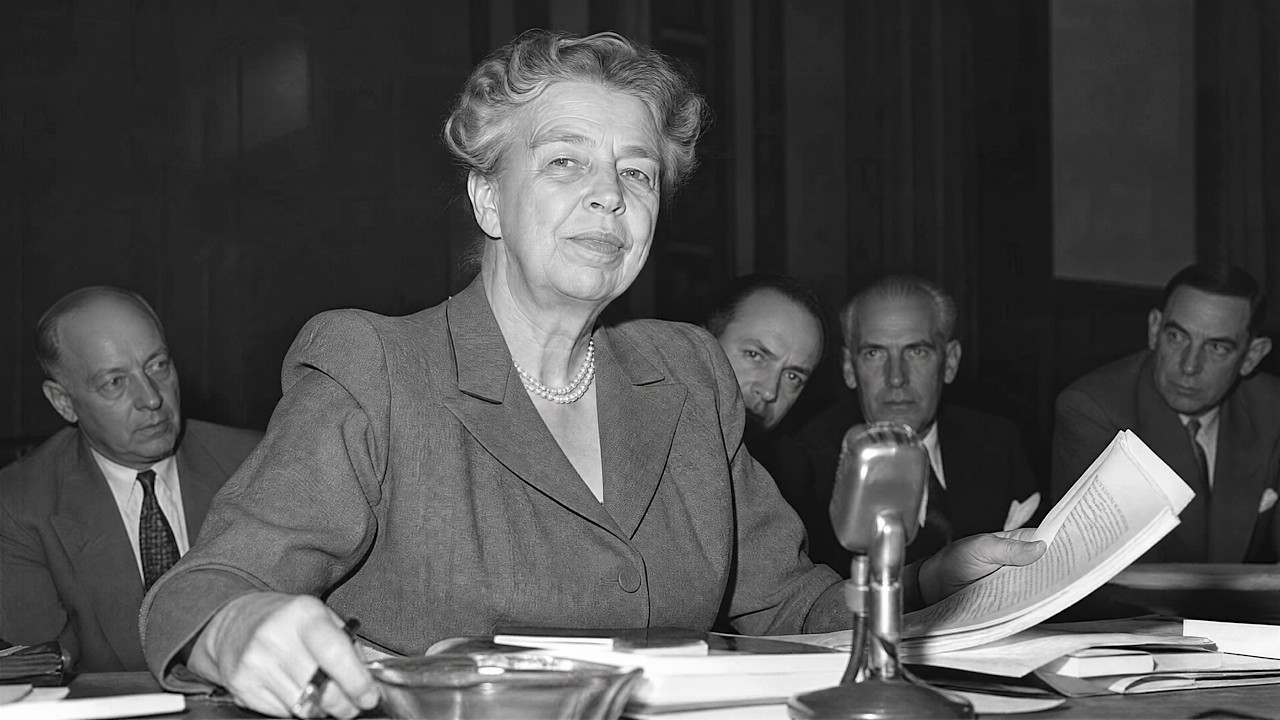
And the office she rebuilt became the template every first lady after her has had to reckon with. Consider the two images that bracket her life: a wife on her knees on a bedroom floor in 1918, holding proof that the relationship she had staked everything on was hollow, and a stateswoman in a great hall in 1948, rising to a standing ovation from the assembled nations of the earth for authoring the rights of all mankind. The same woman, twenty-seven years, and a whole world between them.
She had been handed every reason to vanish, and she chose instead to build.