On the morning of April 9, 1865, Robert E. Lee still had an army. It was exhausted, badly supplied, and pursued by a much larger federal force, but it had not yet surrendered. Lee was still trying to escape.
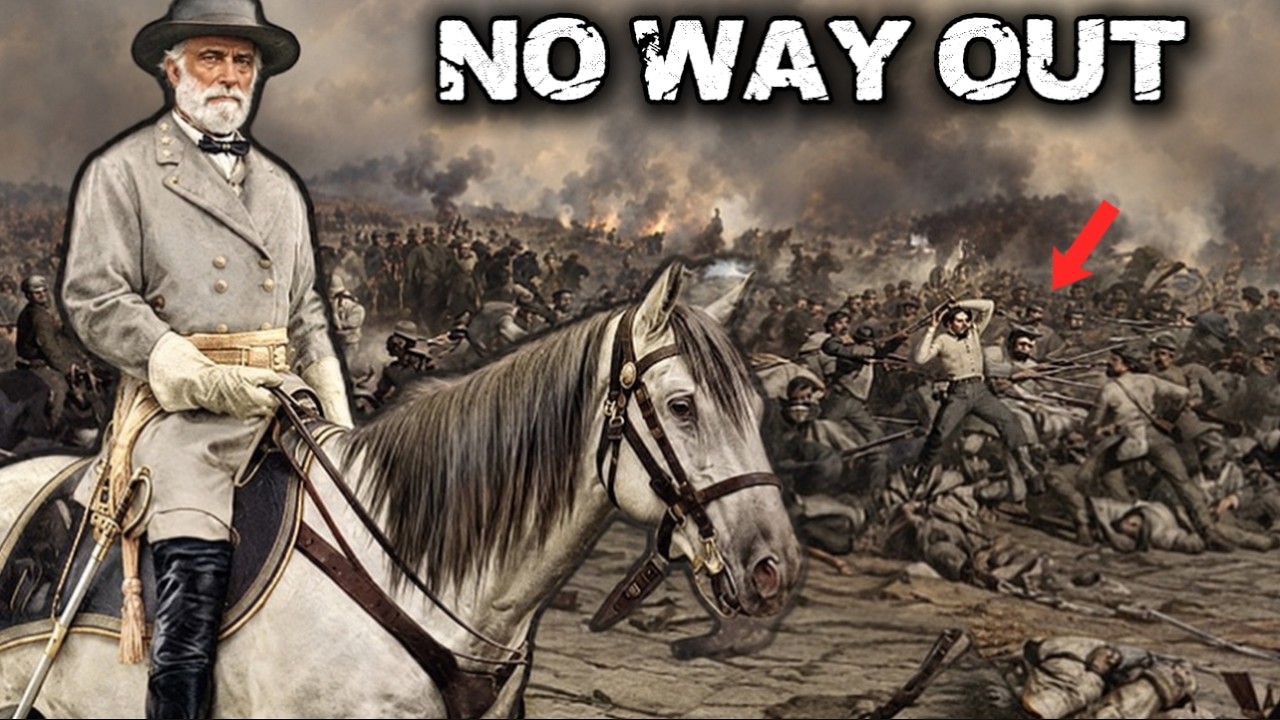
Less than twenty-four hours earlier, his men had been moving west through Virginia, hoping to reach Appomattox Station, seize desperately needed supplies, and continue toward Lynchburg. If they got there first, another route might still be open. If they were stopped, everything would change. By the time Lee understood what had happened, the most important road of his army’s final campaign was already closed.
The famous surrender at Appomattox is usually remembered as a meeting between two generals in a quiet Virginia house. But the meeting was only the final scene. The real story had unfolded outside, on roads, railroad tracks, fields, and crossroads. It began not with a surrender, but with a train.
After the fall of Petersburg and Richmond in early April 1865, Lee’s Army of Northern Virginia began a desperate retreat westward. The Confederates were trying to escape the tightening federal armies and reach the railroad at Appomattox Station. Supplies waiting near the station could replenish his exhausted men, and from there Lee intended to continue west toward Lynchburg and beyond. The plan was difficult, but difficult was not the same as impossible.
For several days, the army kept moving. The problem was that Grant was no longer simply following Lee. He was trying to get ahead of him. The Confederate column moved west while federal forces raced along other roads, attempting to reach the same destination first.
The campaign had become a contest of movement, and in such a contest distance mattered more than courage. A soldier could fight bravely and still lose a race. A commander could make the correct decision and discover that the enemy had already arrived first. By April 8, Lee’s army was approaching Appomattox, and somewhere ahead were the supplies he desperately needed.
The railroad became the center of the entire operation. At approximately four in the afternoon, federal cavalry under George Armstrong Custer reached Appomattox Station. Several Confederate supply trains were waiting there. They never reached Lee.
Custer’s cavalry captured three of the four trains while Confederate artillery under General Reuben Lindsay Walker attempted to respond. The engagement developed rapidly, and the supplies Lee had hoped to reach were lost. This was more than the capture of wagons and railroad cars. It was the destruction of Lee’s immediate logistical plan.
An army cannot survive on determination alone. It needs food, ammunition, transportation, and roads. Above all, it needs somewhere to go. Lee’s army was approaching a position where each of those necessities was becoming harder to obtain.
The Confederate soldiers stopped for the night near Appomattox Courthouse. In the darkness, they could hear the fighting around the station. The sound told them what maps could not. The enemy was already there.
Federal troops were ahead, the railroad was compromised, and the road west was becoming a trap. Lee still had one option: break through. At about two in the morning on April 9, he ordered General John B. Gordon’s Second Corps into position.
The objective was straightforward: attack west, break through the federal forces, open the road, and keep the army moving. But there was a problem Lee could not fully see from his position. The federal force in front of him was not merely cavalry. Lee had believed that much of Grant’s infantry was still behind him.
Instead, federal infantry was arriving rapidly. The escape route was narrowing from two directions. Ahead stood federal cavalry. Behind came pursuing infantry.
Around them, the roads of central Virginia were filling with Union forces. At about nine in the morning, Gordon’s men attacked. For a brief moment, they succeeded. They pushed the federal cavalry back.
For men who had spent the previous week retreating, it must have seemed that the road might actually be opening. But the breakthrough did not solve the larger problem. Gordon’s corps was exhausted after repeated fighting during the retreat, and more federal troops were arriving. Gordon sent word to Lee.
His message was blunt. His command had been fought to a frazzle. Unless Longstreet could support the movement or prevent federal troops from reaching his rear, Gordon could not continue. This was the moment when the military problem became a decision about surrender.
Not because Lee had lost his courage, and not because the men had refused to fight, but because the physical conditions necessary for continued escape were disappearing. The army needed a road Gordon could not open. It needed supplies that had been captured. It needed time Grant’s forces were taking away.
It needed space that was disappearing. Lee understood the implication. He reportedly responded that there was nothing left for him to do but go and see General Grant, adding that he would rather die a thousand deaths. Even then, surrender was not an instantaneous decision.
There was a process of letters, terms, paroles, and eventually the formal laying down of arms. Lee sent word that he wished to meet Grant. The message reached the Union commander while he was moving toward the front. Grant later recalled that he had been suffering from a severe headache when Lee’s message arrived.
After reading it, the headache disappeared. He stopped to write his reply. He would meet Lee. The location would be left to Lee.
Lee rested beneath an apple tree near the Appomattox River. Grant’s officers located him, and the two commanders moved toward the McLean house. The contrast between them became one of the most remembered images of the war. Lee arrived wearing his finest uniform.
Grant had been riding hard, his clothing muddy and travel-stained. The difference was not merely visual. One man had come to surrender. The other had come to receive it.
The atmosphere was not what later generations might imagine. There was no theatrical confrontation, no dramatic humiliation, no grand speech. The two men remembered meeting years earlier during the Mexican-American War. They spoke cordially before turning to the business of the day.
Then came the terms. Grant had already outlined them in correspondence. The Army of Northern Virginia would surrender its arms, artillery, and public property. Officers would give their paroles.
The men would be allowed to return home as long as they obeyed their paroles and the laws where they lived. And there was another provision that mattered enormously to the men outside that house. Confederate officers could retain their side arms, private horses, and baggage. Many Confederate soldiers had relied upon their own horses.
Grant’s terms did not require the defeated army to walk home stripped of everything. The surrender was severe. Weapons and military property were surrendered. The army ceased to exist as an active Confederate force.
But the men themselves were permitted to go home. That distinction was central to what happened next. There was no elaborate formal surrender document signed during the meeting. The heart of the agreement was contained in an exchange of letters between Grant and Lee.
Lee accepted the terms, and with that acceptance the Army of Northern Virginia had ceased to function as an independent Confederate army. But Appomattox was not the instantaneous end of the Civil War. Lee had surrendered the Army of Northern Virginia. Other Confederate forces remained in the field.
Joseph E. Johnston’s army in North Carolina would not surrender until April 26. Kirby Smith’s forces west of the Mississippi would surrender later. The conflict did not simply disappear the moment Lee left the McLean house.
What Appomattox changed was the scale and direction of the war. The Confederacy’s most important remaining field army had been removed, and the surrender terms created a model for what would happen to many other Confederate soldiers. The next stage was the parole. Thousands of men needed documentation proving they had surrendered and were permitted to return home.
The process continued for days. By the end, 28,231 officers and men of Lee’s army had been paroled. That number reveals something important. The famous image of Lee and Grant in a parlor represents only a fraction of the actual surrender.
The real event involved tens of thousands of people. Men who had marched together for years now had to separate. Men who had carried weapons into battle now carried papers allowing them to go home. On April 12, the formal stacking of arms took place.
The surrender had become physical. Weapons were placed down. Flags were deposited. The army that had fought at First Manassas, Fredericksburg, Chancellorsville, Gettysburg, and countless other battlefields was finally disbanded.
Lee would later explain the decision in General Order Number Nine. He wrote that the army had been compelled to yield to overwhelming numbers and resources. He also explained why he had accepted the surrender. Continuing the contest would bring losses without compensating for them.
That was the logic of the decision. Not simply defeat, not simply emotion, but a calculation about what another battle would cost. The final campaign had already demonstrated the problem. The army could still fight, but fighting and escaping were not the same thing.
Gordon had attacked on the morning of April 9. The Confederates had managed an initial success, but success on one portion of the battlefield could not reopen the strategic road. The supply trains were gone. Federal infantry had arrived.
The escape route was blocked, and the pursuing army was closing from behind. The final decision came from a chain of events that had begun well before the famous meeting. The surrender did not begin when Lee walked into the McLean House. It began when the possibility of escape started disappearing.
First came the collapse around Petersburg and Richmond, then the retreat west, then the race for Appomattox, then the loss of the supply trains, then Gordon’s final attack, then the realization that the road ahead could not be opened. Appomattox was not simply the moment when one general decided to give up. It was the final result of a campaign in which movement, supply, geography, timing, and military pressure had steadily reduced the choices available to him. Outside that house were thousands of men who had spent the previous days marching, fighting, retreating, and waiting for news.
For them, Appomattox was not simply a historic meeting. It was the end of an army. The most famous surrender in American history began long before the two generals sat down across from each other. It began with a race.
And Lee’s army lost that race.