The man who would become the most famous outlaw in the American West may not have known his own real name. Historians generally reach for Henry McCarty as the name he was born with, sometime around 1859, though some records suggest 1861 and no birth certificate or baptismal record has ever been conclusively tied to him. His mother, Katherine McCarty, raised Henry and his brother Joseph largely on her own, moving frequently through Indiana, Kansas, Colorado, and New Mexico. In 1873 she married a man named William Antrim in Santa Fe, and Henry became Henry Antrim.
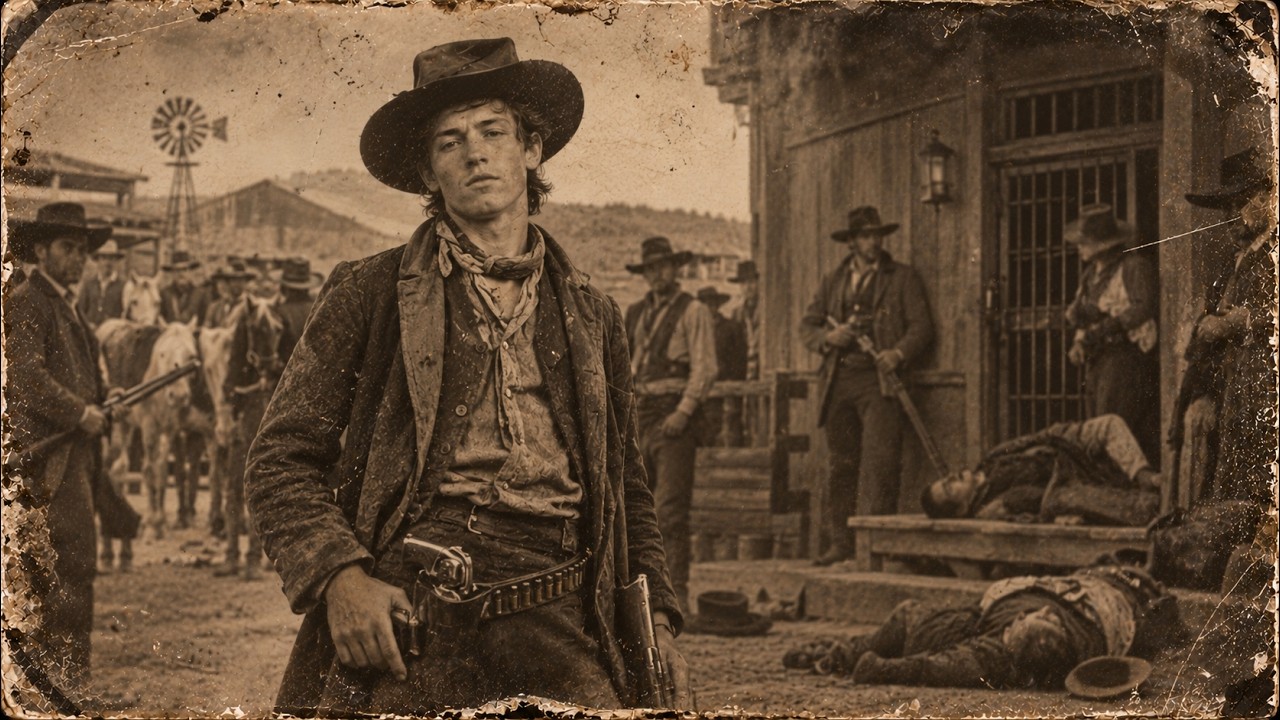
The stepfather did not stay in the picture long. By the time newspapers began writing about him in the late 1870s, he was calling himself William H. Bonney. Where that name came from has never been explained.
Some speculate it was drawn from his mother’s maiden name; others believe he simply constructed a new identity from scratch, the way a young man on the frontier might when the one he was born with no longer belonged to him. The nickname Billy the Kid came later, attached by newspapers and lawmen. It was not invented to make him seem dangerous. At first it was simply accurate: he was young, and almost everyone around him was older.
Katherine McCarty Antrim died of tuberculosis in September 1874 in Silver City, New Mexico. Henry was about fourteen. His stepfather withdrew from the boys’ lives shortly afterward, moving on to his own work and leaving them to survive on their own. Joseph managed to find his footing and built a quiet life.
Henry drifted. He found work washing dishes at a hotel called the Star Hotel, run by a woman named Sarah Brown, for pennies a day. There was no gang waiting to take him in, no mentor, no outlaw fraternity. There was just a teenager trying to eat and sleep in a rough mining town with no family, no money, and no safety net.
The frontier in the 1870s had no juvenile justice system, no social services, no child welfare infrastructure of any kind. Children fell through the cracks regularly. They became laborers, beggars, criminals, or some combination of all three. The slide into violence happened in stages.
In the fall of 1875, Henry was arrested for the first time, around age fifteen, on a charge of possessing stolen property, specifically clothing and butter taken by a local man nicknamed Sombrero Jack. Henry’s role was at best minor. Sheriff Harvey Whitehill locked him in a jail cell. After two days, Henry climbed up the jailhouse chimney and escaped.
The sheriff expected the boy to come back or be found nearby. He was wrong. Henry McCarty did not return to Silver City. He ended up in Arizona Territory, drifting through ranch jobs in the Sulfur Springs Valley.
He was good with horses. He was also learning to be good with a gun, though at that stage it was a practical frontier skill more than a declaration of intent. The first killing happened in August 1877 at a cantina near Camp Grant, Arizona. The man who died was a civilian army blacksmith named Francis Cahill, a physically imposing man with a reputation for bullying smaller men.
By multiple accounts, he had been harassing Henry for months and physically manhandling him. On the night of August 17, Cahill wrestled Henry to the ground and pinned him. Henry managed to get his gun free and fired once. Cahill died the following day.
The coroner’s jury ruled the killing criminal, though a modern assessment would likely land somewhere around self-defense or manslaughter. Henry did not wait for the legal process to decide. He ran, back across the border into New Mexico Territory. He was seventeen years old with one killing behind him.
Lincoln County in the late 1870s was one of the largest counties in the United States by land area, a vast stretch of high desert and grassland that functioned as an almost self-contained economic universe. That universe was controlled by two men, Lawrence Murphy and James Dolan. Through their company store, known locally as “the House,” they held a monopoly on the county’s commercial life. They controlled the supply of goods, held lucrative contracts to supply beef to Fort Stanton and rations to the nearby Mescalero Apache Reservation, and had political connections reaching up through the Santa Fe Ring, a network of lawyers, politicians, and businessmen who manipulated territorial governance for their own financial benefit.
Farmers and ranchers who needed credit had to get it from the House, and the House charged whatever it decided to charge. Into this arrangement stepped John Henry Tunstall, a young English rancher with money behind him, and Alexander McSween, a lawyer with similar ambitions. Together they established a competing store and bank in the town of Lincoln, offering lower prices and competing for the army contracts. Murphy and Dolan decided to end it.
What followed was a coordinated campaign of legal harassment, property seizure, and eventually open killing. Tunstall was murdered in February 1878 by a posse operating under legal authority but functionally serving Murphy and Dolan’s interests, with cover from a county sheriff named William Brady who was deep in the House’s pocket. Tunstall had treated Billy with a degree of basic human decency that was not common in his experience. He had given him work and spoken to him without contempt.
When Tunstall’s allies organized their response, Billy was ready to join. The group that formed around the Tunstall-McSween side called themselves the Regulators. At the beginning, they were not outlaws. They were legally deputized.
Dick Brewer, who managed Tunstall’s ranch, was appointed special constable by a justice of the peace aligned with the McSween faction, giving the men riding with him legal authority to arrest those connected to Tunstall’s murder. Billy rode as a Regulator under that legal mandate. Then the Regulators killed Sheriff William Brady and his deputy on the streets of Lincoln in April 1878. Brady was corrupt and had obstructed justice in the Tunstall case, but killing a sitting sheriff crossed a line that could not be uncrossed.
More killings followed. The violence escalated through the spring and summer of 1878, culminating in a five-day battle in the town of Lincoln itself that left McSween dead and the anti-Murphy-Dolan cause broken. The House’s faction won not because it was more righteous, but because it had more political backing, more money, and more powerful friends. After the five-day battle, Billy and the surviving Regulators were left in an impossible position.
The side they had fought for had lost. The legal authority they had operated under was void or ignored by the new power structure. The men controlling Lincoln County had every reason to see Billy charged, convicted, and hanged. The territorial government in Santa Fe, thoroughly infiltrated by the Santa Fe Ring, was not going to intervene.
Billy became an outlaw not because he chose that life, but because the political machinery of New Mexico Territory decided that was what he was, and the people with the power to decide those things had just won a war. The number that attached itself to Billy’s name was twenty-one: one kill for every year of his life. It was reported in newspapers across the country with the confidence of established fact and appeared in Pat Garrett’s own account of Billy’s life, a book ghostwritten by a journalist named Ash Upson. It was almost certainly not true.
The most rigorous modern assessments put the number of men Billy personally killed somewhere between four and nine. Some counts go as high as eleven, depending on how contested incidents and group killings during the Lincoln County War are assessed. The famous twenty-one has no credible historical foundation. It had a quality that four or nine lacked.
One killed per year of life carried a narrative symmetry that made the story feel almost mythological. Ash Upson, writing for Garrett, understood that a neater story sold more books than an accurate one, and Garrett had reasons to want the legend inflated. Killing an ordinary young man was a modest achievement. Killing the most dangerous outlaw in the American Southwest was a career-making act.
Billy was, by multiple accounts, unusually media savvy. He granted interviews and talked to reporters because he understood they could be useful. He offered quotes that were colorful, self-aware, and carefully constructed to shape public perception. He leaned into the nickname “the Kid” because it framed him as young and sympathetic rather than a seasoned, hardened criminal.
Researchers at the University of New Mexico have described his management of his own public image as resembling genuine press agentry. He was also fluent in Spanish, having grown up around Hispanic communities in New Mexico. Among many Mexican families in the region, he was known by the nickname El Chivato, the kid goat, a term of rough affection. The Murphy-Dolan monopoly had squeezed Hispanic ranchers and farmers hardest, and Billy, who had ridden against that monopoly and could speak without condescension in their own language, was a figure many families were genuinely glad to shelter.
When he was on the run, it was often Hispanic families who took him in, hid him from posses, fed him, and kept his location to themselves. In 1878, the governor of New Mexico Territory was Lew Wallace, better known as the author of Ben-Hur. He had been sent to bring order to a territory descending into open warfare. Billy had information about murders and corruption in Lincoln County that Wallace needed.
The two men made contact. Wallace offered immunity: Billy would testify about the Lincoln County killings, providing names and details that could be used to prosecute the men most responsible. In exchange, the charges against him would be dropped. Billy agreed.
He gave himself up to a staged arrest, met with Wallace in person at night in a private house in Lincoln, and testified, giving detailed statements about the killings he had witnessed and participated in. Wallace, by the account of that meeting, found him intelligent and credible. Then Wallace stopped holding up his end of the arrangement. The reasons were almost entirely political.
Wallace was navigating a territorial government still heavily influenced by the Santa Fe Ring, and pushing for the prosecutions Billy’s testimony could support would have meant picking an expensive fight with very powerful men. Wallace left New Mexico in 1881 to become United States Minister to the Ottoman Empire. Billy sent him letters, careful, articulate letters reminding the governor of the promises made in that private room. The letters went unanswered.
The prosecutions Billy’s testimony was supposed to enable never materialized. The deal was treated as if it had never been made. By late 1880, Billy was in Fort Sumner, New Mexico. The war was over.
The Regulators were scattered or dead. He was twenty years old and tired. He worked cowboy jobs on the ranches surrounding the old military post. He danced at the fandangos that brought together Anglo settlers and Hispanic families in the evenings.
By multiple accounts, he was a good dancer, laughed easily, played cards, and was good company. The Hispanic families of Fort Sumner knew who he was and sheltered him anyway. Given something resembling stability and community, given people who treated him as a human being rather than a weapon or a target, Billy was capable of living quietly. The violence that defined his legend was not intrinsic to him.
It was a response to conditions. Pat Garrett’s path had crossed Billy’s during those Fort Sumner years. They had drunk in the same saloons, played cards at the same tables, and were by the standards of the time something close to friends. In November 1880, Garrett was elected sheriff of Lincoln County on an explicit platform of capturing or killing Billy the Kid.
The people with money and political influence wanted Billy gone, and Garrett knew the territory, Billy’s habits, his hiding places, the families who sheltered him, the people he trusted. Garrett captured him at Stinking Springs in December 1880. Billy was taken to Santa Fe, tried, convicted, and sentenced to hang in the spring of 1881. Then he escaped again, killing two guards in the process, men named Bob Olinger and James Bell.
He rode back toward Fort Sumner, back toward the last place that had felt like home. Garrett followed. On July 14, 1881, Pat Garrett rode into Fort Sumner quietly with two deputies. He went to the house of Pete Maxwell late in the evening and sat on the edge of the bed in the dark.
Billy was outside. He had been sleeping elsewhere on the property and walked over to Maxwell’s room. He was wearing only his socks, holding a knife, his gun holstered at his side. He noticed figures in the darkness, Garrett’s deputies standing near the porch, and backed away from them, moving toward Maxwell’s doorway.
The room was dark. Garrett was sitting on the bed beside Maxwell, invisible to anyone stepping in from outside. Billy sensed someone in the room and asked in Spanish, “Who is there? ” He said it twice.
Garrett drew his pistol and fired two shots. The first struck Billy in the chest above the heart. The second went wide. Billy fell to the floor and died within seconds.
He never saw who shot him. He never had the chance to draw. There was no duel, no last stand, no dramatic confrontation. There was darkness, a question asked twice in Spanish, and two shots from a man Billy could not see.
Billy the Kid had been dead for less than two months when the first book about him appeared. Pat Garrett’s account, ghostwritten almost entirely by Ash Upson, was titled The Authentic Life of Billy the Kid, one of the more audacious uses of the word “authentic” in publishing history. The twenty-one kills appeared in its pages as established fact. The Lincoln County War was simplified into a story of good law and bad outlaws.
The political corruption, the broken immunity deal, the years of poverty and abandonment, all of it was absent or distorted. The book sold. The American reading public was hungry for exactly that kind of story. The frontier was closing, and Americans wanted their memories packaged in a form that felt heroic and morally uncomplicated.
Dime novels picked up where the newspapers left off, and cinema carried it forward. Every generation rebuilt Billy the Kid into whatever version of the Wild West it needed. The myth was already being sold before anyone had properly buried him. The real story of Billy the Kid is not a western.
It is a story about what America does with the people it fails. A child abandoned into poverty, drifting toward violence not by choice but by circumstance. A teenager with no name he could fully claim, no family to return to, no institution that saw him as worth protecting. A young man handed a gun under legal mandate by one side of a corrupt business war, then discarded when that side lost.
A person who, given a brief window of peace in Fort Sumner, demonstrated that the violence was not who he was but what he had been shaped into. The myth made him dangerous. The real story just makes you uncomfortable, which is a different thing entirely and harder to sell.