In the autumn of 1924, a sheriff’s deputy named Elma Cuillier walked out of a private asylum south of Baton Rouge, sat down in the dirt of the yard, and would not speak for four hours. When he could finally speak, he would answer only one question: whether the people inside were alive. He said they were. He said that was the problem.
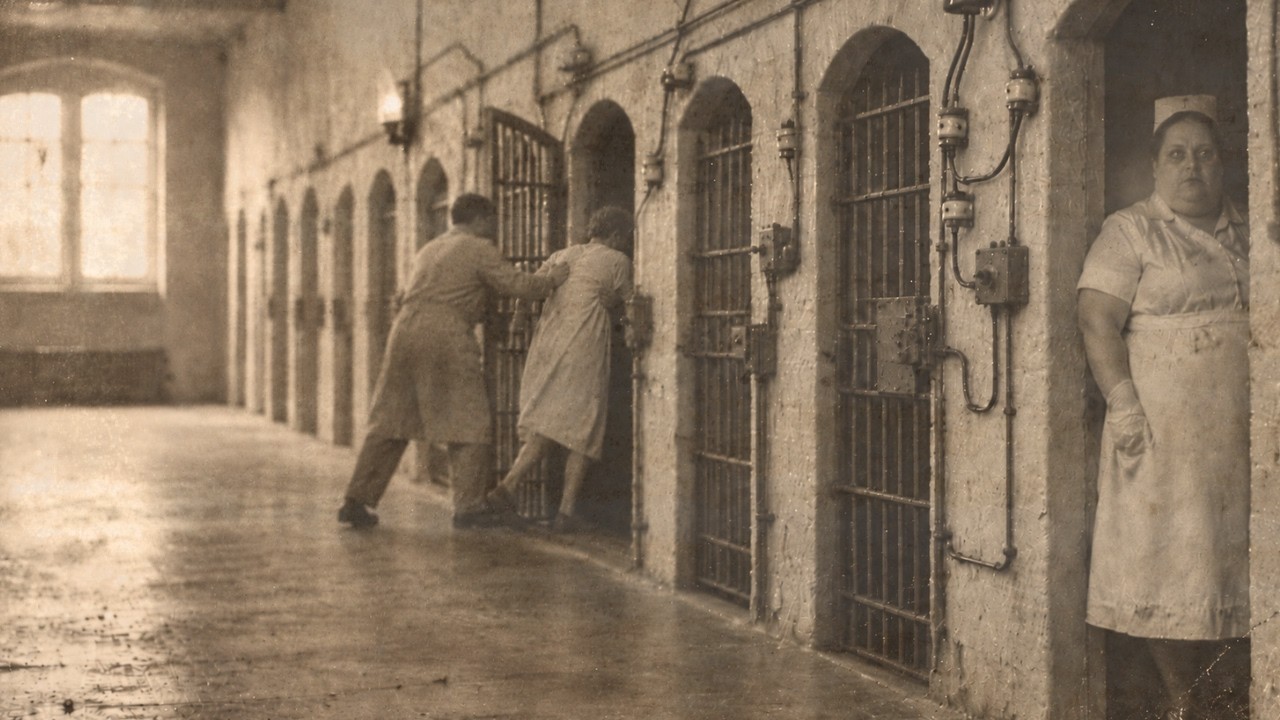
Cuillier had been a deputy for eleven years. He had worked the yellow fever camps, the levee collapses, the sugar house fires. None of it had put him in the dirt. What he saw inside the Verdun Home for the Nervous and Infirm, out past the cane fields on a narrow shelf of pale clay, did.
He never finished his report. He drank through the winter, quit the department in the spring, and moved to a town in East Texas where there was no low ground anywhere. He died of a stroke at forty-seven. The only paper he ever wrote about the Verdun Home was a single page left in a wooden box in a closet.
It said that the woman who ran the home had been keeping her patients in kennels in locked rows on the dirt of a cellar under the kitchen, and that the kennels had been there longer than the home. It said she had been doing it to everyone who came in for thirty-one years. Underlined twice was a final line: the worst part was not that she was keeping them in kennels. The worst part was that she was keeping them in kennels because something underneath the house would not let her keep them any other way.
The woman was called Sister Odal. She ran the home from 1893 until the autumn Cuillier came up her drive. The parish spent forty years trying to decide what to make of her story, and the state spent sixty years keeping it quiet. A historian from Baton Rouge finally pieced it together in 1971 in a back room of a parish library, from the deputy’s page, a surveyor’s field book, a geologist’s sample report, a priest’s notes on a Jesuit map from 1697, and the private accounting of the Belgian woman herself.
The parish sat along a bend where the Mississippi had once run before cutting a shorter channel in a flood sometime in the 1700s, leaving an oxbow of standing water. Most of the land there was low and black and good for cane, except for one narrow shelf of pale clay running north and south between two cypress sloughs, slightly higher than everything around it, flat for about a mile and a half. The old maps called it the shelf. The Houma word recorded by a Jesuit in 1697 meant something like the place that is not underwater when other places are underwater.
The Jesuit added his own note: the Houma did not build on it, did not graze on it, did not hunt on it. One of the old men told him the ground there did not like a thing walking on two legs, and preferred a thing walking on four. The Jesuit marked the shelf with the Latin word for forbidden and filed the map in a lock cabinet in a New Orleans seminary, where it stayed for 190 years. It was still in that cabinet when a woman named Odal Boot arrived in the parish in the summer of 1891 and bought the shelf and both sloughs for forty-three dollars.
She was not from Louisiana. She was from a town in southern Belgium called Jouri, where a convent of the Order of Santa Gat stood over an older chapel, and a charnel house beneath the chapel older still. She had grown up with her mother washing floors in all three. She entered the convent as a girl of fifteen and left at thirty-one, after a formal inquiry was opened by a visiting Jesuit who had noticed the arithmetic in her infirmary ward.
Over eleven years, Sister Odal had handled 431 patients and lost none of them to death, while other wards lost roughly one in three of their acute cases. The record of the inquiry closes with the note that Odal departed the order of her own accord before it concluded, taking with her only her habit and a small locked wooden box. She arrived in Louisiana with the box and a bank draft that paid for the shelf. The home opened in the autumn of 1893.
She called it the Verdun Home after a street in her Belgian town. She built a plain two-story house at the north end of the shelf with a kitchen wing and a cellar beneath it. The main house held her rooms, a day room, a front parlor, and twelve small bedrooms upstairs, clean and sunny with washed curtains and framed scripture. Families inspecting the home before leaving a relative in her care saw those twelve bedrooms.
The patients slept in the cellar, in kennels on the dirt. The kennels were built the first winter by a Cajun carpenter who was paid in cash and did not return. He built forty-one of them in two rows of twenty, plus one extra at the north end. Each was about four feet long, three feet wide, and three feet high, framed in cypress with a door of iron bars and a bowl for water set into the dirt.
When he asked what she intended to keep in them, she said she intended to keep what she had always kept, which was patience, and that if he did not understand the answer, he would not understand any answer she could give. He finished the work and left, and he never went back to the shelf. His wife later told her granddaughter that her husband had confessed he had lied to the Belgian woman: his knees had hurt from kneeling on the dirt every day of the work in a way he did not understand, and when he had crawled under a kennel frame with his belly on the dirt, the pain had stopped and been replaced by a warm, pleasant tiredness. He had wanted to lie flat and sleep.
He had not told her because he did not want to spend one more hour in that cellar than he had to. The home never had more than forty-one patients and never fewer than thirty-eight. Families paid monthly and almost never visited. Those who did were received in the front parlor, shown the twelve bedrooms, and told their relative was resting.
If they insisted on seeing the relative, Odal produced the patient washed, dressed, and seated upright in a chair for twenty minutes. The patient would be glassy and slow and would not say what had happened, because what had happened had not left any language the family would recognize. The parish knew the home existed. It did not know what the home was.
The parish doctor visited twice a year and signed the papers the state required, and never asked to see the kitchen wing cellar. The parish undertaker collected a body from the home only three times between 1893 and 1924. Three deaths across thirty-one years in a home holding forty chronic patients was so improbable that any honest doctor who thought about it for ten minutes would have asked a question. Nobody did.
The other patients did not die. They went on and on, year after year, in the kennels. What brought the deputy up the drive was a letter. In the summer of 1924, a widow’s daughter in the Mississippi Delta found in her dead father’s desk a bundle of monthly receipts going back fourteen years from the Verdun Home, made out for a Hortense Boon.
The daughter had been told her aunt had gone to Switzerland in 1910 and had died there of consumption within a year. Instead, she found fourteen years of receipts from a parish in South Louisiana. She wrote to the home and received a reply saying Hortense Boon was quietly settled and resting comfortably. The daughter went to the sheriff of her father’s county, who sent a letter of inquiry to the sheriff of Pointe Coupée Parish, who sent out his deputy, Elma Cuillier, to investigate.
He arrived at the Verdun Home at ten in the morning on a Thursday in October. He left the next morning at six. What he saw in the cellar was a long low room running the length of the kitchen wing, forty-one feet by twenty, with a dirt floor packed hard and smooth by thirty-one years of knees and hands, and two rows of cypress kennels against the long walls. In each kennel was a human being on all fours.
The ones who could lift their heads lifted them when the lamp came in. The ones who could not turned their eyes toward the light. Nobody made a sound. The cellar was cleaner than he would have believed possible.
The patients were washed. The dirt was swept. The water bowls were full. He walked down the aisle and looked into all forty-one kennels.
In each was a person who had once been somebody’s daughter or son or sister or father, now on all fours in the dirt, hair long, hands and feet thickened and calloused like paws, shoulders hunched, backs rounded. And in their eyes they were still awake, still present, still there behind what their bodies had been made into. He saw a man he recognized, a lawyer from Baton Rouge who had vanished into some asylum up north fifteen years back. The lawyer breathed one word: his own name, slowly, as if afraid he had forgotten how it sounded.
Near the end of the east row, in the last kennel, a thin old woman with silver hair met his lamp with bright eyes. He said her name, Hortense Boon, and she nodded once. She had been awake the whole fourteen years. That was what put him in the dirt.
Not the kennels. The eyes. Odal Boot sat down across from him at her kitchen table and told him she would explain everything, under one condition: that he not open the kennels until a man from the parish seminary could be fetched. If he opened the kennels before someone came who understood the place, she said, he would wish he had drowned himself in the Mississippi instead.
He agreed. She talked for nine hours. This is what she told him. The shelf was not natural.
Under the pale clay, at a depth of about seven feet, lay a layer of fitted, dressed stone extending the length and width of the shelf, continuing some unknown distance under the slough mud. It was not Louisiana stone. It had been laid by hand, long enough ago that the delta had grown over it rather than against it. The geologist who finally measured it in 1968 reported that it matched no known formation in South Louisiana, gave his notes to the librarian, and said he did not want to know anymore.
The ground under the shelf kept an inventory of living weight on its surface. It did this by posture. It did not read heat or heartbeat or breath. It read the shape a living body made against its surface.
A thing standing upright on two legs, with its weight concentrated on two small points far apart, the long bones running vertical, the center of mass carried high, was one kind of weight. A thing on four legs, with its weight spread across four points close to the ground, was another. The ground reached for the first kind and let the second alone. An upright person standing on the shelf would feel a slow, steady pull moving up the long bones from the feet, settling in the hips and ribs, and after a day or two in the back of the head.
The person would call it fatigue, then a cold coming on, then would start to think about lying down on the shelf, and would within another day be found quietly dead with no cause the parish doctor could put on paper. The person inside the body was gone. The body was there. A dog on the shelf was fine.
The Houma had understood this for generations. The shelf did not reach for four-legged things. Odal had understood from her first week on the shelf, when she felt the reach in her own hips, that the shelf would kill anyone who stayed upright on it. She had grown up in a Belgian convent where the sisters had managed a stone floor very much like the one under the shelf for seven centuries, by a method of keeping patients low, on prayer cushions in a stone antechamber, at what the sisters called the rest, until they became invisible to the floor.
She had brought that method to Louisiana. She built the kennels because a kennel four feet by three by three was tall enough to enforce the posture: a patient who tried to kneel upright hit their head, a patient who tried to lie flat felt the beginning of the reach, and went back onto their hands and knees. There was no other way to keep them alive. She was not cruel, she told the deputy.
She was merciful. She was keeping her patients from the thing that would have taken them inside a day and a half. They were still themselves. Their minds had not gone.
The lawyer could still describe his last case. The deacon could still quote doctrine. The schoolteacher could still recite the names of every student she had taught. Odal fed them, bathed them, combed their hair, trimmed their nails, and prayed with them one by one every evening, kneeling at the bar of each door.
Across thirty-one years she made forty-one friendships that only she and her patients knew about. She did not know what the shelf was for, she said. It had been built by people who were not here anymore, and it kept working because nothing had stopped it. She suspected it was a very old instrument of a very old people, still sorting.
The only way to survive it was to stay off its surface, or hide from its attention. The deputy nodded. He agreed. He did not open the kennels.
Odal Boot was arrested and charged with false imprisonment and practicing medicine without a license. The trial was closed to the public because the testimony was too strange to put before a jury. The state brought in a specialist from Charity Hospital who did not believe a word of her story and ordered the kennels opened. The orderlies lifted a woman who had been in the home for twenty-two years onto a stretcher on her back.
By the time they reached the top of the stairs, she was dead, with no mark on her. The removal was halted. The trial closed with a predetermined verdict: thirty years at Angola. On the morning she was to be transferred, she was taken instead, by arrangement with the governor’s office, back to the Verdun Home.
She resumed her care of the forty remaining patients. She never left the shelf again. The official record said she was serving her sentence at Angola. The actual arrangement was that she had been returned because the patients would not survive without her.
She lived in the main house and cared for the patients for sixteen more years. One by one they died of old age in their kennels. By 1940 the cellar was empty. The last to die was the schoolteacher from Opelousas, after thirty-nine years in her kennel, having recited for Odal one final time the full list of her students from 1901, and lain down on her side, and died at dawn.
Odal closed the kennel and climbed the stairs. She died in her sleep in the spring of 1942. The state pulled down the house and the kitchen wing, filled in the cellar with pale clay carted from a borrow pit three parishes away, and left the kennels in place under the fill because the patients were buried in their kennels. The shelf was reseeded with cane grass.
The drive was obliterated. By 1950, if you drove the parish road, you would have seen only a long, low rise of pale clay among the cypress sloughs with no mark on it. The historian who assembled all of this understood that the Verdun Home had not been the horror the parish had at first believed. The horror was the shelf.
The thing was still running, still reading posture, still reaching. Nothing had stopped it. No one now that Odal was gone remembered how. The last item in the folder in the parish library is a photograph taken by the state crew during the demolition in 1942.
It shows the cellar with its roof removed and its two rows of kennels standing open to the sky. In the dirt of the floor you can see the pattern of hands and knees that thirty-one years of patients and one woman kneeling at every kennel every evening had worn into the earth. Underneath all of it, barely visible where a shovel had scratched the dirt, you can see the pale fitted stone.
Still there now, under the pale clay of the reseeded shelf, waiting for the next thing on two legs to stand on it long enough.