Emma Coronel Aispuro stood in the gallery of a Brooklyn federal courtroom in 2019, impeccably dressed, perfectly composed, while witness after witness described the inner workings of the Sinaloa Cartel. Her husband, Joaquín “El Chapo” Guzmán, sat at the defense table facing a trial that would end with a life sentence. The cameras followed her every exit from the courthouse. Fashion publications wrote about her outfits.
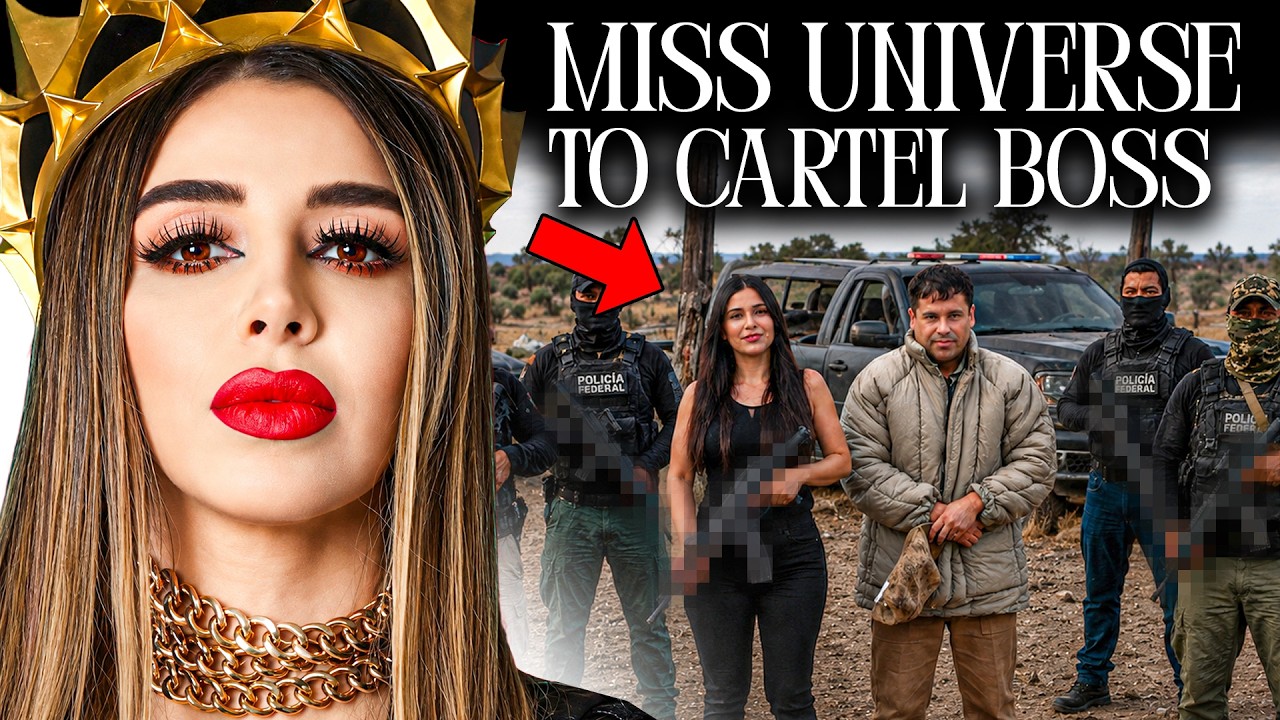
Social media dissected her demeanor. She said almost nothing publicly, and that silence allowed the media to shape her into a single, simple image: the loyal wife of a drug lord. But behind the scenes, federal prosecutors were building a different portrait entirely. Their version of Emma Coronel was not a passive spouse.
It was a woman who, according to the evidence they had assembled, had been functioning inside the cartel itself. Born in 1989 near San Francisco, California, Emma Coronel held United States citizenship by birth. She grew up in Canelas, a remote mountain town in Durango, Mexico, deep inside territory where the Sinaloa Cartel’s influence shaped daily life. Her family had connections to that world long before Guzmán appeared.
When El Chapo, decades her senior, pursued her at a local festival while she was still a teenager, she was not entering a foreign world. She was already inside it. The marriage placed her at the center of a criminal network that moved cocaine, methamphetamine, heroin, and marijuana across borders on a scale that generated billions of dollars annually. For years, that network operated under constant surveillance from law enforcement on both sides of the border, and Emma Coronel’s public role was defined by a single recurring visual: her appearance at her husband’s side, composed and glamorous, as the world’s most consequential cartel prosecution unfolded.
That image began to crack once investigators started looking at what she actually did. According to prosecutors and the record later established through her own guilty plea, Emma Coronel served as a messenger and intermediary between Guzmán and members of his organization. From 2012 to early 2014, she allegedly relayed messages that helped him conduct drug trafficking operations. After Mexican authorities arrested Guzmán in February 2014, she visited him in prison.
Investigators alleged she used those visits to continue passing messages to people running the cartel on the outside. In their framing, she was not merely present in his life. She was a functioning conduit in a criminal enterprise that kept moving even with its leader behind bars. The detail that permanently reframed her public image came in July 2015, when El Chapo escaped from Mexico’s Altiplano maximum-security federal prison.
He did not walk out through a gate or slip past a bribed official. He escaped through a tunnel roughly five feet high and nearly three feet wide, equipped with ventilation, lighting, and a modified motorcycle on rails. The tunnel ran from a construction site near the prison directly beneath the facility’s floor and emerged inside Guzmán’s cell. The engineering alone was extraordinary.
The planning required to execute it inside one of Mexico’s most secure facilities stunned law enforcement around the world. Prosecutors alleged that Emma Coronel helped make it happen. They said she carried messages from Guzmán to the group planning the breakout, using her prison visits as a vehicle for communication. They also alleged she helped smuggle a GPS-enabled watch into the facility, concealed inside a food item, so that his associates on the outside could track his exact location within the prison and calibrate the tunnel’s construction accordingly.
Without that watch, the precision required to reach his cell was essentially impossible. With it, the operation became solvable. Investigators viewed her involvement as clear evidence that she understood his operation from the inside, not as an uninvolved family member watching events unfold from a distance. El Chapo rode out of Altiplano on that modified motorcycle and disappeared into Mexico for months before being recaptured in January 2016.
He was extradited to the United States in 2017, tried in Brooklyn, and convicted in February 2019. He received a life sentence plus thirty years and is currently confined at ADX Florence, the federal supermax facility in Colorado. He will not leave. Emma Coronel’s outcome followed a different path entirely.
On February 22, 2021, she was arrested at Dulles International Airport in Virginia on a criminal complaint charging her with conspiracy to distribute cocaine, methamphetamine, heroin, and marijuana for importation into the United States. She appeared in federal court the following day. On June 10, 2021, she pleaded guilty before United States District Judge Rudolph Contreras in Washington, D. C.
to three counts: conspiracy to distribute narcotics for importation into the United States, conspiracy to launder narcotics proceeds, and illegal financial dealings related to her husband’s property under the Foreign Narcotics Kingpin Designation Act. Speaking through a Spanish translator, she confirmed her plea was voluntary. “I accepted my guilt,” she later said publicly, “and I’m good with that. ” Prosecutors had asked for four years.
The court sentenced her to approximately thirty-six months. She served roughly thirty-one months before transitioning to a halfway house and community confinement. She was released from federal custody in September 2023, placed under four years of supervised release, and ordered to turn over one and a half million dollars to the government. The contrast with her husband could not have been sharper.
He will spend the rest of his life in a supermax cell. She walked out of federal custody in the fall of 2023 and did not disappear. She did not retreat quietly into private life. Within a year, she was building a second public identity, one built not around the man she had married but around herself as a figure in fashion, social media, entertainment, and documentary storytelling.
In September 2024, she made her international modeling debut at Milan Fashion Week, walking for designer April Black Diamond at the historic Palazzo Serbelloni. She opened and closed the runway in white gowns from the spring/summer 2025 collection. The imagery generated enormous international attention. The same person who had pleaded guilty in a federal courtroom three years earlier to drug trafficking and money laundering charges connected to the Sinaloa Cartel was now walking high-fashion runways in Milan.
The designer framed her as a symbol of strength, courage, and hope. Coronel embraced the moment fully, documenting every step for her social media following. She was accompanied by Mariel Colón, her former defense attorney, who had reinvented herself as a regional Mexican singer and was walking in the same show. The Milan appearance was followed by a steady stream of public visibility.
In May 2026, she posted gym and fitness content from California. She appeared publicly alongside Mariel Colón at El Farallon, an event center, placing the two women together in an entertainment and nightlife context. Then came July 12, 2026, and Bellico Fest at SoFi Stadium in Los Angeles, a regional Mexican music festival built around corridos tumbados, música bélica, norteño, and banda, a genre world where organized crime mythology and narco-corrido storytelling have been intertwined for decades. Emma attended as a VIP guest of the same designer from Milan.
She stepped onto the stage in front of thousands of people, took the microphone, and said, “How is my people from Mexico doing? How is my people from Sinaloa doing? And Guerrero, Jalisco, Michoacán, Durango? ” The crowd erupted.
She sang, she danced, and she documented every moment across her Instagram stories. The VIP area where she spent the night was called The Vault, and a commemorative plaque inside it read, “Emma Coronel, Mariel la abogada, para la cultura. ”
None of these appearances prove that Emma Coronel is currently involved in criminal activity. But the pattern of where she is being seen, who she is being seen with, and the cultural worlds she is choosing to move through has drawn criticism.
For a woman who pleaded guilty to a Sinaloa Cartel conspiracy to appear on stage at a narcocorrido festival, greeting crowds state by state from Sinaloa, Durango, and Guerrero, is not a neutral act. Visibility, however, is not the same as operational power. Her documented post-prison career is built around modeling, social media, entertainment, and personal branding. That is what the evidence of her current life shows.
The past is established by her guilty plea. The present is a different story. Her documentary work added another layer. In November 2025, Oxygen True Crime aired “Married to El Chapo: Emma Coronel Speaks,” a two-hour special where she reflected on her relationship with Guzmán, addressed her time in federal custody, and grappled publicly with her own accountability.
She said she accepted her guilt. She said she never saw the billions attributed to El Chapo’s fortune. And she said she was focused on building her own name, which is precisely what she has been doing since walking out of federal custody. Was Emma Coronel ever just the wife?
The evidence says no. Her guilty plea established definitively that she participated in a drug trafficking conspiracy and a money laundering conspiracy connected to the Sinaloa Cartel. That is a documented legal finding, not an allegation. The prison escape evidence demonstrated the degree to which prosecutors believed she had operational knowledge and played an active facilitative role.
The GPS watch detail alone speaks to a level of logistical involvement that goes far beyond the role of a spouse who was simply present while criminal activity happened around her. But she was not convicted of being the head of the Sinaloa Cartel. She was not convicted of ordering violence or directing its core trafficking operations. She was convicted of participating in a conspiracy, carrying messages, facilitating communications, and playing a role in one of the most dramatic prison breaks in recent history.
That is serious criminal conduct. It is not the same as running a cartel. The central irony of her story is hard to miss. The Sinaloa Cartel was built on invisibility, hidden tunnels, encrypted messages, and people who moved through the world without leaving a public trace.
El Chapo spent years perfecting the art of disappearing. And now, the most publicly recognizable person to come out of that world is his ex-wife, showing up everywhere and documenting every second of it. The cartel world was about hiding. Her new world is about being seen.
El Chapo will never leave ADX Florence. Emma Coronel is on stage at SoFi Stadium asking a crowd of thousands how her people from Sinaloa are doing. Whether that is genuine reinvention, calculated rebranding, or simply the next chapter in one of the most complicated stories the Sinaloa Cartel ever generated is a question only she knows the answer to, and she has made it clear she will tell that story on her own terms, in her own time, and in whatever room she decides to walk into next.