In 1534, the most powerful woman in England woke each morning knowing that her body was not entirely her own. It belonged to a king, a kingdom, and a dynasty that would not survive without a son. Anne Boleyn was pregnant, and the entire weight of the English Reformation rested inside her womb. Her chamber was neither cold nor warm, but held the particular stillness of a room where too many candles had burned through the night and too many women had slept lightly, listening for the sound of her breathing.
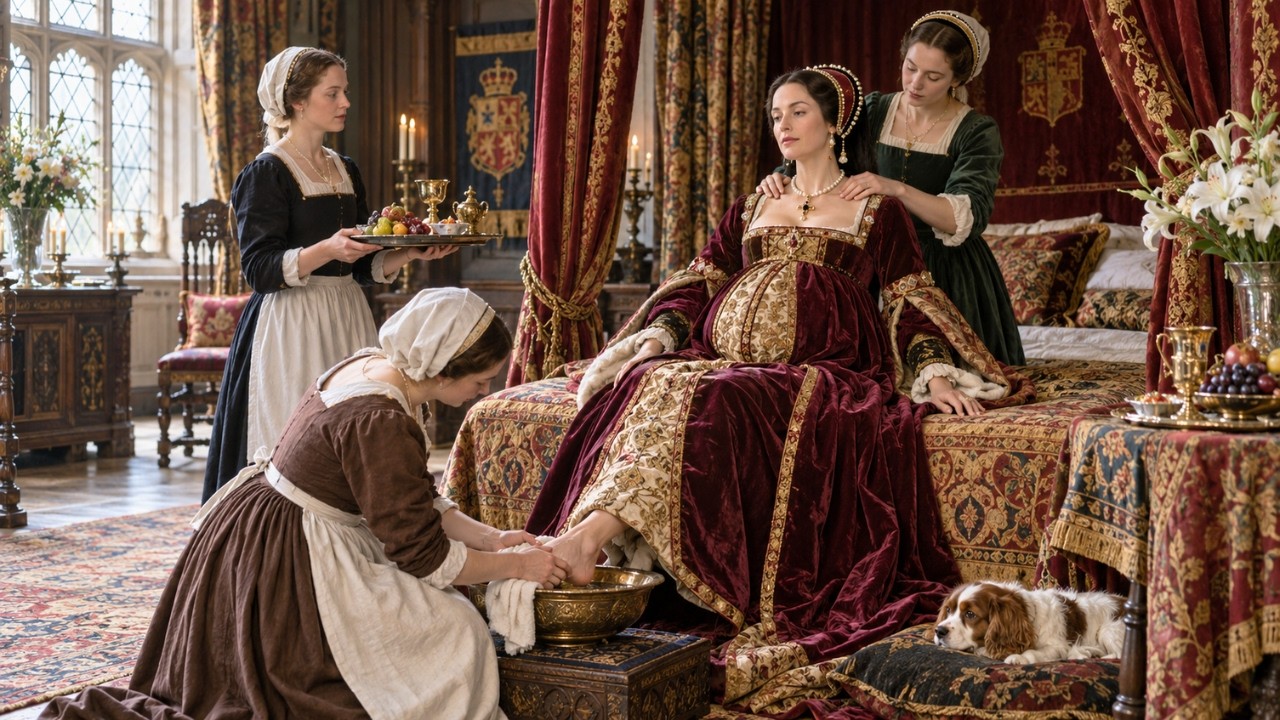
Her ladies-in-waiting were already moving before she opened her eyes. Sleep for a pregnant queen consort in Tudor England was a political act. How she rose, how she looked, and how she carried herself would become part of the court’s conversation before the first meal of the day was served. This was her second confirmed pregnancy.
Her first, in 1533, had produced a daughter, Elizabeth, born in September of that year. The child was perfectly healthy and perfectly wrong in the eyes of everyone who needed her to be a boy. Henry had not hidden his disappointment, and the court had read his face the way courtiers always read a king’s face, like a document full of consequences. This pregnancy carried a weight the first one had not.
This child must be a son. Anne knew it. Henry knew it. Every person in her household knew it.
Her ladies helped her rise. The first assessment of the morning was intimate to her and professional to them. How had she slept? How did her body feel?
Was there nausea? There was almost always nausea. In the sixteenth century, pregnancy nausea was understood through humoral medicine, the ancient Greek idea that the body was governed by four humors: blood, phlegm, yellow bile, and black bile. A pregnancy disrupted this balance, and the resulting sickness was seen as evidence that the body was working, that the child was making its presence known.
The diagnosis of pregnancy was not a test taken at home but a sustained observation conducted by the midwife, the ladies, and the royal physicians over weeks and months. Getting dressed was a procedure that took the better part of an hour and involved multiple people with specific assigned roles. It began with the smock, a long linen garment worn directly against the skin, the layer that protected expensive outer garments from the oils and moisture of the body. Over the smock went the stays, a fitted bodice stiffened with buckram, whalebone, or wood, adjusted to accommodate the pregnancy while not entirely abandoning the flat-fronted silhouette Tudor fashion demanded.
Over the stays came the kirtle, a structured skirt and bodice combination, and then the gown itself, the outermost garment the world saw. Anne’s gowns were extraordinary by any standard. Henry’s court was one of the wealthiest in Europe, and her wardrobe reflected that wealth in silks, velvets, cloth of gold, damasks woven in Florence and Bruges, and heavy satins that caught the light of torches and candles. Her French hood, the crescent-shaped headpiece associated with her, was settled into place with the care given to a crown.
Because in a very real sense, it was a crown. The question of what she ate was deeply tied to humoral medicine. Pregnancy was seen as a warm condition, and the recommended foods were those considered cooling and nourishing. Broths made from capon or veal were ideal, gentle and easy to digest.
White bread was preferred over darker breads. Almonds appeared frequently, often as almond milk, a rich liquid created by soaking and grinding almonds, strained through cloth and sometimes sweetened with sugar and spiced with cinnamon or ginger. She almost certainly ate at table with her ladies present, the food brought to her in a ceremony that reflected her status. The tasting of her food to guard against poison was not theatrical paranoia.
It was a reasonable response to a genuinely dangerous world. Catherine of Aragon’s supporters despised her. The conservative Catholic faction viewed her as a heretic and a usurper. There were people within the palace walls who would celebrate her death.
Her power rested entirely on two things: Henry’s love and her ability to give him a son. Both were outside her ultimate control. She thought about it the way she might think about the weather, constantly, with an eye always toward the sky, watching for signs. After the morning meal, her day moved into its public dimension.
The Tudor court was a machine that ran on visibility. To be seen was to be powerful. To withdraw from sight was to invite speculation about weakness or loss of favor. Even pregnant, even nauseous, even exhausted from a night of broken sleep, she appeared, received, and presided.
Her ladies formed a moving architecture around her, a retinue of roughly sixty people, a small city moving with her through the palace. At Greenwich, her day unfolded against the smell of wood smoke and rushes, of the river nearby, of the food being prepared in vast kitchens that fed hundreds of people three times daily. The Thames was not a clean river; it received the waste of London upstream. This was one reason ale, brewed with processes that killed much of the biological contamination in the water, was the standard drink of the era.
For everyone from the lowest servant to the highest noble, the everyday beverage was ale. Wine appeared at her table regularly, but during pregnancy, the advice from her physicians reflected the principle that moderation was the governing virtue, and anything that heated or disturbed the humors should be approached carefully. Her afternoons were not leisure. They were a hierarchy of obligations, from appearing with Henry at court functions and receiving ambassadors to the more private activities of her chambers.
She embroidered, not as a hobby but as a skill and a form of artistic production, the pieces often destined for altar cloths, cushion covers, or gifts. She sat with her ladies, needles moving, conversation flowing. Among women in the inner chambers, conversation was a form of intelligence gathering, alliance building, and political management that ran parallel to the male-dominated world of the council chamber. She played the lute and the virginals.
She sang and composed. Henry, equally musical, had always valued this in her. When there was music, it was because someone was making it in the room. Henry visited her chambers, and these visits were among the most important events of her day.
By 1534, the marriage had settled into something more complicated than a romance. Henry was a man of enormous appetites and enormous vanity, and he had already demonstrated in the case of Catherine of Aragon that he was capable of setting aside a wife when she no longer served his purposes. Anne knew this. She had been there for the setting aside.
By all historical accounts from ambassadors and courtiers, she argued with Henry. She challenged him. She expressed opinions a more cautious woman would swallow. This was part of what made her historically extraordinary and part of what made her politically dangerous to herself.
The man who had written her passionate love letters, who had called her his heart and his jewel, was a man whose emotional weather changed faster than the English sky. In 1534, he was under enormous political stress. The break with Rome was complete in law but not in reality. Catherine of Aragon was still alive, still corresponding with her nephew, the Holy Roman Emperor.
The conservative faction was restless. Thomas More had refused the oath acknowledging Henry as supreme head of the Church of England. Henry needed everything around him to be simple and supportive. Anne was not a simple or entirely supportive presence.
She was also managing her own political network with particular intensity. The people in her household were political appointments, and she knew which of her ladies were reporting to whom. She had promoted her family members where she could. Her brother George held important positions.
She had cultivated relationships with the reformist religious faction, and evidence suggests she owned and read William Tyndale’s English translation of the New Testament, a deeply radical act. She was not simply the king’s wife. She was a player in a theological and political revolution. Evening brought the main meal, a multicourse event served in a series of removes.
The hierarchy of the Tudor meal was spatial as well as gastronomic. Where you sat determined what you ate. As a pregnant woman, she managed two competing imperatives: eating enough to sustain her pregnancy while observing the humoral restrictions her physicians recommended. After dinner came entertainment.
There was music, dancing of stately choreographies like the pavane and galliard, and cards or dice. Gambling was a universal pastime, and the stakes at a royal card game were not trivial. The nights were long and strange by modern standards. Evidence suggests that before widespread artificial lighting, people slept in two phases: a first sleep after dark, a period of wakefulness lasting an hour or two in the middle of the night, and a second sleep until morning.
During that wakefulness, people prayed, talked, thought, or simply lay in the dark. Anne’s first sleep ended sometime around midnight. She woke and lay in the darkness, surrounded by the breathing of her ladies. She thought about the child.
She prayed in English or French, the languages of her interior life. She prayed for a son, because the alternative was something she could not afford to contemplate too directly. She may have prayed for Henry, whose love was the axis around which her existence turned, and which she could feel shifting subtly like a compass needle responding to a distant magnetic field. She may have prayed for her daughter Elizabeth, being raised in her own household at Hatfield, whom she saw only occasionally and loved with the particular intensity of someone who knew the child represented both everything she had accomplished and the proof that she had not yet accomplished enough.
The pregnancy of 1534 ended in a miscarriage or stillbirth. The records are incomplete and contradictory, and historians have debated for decades exactly what happened and when. What is clear is that no living child came from it. When Henry received the news, he did not take it with the public composure a different kind of man might have managed.
The marriage, already strained, sustained another fracture. But Anne did not know this on any given morning of the pregnancy. She rose in her chamber at Greenwich or Hampton Court, her ladies already moving, the candles from the night before burned down to stubs. Outside the window, the Thames ran silver in the early light or was lost in gray English mist.
She rose. She was helped into her clothes. She ate something carefully, trying to settle the nausea. She prayed.
She went out to be seen. She performed the role with everything she had, because the role was everything she had, and the audience was the most dangerous audience on earth. The stakes were the succession of a kingdom, the future of a religious revolution, and the survival of her own life.