On June 30, 1954, the Blackwood Brothers stood at the peak of their fame. Just weeks after a historic victory on national television, the gospel music legends seemed invincible. But in Clanton, Alabama, that feeling of immunity lasted only moments. As their silver plane climbed toward the sky, it found not glory but a fiery plunge into the earth.
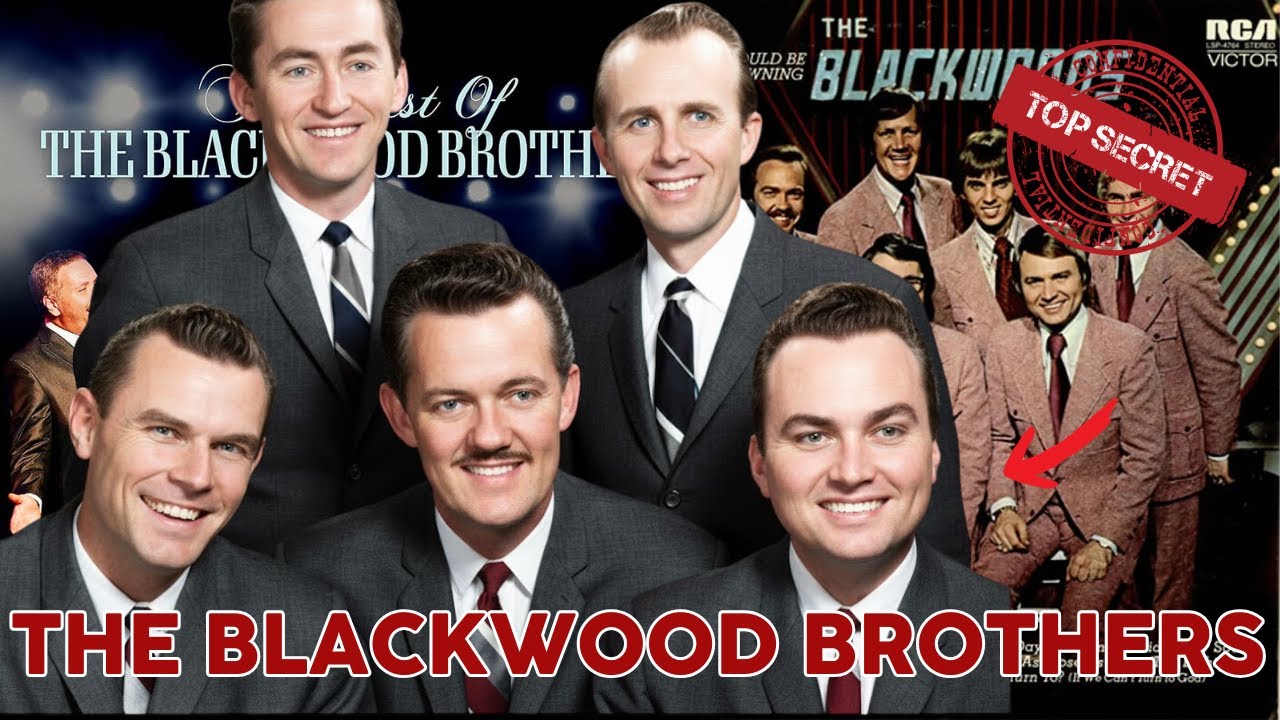
From the summit of fame to a twisted heap of metal, this is the story of a tragedy that shook the world. The Blackwood Brothers’ story did not begin with an airplane. It began with a plow, in the crushing poverty of Choctaw County, Mississippi, during the darkest days of the Great Depression. For the Blackwood family, life revolved around two things: cotton and the Lord.
They were sharecroppers, trapped in an economic slavery that kept families bound to land they did not own, working from dawn to dusk for a share of a crop that barely covered their debts. In that stifling environment, silence was not restful; it was suffocating. To survive, they filled the silence with singing. For Roy Doyle and James Blackwood, music was the only way they knew to keep their minds intact.
Their mother owned a Stamps-Baxter hymnal, the shape-note music book that was the standard text of musical knowledge across the South. This method made music accessible to everyone, designed to be learned quickly by illiterate congregations, turning music into geometry. But the Blackwood brothers did not just learn the notes; they ran with them. In 1934, the brothers, along with Roy’s son R.
W. , gathered around a flickering kerosene lamp and formally formed the Blackwood Brothers Quartet. They had no microphones, no matching suits, no bookings. All they had was a wild ambition to make their voices heard.
The early years were a study in humiliation and perseverance. They traveled in dilapidated cars, held together by prayer and wire, touring the divided, impoverished South to sing in brush arbors and small country churches. Often the payment was a love offering, a hat passed through the room that might yield a few dollars, or sometimes just a sack of potatoes. There were nights they slept in the car because they could not afford a hotel.
There were days they did not eat. But James Blackwood, the younger brother, had a passion bordering on obsession. He was the engine, certain with the certainty of a prophet that they were meant for something greater than cotton fields. Their first big breakthrough came not from a record deal but from a migration.
Reflecting the desperate migrations of that era, the Blackwoods left the South, heading north to Shenandoah, Iowa. It was a cultural shock, boys from Mississippi in the frozen cornfields of the Midwest. But it was a brilliant strategic move. They secured a spot on radio station KMA.
In 1940, radio was the hearth, the altar, and the stage of the American home. When the Blackwood Brothers began singing on KMA, their voices beamed into thousands of kitchens every morning, making them invisible guests at the breakfast table. Listeners did not just hear them; they felt they knew them personally. This familiarity created a fiercely loyal fan base.
By the early 1950s, the Blackwoods had returned South, basing themselves in Memphis, Tennessee. Memphis was the crucible of American music, where Delta blues and country music collided. The quartet lineup evolved into what historians now call the classic group: James Blackwood the lead vocalist, Bill Lyles on bass, Jackie Marshall on piano, and at the heart of it all, R. W.
Blackwood. R. W. , Roy’s son and James’s nephew, sang baritone, but calling him a baritone does not do him justice.
His voice was like poured honey, rich, warm, impossibly smooth. More than that, he was a star in a genre known for restraint and humility. He was captivatingly handsome, with thick dark hair and a smile that lit up the back rows of cathedrals. Among those he mesmerized was a shy truck driver with acne scars named Elvis Presley.
Elvis lived in the Lauderdale Courts housing project, just steps from Ellis Auditorium where the Blackwoods held their legendary all-night sings. He did not just attend these shows; he studied them, watching their movements, their sharp suits, how they moved the crowd. Elvis idolized R. W.
Blackwood. His first love, his true compass, was the sound of the Blackwood Brothers. By 1954, the Blackwoods were more than a group; they were a corporation. They were the first to treat gospel music not as a humble service but as a profitable, high-stakes business.
They sold records in massive numbers and commanded fees rivaling country stars. Then came the plane. Buying the airplane was the ultimate declaration of arrival. It was practical, allowing them to play Texas one night and Florida the next, but it was also symbolic.
It was their escape from the shackles of geography that had imprisoned them. But with this new machine came a new, hidden danger. They were musicians, not pilots, pioneers of a mode of travel that was still perilous. By the summer of 1954, their confidence approached a sense of invincibility.
The momentum was so strong, the ascent so vertical, they felt as though God himself was piloting the vehicle. In June 1954, they reached the pinnacle of their success. They traveled to New York City for the Arthur Godfrey show. Gospel quartets were viewed by the northern media establishment as regional curiosities, country bumpkins.
The Blackwoods stepped onto the New York stage in their sharp suits, opened their mouths, and shattered stereotypes. They sang “Did You Talk to the Man Upstairs? ” with such precision and undeniable charisma that they won the competition overwhelmingly. They returned South not just as gospel singers but as national stars.
They arrived in Clanton, Alabama, for the Peach Festival. It was June 30. The day was hot, the atmosphere carnival-like, filled with joy. The airport was a small rural strip surrounded by curious spectators who wanted to see the famous singers and their silver plane.
There were no warnings, no storm clouds. That day, Johnny Ogburn, a young local friend of the group, prepared to take the plane up for a quick check, a few laps around the airport to make sure everything was ready for the next stage of the tour. It was supposed to be a routine procedure. R.
W. Blackwood and Bill Lyles, the baritone and the bass, the heart and the foundation, decided to join him. It was a spontaneous decision. James Blackwood stayed on the ground.
He watched his nephew and close friend climb into the cockpit. He watched the door close. He watched the propellers spin up and the engines roar. He watched the plane roll down the runway, gain speed.
The plane rose. It banked. The view was spectacular. Then the sound changed.
The roar became a cough, then a hollow, sickening silence. The sound every pilot fears, the moan of an engine starving for fuel or air. On the ground, James Blackwood snapped his head up. The plane, moments before a symbol of their triumph, suddenly became a heavy burden, surrendering to the laws of physics.
It banked hard, turning back toward the runway. Whether from loss of power, a wrong angle, or bad luck, it failed to maintain altitude. Instead of gliding, it dove. Its nose pointed directly at the unforgiving concrete.
For the spectators, time seemed to distort, stretching that brief moment into an eternity. Then came the impact. The plane hit the ground with such force that it burst apart instantly. In 1954, aviation fuel was highly volatile, and a spark from torn metal ignited a fireball that erupted into the Alabama sky.
James Blackwood, Cecil Blackwood, and J. D. Sumner, who was traveling with the group but stayed on the ground, did not just watch. They ran, racing toward the wall of flame.
James ran toward the burning wreckage, screaming the names of his nephew and friend. Witnesses later described the heartbreaking scene of James Blackwood trying to throw himself into the fire, held back by men who grabbed him. Three men had to physically restrain him as he kicked and wept. But he could not fix this.
He was forced to witness the burning of R. W. Blackwood, the golden voice of a generation, and Bill Lyles, the group’s pillar. R.
W. Blackwood, Bill Lyles, and Johnny Ogburn all died in the crash. In less than sixty seconds, the Camelot of gospel music had become a pile of charred ash on a rural airstrip. The chaos that followed was a fog of sirens and screams.
But for James, silence enveloped the world. The bodies were gone, lost in the intensity of the heat. R. W.
was thirty-two years old. He left behind a wife and young children. Bill Lyles was beloved, a gentle giant. The news of the crash spread like wildfire.
By evening, the entire gospel music community was in collective paralysis. It was a day when music left the realm of the mundane, years before Buddy Holly’s plane went down in Iowa. The bodies were returned to Memphis, the city that had embraced them as kings. The funeral that followed was not just a service; it was a cultural event, a moment of public mourning rivaling that of heads of state.
Two closed coffins were placed on the stage where the Blackwoods had performed their triumphant all-night sings, now covered in black. Thousands of people lined the streets of Memphis. In the back of the auditorium sat a young man with greased hair and red eyes, trying to disappear. Elvis Presley was devastated.
Witnesses remember seeing him collapsed on a seat, shaking from weeping. R. W. Blackwood was his idol, the man whose voice he had tried to imitate in the bathroom, whose stage presence he had studied like a textbook.
Some historians believe the ghost of that crash haunted Elvis for the rest of his life, fueling his later fear of flying and obsession with spiritual reassurance. After the last hymn was sung, silence fell over the Blackwood household. James Blackwood retreated into his home, a broken man. He was the sole survivor of the original quartet’s core.
For weeks, the piano went untouched. He told his wife Myrl that he was finished. But the music industry machine did not care about grief. The phone kept ringing.
Promoters called, saying they had contracts, bookings in Texas, a recording deal with RCA. The pressure mounted. James was not just a grieving brother; he was the CEO of a company that supported many families. And beyond commerce, there was a calling.
The Southern gospel tradition is rooted in the belief that singing is a divine duty, not a career choice. Letters poured in from fans, thousands of them, begging him not to let the music die. Then Cecil Blackwood, R. W.
‘s younger brother, came to James. Cecil offered to take his place as baritone. James looked at Cecil and saw an echo of R. W.
in his eyes. He agreed. But they still needed a bass singer. James picked up the phone and called J.
D. Sumner. If the crash was the end of the classical era, hiring J. D.
Sumner was the beginning of the modern age. J. D. was known for an extraordinary ability to produce notes so low they registered as vibrations rather than sounds.
He held the Guinness World Record for the lowest note ever produced by a human voice. He was tall, imposing, with a dry, rhythmic wit. When J. D.
agreed to join, a new Blackwood Brothers was born. The first rehearsal was terrifying. They gathered around the piano. James, the grieving patriarch; Cecil, the terrified replacement; J.
D. , the newcomer; and Bill Shaw, the tenor, who had joined just before the crash. The sound was not the velvet blend of the R. W.
era. It was stronger, louder, more dynamic. They were no longer singing to dazzle audiences; they were singing to survive. Their first concert back was a harsh test.
The audience sat in deathly silence. J. D. Sumner hit his first low note, the floor of the auditorium shook, and the crowd gasped.
When James soared above it all with a high tenor note that sounded like a cry of victory, the tension broke, and the audience exploded. They were not cheering for a song; they were cheering for the return of life. But the crash changed their relationship with travel. The group developed a deep fear of small planes.
In a moment of vision, J. D. Sumner looked at the Greyhound buses crossing America’s highways. He told James, “We need one of these.
” The idea seemed absurd; bands did not own buses. But J. D. argued the bus could be a mobile hotel.
They could sleep in real beds while traveling. He stripped the interior with his own hands, built bunk beds, installed a small kitchen, wired an electrical generator. When the Blackwood Brothers showed up in town in their converted bus, industry workers stared in wonder. It was like a spaceship landing in a cornfield.
The Blackwood Brothers had just invented the tour bus, a direct psychological reaction to the Clanton crash. The bus was heavy, grounded, slow. It was the anti-plane. Inside that steel shell, James Blackwood could finally close his eyes and sleep, knowing he would not fall from the sky.
With the new lineup stable, the Blackwoods entered the second half of the 1950s as a force. They signed a major deal with RCA Victor, the same company that would later sign Elvis. By 1956, the Blackwood Brothers became a traveling entity of their own. The bus, a massive presence on American highways, was the physical embodiment of a new reality.
Inside, James Blackwood, the surviving patriarch, sat in the front seat, the commander’s seat. He was now known as “Mr. Gospel Music,” a title of great respect, but one that also created a glass wall between him and the rest of the world. In the back of the bus, J.
D. Sumner ran things, the creative engine, the relentless inventor. He pushed for better microphones, better acoustics, better lighting. He realized they were competing with rock and roll, and Jesus could not afford bad sound.
This tension between James’s rigid discipline and J. D. ‘s explosive creativity created the Blackwood sound of the late 1950s, a sound of absolute perfection. The relationship between the Blackwoods and Elvis Presley during this era is one of the most moving, often overlooked subplots in American music history.
By 1956, Elvis was the most famous man on earth. But behind the closed doors of Graceland, Elvis was not the King. He was still that child in the back row of Ellis Auditorium looking up in admiration. Elvis craved the Blackwoods’ approval.
He constantly invited them to Graceland. Imagine the scene in the early hours of the morning. Elvis sits at the piano, surrounded by the Blackwoods. They sing “How Great Thou Art.
” For Elvis, this was the only place he felt safe. The Blackwoods were his link to a logical world. In August 1958, Gladys Presley died. Elvis was hysterical with grief.
He did not want celebrity mourners at his mother’s funeral; he wanted the Blackwood Brothers. James Blackwood, who had buried his brother and close friend just four years earlier, knew exactly what Elvis was feeling. He sang not as a performer, but as a fellow traveler in the valley of death. That day cemented the Blackwoods’ position not just as singers, but as masters of Southern culture.
As the 1960s dawned, the Blackwoods were at the height of their power. They were winning Grammy Awards, the first gospel group to do so consistently. But the world outside the bus windows was cracking. The Beatles and the Rolling Stones brought a new, electric, rebellious sound.
For the youth of 1965, the Blackwoods, with their sharp suits and polished smiles, seemed like relics of the past. For their core audience, the silent majority of white Christian America, this made them heroes. But the relentless demand meant a brutal schedule, 250 to 300 shows a year. They essentially lived on the bus.
James never relented. His drive was the memory of the poverty of Choctaw County. In 1965, the inevitable happened. J.
D. Sumner announced he was leaving. He bought the Stamps Quartet, determined to reshape it according to his own vision. He was a blow.
James turned to London Parris, a bass with a resonant voice. The group continued to win Grammys and fill auditoriums. But a subtle shift had occurred. They were no longer young rebels; they were the establishment.
The 1970s arrived not with a bang but with a jolt. Christian music was splitting. The Jesus Movement, born from California’s counterculture, featured long-haired youth with acoustic guitars singing about Jesus, but not with shape notes. For James Blackwood, they lacked the dignity and order he had spent thirty years building.
The Blackwoods remained kings of a shrinking kingdom. On August 16, 1977, the phone rang at the Blackwood office in Memphis. It was a call James had perhaps feared for years. Elvis Presley was dead.
The request came quickly. The family wanted the Blackwoods to sing at the funeral. Nineteen years earlier, James had stood over Gladys Presley’s coffin to console a young Elvis. Now he stood over Elvis’s coffin to console a grieving world.
They sang “How Great Thou Art, Elvis’s favorite hymn. It was a final lullaby to a lost member of the tribe. The years after Elvis’s death were a strange twilight for the group. In 1981, James Blackwood formally stepped down, handing leadership to his son, Jimmy.
With The Masters V, a supergroup of gospel legends, James found redemption, winning a Grammy for their first album. James Blackwood died on February 3, 2002. When he drew his last breath, the golden age of gospel music officially ended. He was the last of the giants.
His funeral was a gathering of kings. The Blackwood Brothers name did not die with James. The group continues today under the leadership of Billy Blackwood. They are a heritage group performing for audiences who appreciate the legacy.
In their concerts, they often pause to tell the story of the plane crash, to speak of R. W. and Bill Lyles, and then they sing. It is an act of remembrance, a way of keeping the dead alive through harmony.
In those moments, the line between 1954 and the present dissolves. The story of the Blackwood Brothers matters because it is the greatest American example of resilience through art. They endured an unbearable trauma, the violent public death of their family and future, and they did not respond with silence but with strength. They took the pain of trauma and turned it into a sound deeper, richer, and more powerful than anything that had come before.
They teach us that grief is not the end but fuel. The Blackwood sound was not just a musical style; it was the sound of men resisting the darkness, a sonic affirmation that death does not have the last word. They were pioneers of modern fame, inventors of the traveling musician’s infrastructure. They showed the world that you could rise from the dirt and force the world to listen.
And in a world that is polarized and divided, the concept of a quartet is revolutionary. A quartet only works if you listen to the person next to you. The Blackwood Brothers always found harmony, standing close together, four men around a single microphone, creating a unity greater than the sum of its parts. If you drive through Clanton, Alabama, today, the old airport still stands.
It is quiet now. But if you listen carefully to the wind, you might hear it. You might hear a low bass note, steady as a heartbeat. You might hear a high tenor rising toward the clouds.
You might hear the sound of the Blackwood Brothers still singing, proving that while planes may crash and men may die, the song never ends.