In the winter of 1864, Robert E. Lee wrote a letter from Virginia, choosing his words with deliberate care. Lee was a man of the old army, a West Point graduate who had served the United States for more than three decades before the country split apart, and he rarely let the formal composure of a commander slip. But in this letter, according to those who have studied it, he did something unusual.
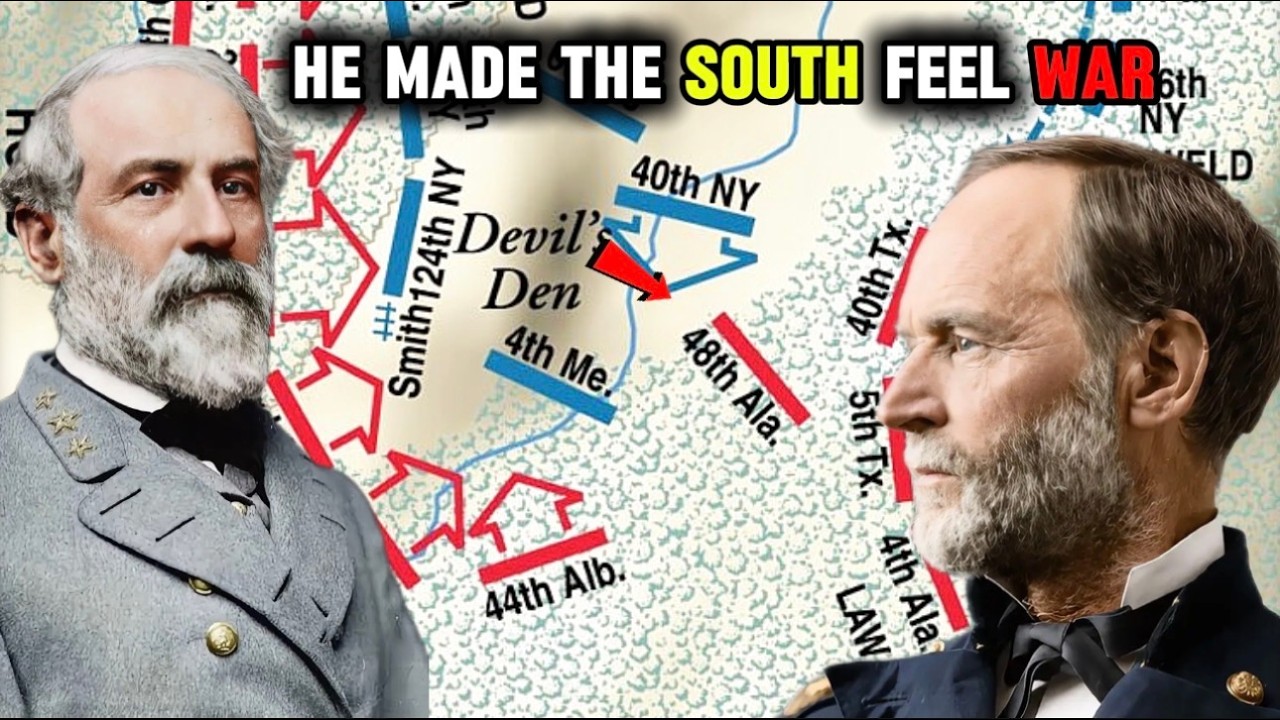
He dropped the distance of official language and wrote with direct concern about a Union general who was not yet famous: a red-haired, hollow-eyed Ohioan whose name was William Tecumseh Sherman. The warning Lee left in that letter was not about Sherman’s tactics on the battlefield. It was about the philosophy Sherman was bringing to war itself. Sherman’s origins gave no obvious hint of what he would become.
He was born in 1820 in Lancaster, Ohio, the sixth of eleven children. His father died when Sherman was nine, and the family was scattered. A powerful neighbor, Ohio senator Thomas Ewing, took the boy in, and it was Ewing who secured Sherman’s appointment to West Point. There he absorbed the theories of war that would later guide him: Jomini’s writings on concentration and maneuver, the Napoleonic principles of rapid movement, and the older, grimmer understanding that wars end when a population loses the will to keep feeding them.
He graduated sixth in his class in 1840 and served in the artillery, including duty in Florida during the Second Seminole War. He was posted to southern garrisons and spent time in Charleston and Georgia. He liked the South, and he understood its pride and its contradictions in a way that would later make him more dangerous to it than any general who treated it as foreign soil. He left the army in 1853, tried banking in San Francisco and failed, tried law in Kansas and failed, then took a position in Louisiana as superintendent of a school that would become Louisiana State University.
He was genuinely admired there. When the war came, everything before it began to feel like preparation for something he had not yet been told about. His first major engagement was Bull Run in July 1861, and it was a disaster for the Union. Confederate forces broke the federal lines and sent soldiers fleeing toward Washington in a chaos that shocked the northern public, which had expected the rebellion to collapse in weeks.
Sherman handled his brigade competently, but he was shaken. He wrote to his wife that the war would be long, far longer than Washington was willing to admit, and that the politicians directing it had no real grasp of what they were facing. He was right, and it cost him. Given command of the Department of the Cumberland in Kentucky, he began to unravel under the weight of the posting, the shortage of resources, and his conviction that the Union was losing.
Newspapers began calling him insane. He was relieved of command and went home to his wife, Ellen, and for a time he disappeared from the war entirely. Ulysses Grant brought him back. Grant had met Sherman early in the war and recognized something the newspaper editors missed: that the anxiety Sherman suffered was not weakness, but the natural response of a man who understood the situation more clearly than those around him.
Grant asked for him, and at Shiloh in April 1862, Sherman became Sherman. Confederate forces under Albert Sidney Johnston launched a surprise attack at dawn on April 6 and nearly drove Grant’s army into the Tennessee River. The fighting was close, brutal, and unglamorous. Sherman was everywhere that day.
Two horses were shot from under him; he was wounded in the hand; he refused to leave the field. By the time the Union counterattack drove the Confederates off on the second day, Sherman had proven the defining quality of his career. He bent under pressure, sometimes dramatically, but he did not break. Grant promoted him, and their partnership became the spine of the Union war effort in the West.
Together they took Vicksburg in July 1863, splitting the Confederacy along the Mississippi and cutting off the trans-Mississippi states. After Vicksburg, Sherman began to speak openly about what Lee was already picking up across the lines. He argued in letters and dispatches that the Confederate civilian population was as much a part of the war as its armies: the planters, merchants, politicians, and ordinary white families who sustained the rebellion were not innocent bystanders. The war could not be won by defeating Confederate armies alone, because the South had too much land and too much determination to raise new forces indefinitely.
The only way to end it was to make the population feel the war in a way it had not yet felt it. He called this hard war. Lee had been watching the Western Theater closely. In private correspondence and in his communications with President Jefferson Davis, he flagged Sherman’s approach as qualitatively different from the Union strategy they had faced before.
Lee was not warning about Sherman’s tactics. He was warning about Sherman’s method of war. In the fall of 1864, that method was demonstrated on a scale no one had fully anticipated. Atlanta fell to Sherman on September 2.
The city was the industrial and railroad heart of the Deep South, and its capture arrived at the lowest point of northern morale, when Lincoln himself believed he would lose the November election to George McClellan on a peace platform that would effectively end the war without reunification. Sherman’s capture of Atlanta saved Lincoln’s presidency and changed the trajectory of the conflict. But what he did next is what history still argues about. He ordered the evacuation of the civilian population of Atlanta, every man, woman, and child.
When the mayor and two Confederate generals protested on humanitarian grounds, Sherman answered with one of the most remarkable documents of the war. He told them they were correct: it would cause suffering, and the Confederate leadership bore that responsibility because they had started the war. War was cruelty, he wrote, and it could not be refined. The sooner the South understood this, the sooner the war would end and peace could begin.
Then he burned Atlanta’s military and industrial infrastructure and turned his army south. What followed has been called Sherman’s march, the march to the sea, the burning. Sixty thousand Union soldiers moved through Georgia in a column sixty miles wide. They destroyed railroads by heating the rails and bending them around trees, producing what soldiers called Sherman’s neckties.
They burned cotton gins, warehouses, granaries, and mills, and consumed the livestock and food stores of every plantation and farm in their path. They did not systematically burn civilian homes as official policy, though individual soldiers did, and Sherman’s control over his army was imperfect. What they systematically destroyed was the economic infrastructure that sustained the Confederate war effort: the plantations that fed the armies, the railroads that moved supplies, the mills that processed the cotton that financed the rebellion. Confederate forces in Georgia, under General John Bell Hood, had marched off toward Tennessee, leaving Sherman’s path essentially uncontested.
From Virginia, Lee watched with a clarity that his dispatches to Davis carry even across a century and a half. He told Davis that if Sherman reached the Atlantic and pivoted north, the Army of Northern Virginia would be caught between two Union forces and its position would become untenable. He was describing the end of the war. He also warned of something beyond the military situation.
The reports from Georgia of plantations stripped bare, of enslaved people walking away by the thousands to follow the Union columns, of families writing to their sons in the Confederate army telling them to come home because there was nothing left, were doing what no battlefield defeat had managed. They were making the war feel lost. Sherman reached Savannah on December 21, 1864, and sent Lincoln a telegram offering the city as a Christmas present. Then he turned north.
The march through South Carolina was worse than Georgia by most accounts. South Carolina was where secession had begun, and Sherman’s soldiers carried a particular fury into it. Columbia, the state capital, burned on the night of February 17, 1865. The question of who started the fire has been argued ever since.
Sherman denied ordering it, though the weight of the historical record suggests Union soldiers started most of the fires. What is not disputed is that much of the city burned and that Sherman did not try very hard to stop it. He moved through the Carolinas with the same relentless rhythm: cut railroads, destroy supplies, move forward. By March 1865, the Confederate position had become exactly what Lee had warned it would become.
Grant pressed from the north; Sherman pressed from the south. Lee’s army was exhausted, undersupplied, outnumbered, and shrinking daily as soldiers deserted to go home to families who had told them the Yankees had already been there and there was nothing left to defend. Lee surrendered to Grant at Appomattox on April 9, 1865. The arguments began almost immediately and have not stopped.
In the South, Sherman became a villain of nearly mythological proportion. Families passed down stories of destruction and loss for generations, shaping how the war was remembered below the Mason-Dixon Line: not primarily as a fight over slavery, but as an invasion and a brutal imposition of northern will on southern civilization. That narrative served certain purposes, some of them ugly, and it was not an accurate account of the war’s causes, but it was a genuine account of the suffering the march caused. In the North, Sherman was a hero.
The march did shorten the war, and the destruction of Confederate infrastructure did contribute to Lee’s decision to surrender. The question that neither side has fully answered is whether the goal alone justifies the method. Because Sherman’s march did not remain in the nineteenth century. Historians have traced a direct line from his concept of hard war to the strategic bombing campaigns of the Second World War, to the firebombing of Dresden and Tokyo, to the doctrine of total war that defined the twentieth century’s most catastrophic conflicts.
Sherman himself argued in his memoirs that making war terrible was the most humane approach because a terrible war ends quickly; a gentle war drags on and kills more people in the aggregate. That argument has been repeated by military planners in every major conflict since. Lee was a man of the nineteenth century. He believed in the old rules of war and practiced them, avoiding the systematic destruction of civilian infrastructure even during his invasions of Maryland and Pennsylvania.
He believed, or wanted to believe, that the other side would observe similar constraints. Sherman disabused him of that belief, and in doing so, he did not simply win a campaign. He changed the nature of war itself. Sherman died in New York City on February 14, 1891, at the age of seventy-one.
At his funeral, former Confederate general Joseph Johnston, who had faced Sherman in Georgia and the Carolinas and surrendered to him in April 1865, insisted on standing as a pallbearer despite the cold. Friends urged him to put on his hat. Johnston refused, saying it would be disrespectful. He stood bareheaded in the February cold as Sherman’s coffin passed, developed pneumonia shortly afterward, and died within the month.
The story is often told as a touching example of reconciliation. There is another way to read it. Johnston stood in the cold because he understood, as Lee had understood, what he was dealing with: not simply a general who had beaten him, but a man who had changed the nature of the fight itself. Lee died in 1870, more than twenty years before Sherman.
But the warning he left in his letters and dispatches, that Sherman represented something the old categories of soldier and commander did not quite cover, has echoed through every conflict since in which the line between combatant and civilian has been deliberately erased in the name of ending a war quickly. He was right, and understanding that did not save him, and it did not save the South, and it did not prevent the precedent from being set. It only meant that someone, at least, had seen clearly what was coming and understood its consequences before they arrived.