The Cushing sisters were marked for greatness long before they entered the world of royalty, dynasties, and high society. Their mother, Gogsie, groomed them for power, shaped their ambitions, arranged their marriages, and made certain they would be not merely admired but revered. After her death, each sister had to find her own way in a world where the rules of that upbringing no longer applied. By the late 1940s, they had reached the summit of American prominence: Minnie bound in a loveless marriage to Vincent Astor, Betsy and Jock Whitney moving toward the heights of American politics, and Babe newly married to CBS magnate Bill Paley.
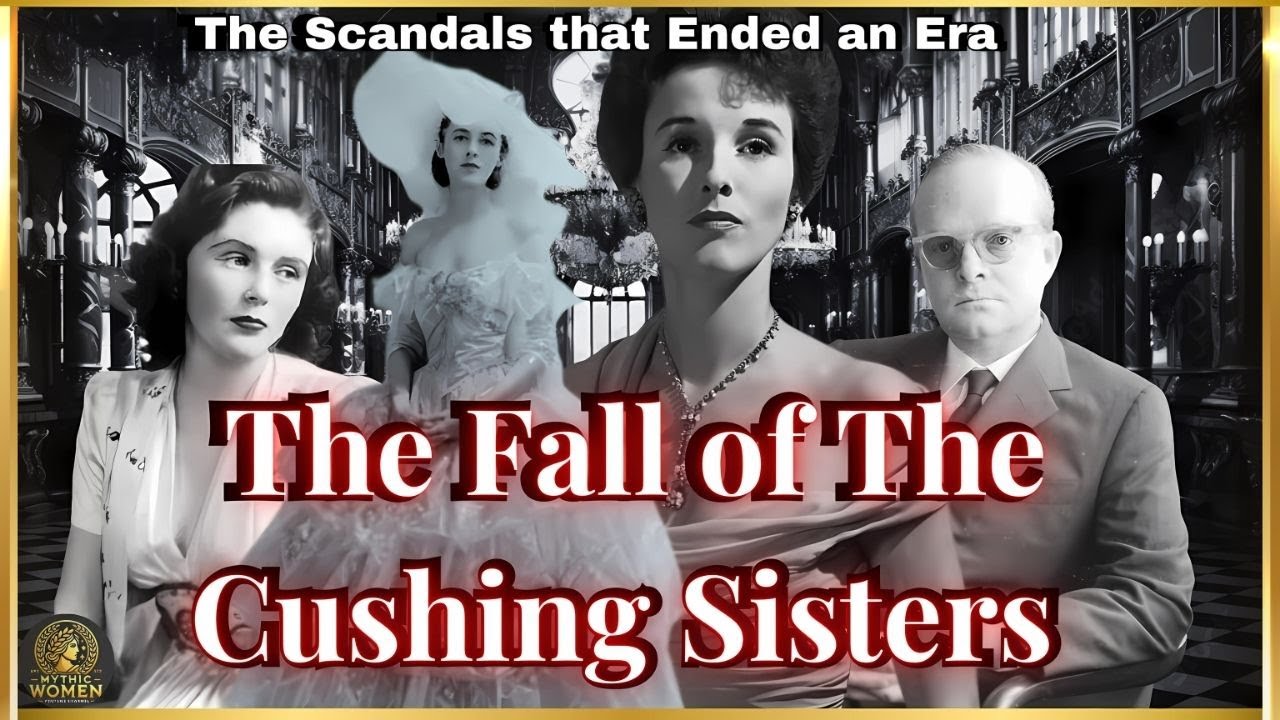
But the second chapter of their story began with everything coming apart: a public betrayal that shattered lifelong friendships, a carefully crafted image collapsing under scandal, and the tragic decline of a woman who had once been the queen of American elegance. For Minnie Astor, the absence of her mother marked the start of a personal reckoning. Trapped in a marriage she had entered to satisfy her mother’s expectations, she now sought freedom. The turning point came at a dinner party where Vincent’s attention fixed on Brooke Marshall, a recent widow long admired in New York society.
Vincent did not waste time. At the Astor estate, Ferncliff, he made his intentions clear: Minnie wanted a divorce, and he would agree, provided Brooke would marry him. By September 1953, the divorce was complete. Although Vincent’s fortune exceeded $200 million, Minnie’s settlement was modest, barely over two million dollars.
For her, the divorce was never about money; it was about liberation. Within a month, she married James Whitney Fosburgh, a Manhattan painter and World War II glider pilot with deep ties to New York’s art world. Vincent quickly married Brooke, prompting one observer to remark that the whole affair had been a petty, cowardly play acted out in the drawing rooms of the elite. Babe and Bill Paley began their marriage in grand style, spending a three-and-a-half-week European honeymoon before returning to New York aboard the Queen Elizabeth.
Their main residence was Kiluna Farm, Bill’s sprawling 80-acre estate on Long Island’s Gold Coast, transformed into a private paradise with manicured gardens, guest cottages, stables, a pool, and a glass-enclosed tennis court. In Manhattan, they kept an apartment in the St. Regis Hotel, which Babe covered in gathered Indian cotton and adorned with her own embroidered rugs. Famous decorators came and went, but Babe’s vision shaped the home.
The gardens became her greatest refuge as Bill’s moods and demands grew increasingly difficult. Her reputation as the high priestess of American elegance reached new heights; when she casually tied a scarf to her handbag one warm afternoon, the look swept the country. She kept yellow notebooks filled with meticulous details, and even at glamorous social events, she carried an elegantly gold-framed notebook. Bill’s need for control extended into every aspect of their lives, yet his emotional detachment left Babe isolated.
Their children, William and Kate, were housed in a separate cottage with a nurse and cook rather than in the main house. Babe, always composed, played the perfect wife, but the pressure never relented. She turned to psychotherapy and mild sedatives, a radical step for a woman of her era, while building a cultural identity beyond her marriage. Betsy Whitney sought refuge in privacy at Greentree, the Whitney estate where masterpieces of Impressionism hung on the walls.
Her life was shadowed by the devastation of two miscarriages that left her unable to give the Whitneys an heir, but her two daughters from her first marriage found in Jock a devoted father who formally adopted them in March 1949. Betsy reshaped their social circle with a delicate but firm hand, described by those close to her as the most intelligent of the Cushing sisters, exercising influence with an iron fist in a velvet glove. Jock shifted from the excesses of his youth to serious pursuits in business and politics, becoming a supporter of Dwight Eisenhower. When Minnie declared her intention to divorce Vincent Astor, Betsy and Babe pleaded with her to endure the marriage, pointing to Vincent’s failing health and the fortune she would inherit as his widow.
Minnie refused to sacrifice her happiness for wealth, and by 1953 her sisters conceded defeat. Worse, in their eyes, she then married James Fosburgh, a painter of modest talent who was openly gay, thereby diminishing the family’s prestige. Betsy never forgave Brooke Astor, once leaning in at a luncheon honoring her civic achievements and asking with a mocking smile, “Brooke Shields? ” The laughter was as deliberate as it was insulting.
For Minnie, Fosburgh offered companionship without emotional or physical complications. In return, she became his patron and social face, while his artistic connections gave her access to the finest intellectual circles in New York. Leonard Bernstein, Tennessee Williams, Cole Porter, and Princess Margaret passed through her salon; an invitation to her home became the ultimate privilege. Yet time was not kind.
She grew frail, her once-bright blond hair fading, and friends compared her to actress Zasu Pitts, charming but withered, always needing reassurance. Rumors spread about her drinking, and a silent despair replaced her natural sparkle. By the 1960s, the social center of gravity had shifted to Babe. The Paleys sat on the throne of Manhattan glamour, their presence elevating any occasion.
In January 1958, Babe reached the peak of her quest for perfection, entering the Fashion Hall of Fame alongside the Duchess of Windsor, Gloria Guinness, and C. Z. Guest. Tex McCrary observed that Babe was the only woman all wives allowed their husbands to admire.
She found real pleasure in elegance as an expression of herself, more radiant than ever. But even the most polished surfaces can crack. While on holiday, the Paleys noticed that their young daughter Kate was losing her hair. By summer’s end, it was all gone: her lashes, her brows, every strand.
The diagnosis was alopecia universalis, a rare autoimmune condition. In a family where perfection was paramount, the illness seemed a betrayal of the implicit pact on which Babe had built her life. No doctor could restore Kate’s hair. Babe, desperate to protect her daughter from scrutiny, had the child fitted with a wig, a turban after swimming, a carefully tilted hat, all to conceal her condition.
The emotional cost was immense, a crack in the perfect facade of the Paley family. The Paley children each carried heavy burdens. William, sensitive and introverted, was forced by Bill to abandon his natural left-handedness, sent to boarding schools, and descended into rebellion and drug use. He later said his parents thought he was crazy, that he was sent to a psychiatrist at ten, expelled from schools, and using drugs by sixteen.
Kate turned to religion and solitude. Babe’s focus remained on pleasing Bill, scouring the city for rare delicacies to satisfy his changing appetites, organizing her life around his desires, moods, and ambitions, only to be met with polite indifference. She had married for love, or what she thought was love; he had married for influence and status. His boredom became increasingly hard to hide.
Babe began to realize her marriage was a gilded cage. There was an unwritten rule in the Cushing family: never show weakness, never complain, never confide in strangers. Yet one day, Babe broke it. The stranger was Truman Capote.
Their meeting at the Paleys’ Jamaican estate, Round Hill, seemed inevitable. Bill had agreed to bring along a guest, expecting former president Harry Truman, but instead opened the door to a small, dandified writer with a sharp tongue. Bill was unimpressed; Babe was charmed. Before the plane even took off, they were deep in conversation, forming a bond of effortless intimacy.
Babe saw the wounds behind his wit, and Capote saw in her the embodiment of elegance, a living novel he had long yearned to write. He introduced her to Proust and Flaubert; she taught him about antiques, art, and aristocracy. He joined the Paleys on yachts and European travels, listening and watching, capturing every whisper, every betrayal, every wistful smile hidden behind a cocktail glass. Babe enjoyed his admiration, delighted that someone could see behind the mask she had crafted so carefully.
But Capote was never content merely to observe. He was fascinated by Babe, yet obsessed with them all. The swans, as he called them, were his living characters of incredible elegance: Gloria Guinness, C. Z.
Guest, Slim Keith, Marella Agnelli, Pamela Churchill. Each was magnificent, but no one matched Babe in perfection. He said she had only one flaw: she was perfect. Apart from that, she was perfect.
Babe, for all her intelligence, missed the warning signs. She saw a kindred spirit, not a novelist mining her life for material. He granted her access to his world; she granted him loyalty. But the reckoning was coming.
While the Paleys and Capote reveled in their dazzling world, Betsy and Jock moved in a circle of quiet distinction. Jock, once a loyal Democrat, shifted toward the pragmatic conservatism of Eastern Republicans, becoming one of Eisenhower’s most valued allies and helping secure his victory. After Eisenhower’s reelection in 1956, Jock was informed of the president’s intention to appoint him ambassador to the United Kingdom. For Betsy, a lifelong Anglophile, it was a dream come true.
They settled in London in early 1957 amid the tensions of the Suez crisis. Jock’s innate diplomacy and charm earned praise from Prime Minister Harold Macmillan, who considered him the best American ambassador in years. His passion for horse racing created unexpected bridges to the royal family, and Betsy flourished, befriending the British aristocracy and filling Winfield House, the ambassador’s grand Georgian residence, with treasures from Greentree, including Impressionist masterpieces. Their Thanksgiving dinners brought together Vice President Richard Nixon and Queen Elizabeth, while intimate lunches hosted figures like Lord and Lady Mountbatten.
Yet old ghosts resurfaced. Pamela Digby Churchill, a woman whose talent for social maneuvering rivaled her beauty, had long been rumored to have had an affair with Jock during the war. Betsy, with hidden reluctance, invited Pamela to Greentree, enlisting Babe as hostess to keep the weekend formal. Pamela arrived with her own maid, silk sheets, and a vanity table laden with perfumes and creams.
To provide her an escort for an evening at the theater, Babe arranged for Leland Hayward, a prominent Hollywood producer and husband of her close friend Slim Keith, to accompany her. What began as a passing acquaintance became a stormy affair; within months, Hayward had left Slim and married Pamela. For Babe and Betsy, it was a mortifying lesson in the dangers of hospitality. What had been intended as a social duty became the spark of a scandal.
By October 1959, the Whitneys returned briefly to New York for the wedding of their younger daughter Kate to William Haddad, a man of modest background, though Betsy, with her usual composure, hid any disappointment. Their final months in London were filled with farewells and diplomatic successes. The queen held a farewell luncheon at Buckingham Palace, and Macmillan hosted a private dinner in their honor. As they boarded the ship home, Betsy turned to Jock with a quiet smile and said, “Thank you for giving me the best four years of my life.
”
For more than two decades, Capote moved with the Paleys as a trio, always on their dime, his sharp wit and scandalous storytelling making him irresistible. The swans trusted him with their most private secrets, each believing she alone possessed his loyalty. Babe especially confided in him, speaking of Bill’s growing indifference and a marriage whose emotions had long faded. She revealed her fears of aging and creeping isolation, laying bare weaknesses she hid from everyone else.
In return, he betrayed her, repeating her deepest confessions within the very circle that adored her. No one dared warn her. In January 1966, In Cold Blood reached bookstores, cementing Capote’s status as one of America’s most famous writers. In 1966, he began planning what he called the party of the century.
On November 28, 1966, 540 of the most desired names in society gathered at the Plaza Hotel for his black-and-white masquerade ball, a triumph elevating him, in his own mind, to the ranks of the great arbiters of taste. For days, weeks, and months afterward, New York society talked of nothing else. He became the darling of talk shows, his face on magazine covers, his presence in constant demand. Encouraged by fame and fueled by alcohol and amphetamines, his charm turned harsher, his sharp tongue wounding those closest to him.
Worst of all, he began to believe his own legend. By the early 1970s, Babe remained a symbol of timeless beauty at fifty-five, while Bill, at seventy, still wielded immense influence as a media titan, leaving little time for his marriage. Babe succumbed to her role, finding solace in perfecting every detail of her appearance, her home, her status. Behind closed doors, she often described herself as an expensive ornament.
The pressure of maintaining her image grew heavier with age. Her children drifted away: William into the counterculture, Kate into a bohemian Greenwich Village life, while Amanda rose as a star in the young social elite, claiming the top spot on the best-dressed list in 1966, an honor her mother once held. Only her son Tony shared genuine closeness with her. To Truman, she confessed her frustrations, her loneliness, and the emptiness of her beautiful life.
One evening, she told him she was thinking of divorce. He dismissed the idea completely: she had no money, four children, and Bill had bought her; it was the best role in the world. It was the same lesson her mother had taught her: marriage was a transaction. In Paris, the Paleys made their usual visits to Pamela Churchill.
Bill, like Jock, found her utterly captivating. Babe saw her as a rival, quiet but persistent. She increased her smoking to more than two packs a day, a silent rebellion against the constraints of her public image. Yet she remained an impeccable hostess, shopping year-round for Christmas gifts, remembering birthdays and anniversaries with precision, sending handwritten notes perfectly timed.
Her perfectionism, once a survival tool, became a legacy of care, a refusal to let her personal unhappiness taint the lives of those she loved. Betsy found her greatest happiness in quiet family stability. Hers was the only true love marriage among the sisters, a partnership her friends described as devoted without being fawning. By the end of the 1960s, Greentree echoed with the laughter of eight grandchildren.
She remained deeply engaged in the John H. Whitney Foundation and devoted herself to a few selected charities, including the Museum of Modern Art, Yale, and New York Hospital, with her greatest commitment to North Shore Hospital. When Jock fell seriously ill in the early 1960s, she enforced his doctors’ strict dietary regimen with loving precision. Minnie continued to find purpose in the arts, serving as a trustee of the Metropolitan Museum and patron of struggling young artists, her salon a legendary international crossroads.
James painted less and less, his health and spirits declining. Their marriage had always been unconventional; his homosexuality was no secret, and whispers about Minnie’s own inclinations had circulated for years. By the 1970s, both were too frail to host gatherings, their circle shrinking to family and a few loyal friends. In April 1973, Babe found herself confined to a hospital in Shanghai, burning with fever at 104 degrees, caught in Bill’s relentless travel schedule.
Doctors diagnosed pneumonia. After two weeks, she returned home, where a team of physicians issued a stern directive: she must stop smoking immediately. For once, she obeyed. But the damage was done.
In January, doctors found a small tumor in her right lung, and a third of it was removed. There was initial optimism, but a year later, surgeons removed the rest of her right lung. Even then, she continued receiving guests and attending events, maintaining her image of effortless perfection. After the second surgery, the bright image began to fade.
Bill, desperate, searched the world for a cure, consulting specialists, seeking miracle treatments, refusing to accept a reality his wealth and will could not control. Then, in November 1975, without warning, Esquire published an excerpt from his long-awaited novel, Answered Prayers. The chapter, “La Côte Basque,” was a devastating indictment of the very elite that had embraced him. The swans found themselves transformed into characters, their most private secrets exposed.
At the heart of the story was Lady Ina Coolbirth, a thinly disguised version of Slim Keith, and among the most controversial tales was that of Sidney Dillon, a fictionalized Bill Paley, and his wife Cleo, a stand-in for Babe. The story depicted Dillon’s obsessive pursuit of a governor’s wife, ending in a humiliating, bloodstained episode. For Babe, who had spent her life crafting an image of perfection, the public revelation of her husband’s infidelity, and worse, the implication of her own coldness, was an unforgivable betrayal. She called Slim Keith, who told her to forget it, that it was just fiction.
Babe did not forget. She called every member of her family and issued an irrevocable decree: Truman Capote was no longer welcome. He tried to reach her, but she would not take his calls. When he finally reached Bill, the response was cold.
Bill said he had started reading but had fallen asleep. When he woke up, they had thrown it away. When Truman pressed for a response, Bill was blunt: his wife was sick, and he had no time for this. Babe never spoke to Truman again.
He later lamented that she had been his dearest friend, that he had truly loved her, and that the saddest thing was being unable to visit her while she was ill. He wrote her two long letters, but they went unanswered. According to one of her closest friends, she always spoke of him as the snake that betrayed her. Beneath her anger was grief: she had lost her closest friend.
By the late 1970s, Babe’s cancer seemed to stabilize after experimental interferon treatments. In the summer of 1977, she felt well enough to sail the Mediterranean with Bill on a Guinness family yacht. It was the last perfect moment of her life. Upon her return to New York, she declined rapidly.
For the first time, Bill Paley seemed genuinely shaken. The cancer and harsh treatments caused her hair to fall out, and she began wearing wigs or wrapping her head in scarves. In her final months, she and her daughter Amanda grew close. Babe had long seen Amanda as a threat to her carefully tended throne, but now she apologized.
Her daughter Kate refused to come, unable to forgive a childhood of feeling unwanted and neglected. Her eldest son Tony visited every morning and evening, giving her as much comfort as he could. As her illness worsened, something changed within her. For three decades, she had borne Bill’s whims with silent grace, perfecting herself as the ideal wife.
Now she was dying, and with that realization came liberation. She no longer had to perform, to smile, to pretend she did not resent him. For the first time in their 30-year marriage, she dropped the mask, criticizing him openly before friends and colleagues. Calling CBS, she asked what that miserable old man was doing that day.
At a dinner in New York, she asked the head of CBS how he could stand him. The perfect wife had vanished, and Bill Paley was not prepared for it. Yet he continued his frantic search for a cure, and even as Babe’s health deteriorated, he found solace elsewhere, with a society woman named Jan Cushing. By late winter and spring of 1978, Babe had disappeared from public life entirely.
Her visits were limited to Minnie and Jim, who were also dying. The two dazzling sisters were fading one after another, both stricken by cancer. Jim Fosburgh, a former 101st Airborne glider pilot who had crossed the Rhine and helped liberate Norway, faced his own end; his cancer resisted surgery, and he drank heavily and took sedatives. On April 23, 1978, at the age of 67, Jim Fosburgh succumbed to his illness, leaving behind paintings, an $800,000 estate, and a widow with little time left to grieve.
Minnie bore it all with silent dignity, too frail to receive guests, too weak to return to the world that had once adored her. Babe could offer only moral support, a daily phone call, an occasional visit when she found the strength to leave her Fifth Avenue apartment. Betsy balanced the demands of Greentree and the quiet burden of watching her sisters wither. By Easter 1978, Babe had taken to her bed.
Only family and close friends were allowed into her sanctuary, a bedroom designed by Sister Parish and Albert Hadley that was as perfect as she had always been. Even with her body failing, she remained an icon of beauty, her makeup meticulously applied, wearing pristine silk nightgowns, dying with as much elegance as she had lived. She left her bedroom only once, in June, for her final journey to Kiluna, the rural sanctuary she had first arrived at 31 years earlier, full of youthful hope. On a golf cart, accompanied by Bill, Tony, and Amanda, she toured the gardens she had designed and the paths she had tended.
During that final weekend, Betsy came to visit. But according to Amanda, the visit was not an offering of sisterly comfort. Betsy spent the whole time complaining about her servants. Babe, hovering between life and death, said nothing.
They had spoken nearly every day for decades, yet now, in this final moment, Amanda saw what had always been hidden beneath the surface. She believed Betsy had been jealous of Babe all along. Even in death, the distance remained. Back in Manhattan for the last time, Babe remained in bed, sleeping often under the influence of morphine, refusing to be bound by tubes or machines.
When awake, she listened to old radio programs, Paul Newman films, and Sherlock Holmes puzzles. Eventually, she gave up even television. There were no guests, no parties, no grand entrances. The hostess of the century had closed the curtain on her own stage.
The family gathered almost every night, but Tony and his wife were the closest, caring for her with silent devotion. The other children, distant emotionally and physically, were mostly absent. Life leaked from Babe slowly, then suddenly and completely. On July 5, 1978, she turned sixty-three.
It was her last birthday. There was no champagne, no flowers, no carefully curated guest list, just a quiet family vigil lasting until dawn. With the dawn, she was gone. She died as she had lived, elegant to the end, wearing an imported lace jacket, her bald head covered with a silk scarf, her makeup carefully applied.
Babe Paley made her final bow. Her daughter Kate, estranged, arrived in time to witness her mother’s final hour, their first meeting in years, the distance between them greater than ever. Condolences poured in from around the world, but perhaps the words that would have pleased her most came from Enid Nemy of The New York Times, describing her as the supreme symbol of taste and perfection, an icon. Babe Paley left the world as she had lived in it: gracefully, beautifully, and entirely on her own terms.
With a sense of unease, Bill plunged into constant motion: dinners, parties, endless engagements, as if movement alone could ward off the loneliness creeping toward him. He turned to Francine du Plessix, who quickly took over hosting duties at 820 Fifth Avenue, and the guest list evolved under her reign to include a broader crowd. Even Slim Keith became a frequent visitor, serving as a substitute hostess. Yet Bill was not himself.
He began drinking, first a cocktail before dinner, then one vodka after another, losing control entirely. On October 26, 1990, less than a month after his eighty-ninth birthday, Bill Paley died of kidney failure. He was buried beside Babe, who had been waiting for him for twelve years. Minnie Cushing Astor Fosburgh faded into quiet seclusion.
Like her late husband, her cancer was inoperable, but she sought no fanfare. Her world shrank; her once-vibrant salons became distant memories. Only family and a handful of old friends remained. On November 4, 1978, just four months after Babe’s death, Minnie died in her Manhattan apartment.
Her funeral at St. Thomas Church on Fifth Avenue was small and quiet, a stark contrast to the life she had once lived. The eldest Cushing sister, who had held the keys to the Astor fortune but turned away from it, was gone. She had married for power, then rejected it, choosing independence over dynasty, art over aristocracy.
In the end, she left behind a fortune that might have impressed the Astors themselves. With Babe and Minnie gone, Betsy turned her full attention to Jock, her days revolving around his declining health and securing her grip on the vast Whitney fortune. Jock never fully recovered from the severe heart attack he suffered in 1976. On February 8, 1982, he died of congestive heart failure at North Shore Hospital, leaving behind an empire of wealth, estates, and a legacy of philanthropy.
As one mourner said, he was a man who used his fortune for good, which money cannot buy. With his death, Betsy became the last surviving Cushing sister. She was financially secure but devastated, bearing her grief in proper Cushing style, without public display. Her days at Greentree continued, though the staff shrank from seventy to twenty.
She watched history repeat itself as her daughters divorced their first husbands and remarried powerful, ambitious men: Sarah married businessman Ronald Wilford; Kate left William Haddad for Franklin A. Thomas, who later became president of the Ford Foundation. At Greentree, Betsy lived alone, as alone as one can be in a 76-room mansion surrounded by priceless wealth. On March 25, 1998, she died at North Shore University Hospital.
By then, her personal fortune was estimated at $700 million, a sum that would surely have impressed Gogsie. And so the last of the Cushing sisters was gone. What remains of the Cushing sisters? They rose from Boston propriety to the peaks of American society, shaped by a mother whose ambition was relentless and precise.
They married into great families, walked the gilded corridors of power, wealth, and influence, and defined an era in which elegance was currency and social dominance was an art. At the height of their glory, they dominated ballrooms, boardrooms, and salons, setting standards of beauty, refinement, and discretion. They knew glory and grief, the privilege of perfection and the loneliness of maintaining it. They mastered the world of socialites and evening parties, but in the end, that world faded into history, a relic of another time, other rules, another kind of power.
Perhaps that is their greatest irony: they built their lives to be remembered, yet the society they ruled has vanished. The great reception halls stand empty. For a moment, they were undeniable and unforgettable, the golden swans of an era that would never come again.