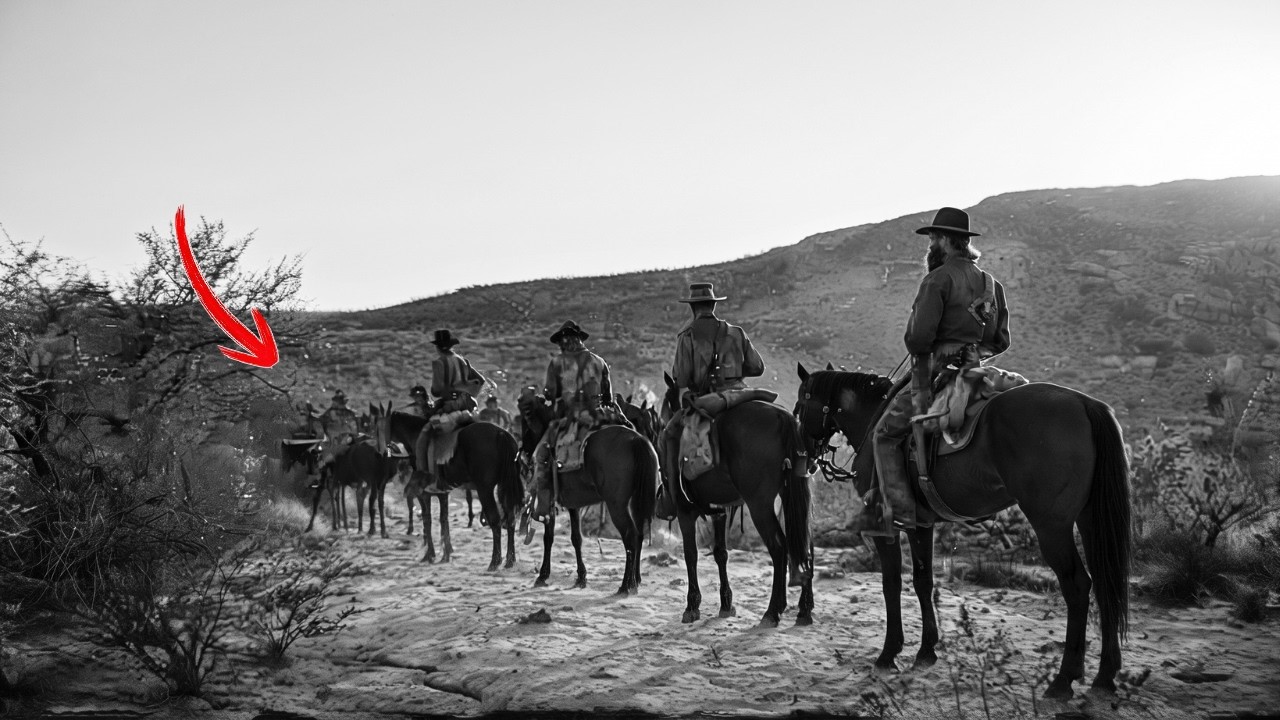
In the summer of 1880, a detachment of nine soldiers, a lieutenant, and a guide was sent ahead of a surveying team in the arid wastes of northern Chihuahua. Their job was simple and monotonous: ride ahead, find water, mark safe ground for the wagons, and wait. They had been doing it since spring. The men knew the routine by heart—waking before dawn, black coffee over whatever fuel the earth provided, mounting up in the cold, riding until the heat became unbearable, finding springs or mud traces of winter water, then camping to eat the same beans from the same tins and trade the same worn jokes.
It was a life built on repetition, and the men clung to that boredom like a coin in a pocket. Boredom meant nothing had gone wrong. In that land, when boredom broke, it never broke toward anything good. They had learned that lesson in small ways already.
A dry tank where the map promised water. A dead horse in a place where a dead horse had no business being. The scattered remains of an abandoned camp with cold ashes and scattered gear, which should have made any soldier pause. Men do not leave good equipment behind unless something made them run faster than they could carry it.
But those were small breaks, and the land always settled again, giving them back their stones and beans and tired jokes. The arroyo was where the boredom broke forever. The farrier was a man named Emery Voss, thirty-eight years old, an age considered old for his trade in that country. He carried his years in his hands more than his face.
He was a large man, broad-shouldered, with a long sun-beaten face and a white scar through one eyebrow where a colt had kicked him years before. His hands were cracked at the joints, hard as saddle leather, stained black to the wrists from forge work, and steady. Voss’s hands never trembled. The men trusted that about him.
When things in camp went wrong, a man could look at Emery Voss’s hands and find them steady, and that steadiness was a comfort. They descended from the burning plains late in the afternoon of the first bad day, and the guide stopped suddenly at the edge of the wash and refused to go down. The guide was a man named Lisandro Ocampo, a vaquero over fifty with a coarse gray mustache, hired because he knew that country’s water as a man knows the rooms of his own house in the dark. Ocampo stopped his horse at the edge of the dry stream and looked into its coolness below, and said they would camp up high.
The lieutenant asked why. The lieutenant’s name was Ansel Rourke, not a fool and not a coward, a young officer of the cautious sort who noted everything in a small book and hated being mocked. When Ocampo said, without meeting his eyes, that the men would sleep better on the plain where the wind moved, Rourke caught something beneath the words and did not like it. Ocampo gave no explanation, only that his grandfather had advised him never to sleep in low places in that country, and that his grandfather had lived a long time, and he intended to do the same.
On the first evening, the younger men began teasing Ocampo about his grandfather, gently, the way soldiers do, asking why an old man would object to a shady valley on a hot day. Ocampo let them talk. Then he told them that his grandfather had once, when young, gone down into a low place he had been told to avoid, to save an hour of travel with a friend he had known since childhood. The grandfather came out alone, not the next morning, but that very night, running at full speed.
He never said what he was fleeing. He never went back for his friend. A voice had called to the friend twice from the darkness, and the voice sounded like the friend’s true voice, and what made the grandfather run and stay alive was that the voice the third time got the name wrong. Something down there, Ocampo said, had known them both so well that it confused which one it had taken.
The friend was never found. Not the friend, not his horse, not even his hat. The earth had simply swallowed him. No one teased Ocampo after that.
They sat looking at the fire, and one by one found excuses to sleep. The first night, nothing happened. The first night is always a gift. It makes you decide you were being foolish.
On the second day, the horses began acting strange at the picket line. Not sick, just not right. Voss walked the line in the first light as he did every morning, running his hand over each animal, and at the third horse he stopped humming, which the other men noticed because Emery Voss always hummed to the horses in the morning. The horses all stood the same way: heads stretched out, ears forward, facing the slope toward the wash, not eating, not swatting flies, all staring at the same patch of empty ground where the sand held the trace of forgotten moisture.
Voss looked where they looked. There was nothing there. He convinced himself it was just a predator in the brush. Maybe a lion the horses smelled.
It would settle once the sun burned the shadows out of the bottom. The sun rose. The horses did not settle. By mid-morning, Rourke sent two men down to scout the water, along with Ocampo.
The old vaquero walked the way a man walks toward something he has decided is unavoidable, slowly, carrying his hat in his hands all the way, which no one understood at the time. They were gone two hours. They came back in early afternoon, two of them silent in a way that heat and hardship do not explain. The third, a young soldier named Wickliffe Farrar, could not stop talking, which was worse.
They had found tracks. The tracks were the daily bread of men who live in the open, and it was clear Farrar was talking about them the way you talk about something to avoid thinking about it. A single line of prints in the center of the wash on soft sand, coming out of the brush at the head of the valley, going down and out of sight. The problem was that they could not say what had made them.
It began as a big cat track. A broad pad, no claws, clean round print of a lion walking quietly. They followed it for about two hundred yards, and somewhere along that stretch, with no break, no scrambling, no pause or turn, the track changed. The pad narrowed, toes appeared, and by the end it walked on two feet.
Not a man’s boot. Not a bare foot either, not quite. Something long-heeled, different in toe count, sunken deep the way something heavy sinks, spaced the way a walking man’s feet space, patiently, going along the wash on two legs where two hundred yards before the continuous line of tracks belonged to something on four. And there was more.
Farrar said the wash was silent. Not the ordinary quiet of a valley. The usual wild sounds faded and stopped as far as they followed that track line. No birds, no flies, and flies are always there.
No dry rustle of lizards darting through the brush ahead of their steps. It was like entering a room where everyone had stopped talking at that same moment, and watched you enter. The loudest sound in the whole wash, in the end, was their three breaths, and he found himself trying to breathe more quietly, and had no reason to explain. They found a place where that thing had rested.
That was his word for it, rested, and none of them had a better. A patch of sand beside the track scraped smooth and hollowed to the size of a large animal lying down, except animals that lie down leave hair and leave their small messes, and this one left nothing. Just a smooth clean hollow carved into the sand. Salas said it was cold to the touch, colder than sand should be in that heat, and driven around its edge pointed down into the earth in a neat ring were bones.
Old bones, white as sun, unidentifiable. Salas guessed mostly animal bones, set upright and even around the place like a low fence, a corral someone had seen men build and understood almost, but not quite, the purpose of. None of them touched them. They stood at the edge of that ring and looked, and then climbed out of the wash.
Afterward, Farrar said the prints behind them changed from four feet to two while they were climbing, though no one heard anything. They made camp well back from the edge that night. The fire was built high, and every man in that camp was awake past his watch without being asked. The men lay in their blankets with open eyes on the stars, rifles under their hands, pretending to sleep.
The first thing they noticed was the smell. It came up from the wash after full dark, with no breath of air to carry it, which is unnatural. It was not the smell of something rotten. It was colder than that, stranger.
Voss, who had spent his life among honest strong smells—animals, iron, fire, said the closest description he could find was the smell of the inside of something that should have remained outside. The second thing was the cold, in patches. A man could sit close enough to the big fire to feel its blast on one cheek while his other side, facing the dark, began to cool suddenly, a deep wet grave-cold, no source, as if a door had opened behind him onto a colder country, and pass, to come again somewhere else along the line of men, moving the way something moves slowly around the edge of light, unhurriedly peering in. The young Farrar swore he saw something early in the night.
A wild wolf came to the edge of the firelight and stood. Nothing strange in that; coyotes do that, drawn by the smell of beans and men. But it stood too long and stood too still. It stood too upright on its legs, as if told what a coyote was, told its leg count and its shape, made one, gotten everything right except the way a living animal never stops fidgets with being alive.
It only. watched. When Farrar threw a stick at it to break the horrible stillness, it did not flinch and did not run. It turned its head the wrong way, too far, farther than a neck allows, slowly, until it looked at him over its spine with firelight in its eyes.
Then darkness swallowed it. It did not run so much as simply stopped standing there. The fire was made higher. The men stopped pretending to sleep and sat, backs to the flames, waiting for what the wash had for them.
The voices began shortly after the moon rose. The first to hear them was the soldier on the farthest watch. He came quietly and woke the lieutenant with a hand on his shoulder and said, look, there is someone in the wash calling his name. Rourke listened.
For a long time there was nothing but the wind. Then the voice came, thin and distant from the bottom of the cold wash, saying, Salas, Salas, come down, come down to see. Rourke wrote later in his small book that what disgusted him was not the call of a voice from an empty wash at midnight, but that he knew the voice. It was the voice of Diódoto Salas himself calling the name of Diódoto Salas from down in the dark, while Salas stood right beside him.
The voice did not call Farrar with his own voice. It called to Farrar with his mother’s voice, a woman two thousand miles away who had no business having her voice in that dreadful place. The young Farrar bit down on his blanket to keep himself from answering, and shook until the man beside him held him by the shoulders. It called Rourke with the voice of a man who had served under him and been buried by him three years before, and called him by a name only that dead man had used with him, a name from a night they shared and told no one of.
It knew things, private things, buried secrets. It was as if, learning the voice, it had learned the man himself. One by one, with clamped jaws and pale hands gripping their weapons, crying without shame in a dark no one would later speak of, they said nothing all night. Their silence was the only reason a story exists at all.
But it never called Emery Voss. The thought of Voss the narrator has carried longer than any other part of this story. It tried every other man in that camp, went down the row, every tent, every voice, and never once used the farrier’s name. There are two thoughts.
The kind one was that Voss had nothing for it, that some men are too plain and too straight inside, and something that hunts your fears and dead finds no bait to lure you with. The other thought was that it had understood him before, that it was not yet done with him, and could wait. Morning came as it always does. The wash was just a dry wash.
The sand held only the single line of tracks going away across the valley. Four feet becoming two. The men’s faces were gray, and they were rude to one another. No one spoke of the night directly.
Rourke did the sensible thing. He decided to move. Forget the survey. They would return the way they came, meet the wagons, take the whole party north around this country entirely.
Ocampo, hearing this, looked at the lieutenant with something approaching gratitude, and said one sentence the narrator has carried a long time: If it allows us. They broke camp fasts, mounted, and struck out toward the burning plain while the sun rose and the wash fell behind. For about an hour, it was the best hour of the whole march, because they were leaving, and leaving is the sweetest feeling in the world when you are in a place you should not be. Then the land turned against them.
There was no mistaking it for feeling or fear. It was the land itself. Mid-morning they passed a dead juniper, one massive tree, struck by lightning long ago, gray and twisted, the only tree of notable size for miles. A man would remember such a tree.
They passed it on the right heading north. Rourke marked it. An hour later riding steadily north they passed it again. Same tree, on the right again, same fissure, same twist, same single dead gray branch pointing down-slope like a finger.
Rourke stopped the columnk and walked all the way around, placed his hand on it. It was the very tree. There is no way in the natural world to pass the same landmark twice on the same course in the same land riding straight north with the sun as witness. Ocampo did not dismount that time, and his face was the face of a man watching a card he knows is in his hand appear in another player’s fist.
Shortly after midday they rode down a long slope into cooler air and easier ground, to the trace of an old watercourse in the sand, and Wickliffe Farrar made the sound of an animal in pain. They had ridden back to the wash itself. They knew it by the tracks, the single line of prints still below, fresh, sharp-edged, as if the thing that made them had walked through again in the hour since they fled. Beside the old line a second line had appeared beside it.
Ten horses, a lieutenant, a farrier, a guide, a handful of soldiers. The second track line was theirs. Their morning’s riding had come to the wash, though every man among them would have sworn his life on his mother’s grave they had ridden north and up away the whole morning without turning once. Ocampo dismounted.
He walked to the head of the wash where the single line came out of the brush, stood over the place where four feet became two, took off his hat, pressed it to his chest, and began to pray quietly. Farrar collapsed. I do not blame him. At twenty-two, two nights of that voice, and now the earth itself folding him back onto the one place on earth he needed to leave.
He turned his horse and spurred it north alone, and the last sight any of them had of Wickliffe Farrar was his small form going over the ridge top in the bright sun with the light behind him. They found his horse that evening. They never found him. They found the horse standing calmly in the plain a mile away, unharmed, bridle hanging, grazing on brush as if nothing had happened.
And found, placed carefully in the sand beside it, side by side, tied together, his boots. Only his boots. Standing in the sand as if he had just stepped out of them. There were no tracks around, no sign of struggle, no dragging, no trace of man or beast departing the place.
Not in a land that printed tracks so clearly it had preserved changing lines for two days. Only the boots, tied and waiting, and a mile of empty plain in the last dusk light. Rourke wrote that in his book that night with a hand so trembling he could hardly read what he had written. He did not write that Farrar was dead.
The body was not there. Ansel Rourke was a precise man to the end. He wrote: soldier missing. And that word is a lie, and every man there knew it.
For the real word for what happens to a man in such a place has no equal in the language of forms and reports. The last night at the wash was the worst and also the shortest to tell, because by then there was little left to happen and much already decided. They did not try to leave again. The horses were the first to go.
At some point in the dead of night the picket rope was empty. Ten halter ropes were knotted and secured and held nothing, the way a coat keeps the shape of its wearer for a moment after he leaves the room. Ocampo said little, but the sense of it was clear: the wash will keep drawing them back to itself until it is finished, and the only thing left in a man’s power is how he waits. Then, in the dark beyond the fire, something began to hum.
Low, tuneless at first, and when they listened, it was not tuneless at all, because it was the low wandering hum a certain man made to the horses at dawn every morning of that whole long march, meaning the day had begun and the animals were in sure hands. It was humming Voss’s morning song to the horses, in Voss’s own voice. The real Emery Voss sat there in the firelight with the others, pale as ash, mouth locked shut, and the hands that had always been steady began to tremble slightly for the first and last time. It did not call his name on the earlier nights.
It did not want the farrier to come out to the dark. It wanted to be the farrier. It had spent three nights learning how the trick was done, and now stood in the dark wearing his voice, humming his song, inviting the whole camp out to the one man they trusted most. Come here.
Morning has come. The horses need tending. I am the only one out here. No one moved.
Rourke held them. But the humming continued all night, patient as weather, hovering at the edge of the firelight just outside the rim. Sometimes it paused its humming and spoke in that same warm steady horseman’s voice, saying the ordinary morning things a good man says. It said the black mare has gravel caught in her back hoof, better come see.
It said, the coffee is ready. It said, the sun is about to up, men. We made it. Come out and let us saddle up.
It got better at it, worse, as the night wore on. By mid-steadfast night it had his slight morning throat hoarseness, his way of naming each horse soft and own, a small speech habit that only the men who had walked with him that long spring had heard, said there in the dark in his voice. One of the older soldiers put both hands over his ears and kept them there. It was not asking them to believe in a monster.
A man can hold out against a monster. It was asking each man not to believe the one thing he had trusted longest and most simply on that hard road: the steady goodness of a good man’s voice telling him morning has come and the danger is gone. It asked them to hear friendship and answer with silence, to hear the very sound of safety and treat it as the mouth of a trap. There is no harder thing asked of tired frightened men, and the narrator believes it was the core of its patience: it was not trying to frighten them out into the dark.
It was trying to comfort them out into the dark. Because comfort from the right voice at the right time can make a man walk toward a cliff’s edge, and fear never does. And the real Emery Voss sat in the firelight with his trembling hands pressed against his thighs and did not answer himself, did not go out to meet himself. The sun rose, as it always does, indifferent.
The humming stopped as a lamp goes out. It rose over the wash, and there was nothing. No horses, no departing hoof tracks in a land that kept every print. No trace of the thing at all except the line still there in the middle of the wash, four feet becoming two, fresh again, walked again in the night, running away down the wash out of sight as it had always done, patient, unhurried.
This time, when they tried to leave, the land let them go. They went on foot, six men and a guide, leading nothing, carrying what they could over the shoulder of the hill in the bright sun, north across the burned plain, never returning to that wash, and the land did not mislead them again. They found a wagon road after two days and were picked up. The survey was abandoned.
The map of that country stayed blank in the middle, remained blank on every map after it. Some empty places on maps are made by ignorance, but that one is a warning the men agreed to keep by leaving the country bare. The narrator has delayed one part for years because it is the least evidence with the most weight, and the decision is left to the listener to weigh and accept. The surveying wagons, the men two days ahead of them, the very ones the detachment had been sent ahead to find water for and mark safe ground, the ones they were supposed to meet, never came to that cursed land, and never came to them at all.
When the six survivors reached the wagon road and were picked up, the riders rode back looking for the survey party along the road they were supposed to have used. In the end they found the party, camped, safe and sound far south of the cursed land, having halted days before. Because a rider had come to them, a rider from the north country for two straight nights, looking in tack and bearing to be one of the escort, who told them to stay where they were, told them the land ahead was bad, told them the escort had ridden on to be certain of water and would send word when the wagons could cross in safety. They trusted exactly what they were told and stayed, safe in good country, waiting for word that never came.
Lists of men they all agreed on: he was kind, of a quiet steady comforting manner, the kind of man you trust at once, and on both nights as he went back into the dark, he was humming. Salas left the service within the year, returned to his homeland, and by all accounts became a man who slept with a lamp burning until his death, and could not bear anyone humming in his house. Ocampo went home and lived as he said he would, long, and never again slept in a low place, and when young men asked why he took the long hot road across the hills instead of the cool valley road, he would only say his grandfather told him not to, and his grandfather had been right about everything. Rourke kept his little book, signed his false word, carried its weight.
In all his years of note-taking afterward, he never once recorded a low land, a valley, a dry wash, a seep in the cool. He stayed to high ground for the rest of his service and wrote his mile counts and never said why. The farrier, Emery Voss, also lived long. He gave up the horse trade, surprising everyone who knew how much he loved it, took up quiet work inside closed places in a town far from any wasteland.
He was the same steady solid man he had always been, kind to animals, easy in company, hands as hard as ever and, to a glance, steady. But he had a habit in his last years that those close to him noticed and never asked about. He never hummed, not ever. Not at work, not at rest, not to a horse if one was near, not to himself in an idle moment.
He had been, all through his youth, a humming man. Then he stopped suddenly in the summer of 1880, and never returned to it. When a man who worked beside him once hummed a stray melody near him, Voss gently took his arm and asked, in a tone that carried something, please do not do that, please not near me, please never do it, and would not speak of that summer to any living being. He told his account only once, to the men who had been there and to the officer who wrote the wrong word in that little book, then shut the door on it and guarded that door all his life.
The guard had a single rule: no humming. For somewhere in a blank space on an old map, they say, something knows his song and wears his voice, and on certain nights still hums its morning song to horses that are not there at the edge of a fire that went out long ago, calling men who will not come. Emery Voss knew, the narrator believes, that as long as he did not hum himself, a thin line remained drawn between the man and the thing that wore his shape.
And the day he forgot and let the old melody slip out without thinking, in a normal morning near the horses he still loved, neither he nor anyone who heard could know which of them was humming.