On June 25, 1876, George Armstrong Custer rode at the head of the 7th Cavalry Regiment toward the valley of the Little Bighorn River in Montana. With his long blond hair and his reputation for reckless daring, he was moving ahead of the broader campaign plan devised by General Terry, which called for the regiment to follow a specific route and hold to a precise schedule. Custer had no intention of holding to anyone’s schedule. He wanted the glory of a decisive victory for himself.
The plan had been to squeeze the Lakota Sioux and Northern Cheyenne from three sides. Custer’s task was simply one part of that larger design. But when his scouts reported that the native camp ahead was very large, the warnings began. Some of his officers urged caution, more information, perhaps waiting for reinforcements.
Custer dismissed them. He divided his regiment, intending to strike the camp from several directions at once. A classic pincer movement. It looked sound on paper.
The paper, however, was not bulletproof. The camp in the valley was far larger than anything the army had anticipated. More than five thousand people were gathered there, with estimates placing the number of warriors between two and three thousand. The Lakota called the place the Greasy Grass.
To them it was sacred ground. To Custer it was simply an opportunity. The attack began when Major Reno crossed the river with the vanguard and struck the southern end of the camp. For a few minutes there was confusion among the defenders.
Then the warriors poured out from everywhere at once. Reno’s men were driven back in a panicked retreat, men piling up in the water as they tried to cross back over the river, leaving their dead behind. Custer, meanwhile, had reached a ridge above Medicine Tail Coulee and looked down at the camp below. The exact thoughts that passed through his mind at that moment were never recorded.
But the sheer scale of what lay beneath him must have become clear. It was already too late. Warriors were moving north to cut him off, and the encirclement of his column began. The fight on Custer’s front did not last for hours.
Historians later estimated that his entire position collapsed within forty-five minutes to an hour. In that brief time, 215 soldiers were killed. Custer died on a hill with his fallen men around him, and what had begun as an ambitious maneuver became the most famous defeat in the history of the American frontier wars. But the battle was not the end of the story.
Down in the valley, in the camps, there were women, children, and the elderly. These were people who had endured cold, hunger, and displacement for years, driven from their lands as the borders of the United States expanded westward. Their men had protected them. For the Lakota and Cheyenne, this was a victory unlike any they had achieved in a long time.
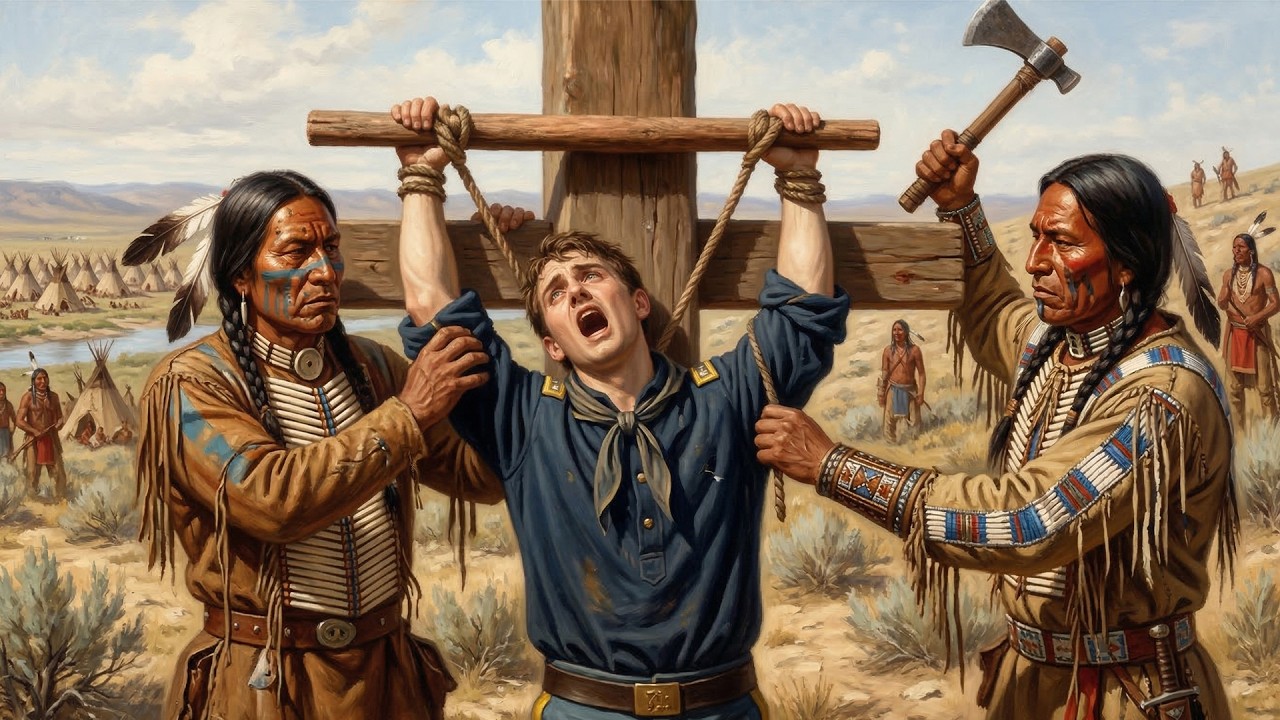
And their traditions required that the victory be completed in a specific way. They came down onto the battlefield, and what followed was not random violence. It was systematic and rooted in a deeply held belief system. In Lakota and Cheyenne culture, the fate of a fallen warrior’s soul was tied to the condition of his body.
If the body remained whole, the soul passed into the next world strong and able to fight again. And if the soul could fight again, it could come looking for its enemies. The mutilation of enemy corpses was therefore not simply an expression of anger. It was an act of war that extended into the afterlife.
An arm was cut off so the dead soldier could not hold a weapon. A leg was severed so he could not pursue. Eyes were gouged out so he could not see where he was going. From the perspective of the warriors, this was not primarily revenge.
It was the neutralization of a threat that would otherwise follow them beyond death. There was another layer to these practices as well. The war had not been a short one. Years of broken treaties, forced removals, and massacres had built a deep fund of anger, and among the warriors who fought that day were people who still remembered the Sand Creek Massacre of 1864.
At Sand Creek, Colorado militia under the command of John Chivington had fallen upon a peaceful Cheyenne camp. Women, children, and the elderly had been slaughtered. Some of the American soldiers had mutilated the dead and displayed body parts in Denver as trophies. Those memories traveled with the people who now stood over the bodies of Custer’s men.
Interestingly, Custer’s own body was found in relatively good condition. Soldiers who arrived in the area in the following days noted this. Some researchers suggested he had not been recognized because he was not wearing his uniform and his appearance had changed. Others offered a different interpretation: that the manner of his death, or his identity, had earned him a different treatment.
Whatever the explanation, the same could not be said for the men around him. Their bodies were found in the days after the battle, most of them unrecognizable. Their names were often only guessed from small belongings or pieces of uniform. Survivors who later described what they saw struggled for words.
Some never spoke of it. Years later, some said that when they closed their eyes at night, they still saw those hills. One witness left a rare written record. Benito Martinez arrived at the battlefield with the burial party two days after the fight.
He tried to convey what he had seen in a letter to his family. Much of the letter was censored, but the surviving lines were enough. He wrote first of the smell. In the June heat, the bodies had lain in the open for two days, and the stench could be sensed miles away.
Then he wrote of the silence. There were no birds, no insects, no animal sounds. Only the wind and the sound of footsteps. In the weeks that followed, investigators moved across the battlefield and documented what had been done to the fallen.
The patterns were consistent. Dismemberment was common. Hands, arms, and legs had been severed. The cutting tools had been used with precision, and the consistency of the wounds indicated a known, practiced ritual.
In Lakota tradition, bodily integrity mattered for their own dead as much as for the enemy’s. Their own fallen were prepared with great care, washed and wrapped so that the soul would recognize the body and find peace. The treatment of enemy bodies was the mirror image of that belief. The enemy’s body was made into a place where the soul would never again be able to fight, walk, or see.
The cutting of ears was also recorded. In some traditions, this meant the enemy would not hear in the next world, would not receive the whispered commands of his leaders. Nothing on that battlefield was meaningless, at least not to those who performed these acts. Yet anger could not be separated from belief.
The two were intertwined. This was not the first time in human history that ritual and grudge moved within the same action, and it was not the last. For the Lakota and Cheyenne, the victory at Little Bighorn was the greatest military triumph of a people who had borne decades of oppression and loss. And they mourned even as they celebrated.
Their own dead were gathered, ceremonies were held, and the ordinary reality of war asserted itself. A victory always comes with someone’s absence. Sitting Bull and Crazy Horse may have sensed what the victory would cost in the long run. A battle had been won, but the war belonged to a much larger machine, and the United States Army would not delay.
The army indeed did not delay. In the years that followed, the battlefield became central to a particular telling of American history. The American press presented Little Bighorn as a tragedy, the slaughter of heroic soldiers by barbaric savages. Custer became a martyr.
Paintings, poems, and plays celebrated him. The mutilations were endlessly described to the public as evidence of savagery, with no context offered for the belief system behind them, the massacres that had come before, or the dispossession that had driven these people to defend their last ground. General Philip Sheridan is famously remembered for having said that the only good Indian was a dead Indian, and that rhetoric hardened immediately after Little Bighorn. The defeat fed the anger, and the anger shaped the policy.
Those who paid the price were not the warriors on the battlefield but the generations that followed. Crazy Horse surrendered in 1877, less than a year after the battle. A few months later he was killed at Fort Robinson under controversial circumstances. Sitting Bull resisted for years, took refuge in Canada, and eventually returned and surrendered.
In 1890, a few weeks before the Wounded Knee Massacre, he was killed with the involvement of an informant from his own people. The journey from the great victory at Little Bighorn to that final disaster took fourteen years. On December 29, 1890, in South Dakota, troops of the 7th Cavalry Regiment opened fire on a camp of unarmed Lakota Sioux. Even the most conservative estimates put the death toll at more than two hundred civilians: women, children, and the elderly, cut down in a snowy field as they tried to run.
Some historians call it a massacre. Some official documents still classify it as a battle. The difference in classification is a heavy thing. And twenty-four soldiers of the 7th Cavalry received the Medal of Honor for their actions that day.
The regiment of the men who had died at Little Bighorn. For decades, Lakota communities demanded the return of those medals. The demands were repeatedly denied. The battlefield itself tells a version of the history.
For many years the site was officially known as the Custer Battlefield National Monument. Even the name was a judgment. In 1991, Congress changed the name to the Little Bighorn Battlefield National Monument. Red granite stones were added years later, bearing the names of Lakota and Cheyenne warriors.
The white stones stand for the American soldiers. The red stones stand for their enemies. Two sets of stones, two colors, on the same soil. The visitor today walks among both, and the earth underneath carries them all together.
The blood, the belief, the anger, and the weight of the history remain there, held in the same valley under the same sun.