On July 14, 1976, a fire consumed the home of Joachim Peiper in the small French commune of Traves. When the flames died down, rescue workers found the partially charred body of a man inside, a revolver and a rifle still clutched in his hands. Medical examination determined the man had suffocated from smoke inhalation. The police found no evidence at the scene, no witnesses, and no suspects.
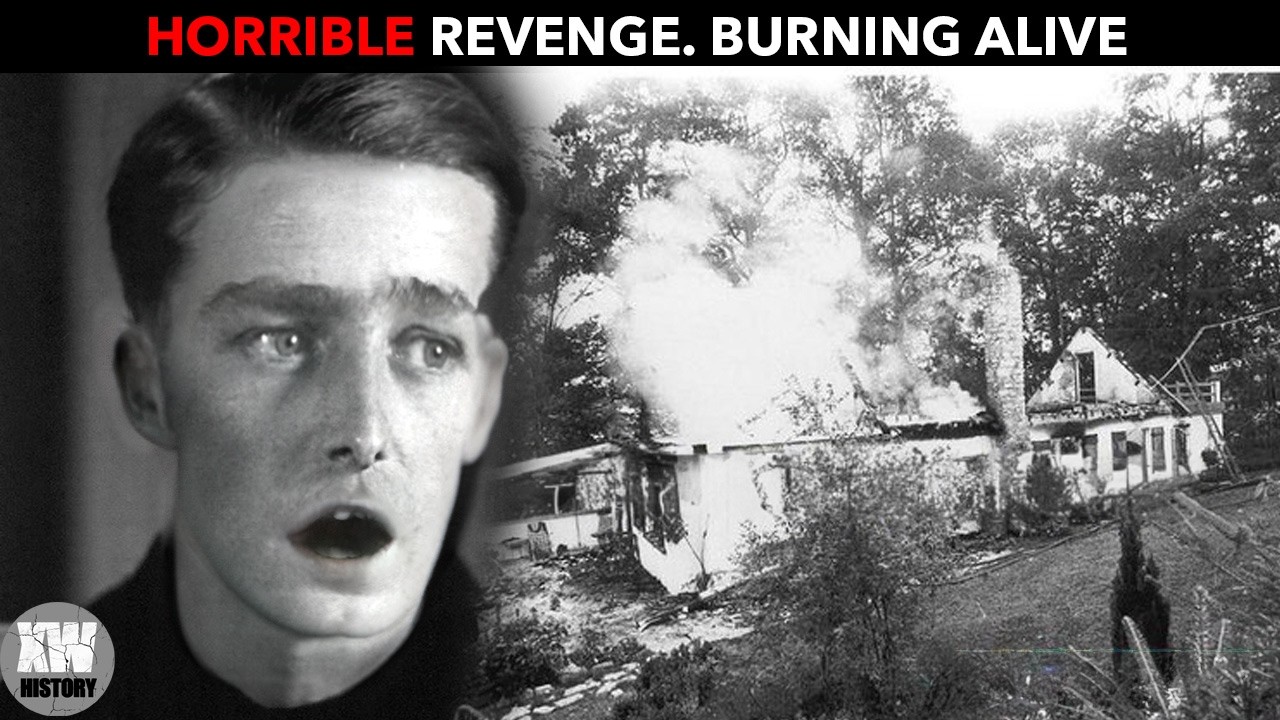
The victim, it turned out, had too many enemies in too many countries for the investigation to ever reach a conclusion. The body belonged to one of the most infamous SS commanders of World War II, a man once known as Himmler’s Golden Boy, and the mystery of his death would never be fully solved. Joachim Peiper was born in Berlin in 1915 into a military family. His father, Captain Woldemar Peiper, had served the Kaiser, and his pedigree was impeccably Aryan, with no trace that any Nazi racial examiner could criticize.
The young Peiper was tall, athletic, blond, and blue-eyed, the very image of the Nazi ideal. He was also intelligent. He graduated from a high school in 1934 with a focus on linguistics, and he developed a particular mastery of French. He adored French culture, its customs, even its cuisine, a passion that would follow him for the rest of his life.
Despite never joining the Nazi Party, he became one of the few non-party members to reach the senior command of the Waffen-SS, and he identified fully with Nazi ideology. At the age of 19, Peiper entered the Army as a cavalryman. Sometime in the mid-1930s, he came to the attention of Heinrich Himmler, who persuaded him to leave the regular Army and join the Leibstandarte Adolf Hitler, the elite unit responsible for protecting the Führer personally. Peiper was younger and slightly shorter than the normal requirements, but he was accepted anyway.
He took SS courses, attended the Junker School in Braunschweig, swore a personal oath to Hitler, and received a commission as an SS-Untersturmführer. His first assignment sent him directly into Himmler’s own staff, where he served as an adjutant handling organizational tasks, appointments, and the delivery of important documents. His career advanced rapidly, and his marriage to Himmler’s personal secretary in 1939 seemed to seal his future. It was an exemplary marriage that produced two sons and a daughter.
When war came, the Leibstandarte was expanded into a Panzer division, and Peiper went into combat as a platoon commander, then a company commander. In 1940, he defeated a British regiment and received the Iron Cross First Class. In 1941, his unit was transferred to the Eastern Front. In early February 1943, commanding a tank battalion near Kharkov, he broke through the encirclement of the 320th Infantry Division, destroying a battalion of Red Army soldiers and allowing the trapped Germans to escape.
In March of that same year, his battalion played a leading role in the Third Battle of Kharkov. In April 1945, just weeks before Germany’s collapse, he received the rank of Standartenführer, becoming the youngest regimental commander in the Waffen-SS. His combat record was impressive, but it was accompanied by a brutality that he seemed to embrace. Peiper’s understanding of how to protect his men was simple and merciless.
If his unit suffered losses, if someone was wounded or captured, he sought revenge, and his revenge was not necessarily directed at the enemy who had caused the loss. Instead, he destroyed whoever came to hand: civilians in surrounding villages, unarmed prisoners, anyone he could reach. In February 1943, after his battalion lost 25 men killed in a skirmish with regular Red Army units, he ordered the burning of at least three villages in the Kharkov region on February 6th, 12th, and 16th, even though the inhabitants had nothing to do with the deaths. Later that year, when his battalion was briefly sent to Italy, he murdered 22 people in the town of Boves in revenge for the death of one of his fighters and the capture of two others.
His tankers fired at houses simply because they were there, indifferent to whether soldiers or peaceful families were inside. The crime that would define his legacy came in December 1944. After the successful Allied landings in Normandy, the Western Allies had liberated most of France and entered Holland. Desperate to turn the tide, Hitler ordered a massive counteroffensive in the Ardennes forest on the borders of Belgium and Luxembourg.
The attack, code-named Operation Watch on the Rhine, was launched on December 16, 1944, under Field Marshal Walther Model. The Germans deliberately waited for bad weather to ground the Allied air forces, hoping to inflict losses so heavy that the Allies would be forced to negotiate a separate peace. On the morning of December 17, 1944, at the height of the offensive, a column of Battery B of the 285th Field Artillery Observation Battalion, consisting of about thirty trucks and tractors under the command of Lieutenant Virgil Lary, passed near the Belgian town of Malmedy. The column ran directly into Peiper’s advanced reconnaissance detachment.
Peiper was then acting commander of the 1st Regiment of the Leibstandarte, and he led the reconnaissance group personally. The Americans were quickly surrounded and captured. Peiper and other German commanders had orders to show no mercy. The Germans lined up the American prisoners in a field and shot them.
Many fell dead, but some survived, playing dead while the SS moved through and finished off the wounded. A local resident watching from a nearby roadside café fled when he realized the Germans would not leave witnesses. Minutes later, a German tank fired on the café, killing the owner and three visitors. In the aftermath, it was estimated that at least 350 captured servicemen and hundreds of civilians were killed in the operations connected to Peiper’s command during the Ardennes offensive.
The Malmedy massacre became the central charge against him. At the Dachau trials in 1946, Peiper’s lawyers argued that he had never given an order to kill prisoners and that the massacre was a spontaneous act by individual soldiers. The defense claimed the testimony of survivors was unreliable, taken under extreme stress in an atmosphere of public indignation that poisoned the proceedings. The court was not persuaded.
On July 16, 1946, Peiper was sentenced to death. But his story did not end there. A peculiar legal battle followed. Peiper’s lawyer filed an immediate appeal, claiming false evidence had been used and that his client had confessed under torture.
There was some truth to the torture claim. During his interrogation, Peiper had been placed in a room where the air temperature reached 60 degrees Celsius, although he quickly smashed the temperature regulator with a chair and returned the room to a normal level. The verdict was reviewed, the fact of pressure on the defendant was acknowledged, and the death sentence was commuted to life imprisonment. Then the strangest part of the case began.
In 1956, Peiper was released from prison as part of a broader amnesty of convicted war criminals. He was not left in peace for long. In 1964, Italy demanded that West Germany bring him to trial for the massacre at Boves. The proceedings dragged on until 1967 and ended with no conviction.
Peiper himself expressed outrage at what he called unjustified persecution, insisting that he had merely been a soldier doing his duty. He dismissed all accusations of murdering unarmed people as propaganda. He returned to a comfortable civilian life in Stuttgart. He worked in the automotive industry in administrative positions, and in 1962, his family bought real estate in France, a hunting lodge in a forest near Besançon.
His lifelong love of French culture drew him there. He used the property as a summer home, and after another wave of public indignation arose in the media over his past, he sued his employers for unjustified dismissal. In 1972, he and his family moved permanently to the estate in France. He never changed his surname, and while he did not advertise his military biography, he did not try to hide it either.
He obtained a residence permit in a country whose occupation he had once participated in, without problems. Still, he took precautions, keeping several trained guard dogs and a supply of weapons in his home. His fears were justified. Shortly after moving to France, he was accidentally recognized by a Frenchman, a war veteran and former member of the Resistance who had seen the SS commander before.
The witness raised the alarm, but nothing came of it. In 1976, a French newspaper published an article revealing that the notorious Nazi now lived in France and gave his location. After that, Peiper’s family faced continuous harassment: anonymous threatening letters, eggs thrown at the house. Peiper complained to the police and was given daytime security.
On the night of July 14, 1976, Bastille Day, the house was attacked. The guard dogs were immobilized with a drug. The house was set on fire and burned heavily. Inside, the body of a man was found, a revolver and a rifle in his hands, as if he had been firing at the attackers before retreating into the building.
The police found the scene surprisingly clean of evidence. No witnesses came forward. Later, the police received an anonymous message from a group calling itself opponents of Nazism, claiming responsibility for the attack, but investigators considered it a fake, doubting that any such group had ever existed. The identity of the body could not be confirmed with absolute certainty, although no one reported seeing Peiper alive afterward.
The French police could not identify specific suspects. The possibilities ranged from extreme anti-fascist groups to outraged neighbors, and there were plenty of people in several countries who wished the man dead. The police admitted they were unlikely to untangle the case. The victim had too many enemies.
The exact circumstances of Joachim Peiper’s death, and the exact fate of his body, remain unresolved to this day.