By first light, the only sounds at Persepolis were stone cooling and wind moving through halls that no longer had roofs. It was 330 BC. The jewel of the Persian Empire lay open to the sky, its cedar beams turned to ash, its treasuries emptied, its floors buried under fallen columns. Alexander the Great’s army had come and gone like a fever burning through a body.
What remained was a crime scene the size of a city. The kings who ruled from these halls were gone, as were the thousands who served inside them. But the city had left witnesses behind, carved into the rock itself. Climbing the great staircase of the Apadana, the ceremonial audience hall of Darius the Great, one meets them: a frozen parade of men from every corner of the known world marching for eternity.
Their faces are calm, their hands carry tribute, bowls, textiles, animals, gold. It is a procession built to last forever, a statement of power so certain it never imagined its own ending. Darius laid the first stones of the terrace around 515 BC on a flank of a mountain the Greeks would later call the Mount of Mercy. The stair itself was shallow, the treads wide and low, designed so a delegate in heavy robes could ascend without breaking a measured pace.
Nothing here was made for hurry. The whole climb was built to slow a visitor down and make him feel watched. Its walls were not decoration but a document. A procession of delegates from the 23 subject nations of the empire moved in silent order toward a single point.
Each group carried something: gold poured into shallow bowls, ivory tusks slung across shoulders, folded cloth, bulls and camels led by the halter. When the reliefs were new, they burned with color under the sun, a painted parade the height of two men. Look closer, and the gifts stop being the point. Every figure leans the same direction, inward toward the center, toward the great king, who sits enthroned, larger than any other man on the wall, larger in a way no human body ever is.
The size itself becomes law. This is the first rule of the Achaemenid world: everything, all power, all worth, all existence, orbits one body. And the carving was an instruction manual for the most important ritual of the Persian court. The Greeks had a word for it that they never spoke without a flinch: proskynesis.
To a stranger, it might read as a bow. Herodotus, who gathered Persian customs the way a money changer weighs foreign coin, tells us it was far more. It was full prostration, a man laid flat, face to the floor before a living king. For a Greek, this was not manners.
It was sacrilege. That posture belonged to the gods, and to lay it at the feet of a mortal was to unmake yourself, to declare out loud that you owned nothing, not even your own spine. Here ran the true border between the Persian mind and the Greek one, wider than the Hellespont. We know how deep that border ran because of what happened years later when a Macedonian tried to cross it.
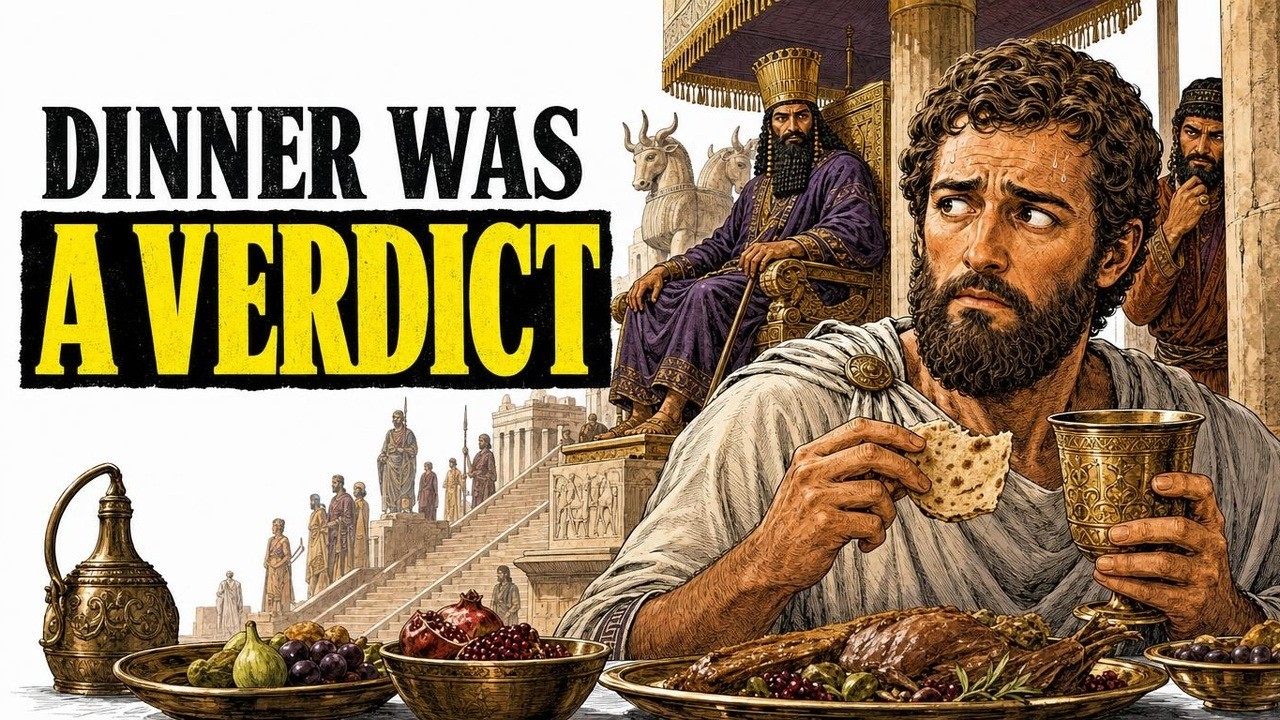
In 327 BC at Bactra, Alexander attempted to make his own Greek and Macedonian officers perform proskynesis as his Persian subjects already did. His court historian, Callisthenes, a kinsman of Aristotle, refused. He would not put his face to the ground for a man he had marched beside. Plutarch records the scene at the banquet: a cup passed round, each man drinking, prostrating, and receiving a kiss from the king.
Callisthenes drank and stepped forward for his kiss without the bow. A courtier named Demetrius pointed it out. The king turned away, and the kiss was withheld. Within months, Callisthenes was dead, accused of conspiracy.
One gesture, and a scholar of the first rank was gone. To the Persians, this was not defiance to be admired. It was a man who did not understand where he stood in the world. The gulf was a matter of two peoples who could not agree on what a human being was worth.
The Persians saw no cruelty in it. They saw arithmetic. It was the price of admission to the king’s presence, non-negotiable, identical for every man who wished to stand before the throne. Think of it as the physics of the court.
The king was a mass so great that everything near him fell toward him. You did not argue with that pull any more than a stone argues with the ground. You submitted or you were removed. But one body cannot be in Sardis and Babylon and the passes of the Hindu Kush at once, and the empire ran from the Aegean coast to the rivers of India.
So the machine needed a way to carry the king to the places he could never reach. It found one in an object you could close inside a fist: the royal cylinder seal. A small barrel of hard stone, no longer than a thumb joint, its surface cut with a scene of the king in triumph. Roll that cylinder across a slab of wet clay, and the carving printed itself in raised relief, a signature no forger could copy without the stone itself in hand.
In the law of the empire, a decree stamped with the royal seal was the king. It carried the same force as if he had walked in and spoken the words with his own mouth. We are not guessing at this. In 1933, in the ruins of the treasury and fortification at Persepolis, archaeologists lifted tens of thousands of clay tablets from the earth, baked hard when the palace burned.
They are ledgers: rations of grain, wine, and beer issued to workers, payments to sculptors and gatekeepers, travel warrants for men crossing the empire on the king’s business. Each was stamped and sealed. They record a bureaucracy so exact it noted the ration owed to a nursing mother, and the larger portion she received if her child was a boy. The roads carried that will as fast as horses could run.
Herodotus describes the royal messenger service that ran the length of the empire, fresh riders and fresh mounts posted a day’s ride apart, so a message crossed from Sardis to Susa in a week over a road nearly 2,500 kilometers long. Neither snow, nor rain, nor heat, nor darkness stopped them. Xenophon, who marched through the wreck of this system a century later, adds that the roads had way stations stocked in advance, so a courier never lost time hunting for a fresh horse. This hunger to fix every human relationship in its exact place did not stop at the audience hall.
Herodotus records how the same logic ran through all of Persian life, down to how two men said hello in the road. When two Persians of equal rank met, they kissed on the lips. If one stood slightly lower, he received the kiss on the cheek. But if the gap between them was wide, the lesser man dropped where he stood and put his face in the dust.
Every meeting was a public reading of the ledger. There was no vagueness in it, no polite fiction, no space to pretend two men were equals when they were not. Even the way a Persian dressed announced his standing: the length of a sleeve, the cut of a coat, the right to wear a certain color could be granted or taken by the king alone. The reliefs on the Apadana showed the world exactly as the Persians understood it: a pyramid, the king alone at its point, every nation stacked in descending layers of service beneath him.
And no delegation marches free. Each is led by a Persian or a Median courtier who holds the foreign delegate by the hand, the way an adult leads a child across open ground. That detail is the whole doctrine in a single gesture. You do not approach the center of power on your own terms.
You are brought. You are handed forward. The stair fed into a hall built to overwhelm anyone who climbed it. The Apadana floor covered more than a hectare.
Its roof was carried by 36 columns nearly 20 meters tall, crowned with the paired heads of bulls and lions carved back to back. The floors were carpeted, the door frames plated in gold. Flanking a doorway of the palace stood carved guardians, human-headed winged bulls with five legs apiece, so the creature appears to stand firm when seen from the front and to stride forward when seen from the side. A delegate crossing that doorway was already being reminded that the building itself outranked him.
Go back to the king one last time. Around the throne, an attendant holds a broad parasol over his head. Another stands close with a fly whisk, sweeping the air beside his face to keep it clean. They are instruments of separation, tools that carve a sterile pocket of air around the royal body.
Ctesias, the Greek physician who spent 17 years inside that court, tells us the isolation went further. When the king ate, he ate apart, screened from view. When he traveled, water was carried for him from a single river, the Choaspes near Susa, boiled and sealed in silver vessels, because no other water was fit to touch his mouth. His food was tasted before it reached him.
Every mouthful the king took had passed through a chain of hands whose only purpose was to stand between his body and death. The second piece of evidence is not carved for anyone to admire. It is buried, and it is a footprint. Deep under the rubble of Persepolis, excavators reached the foundations of the service quarters: kitchens, bakeries, storerooms, wine cellars sunk into the rock to keep the jars cool.
The scale of these rooms does not fit a household, however royal. These are the foundations of an industry laid out with the cold logic of a factory floor. Excavators sifting the refuse pits of the palace pulled out animal bone by the ton. Estimates for what the court consumed in a year run past 15,000 animals, more than 40 sheep, goats, or cattle killed, butchered, and cooked every day of the year without a gap.
Not for a festival, not for a coronation. That was an ordinary day. Heraclides of Cyme, a Greek who watched the court from the inside, left a list of the king’s daily provisions. Athenaeus, a writer of the 2nd century AD, copied that list into a book on dining, and so it survived: 400 sheep, 300 lambs, 100 oxen, 30 horses, 400 fat geese, 300 turtledoves, 600 small birds of every kind, barley and flour by the hundreds of bushels, salt by the cartload from a single oasis in the desert of Ammon, because only that salt was judged fit for the royal mouth.
This was not a banquet menu. This was one day’s requisition, repeated every day the king drew breath. Each night, thousands of the highest men in the empire assembled to eat. Heraclides puts the number fed from the king’s table at 15,000 men, and the daily cost at 400 talents of silver, a sum that could have built and manned a fleet.
The king was not among them. He dined in the next room, hidden behind a single curtain, thin enough to let the light through. The men in the hall could catch the sound of his meal, could smell the dishes carried to him, but they could not see him, only a shape moving behind the cloth. Xenophon watched the system work.
He noticed that the king would send dishes out from his own table into the hall, a portion of game, a cut of roast, carried by a servant to a named man. This was not charity with leftovers. It was a decree delivered on a platter. To receive a piece of the king’s own meal was a promotion announced in front of everyone.
To be passed over night after night was a demotion no one had to speak aloud. It could mean your life was in question. The whole logic reached its yearly peak on the king’s birthday. The wealthiest men of the empire were required to host feasts of their own, and a sheep would not do.
They were expected to roast an ox whole or a horse or a camel or an ass and set it before their followers. The point of the birthday feast was not nourishment. It was scaled so far past need that it landed as a message to any foreigner watching: this is what we spend on one evening. Consider, then, what we hold back for a war.
The empire was also watched from the inside. Xenophon describes an institution that sat outside the ordinary chain of command and answered to one man alone. He called it the king’s eye and the king’s ear. This was the empire’s secret service, and its targets were not foreign enemies.
They were the king’s own officials. Its agents moved through every layer of the state, their identities guarded as a matter of law. They skipped past the satraps and the generals and reported straight to the throne. The king, walled up in his palace behind curtains and tasters, could nonetheless see into a governor’s private chamber a thousand miles away.
The system failed once, and the failure proves the rule. In 401 BC, the satrap Cyrus the Younger raised a private army in secret and marched east to take the throne from his brother, King Artaxerxes II. He got as far as the plain of Cunaxa near Babylon before the royal army met him. Cyrus died on that field, cut down in the moment he thought the throne was his.
Ctesias was in the royal camp to dress the king’s wound. Plutarch records that the king had Cyrus’s head and right hand cut off and displayed, and that later he rewarded, then quietly destroyed, the various men who each claimed to have struck the fatal blow, because he wanted the story to say that he alone had killed his brother. The empire also kept a fist you could see coming for miles: the royal guard, the 10,000 Immortals. Herodotus tells us the name was no boast of magic.
It was arithmetic. The unit was held at exactly 10,000 men always. When one fell, killed, sick, or too old, a man from a standing reserve stepped into the gap at once. An enemy might cut down a hundred of them in an afternoon.
The next dawn, the unit still formed up 10,000 strong. The man died. The unit did not. Their spears did not end in plain metal.
The rank and file carried spear butts capped with a silver pomegranate. The elite among them carried gold. At Thermopylae in 480 BC, Xerxes sent the Immortals against the Spartans holding the pass. The pass was too narrow for their numbers to count.
The gleaming ranks came on and fell back, came on and fell back. Xerxes, watching from a throne set on the hillside, is said to have leapt to his feet three times in fear for his army. All of it, the spies, the guards, the ledgers, ran on one rule taught in the cradle. Herodotus says a Persian boy of good birth was taught three things and three only: to ride, to draw the bow, and to tell the truth.
In a state run by orders sent across a continent and secret reports, the reliability of information was survival. A lie poisoned the stream everything else drank from. Darius said as much in his own words carved high on the cliff at Behistun, where no human eye could ever read them closely. He listed the rebel kings who had lied to seize thrones, called them followers of the lie, and begged whoever came after to believe that what he had written was true.
And so we come back to where this began: the smoking ruins in the hills of Fars. In 330 BC, Alexander took Persepolis. The garrison did not resist. He gave the city over to his soldiers, and later the palaces burned.
Plutarch, Diodorus, and Arrian tell it as drunken revenge. A courtesan from Attica named Thais is said to have called for the torch during a feast, Alexander himself throwing the first flame before the drunken guests took up torches of their own. Or it was a colder decision to close the age of Persian kingship with a blaze every subject could see. The outcome was one.
The cedar beams caught. The painted reliefs cracked in the heat and lost their color. The columns came down one after another into the ash. Arrian records that Alexander later regretted the fire.
He could burn the halls. He could empty the vaults. He could not kill the idea. The idea walked out of the fire in the objects he carried off: that small cylinder seal above all, the emblem of a new way to organize human power.
Centralized, run by professionals, watched from the shadows, funded by an exact tax, and held together by roads that moved a message faster than any rival could react. It was a blueprint for a state governed by administration rather than by a chief and his warband. And it worked so well that the man who destroyed it began to copy it before the ashes cooled. Alexander kept the satrapies and even reappointed Persian governors to some of them.
He kept the tribute system. He adopted Persian dress. At a mass wedding at Susa, he took a daughter of the last Persian king as his wife while marrying dozens of his officers to Persian brides. The last stones of Persepolis went cold.
The design did not. The generals who tore Alexander’s empire apart after his death in 323 BC kept the Persian framework whole. The Romans built their provinces and their imperial post on the same relay of riders that Herodotus had marveled at. The Byzantines ran their informers and their treasury by it.
Every state that dreamed of seeing into its own furthest corner reached, knowingly or not, for the tools first cut into this terrace above the plain of Fars. The body of the empire died in one night of fire. The ghost of how it worked outlived it by 2,000 years.