On the morning of July 7, 1944, on the island of Saipan, a wave of nearly a thousand Japanese soldiers broke through the American lines just before dawn. They came across a railway track used for hauling sugarcane, many of them armed with nothing more than a knife or bayonet lashed to a wooden stick. Within twenty-five minutes, they had pierced the perimeter held by two battalions of the Army’s 105th Infantry Regiment. Before the day was over, the Americans would count 4,311 Japanese dead across the entire battlefield, and the conduct of a single division would ignite one of the most bitter controversies of the Pacific War.
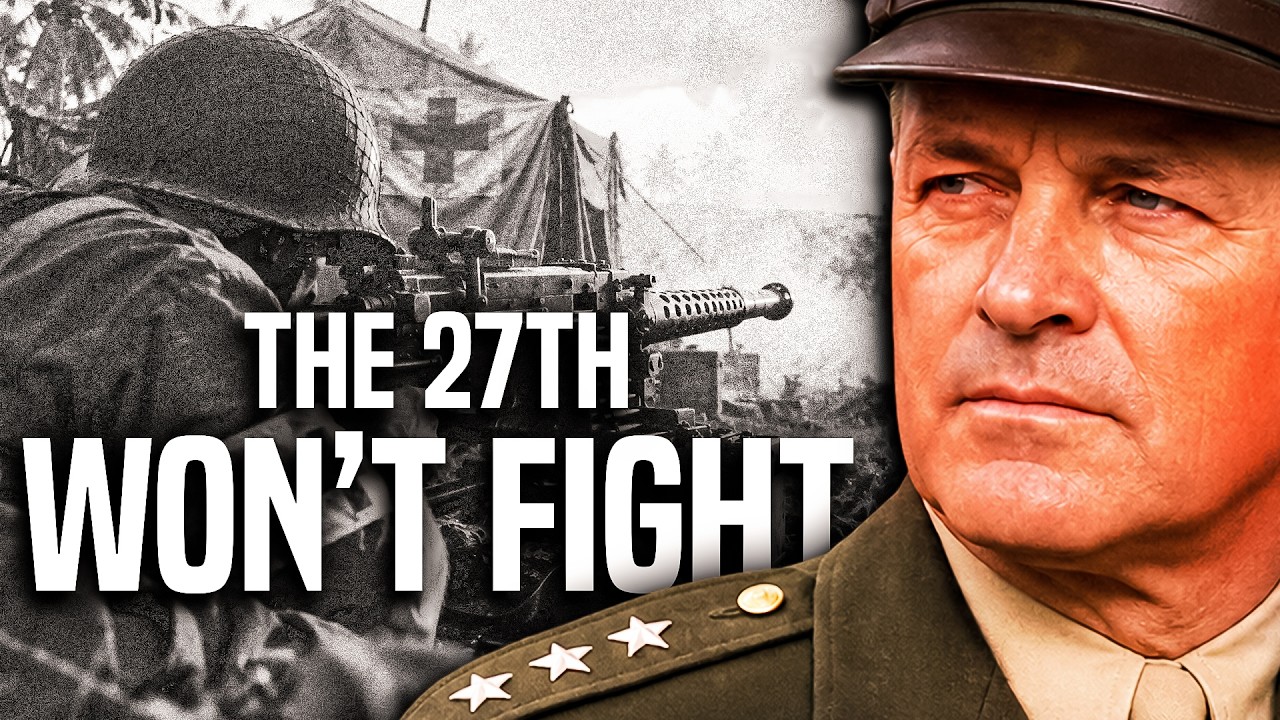
The origins of that controversy lay in the weeks before the attack. The 27th Infantry Division, a New York National Guard unit, had been thrown into the center of the Marine Corps line on Saipan between two Marine divisions. The commanding general of all ground forces on the island, Marine Lieutenant General Holland Smith, had been furious with the division’s performance. On June 24, he drafted formal charges against its commander, Major General Ralph Smith.
There were two charges. The first accused Ralph Smith of twice issuing orders to a battalion that belonged to the corps, not to him. That battalion, from the 105th Infantry, had been left behind to clear out a Japanese pocket at Nafutan Point, and Smith had allegedly ordered it to hold its position when the corps wanted it to attack. The second charge was the heavier one.
On the morning of June 23, the 27th Division had been inserted into the middle of the corps line and had begun its attack late. Holland Smith’s first message claimed the delay ranged from 77 minutes to two hours. Three days later, his report to Admiral Turner narrowed that to a minimum of 55 minutes and added that the division’s slow advance against what he described as only rifles, machine guns, and mortars had forced both Marine divisions to halt. On June 24, Holland Smith and Admiral Turner went aboard the cruiser Indianapolis and presented the case to Admiral Spruance, who authorized the relief.
Ralph Smith was sent back to Honolulu. The 27th Division was temporarily given to Major General Sandford Jarman, an Army general brought in to command the island garrison. The first charge did not survive scrutiny of the official records. On the night of June 22, Ralph Smith’s field order had directed the battalion at Nafutan to continue mopping up and return to corps reserve once the mission was complete.
An hour later, the corps issued its own order to the same battalion. When placed side by side, the official Army historian Philip Crowl found the two orders identical in every essential point. The only difference was two words in the corps version, ordering the battalion to continue at daylight. Crowl dismissed the charge as flimsy legal pretext for the relief.
The second charge was harder to ignore, and the records do not ignore it. The ground the division had been sent into was a valley running north under the eastern face of Mount Tapotchau, with high ground on both sides. The soldiers called it Death Valley. An Army board later concluded that most of the division had been facing the enemy’s main defensive position there, on terrain prepared for defense and exposed to fire from both flanks, and that Holland Smith’s staff had not realized how strong that position was.
They attributed the delay to a lack of aggressiveness. Even on the evening of June 24, the corps was still ordering the division to concentrate its main effort on the west side of the valley, which lacked room to maneuver and offered no avenue of advance except straight up the slope. The board’s other findings cut in the opposite direction. The 106th Infantry had been late on June 23, though not as late as Holland Smith claimed.
The board wrote that the soldiers in the valley were slow and hesitant. Jarman testified that the junior leaders of the 106th seemed unsure and confused. During those two days, the Marine divisions on both flanks suffered heavier losses than the soldiers, yet they made real progress. The 165th Infantry made little progress, and the 106th made almost none.
The board concluded that Holland Smith had good reason to feel disappointed. Whether relieving the division commander was the right remedy was another question, and Crowl doubted it. It took six more days of fighting to clear Death Valley after the relief. When the valley finally fell on June 30, the Marine Corps history of the battle credited Holland Smith with admitting that no one had been given a harder task.
Nafutan is another story, and the division has no defense there worth mentioning. The battalion left at the point held about two thousand yards of front. On the night of June 26, about five hundred Japanese, nearly every able-bodied man left in the pocket, slipped through its lines, met little fire, and advanced all the way to Aslito airfield, where American fighter planes were sitting. They headed for the aircraft, destroyed one, damaged two others, before colliding with a Marine regiment resting in reserve beside its artillery, which wiped them out by morning.
The battalion commander was later relieved. Jarman’s own report, sent to Hawaii on June 30, was no kinder to the division. It described battalions halted for hours by a single machine gun, and troops withdrawing hundreds of yards at night to dig in. Jarman had already relieved the colonel of the 106th.
By the evening of July 6, the fighting had moved to the northern end of the island. Two battalions of the 105th Infantry, one led by Lieutenant Colonel William O’Brien and the other by Major Edward McCarthy, had dug in together for the night near the sugarcane railway. That evening, O’Brien told his men, “Sooner or later, we will be trapped, and this may be the moment. ” There were about five hundred yards of open ground between his perimeter and the nearest American company.
O’Brien positioned every anti-tank gun he had to fire toward that gap. A little after dark, a soldier on the road captured a sleeping Japanese sailor who had his weapon with him. The prisoner said that every Japanese still able to fight on the island had been ordered to attack that night. O’Brien asked the regiment for men to close the gap and was told there were none.
The regiment asked the division for help and received the same answer. The attack came across the railway just before five in the morning. The dead were later identified as men from nearly every unit remaining on the island. Within twenty-five minutes, the attackers had breached the perimeter of both battalions.
McCarthy, one of the few officers to survive, later compared the assault to a stampede of cattle in an old western movie, with the Americans hiding in their holes like camera crews. O’Brien fought with a pistol in each hand, was hit, then climbed onto a . 50 caliber machine gun and kept firing until he was killed there. Sergeant Thomas Baker of Company A, wounded, refused to let the others risk carrying him further and asked to be left with a loaded pistol.
When they found him, the pistol was empty and eight dead Japanese soldiers lay around him. Fifty yards behind the trenches lay the aid station of the 2nd Battalion. Captain Ben Salomón, the battalion dentist, had volunteered to replace a wounded surgeon. There had been little dental work in battle, but there was a war to be fought.
According to his citation, about thirty wounded lay inside and around his tent in the first minutes. A Japanese soldier began stabbing a man lying outside with a bayonet. Salomón shot him. He took on the soldiers who followed as they slipped under the tent walls, one by one, using a bayonet he had taken.
Then he ordered the wounded to fall back toward the regimental aid station. Then, with all his strength, he took a rifle and headed for a water-cooled machine gun whose crew had just been killed. Days later, an Army team returned to the site, Edmund Love among them, and found his body over that gun. Ninety-eight dead Japanese soldiers lay in front of him.
His body carried seventy-six gunshot wounds. As many as twenty-four of them may have hit him while he was still alive. The assault continued past the 105th and struck the 3rd Battalion of the 10th Marines, whose howitzers were positioned five hundred yards southwest of Tanapag. One Marine battery destroyed a Japanese tank before its gunners had to abandon their positions, while another removed the firing locks from its howitzers before falling back.
The gunners kept fighting while the three light artillery battalions of the 27th Division fired 2,666 shells into the 105th’s area in the hour after 5:15, more than forty shells a minute, as close to their own withdrawing men as they dared. The remnants of the two battalions regrouped in the ruins of the village of Tenaru, where McCarthy organized a perimeter by 8:00. For four hours, the men fought there house to house, short of water, short of ammunition, with no way to evacuate their wounded. When American shells fell on a group trying to return toward the regimental headquarters, some men ran to the lake and swam toward the reef.
Amphibious vehicles came to rescue them. Landing craft carried others to destroyers waiting behind the reef, and the last man left the village perimeter around ten that night. The 1st and 2nd Battalions lost 406 dead and 512 wounded. That morning, the new division commander, Major General George Griner, had asked the corps command for Marine tanks and been refused.
He later wrote that the corps command had not accepted his report of how serious the battle was. By July 8, Holland Smith had pulled most of the 27th Division off the line and sent the 2nd Marine Division in their place. Then came the counting. Of the 4,311 bodies found across the entire area the attack covered, 2,295 lay in front of the 105th’s positions.
Some had been killed by naval and artillery fire before the attack began. The captured intelligence officer of the Japanese 43rd Division first estimated the attacking force at 1,000, then raised the number to 3,000. A Korean laborer also gave the number as 3,000. The American estimate accepted the figure, and noted that the Japanese commanders themselves had no clear idea of how many men remained.
On July 7, the same day as the attack at Tanapag, a military board convened at Oulethi to consider the question of the relief. The board, headed by Lieutenant General Simon Buckner with four other Army officers, heard Army witnesses and examined Army files, all it had the authority to examine. It concluded that Holland Smith had full authority to relieve Ralph Smith and that the orders had been properly issued. It also found that Holland Smith had not been fully informed of the conditions in the 27th Division’s sector, and that the relief had not been justified by the facts.
Holland Smith wrote to Admiral Nimitz, calling the board’s findings baseless. Admiral King told George Marshall the whole proceeding was one-sided and suspicious. Marshall’s staff found faults on both sides, and one of his senior planners recommended sending both Smiths away from the Pacific. After the battle, the Army relieved nineteen more officers of the division, though only one of them had commanded a unit in combat.
Ralph Smith lost his next post, command of a garrison division in Hawaii, and ended the war in Europe. The Marine general rose to command Marine forces in the Pacific Fleet. Before all that, Ralph Smith had recorded a radio broadcast five days before his relief, praising the friendly relations between soldiers and Marines, and quoting an officer who said the island had cemented a brotherhood in blood between the forces. His enemy reprinted that in his memoirs.
The controversy became public within days. Hearst newspapers called the losses on Saipan excessive, while Time and Life defended the corps commander. In November 1948, Holland Smith serialized his memoirs in three issues of the Saturday Evening Post. The issue containing the second part also carried a reply under a headline declaring that the Army believed Holland Smith had been wrong.
The reply was by Edmund Love. In the book version of the memoirs, he named the division’s problems “militia disease, blaming National Guard loyalties and officers more comfortable with one another than firm with their subordinates. In the same chapter, he noted that the 105th Division had since received the Army Distinguished Unit Citation for the events of July 7. Crowl’s volume appeared in 1960, and it opened its judgment by admitting that the case could not be settled to everyone’s satisfaction.
It divided the blame equally, as it has been described. Justice to both sides seems easier than Washington. Edmund Love had never given up on the recommendation he had written that summer for Ben Salomón. Griner had returned it in 1944 for one reason alone.
Salomón was a medical officer wearing the Red Cross insignia, and under the Geneva rules the United States had accepted, a medical officer could not carry arms against the enemy. The machine gun made it worse, since it was considered a crew-served, not a personal, weapon. In 1951, Love submitted the recommendation again through the Army’s chief of military history. It came back without action, because the World War II award deadline had passed.
In 1969, the Army Surgeon General submitted it. In 1970, Secretary of the Army Stanley Resor endorsed it and referred it to the Secretary of Defense. It came back again. In 1998, Robert West of the University of Southern California dental school, where Salomón had trained, pushed the case again through California Congressman Brad Sherman, with support from the Army Dental Corps chief.
On May 1, 2002, fifty-eight years after that morning at Tanapag, President George W. Bush presented the Medal of Honor to Captain Ben Salomón. West accepted it and gave it to the Army for its medical museum in San Antonio. Edmund Love had died in 1990, twelve years before that.
The citation, when it finally came, gave the same number the Army team had counted on the ground that summer, ninety-eight enemy dead stacked up in front of his position.